# Essential Japanese Travel Phrases to Know to Help You Navigate
> The must-know Japanese travel phrases for getting around, ordering food, and connecting with locals. Includes pronunciation guides and cultural tips.
**URL:** https://migaku.com/blog/japanese/japanese-travel-phrases
**Last Updated:** 2025-12-31
**Tags:** fundamentals, vocabulary, phrases, pronunciation
---
Worried you won't be able to communicate during your trip to Japan? I get it. Landing in a country where you can't read the signs or order food sounds intimidating. I'm going to walk you through the essential Japanese travel phrases that'll actually make your trip smoother. These aren't random vocabulary lists from a textbook for [Japanese learners](https://migaku.com/learn-japanese). These are the specific phrases you'll use multiple times every single day while getting around, eating, shopping, and interacting with locals.
---
## Do Japanese people speak English?
Let's be real about this. In major tourist areas like Tokyo, Kyoto, and Osaka, you'll find English signage and some English speakers, especially among younger people and hotel staff. But outside those bubbles? English becomes pretty rare.
Even in big cities, many restaurant staff, taxi drivers, and shop owners speak minimal English. That doesn't mean they're unfriendly. Most Japanese people are incredibly helpful and patient with travelers. They'll often go out of their way to assist you, pulling out translation apps or drawing maps. But relying entirely on English will limit your experiences and add unnecessary stress.
The good news? You don't need to be learning Japanese seriously to navigate Japan. A handful of well-chosen phrases will open up your trip in ways you wouldn't expect.
---
## Basic Japanese greetings and politeness phrases
Japanese culture places huge emphasis on politeness. Using even basic greeting phrases shows respect and almost always gets you better service and warmer interactions.
1. Konnichiwa (こんにちは) means "hello" or "good afternoon." This is your go-to greeting from late morning through evening. You'll use this constantly when entering shops, restaurants, or starting any interaction.
2. Ohayou gozaimasu (おはようございます) means "good morning." The casual version is just ohayou (おはよう), but stick with the full phrase to be polite with strangers.
3. Konbanwa (こんばんは) means "good evening." Use this after the sun goes down instead of konnichiwa.
4. Arigatou gozaimasu (ありがとうございます) means "thank you very much." This phrase alone will get you surprisingly far. Japanese people really appreciate when foreigners make the effort to say thank you properly. The casual version is arigatou (ありがとう), but again, stick with the formal version for people you don't know.
5. Sumimasen (すみません) is incredibly versatile. It means "[excuse me](https://migaku.com/blog/japanese/excuse-me-in-japanese)" or "I'm sorry." Use it to get someone's attention, apologize for bumping into someone, or call a waiter. You'll say this phrase dozens of times per day.
6. Onegaishimasu () means "please" or more literally "I humbly request." You'll often pair this with other phrases when making requests.
7. Shitsurei shimasu (), which means "excuse me for being rude" or "pardon me." Use this when entering someone's space, like a small shop or when leaving a conversation.
8. Sayonara (さようなら) technically means "goodbye," but Japanese people rarely use it in daily life because it feels very final. Instead, use ja mata (じゃまた), meaning "see you later", or shitsurei shimasu when leaving a shop.
---
## Japanese words and phrases for getting around & asking for directions
Transportation phrases are crucial because you'll navigate trains, subways, buses, and taxis constantly.
1. Koko wa doko desu ka? (ここはどこですか?) means "Where am I?" or "Where is this place?" Super useful when you're lost, which will probably happen at least once in Tokyo's massive train stations.
2. (Place name) wa doko desu ka? ((Place name)はどこですか?) means "Where is (place)?" Just insert your destination. You can point at a map or show someone the written name on your phone while saying this.
3. (Place nam) ni ikitai desu ((Place name)) means "I want to go to (place)." This works great in taxis when you show the driver an address.
4. Eki () means "station." Combine this with place names to find train stations.
5. Kore wa ikura desu ka? (これはいくらですか?) means "How much is this?" Essential for shopping and confirming taxi fares.
6. Kippu () means "ticket." Point at ticket machines and say kippu onegaishimasu when you need help buying tickets.
7. Toire wa doko desu ka? (トイレはどこですか?) means "Where is the bathroom?" Memorize this one early. Japanese toilets are famously high-tech, but first you need to find them.
---
## Japanese phrases for food and drinks
Eating in Japan is one of the best parts of traveling there, but restaurant situations can get awkward fast without basic phrases.
1. Kore o kudasai (これをください) means "This one, please." Point at a menu item or the plastic food displays outside restaurants and say this. Works every single time.
2. Mizu o kudasai () means "Water, please." Some restaurants automatically bring water, but not all.
3. Oishii (おいしい) means "delicious." Say this after eating something good. The chef or server will genuinely appreciate it, and you'll often get a big smile.
4. Okaikei onegaishimasu () means "Check, please." In Japan, you don't usually get the check automatically. You need to request it. Also, you typically pay at the register near the entrance, not at your table.
5. Gochisousama deshita (ごちそうさまでした) means "Thank you for the meal." Say this when leaving a restaurant. It's a gesture of gratitude that Japanese people always use.
6. Osusume wa nan desu ka? (?) means "What do you recommend?" Great for when you can't read the menu and want to try something local.
7. (Food item) wa arimasu ka?** ((Food item)はありますか?) means "Do you have (food item)?" Useful for dietary restrictions or finding specific dishes.
8. Biru kudasai (ビールください) means "Beer, please." Because sometimes you just need a drink after a long day of sightseeing.
---
## Useful phrases for shopping during your trip to Japan
Shopping in Japan ranges from high-end department stores to quirky 100-yen shops, and these phrases work everywhere.
1. Kore (これ), sore (それ), and are (あれ) mean "this," "that," and "that over there." Point and use these words constantly when shopping. Combine with kudasai (ください) to say "this, please."
2. Motto yasui no wa arimasu ka? (?) means "Do you have anything cheaper?" Useful in souvenir shops.
3. Motto ookii/chiisai saizu wa arimasu ka? (?) means "Do you have a bigger/smaller size?"
4. Mite mo ii desu ka? (?) means "May I look?" Some smaller shops prefer you ask before touching items.
5. Kurejitto kaado wa tsukaemasu ka? (?) means "Can I use a credit card?" Many small shops and restaurants in Japan still only take cash.
---
## Useful Japanese emergency and help phrases
Hopefully you won't need these, but having them ready gives peace of mind.
1. Tasukete () means "Help!" Pronunciation: tah-soo-keh-teh. The more formal version is tasukete kudasai ().
2. Eigo ga hanasemasu ka? (?) means "Can you speak English?" Useful for finding someone who can help with complex issues.
3. Byouin () means "hospital." Byouin wa doko desu ka? asks where the hospital is.
4. Michi ni mayoimashita () means "I'm lost." People will usually try very hard to help you if you say this.
5. Wakaranai (わからない) or wakarimasen (わかりません) means "I don't understand." The second version is more polite. This phrase is incredibly useful because it signals to people that you need a different approach, like gestures or writing things down.
---
## Going beyond basic phrases like a local
Once you've got the essential phrases down, a few cultural gestures will make your interactions even smoother.
1. Bowing is standard in Japan, but as a foreigner, a slight nod is perfectly acceptable. Match the depth of bow you receive. Deeper bows show more respect or apology.
2. When receiving something with both hands, like a business card, menu, or change, it shows respect. This gesture is more important than you'd think in Japanese culture.
3. Pointing at yourself, Japanese people touch their nose rather than their chest. It's a small thing, but it looks more natural.
4. Remove your shoes when entering someone's home, many traditional restaurants, some temples, and any room with tatami mats. You'll see a genkan (Entryway) or shoe racks as a clear signal.
5. Speaking quietly in public spaces, especially trains, is expected. You'll notice how quiet Japanese trains are compared to other countries. Match that energy.
---
## Making these phrases and pronunciation stick
Reading this list is fine, but you'll forget most of these phrases by tomorrow unless you actually practice them. Here's what works:
1. Write out the phrases you'll use most on a small card or in your phone's notes app. Review them daily for a week before your trip. Say them out loud. Seriously, pronunciation only improves when you actually move your mouth.
2. Watch YouTube videos of these phrases being used in context. Hearing native speakers use them in real situations helps way more than just reading romanization.
3. Practice common scenarios in your head. Imagine ordering food, asking for directions, or buying train tickets. Walk through the conversation using these phrases. This mental rehearsal makes the real situations feel familiar.
4. When you arrive in Japan, use these phrases immediately and constantly. Don't be shy. The first few times feel awkward, but it gets natural fast. Every interaction is practice.
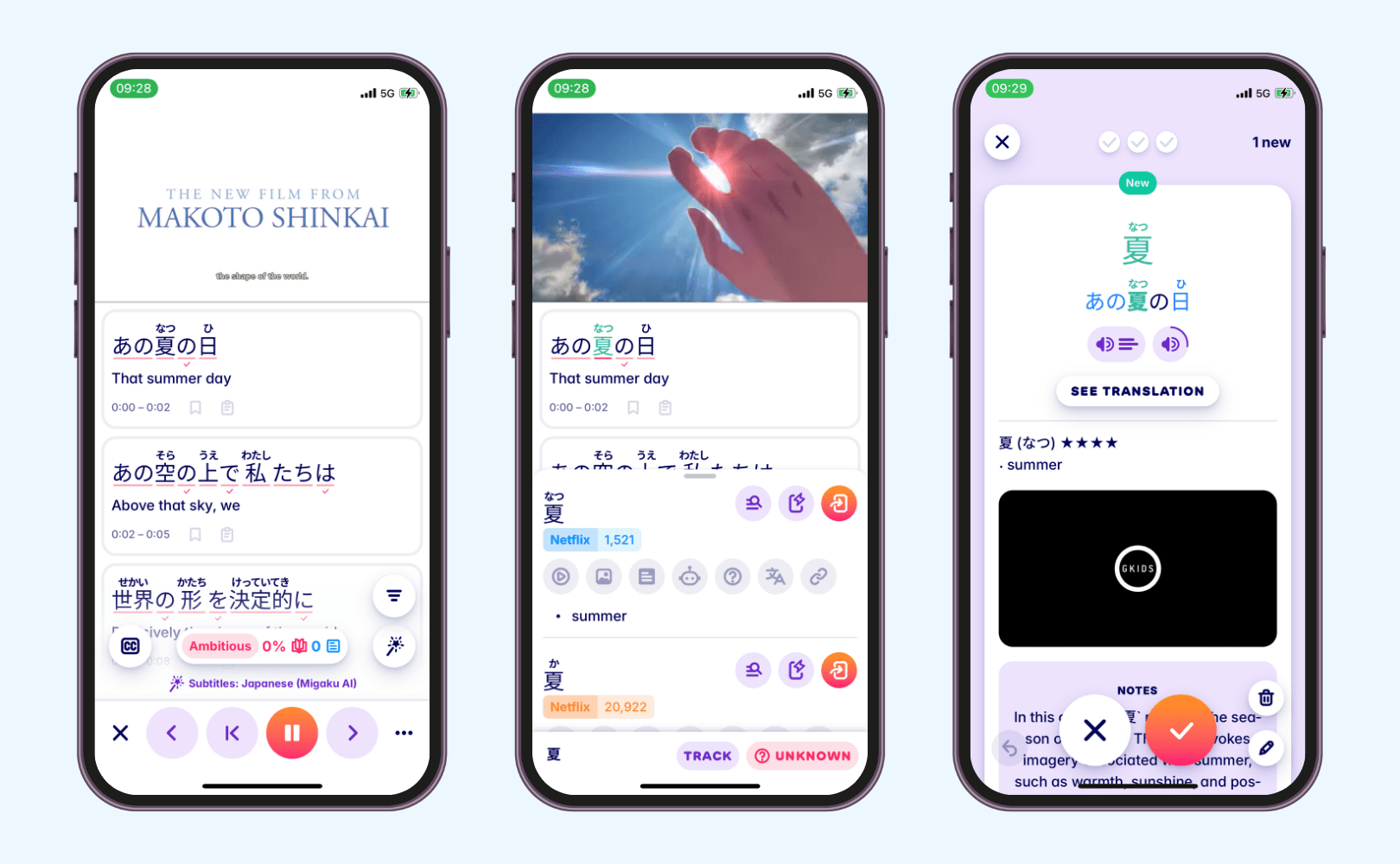
Anyway, if you want to level up your Japanese learning beyond travel basics, Migaku's browser extension and app let you look up words instantly while watching Japanese shows or reading articles. Makes immersion learning way more practical for actually retaining what you study. There's a 10-day free trial if you want to check it out.
 ---
## FAQs
Honestly? You can absolutely travel around Japan without speaking Japanese. Millions of tourists do it every year. Major cities have enough English signage, and translation apps work pretty well for reading menus and signs. But your experience will be so much richer with even basic phrases. You'll eat at tiny local restaurants instead of just chains with English menus. You'll have actual interactions with people instead of awkward pointing and nodding. You'll navigate situations smoothly instead of feeling stressed and confused.
---
## You can practice immersion before heading to Japan
If you're interested in going deeper with Japanese beyond just travel phrases, immersion learning works incredibly well. Watching Japanese shows, reading manga, or following Japanese social media teaches you how the language actually works in real contexts.
> If you consume media in Japanese, and you understand at least some of the messages and sentences within that media, you will make progress. _Period_.
Thorough preps make the journey smoother!
---
## FAQs
Honestly? You can absolutely travel around Japan without speaking Japanese. Millions of tourists do it every year. Major cities have enough English signage, and translation apps work pretty well for reading menus and signs. But your experience will be so much richer with even basic phrases. You'll eat at tiny local restaurants instead of just chains with English menus. You'll have actual interactions with people instead of awkward pointing and nodding. You'll navigate situations smoothly instead of feeling stressed and confused.
---
## You can practice immersion before heading to Japan
If you're interested in going deeper with Japanese beyond just travel phrases, immersion learning works incredibly well. Watching Japanese shows, reading manga, or following Japanese social media teaches you how the language actually works in real contexts.
> If you consume media in Japanese, and you understand at least some of the messages and sentences within that media, you will make progress. _Period_.
Thorough preps make the journey smoother!