Japanese Verb Conjugation: The Complete Guide to Japanese Verbs (It's Easier Than You Think)
Last updated: December 14, 2025
Look, I get it. You're staring at a Japanese textbook with all these conjugation charts and your brain is screaming "what the hell am I supposed to do with this?" You've got godan verbs, ichidan verbs, te form, ta-form, and about seventeen different ways to say "doesn't eat."
Here's the thing though—Japanese verb conjugation is actually one of the easier parts of learning Japanese. Yeah, I'm serious.
Before you roll your eyes, hear me out. Once you understand how the system works, it's way more straightforward than trying to conjugate verbs in English, Spanish, or pretty much any European language you can think of.
- Why Japanese Verbs Are Actually Simple
- The Three Types of Verbs You Need to Know
- How to Tell Godan and Ichidan Verbs Apart
- Present and Future Tenses (They're the Same)
- Past Tense Conjugation
- The Te Form (て Form) - You'll Use This Constantly
- Other Verb Forms Worth Knowing
- Verbs and Adjectives: A Quick Note
- Japanese Conjugation Practice That Actually Works
- Common Verbs to Start With
Why Japanese Verbs Are Actually Simple
The best part about Japanese verbs? They don't change based on who's doing the action.
In English, you've got "I am," "you are," "he is," "we are," "they are"—five different forms just for one verb. In Spanish it's even worse. Japanese? One form. That's it.
食べる (taberu, "to eat") stays the same whether you're talking about yourself, your friend, or a stadium full of people. No person, no number, no gender. The verb is conjugated the same way regardless of subject.
And there's more good news: Japanese only has two irregular verbs in the entire language. TWO. Every other verb follows predictable conjugation patterns.
Compare that to English with its dozens of irregular verbs (go/went, eat/ate, bring/brought), and suddenly those conjugation charts don't look so bad.
The Three Types of Verbs You Need to Know
Every Japanese verb falls into one of three verb groups. Once you know which category a verb belongs to, you know exactly how to conjugate it. This is the foundation of all verb conjugation in Japanese.
Godan Verbs (五段) - The Largest Verb Group
Godan verbs make up about 70% of Japanese verbs. They're also called "u-verbs" or "Group 1 verbs" because they end in an "u" sound in their dictionary form: -ku, -gu, -su, -tsu, -nu, -bu, -mu, or -ru.
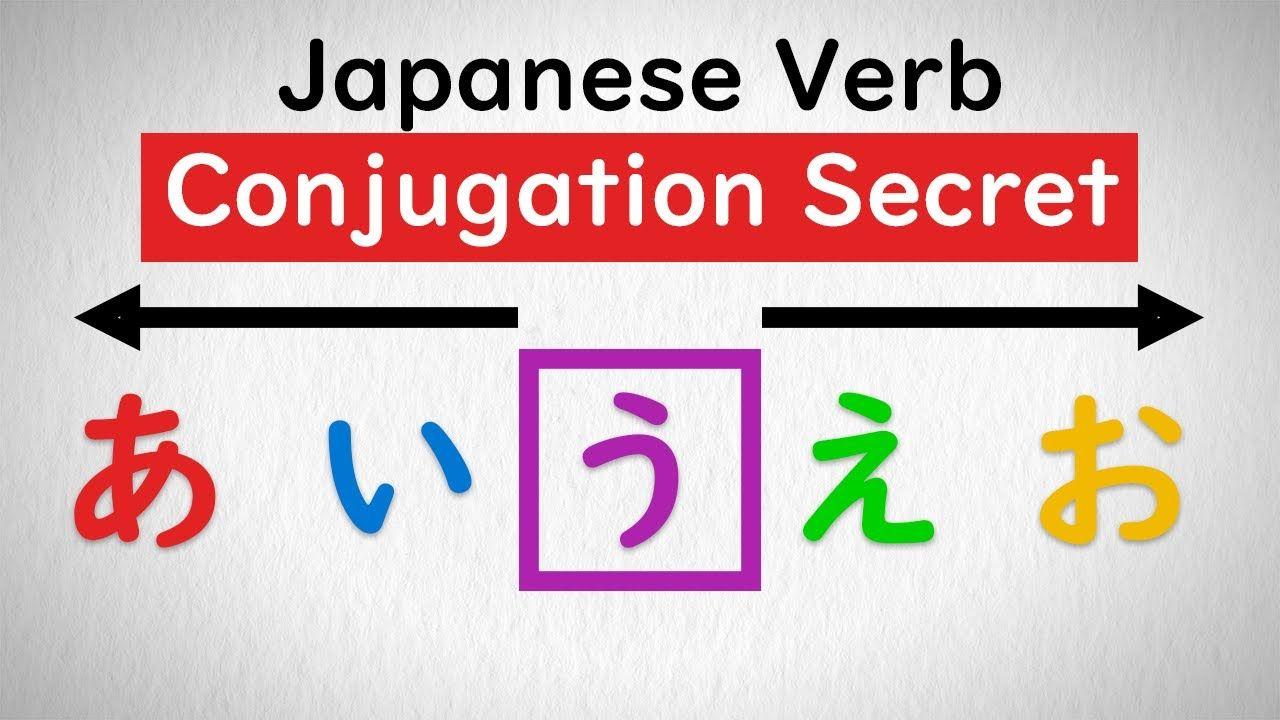
The name "godan" literally means "five steps"—these verbs shift through all five vowel sounds (a, i, u, e, o) when you conjugate them. Understanding this vowel pattern is key to mastering this verb group.
Example: 飲む (nomu, "to drink")
- 飲まない (nomanai) - negative form (doesn't drink)
- 飲みます (nomimasu) - polite form (drinks)
- 飲む (nomu) - dictionary form (drinks)
- 飲める (nomeru) - potential form (can drink)
- 飲もう (nomou) - volitional form (let's drink)
See how the verb stem shifts from "ma" to "mi" to "mu" to "me" to "mo"? That's the five-step pattern in action. Every godan verb follows this same consonant + vowel shift when the verb is conjugated.
Other common godan verbs:
- 書く (kaku) - to write
- 話す (hanasu) - to speak
- 読む (yomu) - to read
- 行く (iku) - to go
- 聞く (kiku) - to listen
Ichidan Verbs (一段) - The Easy Ones
Ichidan verbs are the simplest to conjugate. They all end in -ru in their dictionary form, and you conjugate them by simply dropping the -ru and adding whatever verb ending you need. The verb stem never changes—that's why they're called "ichidan" (one-step).
Example: 食べる (taberu, "to eat")
- 食べない (tabenai) - negative form
- 食べます (tabemasu) - polite form
- 食べた (tabeta) - past tense
- 食べて (tabete) - te form
The stem (tabe) stays constant. You just swap out the -ru verb ending. That's the entire conjugation pattern for every ichidan verb.
Common ichidan verbs include:
- 見る (miru) - to see/watch
- 起きる (okiru) - to wake up
- 寝る (neru) - to sleep
- 教える (oshieru) - to teach
Irregular Verbs - Just Two
There are exactly two irregular verbs in the Japanese language:
- する (suru) - "to do"
- 来る (kuru) - "to come"
That's all of them. Memorize how these two conjugate and you're done with irregular verbs forever. Native Japanese speakers use する constantly—it attaches to nouns to create hundreds of compound verbs like 勉強する (benkyou suru, "to study") and 料理する (ryouri suru, "to cook").
How to Tell Godan and Ichidan Verbs Apart
Here's where learners actually get stuck. Some godan verbs end in -ru, which makes them look like ichidan verbs in dictionary form. How do you tell whether the verb is godan or ichidan?
The rule: Look at the sound before the -ru.
If it's an "i" or "e" sound (like -iru or -eru), it's probably an ichidan verb.
If it's an "a," "u," or "o" sound, it's definitely a godan verb.
Examples:
- 食べる (taberu) - ends in -eru → ichidan verb
- 見る (miru) - ends in -iru → ichidan verb
- 帰る (kaeru) - ends in -aeru → godan verb
- 走る (hashiru) - ends in -ashiru → godan verb
There are some exceptions you'll need to memorize (帰る, 走る, 切る, 知る are all godan despite ending in -iru or -eru), but honestly? You'll learn these naturally as you encounter them in real Japanese content. Most Japanese verb conjugation practice happens through exposure, not memorization.
Present and Future Tenses (They're the Same)
Japanese uses something called "non-past tense" that covers both present and future tenses. So 食べます (tabemasu) can mean either "eat" or "will eat" depending on context. This is one of the grammatical quirks that actually makes Japanese easier—you don't have to learn separate conjugation patterns for future tense.
Polite form (affirmative):
- Ichidan: drop -ru, add -masu (食べる → 食べます)
- Godan: change final u-sound to i-sound, add -masu (飲む → 飲みます)
Plain form / Dictionary form:
The dictionary form is exactly how you'd find the verb in a dictionary. For ichidan verbs like 食べる or 見る, the dictionary form ends in -ru. For godan verbs, it ends in whatever consonant + u (書く, 飲む, 話す, etc.).
Negative form:
- Ichidan: drop -ru, add -ない (食べる → 食べない)
- Godan: change to a-sound, add -ない (飲む → 飲まない)
Past Tense Conjugation
Past tense is where different conjugation patterns really show up. Ichidan verbs stay simple, but godan verbs have some sound changes you need to know.
Ichidan past tense:
Drop -ru, add -た (食べる → 食べた)
Godan past tense (plain form):
The verb ending changes based on the final consonant:
- -ku → -ita (書く → 書いた, kaku → kaita)
- -gu → -ida (泳ぐ → 泳いだ)
- -mu/-bu/-nu → -nda (飲む → 飲んだ, 読む → 読んだ)
- -tsu/-ru/-u → -tta (待つ → 待った, 帰る → 帰った)
- -su → -shita (話す → 話した)
Polite past tense:
Just add -ました to the verb stem (食べました, 飲みました). This works for both verb types.
Past negative:
- Plain form: 食べなかった (tabenakatta), 飲まなかった (nomanakatta)
- Polite form: 食べませんでした, 飲みませんでした
Do you need to memorize all these conjugation rules right now? Nope. The patterns become obvious when you see them in action through real Japanese content.
The Te Form (て Form) - You'll Use This Constantly
The te form deserves its own section because Japanese speakers use it constantly. It's how you connect actions, make requests, describe ongoing states, and about a dozen other things. Mastering Japanese means mastering the te form.
Ichidan verbs: Drop -ru, add -て
食べる → 食べて
見る → 見て
Godan verbs: Follow similar sound changes to past tense, but with て instead of た
- 書く → 書いて (kaite)
- 飲む → 飲んで (nonde)
- 話す → 話して (hanashite)
- 待つ → 待って (matte)
Common te form uses:
- Ongoing action: 食べている (tabete iru) - "is eating"
- Requests: 行ってください (itte kudasai) - "please go"
- Connecting actions: 起きて、朝ご飯を食べた (okite, asagohan wo tabeta) - "woke up and ate breakfast"
The て form is one of the most useful Japanese verb conjugations you'll learn. If you want to learn Japanese effectively, getting comfortable with て is essential.
Other Verb Forms Worth Knowing
Beyond present, past, and te form, there are several other conjugational forms you'll encounter:
Potential form - "can do"
- Ichidan: 食べる → 食べられる (taberareru)
- Godan: 飲む → 飲める (nomeru)
Causative - "make/let someone do"
- 食べる → 食べさせる (tabesaseru)
- 飲む → 飲ませる (nomaseru)
Imperative form - commands
- 食べる → 食べろ (tabero)
- 飲む → 飲め (nome)
Volitional form - "let's do" / "I'll do"
- 食べる → 食べよう (tabeyou)
- 飲む → 飲もう (nomou)
You don't need to master all of these immediately. Learn how to conjugate the basics first—present and past tense, negative form, polite form, te form—and the rest will come naturally as you encounter different verb tenses in real content.
Verbs and Adjectives: A Quick Note
Japanese adjectives also conjugate, which surprises a lot of learners. い-adjectives (like 高い, takai, "expensive") change their endings similarly to verbs:
- Present: 高い (takai)
- Past: 高かった (takakatta)
- Negative: 高くない (takakunai)
な-adjectives work differently and use auxiliary verb forms. But that's a topic for another post.
Japanese Conjugation Practice That Actually Works
Look, conjugation charts and a Japanese verb conjugator tool are useful as reference material. But if you're trying to learn Japanese by memorizing tables or drilling with an online conjugation tool, you're doing it the hard way.
Here's what actually works: seeing verbs conjugated in context, over and over, until the patterns become automatic. This is the problem with textbooks—they teach you about verb conjugation without showing you how native Japanese speakers actually use it.
When you watch anime and hear "食べない" (tabenai) in a conversation about someone not eating dinner, your brain connects the pattern way better than any drill. When you read manga and see "行った" (itta, "went") in a speech bubble, that past tense form starts making sense. This is how you learn how to conjugate Japanese naturally.
The grammatical rules matter, but seeing verbs in action matters more. Whether the verb is godan or ichidan, hiragana or kanji, polite form or plain form—all of it makes more sense when you encounter it in real sentences spoken by real characters.
Common Verbs to Start With
If you're just beginning, focus on these common verbs first. They cover most daily situations:
Ichidan verbs:
- 食べる (taberu) - to eat
- 見る (miru) - to see/watch
- 起きる (okiru) - to wake up
- 寝る (neru) - to sleep
Godan verbs:
- 行く (iku) - to go
- 来る (kuru) - to come (irregular)
- する (suru) - to do (irregular)
- 飲む (nomu) - to drink
- 読む (yomu) - to read
- 書く (kaku) - to write
- 話す (hanasu) - to speak
- 聞く (kiku) - to listen
Master the conjugation patterns for these, and you'll have the foundation for every other verb in the language.
How Migaku Helps You Master Verb Conjugation
Here's the problem with traditional Japanese study: you spend hours drilling conjugation tables, and then when you try to watch anime or read manga, you can't recognize any of it in action.
That's backwards.
Migaku's browser extension lets you learn Japanese from real content—Netflix shows, YouTube videos, manga, news articles, whatever you're actually interested in. When you see a verb conjugated in a sentence, you can instantly look it up, see its dictionary form, and understand which verb group it belongs to. No more guessing whether the verb is godan or ichidan.
Let's say you're watching a Japanese show and hear "行かない" (ikanai, "won't go"). Click it, and Migaku breaks down the conjugation, shows you that it's the negative form of 行く (iku), and adds it to your study queue. You're seeing conjugation patterns in context—the way they're actually used by native Japanese speakers—not just sitting there on a chart.
Our spaced repetition system keeps track of which verb forms you've seen and schedules reviews right before you're about to forget them. Past tense forms, te form, potential form, causative—you'll encounter them all in real Japanese content and actually remember them.
The mobile app keeps everything synced, so you can review your verb conjugations anywhere. And because you're learning from shows, songs, and stories you actually enjoy, the whole process feels less like studying and more like... well, watching TV.
If you want to actually use Japanese verbs instead of just knowing about them, Migaku makes the whole process way more natural. There's a 10-day free trial if you want to check it out.