# Japanese Verb Suru: What’s the Definition and How to Conjugate する
> How to use the Japanese verb suru (する) correctly? Here are conjugation tables, example sentences, and practical tips for forming suru verbs from nouns.
**URL:** https://migaku.com/blog/japanese/japanese-verb-suru
**Last Updated:** 2025-12-29
**Tags:** fundamentals, vocabulary, phrases, grammar
---
If you've been [learning Japanese](https://migaku.com/learn-japanese) for more than a week, you've definitely run into する (suru). This little verb shows up everywhere, and honestly, it's one of the most useful things you'll learn in Japanese. This post teaches you all the things about suru, including the conjugations, meanings, and sample sentences!
---
## What is a suru verb exactly
> Let me give you a simple but complete definition: a suru verb is any noun that can combine with する to create a verb phrase.
These are sometimes called "verbal nouns" because they function as nouns on their own but become verbs when paired with する.
The beauty of this system is that Japanese can quickly create new verbs from nouns, especially loan words from other languages.
When English words get adopted into Japanese, they often become suru verbs. For example, コピー (kopii, copy) becomes コピーする (kopii suru, to copy), and ダウンロード (daunroodo, download) becomes ダウンロードする (daunroodo suru, to download).
You'll see this pattern constantly in modern Japanese. The language keeps evolving, and new suru verbs pop up all the time as technology and culture introduce new concepts.
---
## Basic conjugation of する (Suru)
Alright, let's get into the conjugation tables. Since suru is irregular, you really need to memorize these forms. They don't follow the standard verb rules.
**Present/Future Tense:**
- Plain form: する (suru, do/will do)
- Polite form: します (shimasu, do/will do)
- Negative plain: しない (shinai, don't do/won't do)
- Negative polite: しません (shimasen, don't do/won't do)
Examples:
- 。
*Tomorrow, I will shop.*
- 。
*I study Japanese every day.*
**Past Tense:**
- Plain form: した (shita, did)
- Polite form: しました (shimashita, did)
- Negative plain: しなかった (shinakatta, didn't do)
- Negative polite: しませんでした (shimasen deshita, didn't do)
Examples:
- 。
*Yesterday, I called a friend.*
- 。
*Last week, I made a reservation at a new restaurant.*
**Te-form:**
- して (shite)
Examples:
- 。
*I'm cooking now.*
- 。
*He is driving.*
This form gets used constantly for connecting sentences, making requests, and forming other grammatical patterns. When you see ている (te iru) or ていた (te ita), these are continuous or ongoing action markers. So している (shite iru) means "is doing" and していた (shite ita) means "was doing."
**[Volitional Form:](https://migaku.com/blog/japanese/japanese-verb-volitional-form)**
- Plain: しよう (shiyou, let's do)
- Polite: しましょう (shimashou, let's do)
**Conditional:**
- すれば (sureba, if one does)
- したら (shitara, if/when one does)
**Passive:**
- される (sareru, to be done)
**Causative:**
- させる (saseru, to make/let someone do)
---
## How suru verbs work with nouns
> The standard pattern is simple: noun + する = verb.
The noun comes first, then you attach する.
Here are some super common examples:
- (benkyou, study) + する = (benkyou suru, to study)
- (ryouri, cooking) + する = (ryouri suru, to cook)
- (shigoto, work) + する = (shigoto suru, to work)
- (denwa, telephone) + する = (denwa suru, to telephone/call)
- (souji, cleaning) + する = (souji suru, to clean)
- (unten, driving) + する = (unten suru, to drive)
- (sanpo, walk) + する = (sanpo suru, to take a walk)
- (kekkon, marriage) + する = (kekkon suru, to marry)
- (touchaku, arrival) + する = (touchaku suru, to arrive)
You can also use the particle を (wo) between the noun and する. This makes the noun a direct object of the verb. So you might see (benkyou wo suru) instead of just . Both mean the same thing: "to study." The を version is slightly more formal and emphasizes the noun as the object of doing.
---
## The を (Wo) particle with suru
The particle を can appear in different positions with suru verbs, which confuses a lot of learners.
- (benkyou suru)
- (benkyou wo suru)
- (nihongo wo benkyou suru, to study Japanese)
を marks (nihongo, Japanese language) as the object of studying. You're studying Japanese specifically. The noun stays attached to する without を because they form a single verb unit.
You can also say: (nihongo no benkyou wo suru, to do studying of Japanese). Here, の (no) connects Japanese to studying, and を marks the whole thing as the direct object.
Both ways work fine. Japanese has flexibility in how you structure these phrases.
---
## Why sometimes する disappears
Here's something that trips people up: sometimes you'll see just the noun without する in contexts where you'd expect the full verb. Discord, for example, translates "Create Channel" to just (channeru wo sakusei), why the lack of する here?
This happens in titles, headings, buttons, and short commands where space is limited or where the meaning is obvious from context. It's like how English might say "Exit" on a sign instead of "Please exit here." The する is implied but dropped for brevity.
In full sentences, you'd definitely include it: (channeru wo sakusei suru, to create a channel). But in UI elements or headings, Japanese often drops particles and verb endings to keep things compact.
---
## Grammar tips for using suru correctly
A few practical tips that'll help you use suru verbs without making common mistakes:
1. First, remember that not every noun can become a suru verb. Some nouns just don't work that way. You can't randomly attach する to any noun and expect it to make sense. The noun needs to be a verbal noun, something that represents an action or state that can be "done."
2. Second, when you're using を with suru verbs, think about what you're actually marking as the direct object. If you say (nihongo wo benkyou suru), the を marks Japanese as what you're studying. If you say (benkyou wo suru), the を marks studying itself as the action you're doing.
3. Third, pay attention to whether a verb is a suru verb or a regular verb. Some concepts have both options. For example, (tsuku) is a regular verb meaning "to arrive," while (touchaku suru) is a suru verb also meaning "to arrive." The suru version tends to sound more formal or technical.
4. Fourth, when conjugating suru verbs, you only conjugate the する part. The noun stays the same. So becomes (benkyou shita) in past tense, (benkyou shite) in te-form, and so on. The never changes.
5. Listen for suru verbs when you're watching Japanese content or reading. You'll start noticing them everywhere once you know what to look for. Pay attention to whether people use を or not, and in what contexts.
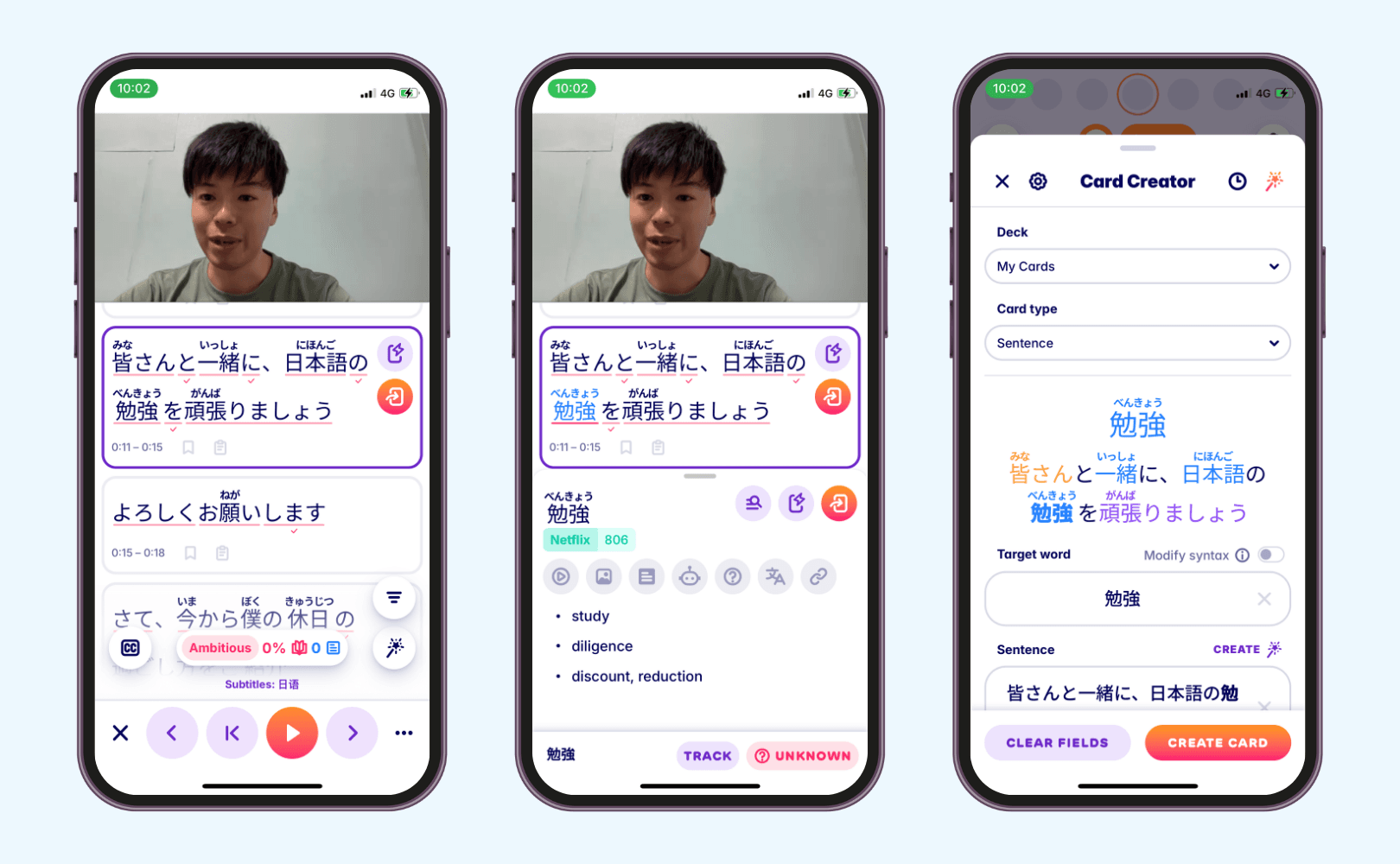
If you want to practice recognizing suru verbs in real Japanese content, Migaku's browser extension and app let you look up words instantly while watching shows or reading articles. You can save suru verbs you encounter to review later. There's a 10-day free trial if you want to check it out.
 ---
## Learning from immersion is a more pleasant journey...
The more you encounter suru in real Japanese, the more intuitive it becomes. Grammar tables are useful for reference, but actual exposure in dramas, anime, and TV shows is what makes this verb feel natural to use.
> If you consume media in Japanese, and you understand at least some of the messages and sentences within that media, you will make progress. _Period_.
Immersion is the complete absorption
---
## Learning from immersion is a more pleasant journey...
The more you encounter suru in real Japanese, the more intuitive it becomes. Grammar tables are useful for reference, but actual exposure in dramas, anime, and TV shows is what makes this verb feel natural to use.
> If you consume media in Japanese, and you understand at least some of the messages and sentences within that media, you will make progress. _Period_.
Immersion is the complete absorption