# JLPT Study Guide: How to Prepare for Japanese Language Proficiency Test
> Complete JLPT study guide covering N5 to N1 prep. Learn what resources work, how to organize study time, and avoid common mistakes. Practical tips inside.
**URL:** https://migaku.com/blog/japanese/jlpt-study-guide
**Last Updated:** 2025-12-23
**Tags:** fundamentals, vocabulary, pronunciation, grammar
---
You've decided to take the Japanese Language Proficiency Test on your [Japanese learning](https://migaku.com/learn-japanese) journey. Pretty cool! Whether you're aiming for N5 or gunning for N1, preparing for the JLPT can feel overwhelming. There's vocabulary to memorize, kanji to learn, grammar patterns to master, and listening practice to squeeze in somewhere between everything else. I'm going to walk you through exactly how to prepare for each JLPT level, what resources actually work, and how to organize your study time so you're not just spinning your wheels.
---
## Understanding the JLPT N5 to N1 levels
The Japanese Language Proficiency Test has five levels, from N5 (beginner) to N1 (advanced). Yeah, the numbering goes backward, which confuses everyone at first.
**N5** is the starting point. You'll need about 100 kanji, 800 vocabulary words, and basic grammar. Think simple everyday conversations, like introducing yourself or ordering food.
**N4** doubles down on everything. Around 300 kanji, 1,500 vocabulary words, and more complex sentence structures. You should be able to understand conversations about familiar topics.
**N3** is where things get serious. This is roughly 650 kanji, 3,750 vocabulary words, and the ability to understand Japanese used in everyday situations.
**N2** requires about 1,000 kanji and 6,000 vocabulary words. At this level, you can read newspapers, understand news broadcasts, and follow conversations at natural speed.
**N1** is the top level. Around 2,000 kanji, 10,000 vocabulary words, and the ability to understand Japanese in practically any context. Are you serious about getting N1? Then buckle up, because you're looking at hundreds of hours of study.
---
## What does the test cover? Taking N5 as an example
Let me break down the N5 specifically since that's where most people start. But what exactly does the N5 test cover?
The exam has three sections: Language Knowledge (Vocabulary/Grammar), Language Knowledge (Reading), and Listening. You need to pass each section individually, plus achieve a certain total score. Getting 100% on vocabulary won't save you if you bomb the listening section.
For **vocabulary**, you'll see questions testing your knowledge of basic words written in hiragana, katakana, and those 100 essential kanji. Questions ask you to match words to their readings or choose the correct word for a sentence.
The **grammar section** tests basic sentence patterns. Particles like wa (は), ga (が), wo (を), ni (に), and de (で) show up constantly. You need to understand how to connect clauses and use basic verb conjugations.
**Reading comprehension** gives you short passages, emails, notes, and simple articles. You'll answer questions about the main idea or specific details. The passages are short at N5 level, maybe 50 to 100 characters.
**Listening** You'll hear conversations, announcements, and short talks, then answer questions. This section trips up a lot of people because you can't go back and re-listen during the actual exam.
If you can understand about 70% of basic conversations, recognize hiragana and katakana instantly, and know your basic kanji, you're probably ready for N5.
---
## Studying for higher levels (N3, N2, N1)
The strategy shifts as you move up. N5 and N4 are about building foundations. N3 and above require immersion and real-world practice.
For **N3**, start consuming actual Japanese content. Read manga, watch anime with Japanese subtitles, listen to podcasts. The vocabulary gets more nuanced and you need context to understand subtle differences.
**N2** requires reading longer passages and understanding implicit meaning. News articles, essays, and opinion pieces become your study materials. The grammar gets tricky with formal written patterns you'd never hear in casual conversation.
**N1** demands near-native comprehension. You'll read about abstract topics like economics, philosophy, and social issues. The listening section includes academic lectures and formal presentations. This level takes serious dedication.
The jump from N3 to N2 is huge. Same with N2 to N1. Don't underestimate how much time you'll need. Most people spend 6 to 12 months preparing for each higher level, even with daily study.
---
## Creating your JLPT study plan
But how do you organize your study time? Good question. Throwing yourself at random study materials won't cut it.
**Assess your current level** Take a practice test to see where you stand. This shows you exactly which areas need work. Maybe your kanji knowledge is solid but your listening skills need help.
**Set a realistic timeline** For N5, most people need 150 to 300 hours of study if they're starting from zero. That's about 3 to 6 months if you study 2 hours daily. For N1, you're looking at 1,700 to 2,500 hours total. Yeah, it's a lot.
**Divide your study time** Divide your time across all four skill areas. A common split looks like this:
- 30% vocabulary and kanji
- 30% grammar
- 20% reading practice
- 20% [listening practice](https://migaku.com/blog/japanese/japanese-listening-practice)
Adjust based on your weaknesses. If listening is your problem area, bump it up to 30% or 35% of your study time.
**Create weekly goals** Instead of just daily ones. "Study 50 new vocabulary words this week" works better than "study vocabulary today." It gives you flexibility while keeping you accountable.
**Using flash cards effectively** Flash cards work, but only if you use them right. Here's what actually helps: Include example sentences. Review daily. Don't make too many cards at once.
**Practice tests and mock exams** Taking practice tests is probably the most important part of JLPT prep. You need to get comfortable with the format, timing, and pressure.
**Final weeks before the exam** You've studied for months. The exam is coming up. Here's how to finish strong: Stop learning new material, take one practice test per week, review your weak areas, prepare logistically, and get good sleep.
---
## Essential JLPT study resources
Let's talk about what actually works. I've seen people waste months on bad resources, so here's what I recommend.
### Official practice materials
The **[JLPT Official Practice Workbook](https://www.jlpt.jp/e/samples/sampleindex.html)** series is your baseline. These books show you exactly what question formats to expect. The practice questions match the real exam better than any third-party materials.
Get the official sample questions from the JLPT website too. They're free and give you authentic examples of each question type.
### Textbooks and workbooks
For N5 and N4, the **Genki** textbooks are solid. They cover grammar systematically and include plenty of exercises. Each chapter builds on previous ones, which helps with retention.
The **Nihongo So-matome** series breaks down JLPT prep by skill area. There's a separate book for vocabulary, grammar, kanji, reading, and listening for each level. The daily study approach works well if you need [structure](https://migaku.com/blog/japanese/japanese-sentence-structure).
**Shin Kanzen Master** goes deeper than So-matome. These workbooks are more detailed and include harder practice questions. Good for N3 and above when you need to really nail the material.
### Kanji resources
Kanji is its own beast. Generally, stick to the official list. The exam won't throw random kanji at you beyond what's specified for that level.
**WaniKani** teaches kanji through radicals and mnemonics. The spaced repetition system keeps kanji in your long-term memory. It goes all the way to N1 level.
**Kanji Study** (the app) lets you practice writing, provides multiple readings, and includes vocabulary examples. The search function is super handy when you encounter unknown kanji.
### Vocabulary tools
**Anki** remains the king of vocabulary memorization. Download pre-made JLPT decks or create your own. The spaced repetition algorithm ensures you review words right before you'd forget them.
### Listening practice
This is where most people struggle. You can't just study listening the week before the exam.
**JapanesePod101** has lessons organized by level. The podcast format works great for commute time or while doing chores.
**NHK News Web Easy** provides news articles in simplified Japanese with audio. Start here for N4 and N3 level listening.
**YouTube channels** like Comprehensible Japanese and Japanese Ammo with Misa offer free content at various levels. Misa's grammar explanations are especially good.
### Grammar resources
**Bunpro** is a grammar SRS (spaced repetition system) that works like Anki but specifically for grammar points. It organizes everything by JLPT level and provides example sentences.
**Tae Kim's Guide to Japanese Grammar** is free online and explains grammar in plain English. The explanations actually make sense instead of just giving you rules to memorize.
---
## Common study mistakes to avoid
I've seen people make the same mistakes over and over. Here's what to watch out for:
**Ignoring listening practice** Until the last minute. Your ears need time to adjust to natural Japanese speed. Start listening practice from day one.
**Only studying from textbooks** Real Japanese doesn't sound like textbook dialogues. Watch Japanese content, even if you don't understand everything yet.
**Memorizing without context** Learning that means hot doesn't help much. You need to know when to use versus for hot temperature versus hot weather.
**Skipping grammar explanations**. Yeah, they're boring sometimes. But understanding why a grammar pattern works helps you remember it and use it correctly.
**Not tracking your progress**. Keep a simple spreadsheet of what you've studied. It's motivating to see how much you've covered and helps you spot gaps.
---
## What to do after the exam
Results come out about two months after the test date. You'll get a score report showing your performance in each section plus your overall score.
If you **pass**, congratulations! Celebrate, then decide if you want to tackle the next level. Each JLPT level roughly doubles the required knowledge.
If you **don't pass**, that's okay. Most people don't pass on their first try, especially for N3 and above. Look at your score report to see which sections were weakest. That tells you exactly where to focus for next time.
The JLPT happens twice a year (July and December) in most locations. Some places only offer it once annually. Either way, you'll have time to improve before the next exam.
---
## Making JLPT study actually work
Here's the real talk: passing the JLPT requires consistent daily effort over months. There's no shortcut or magic method. You need to show up and study, even on days when you don't feel like it.
The Japanese language proficiency test measures your ability to understand Japanese, not speak it. That's worth remembering. You can pass N1 and still struggle with conversation. The exam is a useful goal and milestone, but actual fluency comes from using the language in real situations.
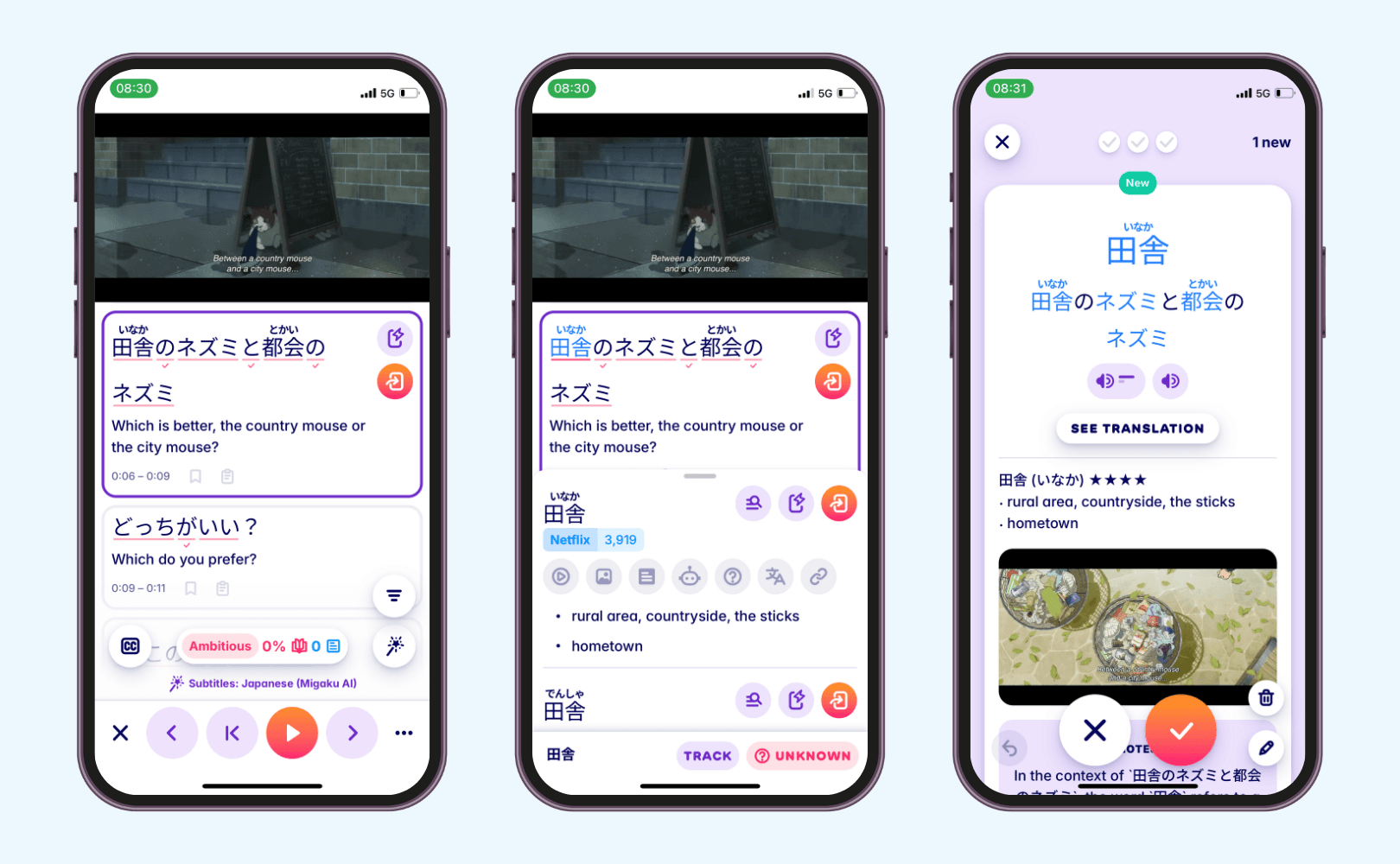
Anyway, if you want to level up your JLPT study with real Japanese content, Migaku's browser extension and app let you look up words instantly while watching shows or reading articles. The built-in SRS automatically creates flashcards from words you look up, which saves a ton of time. There's a 10-day free trial if you want to check it out.
 ---
## Leisure time is equally important for your study!
Studying doesn't have to mean sitting at a desk with textbooks for hours. Listen to Japanese podcasts while commuting. Review flashcards while waiting in line. Read manga before bed. Mix it up so you don't burn out.
> If you consume media in Japanese, and you understand at least some of the messages and sentences within that media, you will make progress. _Period_.
Learn to rest, not to quit.
---
## Leisure time is equally important for your study!
Studying doesn't have to mean sitting at a desk with textbooks for hours. Listen to Japanese podcasts while commuting. Review flashcards while waiting in line. Read manga before bed. Mix it up so you don't burn out.
> If you consume media in Japanese, and you understand at least some of the messages and sentences within that media, you will make progress. _Period_.
Learn to rest, not to quit.