1-Week Shikoku Itinerary: Pilgrimage Towns and Coastline
Last updated: May 27, 2026
Shikoku, Japan's fourth-largest island, rewards a full week with a loop through pilgrimage temples, Edo-era castle towns, the Seto Inland Sea art islands, and the deep gorges of the Iya Valley. This itinerary covers the practical route, fares, and timings travelers actually need in 2026.
Last updated: May 27, 2026
- Why a Week Works for Shikoku
- Transport: The All Shikoku Rail Pass
- Day 1: Arrive in Takamatsu, Ritsurin Garden
- Day 2: Naoshima and the Art Islands
- Day 3: Takamatsu to Matsuyama via Temple Country
- Day 4: Matsuyama Castle and Coastal Drive
- Day 5: Kochi, Katsuo, and the Coast
- Day 6: Iya Valley and the Vine Bridges
- Day 7: Naruto Whirlpools and Tokushima
- Fees at a Glance
- Common Pitfalls
Why a Week Works for Shikoku
Shikoku is large enough that day trips from Honshu only scratch the surface, and small enough that seven days can cover all four prefectures (Kagawa, Tokushima, Ehime, Kochi) without feeling rushed. The classic clockwise loop, Takamatsu to Matsuyama to Kochi to Tokushima and back, lines up well with the JR limited-express network and lets you sample several stops along the Shikoku 88 Temple Pilgrimage without committing to the full 1,200 km, ~45-day walk that around 150,000 pilgrims undertake each year.
The itinerary below assumes you fly or take the Shinkansen into Okayama, then cross the Great Seto Bridge to Takamatsu. It also assumes you buy the All Shikoku Rail Pass, which covers JR Shikoku, Kotoden, Tosaden, Tosa Kuroshio Railway, and Asa Kaigan Railway. Iyotetsu lines in Matsuyama are no longer covered as of March 2026, so budget a bit of extra cash for trams there.
Transport: The All Shikoku Rail Pass
For a one-week trip, the 7-day version of the All Shikoku Rail Pass is the obvious choice. A few things to know before you go:
- The pass is sold only to foreign visitors entering Japan as "Temporary Visitor."
- Buying online and exchanging the voucher in Japan saves roughly 500 yen compared to buying in person.
- Exchange Orders bought abroad are valid for 3 months and must be redeemed at offices in Takamatsu, Matsuyama, Tokushima, Kochi, or TiS Okayama.
- Seat reservations are not included but can be added at 1,200 yen per set of four reservations. Green car seats are not usable.
- Pass holders get 30% off the Wakayama–Tokushima ferry, and the Matsuyama–Kochi Nangoku Express Bus drops from 4,000 to 3,000 yen.
For reference, a single Takamatsu–Matsuyama reserved ticket runs about 6,290 yen, and Matsuyama–Kochi about 10,050 yen, so two long legs already justify the pass.
Check the official JR Shikoku page for current 2026 pass prices, as the English homepage figures shift periodically.
Day 1: Arrive in Takamatsu, Ritsurin Garden
Most travelers reach Shikoku by JR limited express from Okayama. After dropping bags near Takamatsu Station, head straight to Ritsurin Garden, one of Japan's finest stroll gardens.
- Admission: 500 yen adults, 170 yen children.
- Opens at 7:00 (closing varies seasonally), so early arrivals beat the tour buses.
- Stop at the Kikugetsu-tei teahouse on the pond (800 yen adults, 500 yen children) for matcha and a wagashi sweet served on tatami overlooking the water.
In the late afternoon, walk to Tamamo Park, the moated remains of Takamatsu Castle (400 yen as of April 1, 2026). The castle uniquely used seawater moats, and you can still see saltwater fish swimming below the stone walls. End the evening with Sanuki udon, the local specialty, at one of the standing-counter shops near the station.
Day 2: Naoshima and the Art Islands
The Seto Inland Sea art islands are a half-day to full-day side trip from Takamatsu port, about a 10-minute walk from Takamatsu Station.
Ferry options from Takamatsu (Shikoku Kisen):
Route | Adult fare | Time |
|---|---|---|
Takamatsu → Miyanoura (Naoshima) regular | 680 yen | 50–60 min |
Takamatsu → Miyanoura high-speed | 1,590 yen | ~30 min |
Takamatsu → Honmura (Naoshima) | 1,220 yen | ~30 min |
Takamatsu → Ieura (Teshima) | 1,450 yen | ~35 min |
Takamatsu → Tonosho (Shodoshima) regular | 700 yen | ~60 min |
On Naoshima, rent a bike at Miyanoura (about 500 yen/day for a standard cycle, 1,500 yen for an electric assist) and ride between the Benesse House Museum, the Chichu Art Museum, and the Honmura Art House Project. Benesse made reservation system changes in January 2026, so book museum slots in advance through the official Benesse Art Site site.
Return to Takamatsu in time for dinner, or, if you started early, swing through Teshima before the last ferry back.
Day 3: Takamatsu to Matsuyama via Temple Country
The limited express to Matsuyama takes about 2.5 hours. If you want to dip into the Shikoku 88 Temple Pilgrimage, break the journey at Kanonji to ride up to Temple 66, Unpenji (雲辺寺), reached by Japan's fastest ropeway, covering 660 m at 10 m/sec from the base of the mountain. The temple sits at around 900 m elevation, with carved Rakan statues lining the mossy approach.
Arrive in Matsuyama in the late afternoon and check into a ryokan in the Dogo Onsen district, served by the Iyotetsu tram (no longer covered by the All Shikoku Rail Pass, so pay the small cash fare).
Dogo Onsen Honkan, the wooden bathhouse that inspired the bathhouse in Spirited Away, fully reopened on July 11, 2024 after a long restoration.
- Kami-no-Yu (downstairs bath): 700 yen adults, 350 yen children.
- Hours: 6:00–23:00 (ticket sales end 22:30); 2nd-floor seats until 22:00.
- Asuka-no-Yu annex basic bath: 300 yen, open 8:00–23:00.
Go early in the morning or after dinner to avoid the queue.
Day 4: Matsuyama Castle and Coastal Drive
Matsuyama Castle is one of only 12 original castle keeps in Japan, perched on Mount Katsuyama in the middle of the city.
- Keep admission: 520 yen adults, 160 yen elementary students.
- Ropeway/lift round trip: 520 yen adults, 260 yen children.
- Combination ticket: 1,040 yen.
- Keep hours: 9:00–17:00 (last admission 16:30).
- Closed the third Wednesday of December for cleaning.
In the afternoon, take the Nangoku Express Bus to Kochi (3,000 yen with the pass, instead of 4,000 yen). The road climbs through forested mountains and drops down to the Pacific coast, a different feel from the Inland Sea side you have been on so far. Alternatively, the JR Limited Express Shimanto takes a slower mountain route through the interior.
Day 5: Kochi, Katsuo, and the Coast
Kochi Prefecture faces the Pacific, and the food and pace shift accordingly. Start with Kochi Castle, another original keep with sweeping views from the donjon.
- Admission: 420 yen for ages 18+, free for high school students and younger.
- Hours: 9:00–17:00 (last admission 16:30).
- Tram from Kochi Station to Kochijo-mae: 230 yen, about 15 minutes with a transfer at Harimayabashi.
After the castle, browse the Hirome Market for katsuo no tataki (seared bonito), the regional dish. In the afternoon, take a local train or bus out to Katsurahama Beach or the Cape Ashizuri area if you have a car, or visit Chikurinji (Temple 31 on the pilgrimage) on Mount Godaisan, set in cedar forest above the city.
If you are in Kochi in early August, the Yosakoi Matsuri runs August 9–12, 2026, with more than 200 teams and 18,000 dancers filling the streets.
Day 6: Iya Valley and the Vine Bridges
From Kochi, take the limited express Nampu north toward Awa-Ikeda, the gateway to the Iya Valley, one of Japan's deepest and most remote gorges. This is also where you can plug into the 10-day Tohoku itinerary for foreigners approach of trading famous sights for quieter rural Japan.
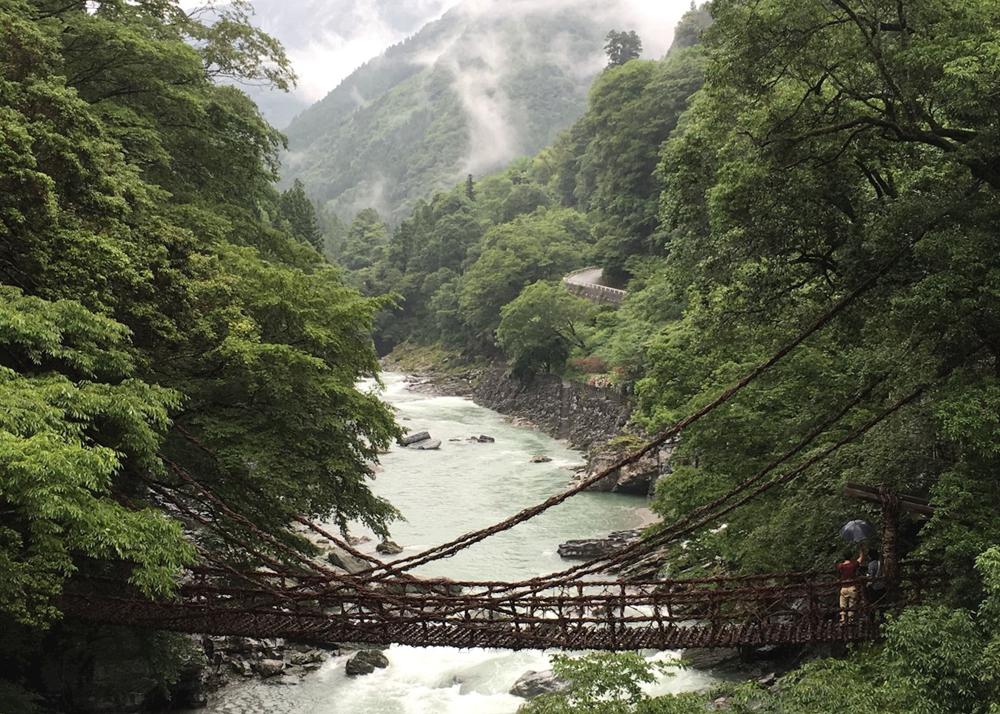
The headline sight is the Iya Kazurabashi vine bridge:
- Crossing fee: 550 yen adults (junior high and up), 350 yen elementary.
- 45 m long, 14 m above the Iya River, rebuilt every three years from real mountain vines.
- Night illumination daily 19:00–21:30 (no crossing during illumination).
The more remote Oku-Iya double vine bridges can be reached by bus from Awa-Ikeda Station to Kubo (about 2 hours, 1,790 yen), then a connecting bus to Nijukazurabashi (about 30 minutes, 430 yen). On weekends and during peak seasons April–November, only two buses per day run the Kubo–bridge segment, so check schedules before committing.
Stay overnight in a thatched-roof minshuku in the Ochiai village area to make the most of the drive, or return to Awa-Ikeda for hotels with rail access.
Day 7: Naruto Whirlpools and Tokushima
Finish on the east coast. Take the train to Tokushima, then a local bus or train to Naruto to see the Naruto whirlpools form in the strait between Shikoku and Awaji Island.
Viewing options:
- Uzushio-Kisen small high-speed boat: 1,600 yen, ~20 minutes, up to 18 trips per day.
- Wonder Naruto large boat: ~1,800 yen, ~30 minutes, no reservation required.
- Aqua Eddy small boat with underwater windows: reservation required.
- Uzu-no-Michi walkway on the underside of Onaruto Bridge: 510 yen.
Time your visit to a tidal swing; the visitor information centers post daily whirlpool peak times.
If you are wrapping up between August 11 and 15, 2026, stay in central Tokushima for Awa Odori, the country's largest dance festival. Around 1.3 million visitors come for the August 12–15 parades, typically running 18:00–22:30. Reserved seat tickets range from about 2,000 to 15,000 yen and sell out early.
From Tokushima, take a limited express back to Takamatsu, ferry to the Kansai region from Tokushima port, or fly out of Tokushima Airport.
Fees at a Glance
Site | Fee (2026) |
|---|---|
Ritsurin Garden | 500 yen |
Tamamo Park (Takamatsu Castle) | 400 yen |
Takamatsu → Miyanoura ferry | 680 yen |
Dogo Onsen Honkan (Kami-no-Yu) | 700 yen |
Matsuyama Castle combo ticket | 1,040 yen |
Kochi Castle | 420 yen |
Iya Kazurabashi crossing | 550 yen |
Naruto whirlpool boat (Uzushio-Kisen) | 1,600 yen |
Uzu-no-Michi walkway | 510 yen |
Common Pitfalls
- Assuming Iyotetsu trams are covered by the All Shikoku Rail Pass. They are not, as of March 2026. Carry small change for Matsuyama.
- Same-day Naoshima museum visits. Benesse adjusted its reservation system in January 2026; check before traveling.
- Last buses in the Iya Valley. Rural routes finish early, and some segments run only twice a day on weekends.
- Awa Odori accommodation. Hotels in Tokushima sell out months ahead for August 12–15. Book early or stay in Naruto or Takamatsu and commute.
- Carrying cash. Many smaller temples, minshuku, and udon shops are cash only. ATMs in convenience stores accept foreign cards.
- Pilgrim etiquette. If you visit pilgrimage temples (霊場, reijō), keep voices down at the hondo (main hall) and daishidō (Daishi hall), and do not photograph praying pilgrims (お遍路, o-henro) without asking.
FAQs
Is a week enough for Shikoku? Yes, for a sampler covering all four prefectures and the main sights. To walk a meaningful section of the 88 Temple Pilgrimage, you would want at least two to three weeks.
Can I do this itinerary without a car? Yes. The route above uses JR limited expresses, ferries, trams, and rural buses. A car helps in the Iya Valley but is not required.
Best time to go? April for cherry blossoms, late October to mid-November for autumn colors in the Iya Valley, and early August if you want the festivals (Yosakoi August 9–12, Awa Odori August 11–15 in 2026). Summers are humid and typhoons are possible from August through September.
Is the Japan Rail Pass better than the All Shikoku Rail Pass? For a Shikoku-only week, the regional pass is cheaper. The national pass makes sense only if you are combining Shikoku with significant Shinkansen travel elsewhere. Verify current prices on JR's official site.
What about visiting only part of the pilgrimage? Temples 1 (Ryozenji) and 2 (Gokurakuji) near Naruto are easy first-day stops. Temple 51 (Ishiteji) is a short walk from Dogo Onsen in Matsuyama. Temple 66 (Unpenji) is accessible by ropeway from Kanonji. Together these give a good feel for the route without committing to the full loop.
For travelers wanting more rural-Japan ideas to pair with this route, see this 2-week Japan itinerary off the beaten path, which extends the same logic to other underrated regions.
If you're heading to Shikoku, knowing some Japanese makes rural buses, minshuku check-ins, and temple etiquette much smoother. Migaku helps you learn Japanese from the shows, books, and signs you already encounter, so the vocabulary you pick up actually shows up on your trip. Try Migaku before you go.