Colombia Healthcare for Foreigners: How EPS Works
Last updated: May 22, 2026
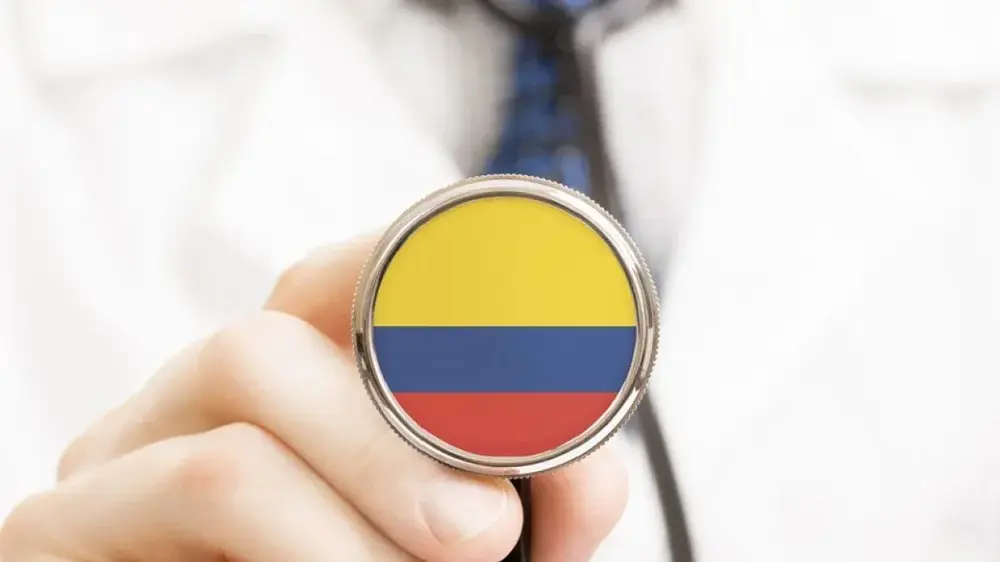
Colombia's EPS (Entidad Promotora de Salud) is the contributory arm of the national health system, and foreigners with a cédula de extranjería can enroll on largely the same terms as Colombian citizens. The catch: EPS coverage does not satisfy the health-insurance requirement attached to most visa applications, and recent regulatory shifts in 2026 have reshuffled which EPS operates where.
Last updated: May 22, 2026
- What EPS Is and How It Fits the Colombian System
- Who Is Eligible (and Who Is Not)
- EPS Contributions in 2026
- Choosing an EPS: The Major Providers
- Document Checklist for Enrollment
- How to Enroll, Step by Step
- EPS and Visa Health-Insurance Requirements: Don't Confuse Them
- What EPS Covers in Practice
- Common Pitfalls
What EPS Is and How It Fits the Colombian System
Colombia runs a two-track public health system. The contributory regime (régimen contributivo) is funded by payroll and self-employed contributions and administered by EPS companies. The subsidized regime (régimen subsidiado) covers low-income residents who cannot contribute. As of March 2026, ADRES data shows about 51.7 million people affiliated nationwide, with roughly 23.09 million in the contributory regime and 26.4 million in the subsidized one.
EPS providers do not run hospitals directly. They collect contributions, manage your file, authorize procedures, and contract with IPS (Instituciones Prestadoras de Salud), the actual clinics and hospitals where you receive care. When you visit a doctor, you go through your EPS network.
The legally guaranteed benefits package is called the Plan de Beneficios en Salud (PBS). It covers consultations with general practitioners and most specialists, hospitalization, surgery, emergency care, maternity, mental health, and a broad list of medications. Dental basics and some preventive services are included. Cosmetic procedures and certain elective items are not.
Who Is Eligible (and Who Is Not)
Foreigners can affiliate with an EPS once they hold a cédula de extranjería, the foreigner ID card issued by Migración Colombia after a visa is granted. Tourist-visa holders (PIP stamps) cannot enroll. A valid visa alone is not enough either; the physical cédula is the document that EPS systems and the PILA platform require.
There is one major exception worth flagging before you choose a visa category. Under Resolution 5477 of 2022, Article 77, holders of the M-Pensionado (Retirement) Visa and the Type V Business Visa are explicitly barred from affiliating with the Colombian Social Security System, which includes EPS. Retirees on the M-Pensionado visa must instead rely on private insurance or prepagada plans for the duration of their stay.
Who can typically enroll:
- Migrant workers on M-Trabajador (work) visas
- Self-employed foreigners on M-Independiente or similar visas
- Spouses and partners on M-Cónyuge or Beneficiario visas
- R (Resident) visa holders
- Students on M-Estudiante visas (often through their institution)
- Dependents added to a primary contributor's account
Foreign employees who remain enrolled in their home country's social security system under a totalization agreement or intra-company arrangement may be exempt from Colombian EPS contributions. This requires documentation submitted to the employer's payroll administrator.
EPS Contributions in 2026
The total mandatory health contribution is 12.5% of your salary or declared income. For employees, the split is:
Party | Share of salary |
|---|---|
Employer | 8.5% |
Employee | 4.0% |
Total | 12.5% |
For employees earning less than 10 monthly minimum wages (COP 17,509,050 in 2026), the employer's 8.5% portion is exempted under the 2014 tax reform, though employees still pay their 4% share.
Self-employed foreigners and freelancers pay the full 12.5% themselves. The contribution base, called the IBC (Ingreso Base de Cotización), is calculated on a minimum of 40% of net monthly income. The IBC has hard floors and ceilings tied to Colombia's monthly minimum wage (SMMLV), which is COP 1,750,905 for 2026:
- Minimum IBC: 1 SMMLV (COP 1,750,905)
- Maximum IBC: 25 SMMLV (COP 43,772,625)
In practice, this means even a freelancer reporting low income will pay at least 12.5% of one minimum wage, roughly COP 218,863 per month, just for EPS. Pension and ARL (occupational risk) contributions are separate.
Contributions are filed and paid monthly through PILA (Planilla Integrada de Liquidación de Aportes), an electronic platform accessible through operators such as Aportes en Línea, SOI, or Mi Planilla. Payment is due in the first two weeks of the following month, with the exact deadline determined by the last two digits of your cédula or NIT.
Decrees 1469 and 1470 of 2025, issued by the national government on December 30, 2025, set the 2026 minimum wage and the COP 249,095 monthly transportation allowance that adjusts contribution bases for lower-paid employees.
Choosing an EPS: The Major Providers
You pick your EPS at enrollment. The PBS benefits are identical across providers by law, but service quality, app usability, IPS network, and wait times vary considerably. The four largest EPS by enrollment in 2026 are:
EPS | Approximate affiliates | Market share |
|---|---|---|
Nueva EPS | 10.89 million | 21.06% |
Sanitas | 5.7 million | 11.18% |
Sura | 5.3 million | ~10% |
Salud Total | 4.7 million | ~9% |
Other providers commonly used by foreigners include Compensar (strong in Bogotá), Famisanar, and Aliansalud. Sura has long been popular with expats in Medellín for its English-speaking specialists and digital tools, though that varies by city and IPS.
A major caveat for 2026: Decree 0182 of 2026, published February 27, 2026, reorganized EPS coverage territorially. Under the decree:
- EPS with less than 3% of a department's total affiliates can no longer operate there
- The threshold rises to 10% in first- and second-category departments
- The threshold rises to 15% in third- and fourth-category departments
- Nueva EPS becomes the only authorized EPS in roughly 45% of Colombian municipalities and absorbs about 2.84 million reassigned members
- Sanitas is being removed from 15 departments and loses a net ~562,000 affiliates
Before committing, check the current map on the Superintendencia Nacional de Salud site (supersalud.gov.co) for your specific municipality, because the EPS you researched a year ago may no longer operate where you plan to live.
For context on how this compares to neighboring systems, see healthcare systems for foreigners in Latin America and healthcare options for foreigners in the region.
Document Checklist for Enrollment
Bring the originals and at least one photocopy of each:
- Cédula de extranjería (front and back)
- Valid passport with current visa stamp
- Proof of address (utility bill or rental contract)
- Employer letter or work contract (for employees)
- RUT (tax ID) if self-employed
- Bank certification, if paying contributions directly
- Marriage or birth certificates (apostilled and translated) for dependents
- Recent passport-style photographs (some EPS require them)
- Email and Colombian phone number for the EPS account
If you are adding a spouse or children as beneficiaries, foreign civil-status documents must be apostilled in the issuing country and translated by an official translator certified in Colombia.
How to Enroll, Step by Step
- Obtain your cédula de extranjería from Migración Colombia after your visa is approved.
- Pick an EPS authorized in your municipality (verify on supersalud.gov.co).
- Complete the Formulario Único de Afiliación, available on the EPS website or in person at a branch.
- Submit documents in person, by email, or through the EPS app, depending on the provider.
- If self-employed, register with PILA through an operator and schedule your first monthly contribution.
- If employed, your HR department handles affiliation and the first PILA payment.
- Wait for activation. Coverage typically activates 1 to 2 weeks after the first PILA contribution clears.
- Download the EPS app, register, and book your initial appointment (cita prioritaria or medicina general).
Dependents are added through the same EPS using the contributor's file. There is no extra premium for spouse or minor-child dependents under the contributory regime.
EPS and Visa Health-Insurance Requirements: Don't Confuse Them
This trips up almost every new arrival. EPS coverage does not meet the health-insurance requirement for a Colombian visa application. Under Resolution 5477 of 2022, issued by the Ministry of Foreign Affairs and in force since October 2022, visa applicants must hold a separate private or international policy covering:
- Accident
- Illness
- Maternity
- Disability
- Hospitalization
- Death
- Repatriation of remains
The policy must remain valid for the entire duration of the visa. The visa authority has up to 30 calendar days under Resolution 5477 to decide on an application, and consulates routinely reject submissions where applicants offered EPS certification in place of a private travel-health policy.
The practical workflow for most foreigners:
- Buy a compliant private travel-health policy before applying for the visa.
- Receive the visa, then obtain the cédula de extranjería.
- Enroll in EPS once the cédula is in hand.
- Maintain the private policy at least until you are confident EPS coverage is active and adequate for your needs.
Many expats keep a complementary private plan or prepagada (Sura, Colsanitas, Coomeva, Medplus) on top of EPS for faster specialist access and private hospital networks.
What EPS Covers in Practice
Key benefits funded through the EPS system in 2026:
- Maternity leave: 18 weeks, funded through EPS
- Paternity leave: 2 weeks (14 calendar days), funded through EPS
- Sick leave: employer pays days 1 to 2 at two-thirds salary; EPS pays from day 3 at 66.67% through day 90, then 50% through day 180
- Outpatient consultations with GPs and specialists
- Hospitalization and surgery
- Emergency room care (no referral needed)
- Medications on the official formulary
- Maternal and child health programs
- Mental health treatment, including therapy and psychiatric care
- Cancer treatment, dialysis, and chronic-disease management
Copays and moderating quotas apply on a sliding scale based on your contribution base. They are capped annually and tend to be modest compared to private-system prices.
Common Pitfalls
- Assuming a tourist visa or PIP stamp allows EPS enrollment. It does not. You need the cédula.
- Choosing an EPS that no longer operates in your department after Decree 0182 of 2026. Verify before signing.
- Letting contributions lapse. Missing a PILA payment can suspend coverage within 30 days, and reactivation may require back-payment plus penalties.
- Using EPS coverage as proof of insurance for your visa application. Consulates reject this.
- Self-employed foreigners under-declaring income below the 1 SMMLV floor. The system will reject the filing, and arrears accrue.
- Forgetting to add dependents within 30 days of a qualifying event (marriage, birth), which can delay their coverage.
- M-Pensionado retirees attempting to enroll in EPS. Resolution 5477 blocks this; plan for private coverage instead.
FAQs
Can I switch EPS providers?
Yes, after at least 12 months of continuous affiliation with your current EPS, you can transfer through the new EPS without losing accumulated time. Under Decree 0182 of 2026, some transfers are happening automatically as providers exit certain departments.
Do I need to speak Spanish to use EPS?
Most public-facing staff and IPS clinics operate in Spanish. Some private IPS in Medellín, Bogotá, and Cartagena have English-speaking specialists, especially in Sura, Colsanitas, and Fundación Santa Fe networks. For day-to-day appointments, Spanish helps enormously. See Spanish medical terminology for healthcare navigation for vocabulary that comes up in pharmacies and consultations.
How long does coverage take to activate?
Usually 1 to 2 weeks after the first PILA contribution is paid and the affiliation is processed.
Are pre-existing conditions covered?
Yes. EPS providers cannot deny coverage or exclude pre-existing conditions. This is one of the strongest features of the Colombian system compared to many private international policies.
Can retirees on the M-Pensionado visa enroll?
No. Resolution 5477 of 2022 bars them from the Social Security System. Retirees should secure private health insurance or a prepagada plan.
Is there an age limit for EPS enrollment?
No. There is no maximum age for affiliation in the contributory regime, provided you have a cédula de extranjería and a qualifying visa category.
What if my employer is abroad?
If you work remotely for a foreign employer while living in Colombia on a qualifying visa, you generally enroll as self-employed (independiente) and pay the full 12.5% on your declared IBC through PILA.
Where do I check official rules?
The primary government sources are the Ministerio de Salud y Protección Social (minsalud.gov.co), ADRES (adres.gov.co), and the Superintendencia Nacional de Salud (supersalud.gov.co). For visa-related health insurance, consult Cancillería (cancilleria.gov.co) and Resolution 5477 of 2022 directly.
If you're moving to Colombia, navigating EPS paperwork, pharmacy visits, and doctor appointments goes much more smoothly when you can handle Spanish in real situations. Migaku helps you learn from the shows, news, and conversations you already watch and read. try Migaku.