# Duolingo Italian Review: Proven Strategy of Learning Italian With Duolingo
> Honest Duolingo Italian review covering what works, what doesn't, and whether you can become fluent. Real pros, cons, and better alternatives.
**URL:** https://migaku.com/blog/language-fun/duolingo-italian-review
**Last Updated:** 2026-02-25
**Tags:** resources, discussion, deepdive
---
So you're thinking about using Duolingo to [learn Italian](https://migaku.com/learn-italian)? Smart move to do some research first. I've spent a good chunk of time testing Duolingo's Italian course, and I'm going to give you the real deal here. No sugarcoating, no affiliate nonsense. Just an honest breakdown of what works, what doesn't, and whether this green owl can actually help you speak Italian. Spoiler: it's complicated.
---
## What Duolingo gets right for Italian learners
Let me start with the good stuff, because Duolingo does have some genuinely useful features for beginners.
### The gamification works
Here's the thing about Duolingo: it makes you want to come back. The streak system is weirdly addictive. I've seen people obsess over maintaining a 200-day streak more than their actual Italian skills, which is both hilarious and kind of the point. If you're someone who struggles with consistency (and honestly, who doesn't?), that little notification reminding you to practice can be the difference between studying and binge-watching Netflix.
The XP system and leaderboards tap into that competitive energy. You earn points for completing lessons, and you can see how you stack up against other learners. Some people hate this approach, but for beginners who need that extra push, it works.
### Bite-sized lessons fit real life
Each Duolingo lesson takes maybe 5-10 minutes. That's perfect for squeezing practice into your commute, lunch break, or while waiting for your coffee to brew. The app breaks down the Italian course into small, digestible chunks that don't feel overwhelming.
You can knock out a lesson while standing in line at the grocery store. Try doing that with a traditional [textbook](https://migaku.com/blog/language-fun/best-italian-learning-apps).
### Vocabulary building is solid
Duolingo introduces Italian vocabulary in a logical progression. You start with basics like "ragazzo" (boy) and "ragazza" (girl), then gradually move to more complex words. [The spaced repetition](https://migaku.com/blog/language-fun/spaced-repetition-vs-cramming) keeps cycling back to words you've learned, which helps with retention.
The app covers a decent range of topics too. Food, travel, family, work. You'll learn practical vocabulary that actually shows up in conversations with Italian speakers. Not just random academic words you'd never use.
### Pronunciation practice exists
Duolingo includes audio from native speakers, which is crucial for a language like Italian where pronunciation matters. You can tap any word to hear how it sounds. The app also has speaking exercises where you repeat phrases, and it gives you feedback on your pronunciation.
Is it perfect? No. But it's better than learning from text alone.
---
## Where Duolingo falls short for Italian language learning
Now for the reality check. Duolingo has some serious limitations that you need to know about.
### The translation approach has problems
Duolingo relies heavily on translation exercises. You translate from English to Italian and vice versa. This creates a mental habit of always thinking in English first, then converting to Italian.
That's not how fluent speakers think. When you're conversing with Italian speakers, you don't have time to translate everything in your head. You need to think directly in Italian.
The constant translation focus means you're building a slower, more mechanical language skill instead of natural fluency.
### Limited speaking practice
Sure, Duolingo has those speaking exercises I mentioned. But they're mostly just repeating pre-written sentences. You're not constructing your own thoughts or responding to unpredictable questions.
Real conversations don't work like that. Someone asks you something unexpected, and you need to form a response on the spot. Duolingo doesn't prepare you for that scenario.
### Grammar explanations are shallow
The Italian course touches on grammar, but the explanations are pretty basic. You'll learn that verbs conjugate differently, but you won't get deep dives into why or when to use different tenses.
For a language like Italian with its [subjunctive moods](https://migaku.com/blog/language-fun/italian-subjunctive) and complex verb conjugations, you need more thorough grammar instruction. Duolingo gives you patterns to recognize, but not the underlying rules to generate new sentences confidently.
### Cultural context is missing
Learning Italian isn't just about words and grammar. It's about understanding Italian culture, humor, social norms, and context. Duolingo lessons feel sterile and disconnected from real Italian life.
You won't learn about regional dialects, cultural references, or the social nuances that make conversations feel natural. The app teaches you the language in a vacuum.
---
## How to use Duolingo effectively for Italian
If you're going to use Duolingo, here's how to get the most value from it.
### Treat it as a supplement, not a solution
Use Duolingo as one tool among many. It's great for daily vocabulary review and [maintaining a study habit](https://migaku.com/blog/language-fun/break-through-language-learning-plateau). But combine it with other resources.
Read Italian news articles, watch Italian YouTube videos, listen to Italian music. Find a language exchange partner on apps like Tandem or HelloTalk. Take an actual Italian course online or in person.
Duolingo works best when it's the thing keeping you engaged daily while you do deeper learning elsewhere.
### Focus on output, not just XP
Don't get obsessed with earning XP and climbing leaderboards. That's a trap. The goal isn't to have the highest score. The goal is to learn Italian.
When you do a lesson, say the Italian sentences out loud. Don't just tap through exercises mindlessly. Repeat phrases multiple times. Try to use new vocabulary in your own sentences, even if you're just talking to yourself.
Make Duolingo an active learning experience, not a passive game.
### Maintain your streak, but don't stress it
The streak feature is useful for building consistency, but missing a day isn't the end of the world. Life happens. If you're sick or traveling or just exhausted, it's okay to skip.
What matters is coming back the next day. Long-term consistency beats a perfect streak that burns you out.
### Move beyond Duolingo when you're ready
Once you've completed a few units and built some basic vocabulary, start branching out. Don't wait until you "finish" the entire Duolingo course. You'll learn faster by [engaging with real Italian content earlier](https://migaku.com/learn-italian).
Start simple. Children's books, slow Italian podcasts for learners, basic YouTube videos. Gradually increase difficulty as you improve.
---
## Is Duolingo Italian better than Babbel
People ask this constantly. I've used both, so here's my take.
- Babbel has more thorough **grammar** explanations and better **cultural** context. The lessons feel more structured and educational. If you want to understand the "why" behind Italian grammar rules, Babbel does a better job.
- Duolingo is more **game-like** and **engaging**. It's easier to stick with because it feels less like studying. The free version is genuinely useful, while Babbel requires a subscription with a free trial.
- For complete beginners who need motivation and consistency, Duolingo wins.
- For learners who want deeper understanding and are willing to pay, Babbel is stronger.
Honestly though? Both have the same fundamental limitation. They're app-based courses that can't replace real conversation practice and immersion. Pick whichever one you'll actually use consistently.
---
## Better alternatives and supplements to Duolingo
Let me give you some other options that address Duolingo's weaknesses.
### For conversation practice
[iTalki](https://www.italki.com/en/teachers/italian) connects you with native Italian tutors for one-on-one video lessons. This is huge. You get real speaking practice with feedback from actual Italian speakers. Prices vary, but you can find affordable tutors.
Language exchange apps like Tandem or HelloTalk let you chat with Italians learning English. Free, and you both benefit.
### For listening comprehension
Find Italian podcasts designed for learners. "[Coffee Break Italian](https://coffeebreaklanguages.com/coffeebreakitalian/)" is solid for beginners. As you improve, move to content made for native speakers.
Watch Italian shows on Netflix with Italian subtitles (not English). This trains your ear and builds comprehension in context.
### For grammar depth
"Italian Grammar in Practice" by Susanna Nocchi is an excellent workbook. It explains concepts clearly and gives you tons of exercises.
The website "[Think in Italian](https://www.thinkinitalian.com/italian-grammar-lessons)" by Stefano Lodola has free, detailed explanations of every grammar point you'll encounter.
### For vocabulary in context
Read graded readers designed for Italian learners. These are stories written at specific difficulty levels. Way more engaging than Duolingo's random sentences.
Use flashcard apps like Anki with Italian sentence decks. You'll learn vocabulary in full sentence context, which helps with retention and natural usage.
---
## The verdict on Duolingo for Italian
So should you use Duolingo to learn Italian? Yeah, probably. Especially if you're a complete beginner with zero Italian knowledge.
Duolingo makes a great entry point.
1. It's free, it's accessible, and it builds the habit of daily practice.
2. You'll learn useful vocabulary and get familiar with Italian sentence patterns.
3. The gamification genuinely helps people stick with language learning longer than they would with traditional methods.
But keep your expectations realistic. Duolingo will not make you fluent. It will not prepare you for real conversations. It will give you a foundation that you absolutely must build on with other resources.
Think of Duolingo as Italian 101. It introduces you to the language and gets you comfortable with basics. But you need Italian 102, 103, and real-world practice to actually use the language.
The best approach? Start with Duolingo if you want. Do your daily lessons. Build that streak. But within a few weeks, start adding other resources. Find conversation partners. Watch Italian content. Read Italian texts. Use Duolingo as your consistency anchor while you do the real learning elsewhere.
That's how you'll actually learn Italian.
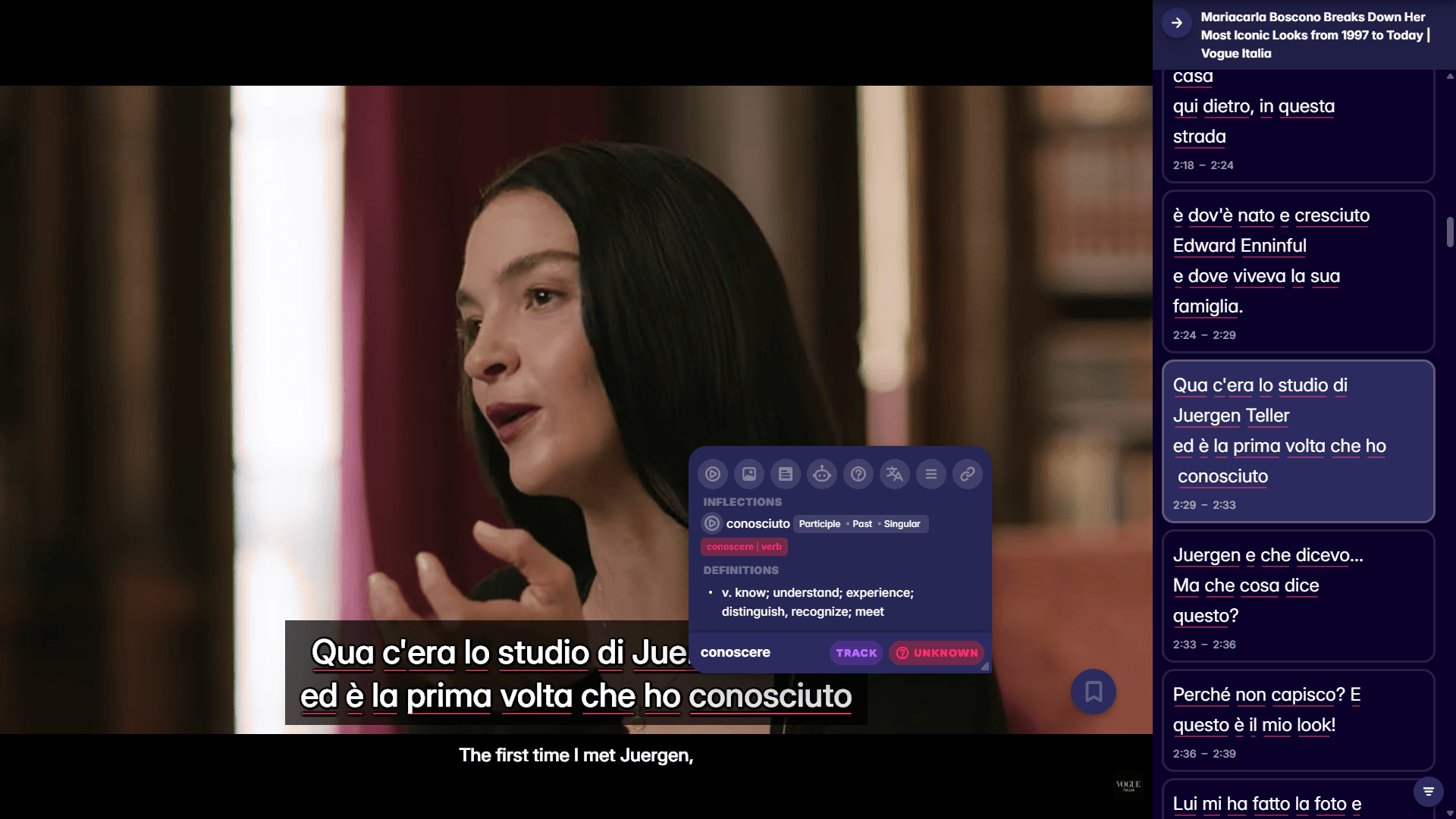
Anyway, if you're ready to move beyond app lessons and learn from real Italian content, Migaku's browser extension and app let you look up words instantly while watching Italian shows or reading Italian articles. Makes the jump to native content way less painful. There's a 10-day free trial if you want to check it out.
 ---
## FAQs
This is the big question everyone wants answered. Let me be straight with you. Yes, to a point. Can you become fluent using only Duolingo? Absolutely not. Duolingo will give you a foundation. You'll build vocabulary, recognize basic sentence structures, and get familiar with how Italian sounds. For a complete beginner, that's valuable. The app makes a great starting point because it's free, accessible, and removes the intimidation factor. But here's what Duolingo won't do: it won't make you conversationally fluent. It won't prepare you to have spontaneous discussions about politics, order confidently at a restaurant in Rome, or understand rapid-fire Italian in movies and podcasts.
The honest answer? You won't become fluent on Duolingo alone, regardless of how long you use it. If you complete the entire Italian course on Duolingo, which takes most people 6-12 months of daily practice, you'll have a decent beginner to lower-intermediate level. But fluency requires thousands of hours of input and output that Duolingo simply doesn't provide.
---
## Learning Italian on Duolingo is not a shortcut
As mentioned previously, Duolingo is mostly a tool for consistent vocabulary drill. Honestly, there is no one-resource-for-all shortcut in language learning. Smart learners combine resources and map out the best strategy that works great for them. As a good start, you can definitely try using Duolingo for vocab, textbooks for grammar, and tools like the Migaku browser extension for efficient media input!
> If you consume media in Italian, and you understand at least some of the messages and sentences within that media, you will make progress. _Period_.
We are what we repeatedly do. 📖
---
## FAQs
This is the big question everyone wants answered. Let me be straight with you. Yes, to a point. Can you become fluent using only Duolingo? Absolutely not. Duolingo will give you a foundation. You'll build vocabulary, recognize basic sentence structures, and get familiar with how Italian sounds. For a complete beginner, that's valuable. The app makes a great starting point because it's free, accessible, and removes the intimidation factor. But here's what Duolingo won't do: it won't make you conversationally fluent. It won't prepare you to have spontaneous discussions about politics, order confidently at a restaurant in Rome, or understand rapid-fire Italian in movies and podcasts.
The honest answer? You won't become fluent on Duolingo alone, regardless of how long you use it. If you complete the entire Italian course on Duolingo, which takes most people 6-12 months of daily practice, you'll have a decent beginner to lower-intermediate level. But fluency requires thousands of hours of input and output that Duolingo simply doesn't provide.
---
## Learning Italian on Duolingo is not a shortcut
As mentioned previously, Duolingo is mostly a tool for consistent vocabulary drill. Honestly, there is no one-resource-for-all shortcut in language learning. Smart learners combine resources and map out the best strategy that works great for them. As a good start, you can definitely try using Duolingo for vocab, textbooks for grammar, and tools like the Migaku browser extension for efficient media input!
> If you consume media in Italian, and you understand at least some of the messages and sentences within that media, you will make progress. _Period_.
We are what we repeatedly do. 📖