English Articles: A Complete Guide to A, An, and The
Last updated: December 14, 2025
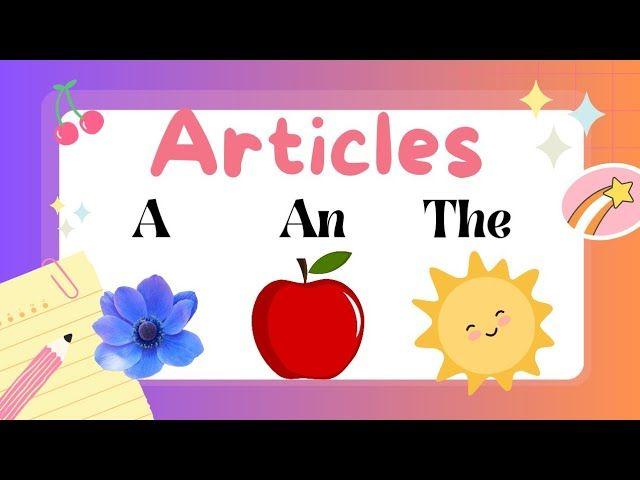
Here's the thing about articles in English grammar: they're tiny words that cause massive headaches. If your native language doesn't have articles (looking at you, Japanese, Chinese, Korean, Russian, and about 50 other languages), you've probably been told to just "feel" when to use "a," "an," or "the."
That advice sucks.
Let's actually break down how English articles work, because once you understand the logic behind them, article usage stops being this mysterious guessing game.
What are the definite and indefinite articles?
English has exactly three articles:
- A and an — the indefinite articles
- The — the definite article in English
That's it. Three words. And yet they appear in almost every English sentence you'll ever read or hear.
The core idea is simple: indefinite articles (a/an) introduce something new or nonspecific. The definite article (the) refers to something specific that both the speaker and listener already know about.
"I saw a dog" — could be any dog, you don't know which one yet
"I saw the dog" — you know exactly which dog I'm talking about
This distinction between definiteness and specificity is the foundation of everything else.
~
When to use articles: The indefinite article (a/an)
Use a or an when you're talking about:
1. Something mentioned for the first time
When a noun phrase appears in your conversation for the first time, its identity is unknown to the listener. You're introducing it.
- "I bought a car yesterday." (first mention)
- "The car is blue." (now we both know which car)
2. One of many (nonspecific reference)
- "Can I have a glass of water?" (any glass is fine)
- "She's an architect." (one of many architects in the world)
3. Jobs and professions
This is a grammatical rule that English just... has. When you specify someone's job, you use a/an before the singular noun.
- "He's a teacher."
- "My sister is an engineer."
A vs. An: The vowel sound rule
Here's where people get tripped up. The rule isn't about spelling — it's about sound.
Use a before words that begin with a consonant sound:
- a book, a car, a university (sounds like "yoo-niversity")
Use an before words that begin with a vowel sound:
- an apple, an hour (the "h" is silent), an MBA (sounds like "em-bee-ay")
The key is listening to how the word actually starts when you say it, not looking at the first letter.
~
When to use articles: The definite article (the)
Use the when you're talking about:
1. Something already mentioned
- "I saw a movie last night. The movie was terrible."
2. Something both people know about
- "Can you close the door?" (there's only one door we're both looking at)
- "I'm going to the store." (the usual store we both know)
3. Unique things
There's only one of these, so they're automatically specific:
- the sun, the moon, the President, the internet
4. Superlatives and ordinals
When you use words like "best," "first," or "only," you're already specifying something unique:
- "She's the best player on the team."
- "This is the first time I've tried sushi."
5. With adjective + noun when making it specific
An adjective alone doesn't require "the," but when you're using it to specify which noun you mean, it does:
- "The tall man in the corner" (you're specifying which man)
- "I prefer the blue one." (which one? the blue one)
~
The zero article: When to use no article at all
Sometimes English uses no article at all. This is called the "zero article," and it catches a lot of learners off guard.
Generalizations with plural nouns or uncountable nouns
When you're talking about something in general, not a specific instance:
- "Dogs are loyal." (all dogs, generally)
- "Water is essential for life." (water as a concept)
- "I love music." (music in general)
If you said "I love the music," you'd be talking about specific music playing right now.
Proper nouns
Names of people, cities, most countries, and languages don't take articles:
- "Maria lives in Tokyo."
- "She speaks French."
- "I'm from Brazil."
Exceptions exist (the United States, the Netherlands, the Philippines), but they're just that — exceptions you memorize.
Institutions used for their purpose
This is a weird one in American English vs. British English. When you go somewhere for its intended purpose:
- "She's in school." (she's a student)
- "He went to prison." (he's a prisoner)
- "I'm going to bed." (to sleep)
But if you're just visiting:
- "I went to the school to pick up my daughter."
- "She visited the prison for research."
Meals, sports, and days
- "Let's have breakfast."
- "I play tennis on Saturdays."
- "See you on Monday."
~
Articles with countable and uncountable nouns
This is where article usage gets more complex, and it's worth taking a minute to understand.
Count nouns (countable) can be singular or plural: one book, two books.
Mass nouns (uncountable nouns, noncount nouns) can't be counted: information, advice, furniture, water.
Here's the rule:
Noun Type | A/An? | The? | Zero Article? |
|---|---|---|---|
Singular count noun | ✓ (a book) | ✓ (the book) | ✗ |
Plural nouns | ✗ | ✓ (the books) | ✓ (books generally) |
Uncountable nouns | ✗ | ✓ (the water) | ✓ (water generally) |
The big takeaway: singular countable nouns almost always need an article (or another determiner like "my," "this," or "some"). You can't just say "I have book" — it has to be "I have a book" or "I have the book."
With plural and uncountable nouns, you have a choice between "the" (specific) and zero article (general).
Tricky uncountable nouns
These nouns that begin with what seems like they should be countable... aren't in English:
- advice (not "advices")
- information (not "informations")
- furniture (not "furnitures")
- luggage (not "luggages")
- news (not "a news")
- research (not "researches")
- progress (not "progresses")
You can't say "I need an advice." You say "I need some advice" or "I need advice."
~
Why articles are so hard (and what actually helps)
Be honest: if you've read this far, you probably already knew most of these rules. The problem isn't knowing the rules — it's applying them in real time when you're speaking or writing.
According to research from the University of North Carolina writing center and other institutions, articles are one of the last things language learners fully master. Even advanced learners who've been studying English for years still make article mistakes.
Why? Because language learning is hard for everyone, and English articles require you to think about:
- Is this noun countable or uncountable?
- Is it singular or plural?
- Have I mentioned it before?
- Does the listener already know what I'm referring to?
- Am I speaking generally or specifically?
That's five things to process for every single noun. No wonder it feels overwhelming.
The solution isn't more grammar drills. It's exposure. Lots and lots of exposure to real English, where you see articles used correctly in context thousands of times until the patterns become automatic.
This is exactly why textbooks fall short for grammar like this — you need to see how native speakers actually use articles in conversation, in TV shows, in articles, in everyday life. Not just in example sentences designed to illustrate a rule.
~
How to actually improve your article usage
Reading grammar guides (like this one) is useful for understanding the concepts. But understanding isn't the same as being able to use them naturally.
Here's what actually works:
1. Immerse yourself in real English content
Watch shows, read articles, listen to podcasts. Pay attention to articles when you notice them, but don't obsess. Your brain will start picking up patterns.
2. When you notice a confusing use, pause and figure it out
"Wait, why did they say 'the' there?" That moment of curiosity is where real learning happens. If you can look up the word, see it in context, and understand why that article was used — that sticks with you.
3. Don't try to memorize every rule
Focus on the big patterns first: indefinite for new/general, definite for known/specific, zero article for generalizations. The exceptions and edge cases will come with exposure.
4. Accept that you'll make mistakes
Native speakers won't even notice most article errors — they'll understand you just fine. Perfect article usage comes with time, not cramming.
~
If you want to speed up this process, Migaku's browser extension is genuinely helpful for grammar like this. When you're watching something on Netflix or YouTube and you hear an article that confuses you, you can pause, see the subtitle, and instantly look up any word in the sentence. You can save the whole sentence to your flashcards with audio, so you're reviewing grammar in context instead of in isolation.
The mobile app lets you review these sentences with spaced repetition, so those article patterns actually stick in your memory. It's basically what we described above — tons of exposure to real English, with tools that help you understand and remember what you're hearing.
There's a 10-day free trial if you want to try it out. No pressure, but if you're serious about getting past the beginner stage and actually internalizing grammar instead of just memorizing rules, it's worth checking out.