# French Emotions Vocabulary: Talk About Feelings Naturally
> Go through essential French emotions vocabulary with practical examples, gender agreement rules, and common expressions to describe how you feel.
**URL:** https://migaku.com/blog/language-fun/french-emotions-vocabulary
**Last Updated:** 2026-02-13
**Tags:** vocabulary, phrases
---
How to open up way more natural conversations than just ordering coffee or asking for directions? You need to learn how to express your emotions [in French](https://migaku.com/learn-french)! Whether you're chatting with a language partner, writing in your journal, or just trying to explain why you're having a rough day, having solid French emotions [vocabulary](https://migaku.com/blog/language-fun/french-body-parts-vocabulary-guide) makes everything easier. This lesson covers the essential adjectives, verbs, and expressions you need to describe feelings in French, plus the [grammar](https://migaku.com/blog/language-fun/french-grammar-guide) rules that'll keep you from making awkward mistakes.
---
## Basic structure with 'je suis' and 'je me sens'
The two main ways to express emotions in French use the verbs être (To be) and se sentir (To feel). Here's the thing: they're pretty similar to English, but French speakers use them in slightly different contexts.
For most everyday emotions, you'll use **"je suis"** (I am) plus an adjective. This works exactly like English: "Je suis content" means "I am happy." Super straightforward.
The verb se sentir gives you **"je me sens"** (I feel), which sounds a bit more introspective. French speakers often use this when describing a temporary state or physical sensation. "Je me sens fatigué" (I feel tired) emphasizes the current moment more than "je suis fatigué" would.
When asking someone how they're feeling, you've got options. "Comment te sens-tu?" is the informal way to ask "How are you feeling?" using se sentir. The more common everyday question is "Comment ça va?" (How's it going?), which works in basically any situation. You can also ask "Comment vas-tu?" or the formal "Comment allez-vous?" using the verb aller (To go), which French people use constantly.
The conjugation for se sentir follows this pattern:
- Je me sens (I feel)
- Tu te sens (You feel, informal)
- Il/Elle se sent (He/She feels)
- Nous nous sentons (We feel)
- Vous vous sentez (You feel, formal/plural)
- Ils/Elles se sentent (They feel)
Pretty cool how the reflexive pronoun (me, te, se) changes with each person!
---
## Positive emotions vocabulary
Feeling positive? Here are the French adjectives you'll actually use when things are going well. Remember that these need to agree with gender and number, which we'll cover in detail later.
The basic happy words include:
| French (Masculine/Feminine) | English |
| - | - |
| Content / Contente | Happy, satisfied |
| Heureux / Heureuse | Happy, joyful |
| Joyeux / Joyeuse | Joyful, cheerful |
| Ravi / Ravie | Delighted |
"Content" and "heureux" both mean happy, but "heureux" carries a deeper, more profound happiness. You'd say "je suis content" after eating a good meal, but "je suis heureux" when talking about your life satisfaction.
For excitement and energy:
| French (Masculine/Feminine) | English |
| - | - |
| Excité / Excitée | Excited |
| Enthousiaste | Enthusiastic |
| Motivé / Motivée | Motivated |
| Énergique | Energetic |
When you're feeling calm and peaceful:
| French (Masculine/Feminine) | English |
| - | - |
| Calme | Calm |
| Tranquille | Peaceful, quiet |
| Détendu / Détendue | Relaxed |
| Serein / Sereine | Serene |
Other positive feelings worth knowing:
| French (Masculine/Feminine) | English |
| - | - |
| Fier / Fière | Proud |
| Reconnaissant / Reconnaissante | Grateful |
| Soulagé / Soulagée | Relieved |
| Confiant / Confiante | Confident |
| Optimiste | Optimistic |
| Amoureux / Amoureuse | In love |
The expression "avoir" shows up in some emotion phrases too. "J'ai de la chance" means "I'm lucky" (literally "I have luck"), and "j'ai hâte" means "I'm excited/looking forward to" (literally "I have haste").
---
## Negative emotions vocabulary
Can't find any good resources about French emotions? The negative feelings vocabulary is just as important as the positive stuff, maybe more so since you'll need these words when something goes wrong.
For sadness and related feelings:
| French (Masculine/Feminine) | English |
| - | - |
| Triste | Sad |
| Déprimé / Déprimée | Depressed |
| Malheureux / Malheureuse | Unhappy |
| Découragé / Découragée | Discouraged |
| Désespéré / Désespérée | Desperate |
How do you express sadness in French? The most straightforward way is "je suis triste," which works for anything from mild disappointment to genuine grief. The context and your tone communicate the intensity.
Anger and frustration:
| French (Masculine/Feminine) | English |
| - | - |
| En colère | Angry |
| Fâché / Fâchée | Mad, upset |
| Furieux / Furieuse | Furious |
| Irrité / Irritée | Irritated |
| Frustré / Frustrée | Frustrated |
| Énervé / Énervée | Annoyed |
Notice that "en colère" uses the preposition "en" instead of just the adjective. You say "je suis en colère," never "je suis colère."
Fear and anxiety:
| French (Masculine/Feminine) | English |
| - | - |
| Effrayé / Effrayée | Scared |
| Anxieux / Anxieuse | Anxious |
| Inquiet / Inquiète | Worried |
| Nerveux / Nerveuse | Nervous |
| Stressé / Stressée | Stressed |
| Terrifié / Terrifiée | Terrified |
Physical and mental exhaustion:
| French (Masculine/Feminine) | English |
| - | - |
| Fatigué / Fatiguée | Tired |
| Épuisé / Épuisée | Exhausted |
| Ennuyé / Ennuyée | Bored |
| Confus / Confuse | Confused |
Other negative emotions:
| French (Masculine/Feminine) | English |
| - | - |
| Jaloux / Jalouse | Jealous |
| Déçu / Déçue | Disappointed |
| Coupable | Guilty |
| Embarrassé / Embarrassée | Embarrassed |
| Seul / Seule | Lonely |
| Vide | Empty |
The word "sentiment" in French refers to a feeling or emotion as a noun. You might say "c'est un sentiment étrange" (It's a strange feeling) when describing something you can't quite pin down.
---
## Gender agreement in adjectives of French emotions
French grammar requires adjectives to match the gender and number of what they're describing. Since you're talking about yourself or others, the adjective has to agree with the person's gender.
> The basic rule: masculine adjectives stay as is, feminine adjectives typically add an "e" at the end.
So a man says "je suis content" while a woman says "je suis contente." The [pronunciation](https://migaku.com/blog/language-fun/french-alphabet-pronunciation-guide) often changes too. "Content" sounds like "con-tan" while "contente" sounds like "con-tant."
Some adjectives already end in "e" in their masculine form, so they stay the same for both genders:
- Calme (Calm)
- Triste (Sad)
- Timide (Shy)
- Énergique (Energetic)
Irregular patterns show up pretty often with emotion words. Adjectives ending in "eux" change to "euse" for feminine:
- Heureux → Heureuse (Happy)
- Nerveux → Nerveuse (Nervous)
- Anxieux → Anxieuse (Anxious)
- Joyeux → Joyeuse (Joyful)
Adjectives ending in "er" become "ère":
- Fier → Fière (Proud)
Some double the final consonant before adding "e":
- Bon → Bonne (Good)
A few are completely irregular:
- Fou → Folle (Crazy)
For plural forms, add "s" to masculine adjectives and "es" to feminine ones. "Nous sommes contents" (We are happy, masculine/mixed group) versus "nous sommes contentes" (We are happy, all feminine group).
The gender thing trips up English speakers constantly because we don't have this in our language. My advice? Practice with real sentences about yourself until the correct form becomes automatic. AI language tools in 2026 can give you instant feedback on agreement errors, which helps way more than just memorizing tables.
---
## Common expressions and phrases
Beyond basic adjectives, French has tons of expressions that describe emotional states. These make you sound way more natural than just saying "je suis triste" all the time.
Using "avoir" for emotions:
- Avoir peur (To be afraid)
- Avoir honte (To be ashamed)
- Avoir envie de (To feel like, to want to)
- Avoir le cafard (To feel down, literally "to have the cockroach")
- Avoir la pêche (To feel great, literally "to have the peach")
The verb sentir and its reflexive form se sentir create useful expressions:
- Je me sens bien (I feel good)
- Je me sens mal (I feel bad/unwell)
- Je ne me sens pas bien (I don't feel well)
Expressions with être:
- Être de bonne humeur (To be in a good mood)
- Être de mauvaise humeur (To be in a bad mood)
- Être à l'aise (To be comfortable)
- Être mal à l'aise (To be uncomfortable)
- Être dans les nuages (To be daydreaming, literally "to be in the clouds")
Some emotions use specific prepositions. You're "en colère" (Angry), "de bonne humeur" (In a good mood), or "à bout" (At the end of your rope).
When intensifying emotions, French speakers use adverbs:
- Très (Very): "Je suis très content"
- Vraiment (Really): "Je suis vraiment fatigué"
- Tellement (So): "Je suis tellement heureux"
- Un peu (A little): "Je suis un peu triste"
- Assez (Quite, rather): "Je suis assez nerveux"
---
## Asking about emotions
Learning to ask others about their feelings makes conversations flow better. The standard "comment ça va?" works anywhere, but you've got more specific options.
Informal questions using "tu":
- Comment te sens-tu?
*How are you feeling?*
- Ça va?
*You okay? / How's it going?*
- Tu vas bien?
*Are you doing well?*
- Qu'est-ce qui ne va pas?
*What's wrong?*
- Pourquoi es-tu triste?
*Why are you sad?*
Formal questions using "vous":
- Comment vous sentez-vous?
*How are you feeling?*
- Comment allez-vous?
*How are you?*
- Vous allez bien?
*Are you doing well?*
To ask about specific emotions:
- Tu es content?
*Are you happy?*
- Tu as peur?
*Are you scared?*
- Tu es fâché contre moi?
*Are you mad at me?*
French people often respond with "ça va" even when things aren't great. It's a cultural thing. If someone asks "ça va?" you can say:
- Ça va bien
*I'm doing well*
- Ça va mal
*I'm doing badly*
- Comme ci, comme ça
*So-so*
- Pas terrible
*Not great*
- Ça pourrait aller mieux
*Could be better*
The question "qu'est-ce que tu ressens?" (What do you feel?) asks someone to describe their emotions in more depth. "Ressentir" means to feel or experience an emotion deeply.
---
## Practical exercises and usage to express emotions and feelings
The best way to lock in this vocabulary is using it to talk about real feelings.
1. Keep a daily journal in French where you write a few sentences about your emotional state. "Aujourd'hui, je me sens fatigué parce que j'ai mal dormi. Je suis un peu frustré avec mon travail, mais je suis content d'avoir du temps libre ce soir."
2. Talk to yourself in French throughout the day. When something annoys you, think "je suis énervé." When you're happy, think "je suis content." This internal narration builds automatic recall.
3. Practice with a language partner by asking each other "comment te sens-tu?" and giving detailed answers. Push past "ça va" and actually describe your emotions with specific adjectives.
4. Watch French content and pay attention to how characters express feelings. Notice the body language, tone, and context alongside the words. Emotions in movies and shows give you the full picture of when to use each expression.
5. Create themed vocabulary lists based on situations. What emotions come up at work? In relationships? During travel? Grouping words by context helps you remember them when you actually need them.
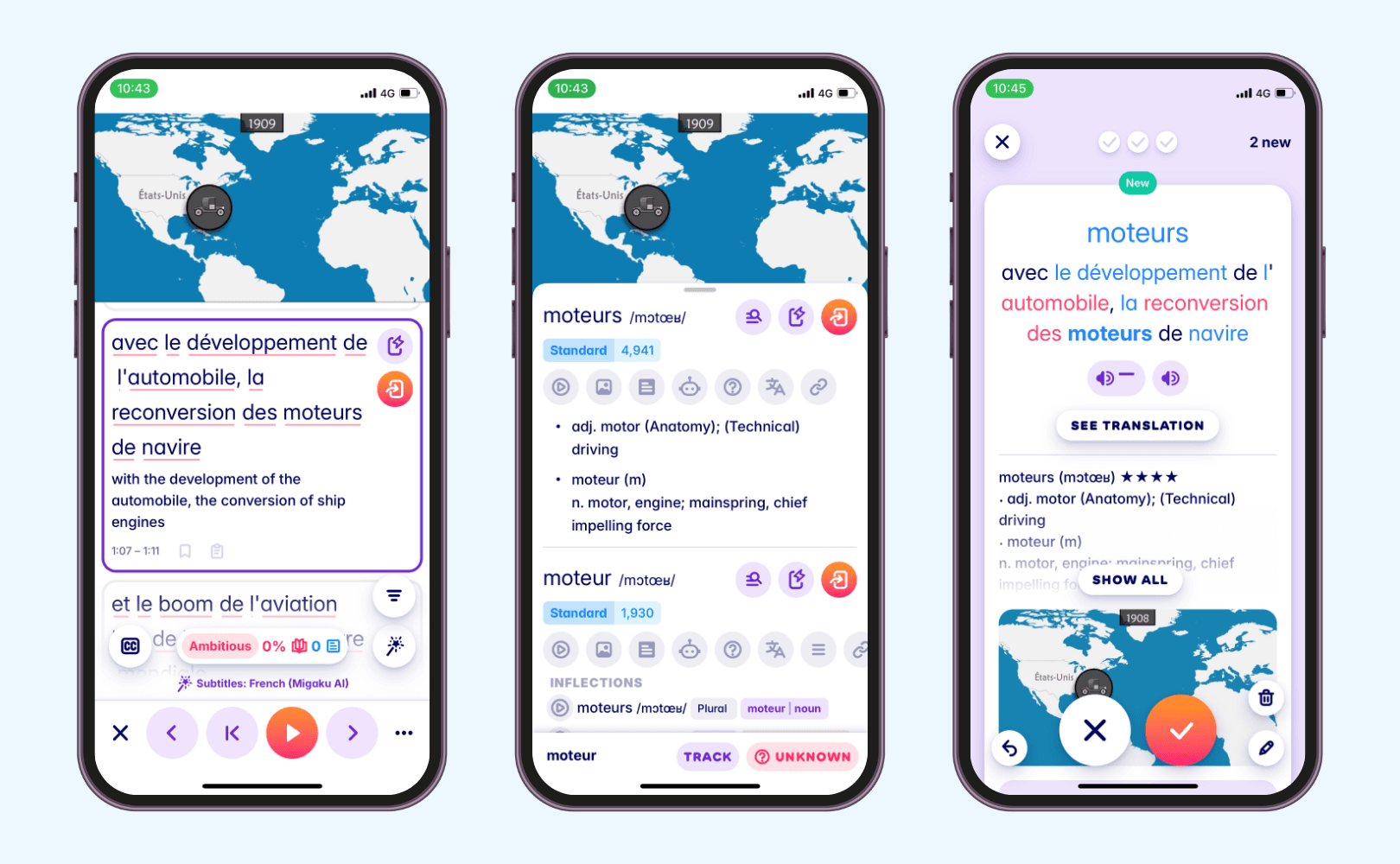
6. Opt for the right tools for vocab acquisition and immersion. If you want to practice this vocabulary with real French content, Migaku's browser extension and app let you look up words instantly while watching shows or reading articles. The immediate context makes emotions vocabulary way easier to remember than flashcards alone. There's a 10-day free trial if you want to check it out.
 ---
## Feeling awkward to share your feelings and sentiments with others?
You are not alone, and you don't have to learn these words through output. Read French blogs, social media posts, or forums where people discuss their feelings. Real people writing about real emotions use vocabulary in ways [textbooks](https://migaku.com/blog/language-fun/best-french-textbooks) don't capture. Listen to French music and pay attention to the lyrics. Songs are packed with emotion vocabulary, and the repetition plus melody helps words stick in your memory.
> If you consume media in French, and you understand at least some of the messages and sentences within that media, you will make progress. _Period_.
Choose what suits you best!
---
## Feeling awkward to share your feelings and sentiments with others?
You are not alone, and you don't have to learn these words through output. Read French blogs, social media posts, or forums where people discuss their feelings. Real people writing about real emotions use vocabulary in ways [textbooks](https://migaku.com/blog/language-fun/best-french-textbooks) don't capture. Listen to French music and pay attention to the lyrics. Songs are packed with emotion vocabulary, and the repetition plus melody helps words stick in your memory.
> If you consume media in French, and you understand at least some of the messages and sentences within that media, you will make progress. _Period_.
Choose what suits you best!