French Nature Vocabulary: Start Your Discussion About Animals, Landscapes, and Environment
Last updated: March 28, 2026

Learning French nature vocabulary opens up a whole new way to talk about the world around you. Whether you're planning to hike in the Alps, read French literature that's full of landscape descriptions, or just want to chat about the weather with native speakers, knowing these words makes everything easier. The cool thing is, French has some really specific terms for natural features that English doesn't always capture the same way. Let's dive into the essential vocabulary you need to describe everything from mountains to rivers to the plants and animals you'll encounter.🌊
Essential French vocabulary for landscapes and landforms
When you're talking about the physical features of the land in French, you'll use a different set of words than you might expect.
- The word for mountain is "la montagne," which you'll hear constantly if you spend any time in regions like the Pyrenees or the French Alps. If you're asking someone "How high is the summit of this mountain?" you'd say "Quelle est l'altitude du sommet de cette montagne?"
- Hills are called "la colline," which sounds pretty elegant compared to the English word.
- A valley is "la vallée," and you'll notice that double "l" shows up in a lot of French geographical terms.
- When you're talking about a cliff or steep rock face, that's "la falaise." The famous white cliffs you see along the French coast? Those are "les falaises."
- Caves are "la grotte" or "la caverne," with grotte being more common for natural caves.
- A plain or flat area is "la plaine."
- If you're in a desert (though France doesn't have many), that's "le désert."
- The beach is "la plage," which is probably one of the first nature words most French learners pick up because, well, French beaches are amazing.
- The word for forest is "la forêt," and you'll see that little hat accent on the "e" which actually hints at an old "s" that used to be there (just like in English "forest").
- A smaller wooded area or woods is "le bois." When you want to ask "Are there wild animals in this forest?" you'd say "Y a-t-il des animaux sauvages dans cette forêt?"
Bodies of water in French
Water features have their own specific vocabulary in French, and getting these terms right helps you sound way more natural. The most basic one is "l'eau" (water), but let's get into the specific types.
A river is "la rivière" or "le fleuve," and here's where French actually makes a distinction that English doesn't. A "rivière" is a river that flows into another river, while a "fleuve" is a river that flows directly into the sea or ocean. So the Seine is a fleuve because it empties into the English Channel, but its tributaries are rivières. Pretty specific, right?
French | English |
|---|---|
le lac | Lake |
l'étang | Pond |
le ruisseau | Stream / Brook |
l'océan | Ocean |
la mer | Sea |
la cascade | Waterfall |
la source | Spring (where water comes up from the ground) |
la vague | Wave |
la marée | Tide |
le courant | Current |
l'île | Island |
la presqu'île | Peninsula (literally "almost island") |
Weather and sky vocabulary
Talking about the weather is probably one of the most common ways you'll use nature vocabulary in everyday French. When someone asks "How's the weather?" they'll usually say "Quel temps fait-il?" The word "temps" here means weather, though it also means time in other contexts.
French | English |
|---|---|
le soleil | Sun |
Il fait soleil / Il y a du soleil | It's sunny |
la lune | Moon |
les étoiles | Stars |
un nuage | Cloud |
Il y a des nuages / C'est nuageux | It's cloudy |
la pluie | Rain |
Il pleut | It's raining |
la neige | Snow |
Il neige | It's snowing |
le vent | Wind |
Il fait du vent / C'est venteux | It's windy |
la tempête / l'orage | Storm (orage specifically means thunderstorm) |
le tonnerre | Thunder |
l'éclair / la foudre | Lightning |
le brouillard | Fog |
Il y a du brouillard | It's foggy |
l'arc-en-ciel | Rainbow (literally "arc in sky") |
le ciel | Sky |
Temperature vocabulary is straightforward:
- "Il fait chaud" means it's hot.
- "Il fait froid" means it's cold.
- "Il fait frais" means it's cool or fresh.
These are way more common than saying an actual temperature number in casual conversation.
Plants, trees, and flowers in la nature
The general word for a plant is "la plante," and a tree is "un arbre."
French | English |
|---|---|
un chêne | Oak |
un pin | Pine |
un bouleau | Birch |
un saule | Willow |
le tronc | Trunk |
une branche | Branch |
une feuille | Leaf |
les racines | Roots |
Flowers are "les fleurs," and this is another word you'll hear constantly.
French | English |
|---|---|
une rose | Rose |
un tournesol | Sunflower (literally "turns toward the sun") |
une marguerite | Daisy |
l'herbe | Grass |
un buisson / un arbuste | Bush / Shrub |
la mousse | Moss |
le blé | Wheat |
le maïs | Corn |
la vigne | Vine (for grapes) |
le jardin | Garden |
le potager | Vegetable garden |
un champ | Field |
Animal and wildlife vocabulary
When you're talking about animals in French, the general term is "un animal" (plural: "les animaux" ). Wild animals are "les animaux sauvages," and domestic animals are "les animaux domestiques."
Common wild animals include:
French | English |
|---|---|
le cerf | Deer |
le sanglier | Wild boar |
le renard | Fox |
le loup | Wolf |
les ours | Bears |
un lapin | Rabbit |
un lièvre | Hare |
For birds, the general word is "un oiseau."
French | English |
|---|---|
un aigle | Eagle |
une chouette / un hibou | Owl |
un corbeau | Crow |
un canard | Duck |
un cygne | Swan |
les moineaux | Sparrows / Small birds |
Insects are "les insectes."
French | English |
|---|---|
un papillon | Butterfly |
une abeille | Bee |
une fourmi | Ant |
une araignée | Spider |
une mouche | Fly |
un moustique | Mosquito |
In the water, a fish is "un poisson."
French | English |
|---|---|
une grenouille | Frog |
un crapaud | Toad |
un serpent | Snake |
These are the basic animals you'll encounter or talk about when discussing French nature.
Seasons and natural cycles
The seasons in French are "les saisons."
French | English |
|---|---|
le printemps | Spring |
l'été | Summer |
l'automne | Autumn |
l'hiver | Winter |
You'll use these constantly when talking about nature and weather patterns.
The grammar of French nature vocabulary
When you start using these words in real conversations or reading, you'll notice some patterns.
French uses a lot of "il fait" constructions for weather: "Il fait beau" (nice weather), "Il fait mauvais" (bad weather), "Il fait gris" (gray/overcast). This is different from English where we might say "it's nice out" or "it's gray."
The gender of nature words matters for agreement. Rivers can be masculine (le fleuve) or feminine (la rivière), mountains are feminine (la montagne), and the sun is masculine (le soleil) while the moon is feminine (la lune). You need to memorize these because they affect the articles and adjectives you use.
Many French nature terms are more specific than their English equivalents. That fleuve versus rivière distinction is a good example. Another one is how French distinguishes between different types of rain: "la pluie" is general rain, "une averse" is a shower, "une bruine" is drizzle, and "un déluge" is a downpour.
Making these words stick in your memory
The best way to learn French nature vocabulary is through context and repetition.
- Reading French books that describe landscapes helps a ton. Authors like Jean Giono write incredibly detailed nature descriptions that'll teach you words you'd never find in a basic vocabulary list.
- Watching French documentaries about nature is another solid approach. You hear the words pronounced correctly, you see what they're describing, and you get natural example sentences. French channels like Arte produce excellent nature content.
- Labeling things in your environment works too. If you can see trees, sky, or weather from where you study, practice describing what you see in French. "Il y a des nuages aujourd'hui. Le ciel est gris. Il fait frais." Just narrating the weather to yourself builds the habit of using these words.
- Creating themed flashcard decks helps, but make sure you're using full sentences, not just isolated words. "La rivière coule vers le fleuve" (The river flows toward the main river) is way more useful than just memorizing "rivière = river." Context makes the word stick better and teaches you how to actually use it.
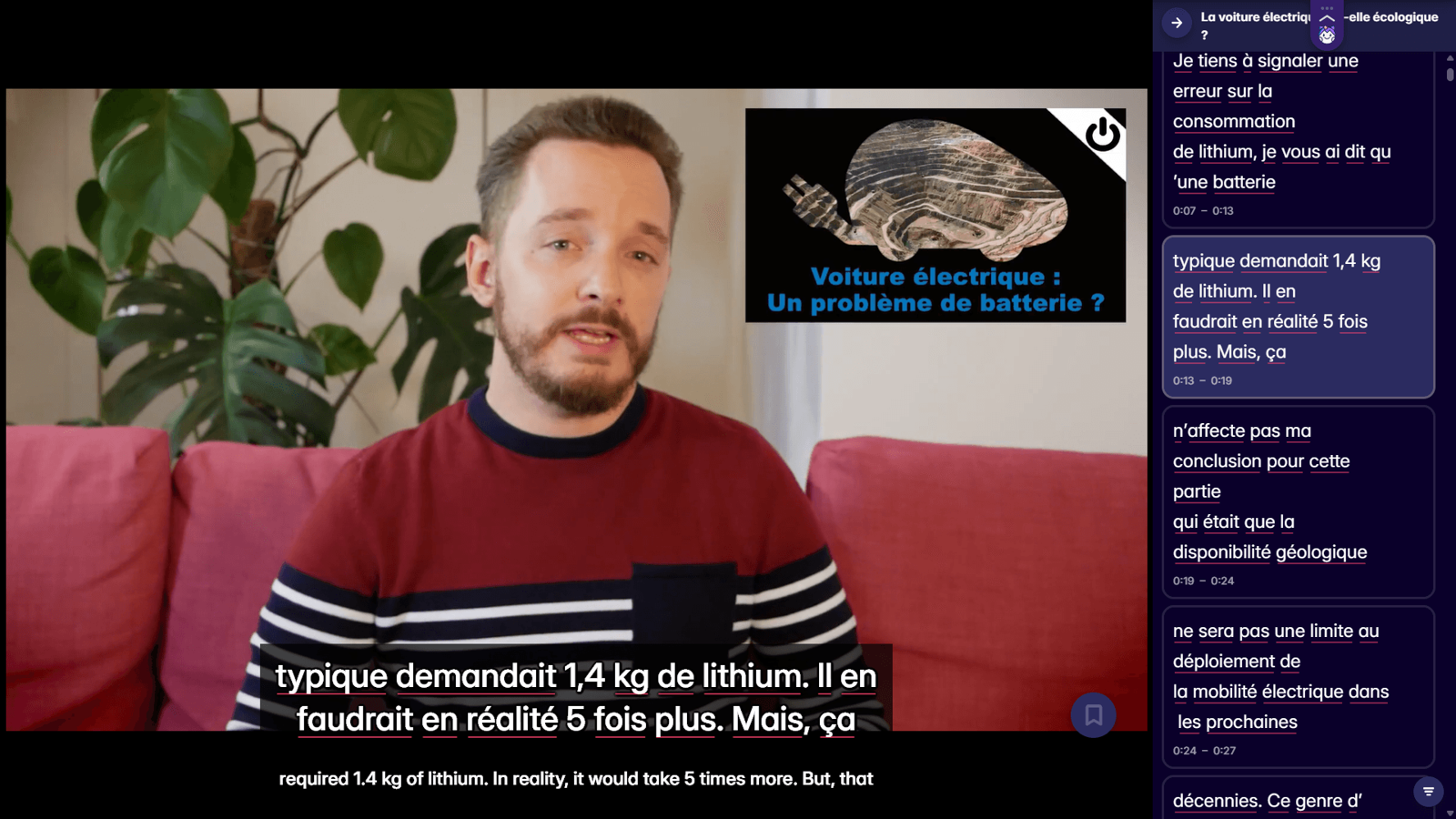
If you're serious about building your French vocabulary through real content, Migaku's browser extension and app let you look up words instantly while watching French nature documentaries or reading articles. You can save the words you find directly to your flashcard decks with context included. There's a 10-day free trial if you want to see how it works with actual French media.
Learning vocabulary related to nature gives you access to a huge part of French culture and daily life
From casual weather chat to describing hiking trips to understanding French poetry and literature, these words come up constantly. The vocabulary isn't hard to learn because you can connect it to things you see and experience. Every time you look outside, you have a chance to practice. Every weather forecast you read in French reinforces these terms. Every nature documentary you watch adds new words in context.
If you consume media in French, and you understand at least some of the messages and sentences within that media, you will make progress. Period.
Get outside, look around, and start describing what you see in French.⛱️