# French Past Tense: Passé Composé vs Imparfait Tense in French Explained
> Learn how to form and use the French past tense with passé composé and imparfait. Includes conjugation rules, examples, and when to use each tense together.
**URL:** https://migaku.com/blog/language-fun/french-past-tense-passe-compose-imparfait
**Last Updated:** 2026-02-11
**Tags:** fundamentals, grammar
---
[Learning French](https://migaku.com/learn-french) past tense feels overwhelming at first because French has several ways to talk about the past. The good news? For everyday conversation, you really only need to master two: passé composé and imparfait. These two tenses handle about 90% of past tense situations you'll encounter when speaking French. Once you understand how they work and when to use each one, talking about past events becomes way more natural. Let's break down exactly how to form these tenses and when to use them.
---
## Understanding the French past tense system
French has four main past tenses, but you won't use all of them equally. The passé composé and imparfait dominate spoken French and informal writing. The passé simple appears mostly in literature and formal writing, while the plus-que-parfait (Pluperfect) describes actions that happened before other past actions.
Here's the thing: native French speakers use passé composé and imparfait constantly in daily conversation. The passé simple? You'll see it in novels and historical texts, but almost never hear it spoken. So if you're learning French to actually communicate, focus your energy on passé composé and imparfait first.
> 💡The basic distinction:
> - passé composé describes **completed** actions with specific endpoints,
> - while imparfait describes **ongoing** states, habitual actions, or background descriptions in the past.
Think of passé composé as what happened, and imparfait as what was happening or used to happen.
---
## How to form the passé composé in French
> The passé composé is a compound tense, meaning it requires two parts: **an auxiliary verb** (Either avoir or être) in the present tense, plus the **past participle** of the main verb.
### Avoir or être?
Most French verbs use avoir as their auxiliary verb. About 80-85% of verbs fall into this category. You conjugate avoir in the present tense, then add the past participle.
A smaller group of verbs uses être instead. These include:
| Category | French Verb | English |
| - | - | - |
| Movement | aller | To go |
| | venir | To come |
| | arriver | To arrive |
| | partir | To leave |
| | entrer | To enter |
| | sortir | To go out |
| | monter | To go up |
| | descendre | To go down |
| | tomber | To fall |
| | retourner | To return |
| State change | naître | To be born |
| | mourir | To die |
| | devenir | To become |
| | rester | To stay |
| Reflexive | se laver | To wash oneself |
| | se lever | To get up |
| | s'habiller | To get dressed |
The classic mnemonic for être verbs is "DR & MRS VANDERTRAMP," where each letter represents a verb that takes être.
### First things first: how do we form the past participle?
For regular verbs, the past participle follows predictable patterns based on the infinitive ending:
- ER verbs: drop the -er, add -é (parler becomes parlé)
- IR verbs: drop the -ir, add -i (finir becomes fini)
- RE verbs: drop the -re, add -u (vendre becomes vendu)
Irregular verbs have unpredictable past participles you need to memorize. Common ones include:
- avoir ➡️ eu
- être ➡️ été
- faire ➡️ fait
- prendre ➡️ pris
- voir ➡️ vu
- mettre ➡️ mis
- venir ➡️ venu
- pouvoir ➡️ pu
- savoir ➡️ su
- vouloir ➡️ voulu
### Conjugating passé composé with avoir
Let's conjugate "parler" (To speak) in passé composé:
- J'ai parlé (I spoke/have spoken)
- Tu as parlé (You spoke/have spoken)
- Il/Elle/On a parlé (He/She/One spoke/has spoken)
- Nous avons parlé (We spoke/have spoken)
- Vous avez parlé (You spoke/have spoken)
- Ils/Elles ont parlé (They spoke/have spoken)
The past participle stays the same for all subjects when using avoir, unless there's a preceding direct object (which is an advanced [grammar](https://migaku.com/blog/language-fun/french-grammar-guide) point you can worry about later).
### Conjugating passé composé with être
When you use être, the past participle must agree with the subject in gender and number. This means adding -e for feminine, -s for masculine plural, or -es for feminine plural.
Let's conjugate "aller" (To go):
- Je suis allé(e) (I went)
- Tu es allé(e) (You went)
- Il est allé (He went)
- Elle est allée (She went)
- Nous sommes allé(e)s (We went)
- Vous êtes allé(e)(s) (You went)
- Ils sont allés (They went - masculine)
- Elles sont allées (They went - feminine)
The agreement rule trips up learners at first, but you get used to it with practice.
### When to use the passé composé
Use passé composé for:
- **Completed actions**: "J'ai mangé une pomme" (I ate an apple)
- **Specific events**: "Elle est arrivée hier" (She arrived yesterday)
- **Actions with clear beginning and end**: "Nous avons étudié pendant deux heures" (We studied for two hours)
- **Series of completed actions**: "Il a ouvert la porte, il est entré, et il a fermé la porte" (He opened the door, he entered, and he closed the door)
---
## How to conjugate the imperfect tense
The imparfait (Imperfect tense) is simpler to form than passé composé because it uses just one verb form instead of two parts.
To conjugate any verb in imparfait:
1. Take the nous form of the present tense
2. Drop the -ons ending
3. Add the imparfait endings: -ais, -ais, -ait, -ions, -iez, -aient
Let's conjugate "parler" (To speak):
- Present tense nous form: parlons
- Stem: parl-
- Je parlais (I was speaking/used to speak)
- Tu parlais (You were speaking/used to speak)
- Il/Elle/On parlait (He/She/One was speaking/used to speak)
- Nous parlions (We were speaking/used to speak)
- Vous parliez (You were speaking/used to speak)
- Ils/Elles parlaient (They were speaking/used to speak)
This pattern works for almost every French verb. The only irregular verb in imparfait is être:
- J'étais
- Tu étais
- Il/Elle/On était
- Nous étions
- Vous étiez
- Ils/Elles étaient
Pretty cool that there's only one irregular verb to memorize for this tense!
### When to use imparfait tense in French
Use imparfait for:
- Ongoing past actions: "Je lisais quand tu as appelé" (I was reading when you called)
- Habitual past actions: "Quand j'étais jeune, je jouais au foot tous les jours" (When I was young, I played soccer every day)
- Descriptions in the past: "Il faisait beau" (The weather was nice)
- Background information: "La maison était grande et vieille" (The house was big and old)
- States of being: "J'avais faim" (I was hungry)
---
## What's the difference between passé composé and passé simple
The passé simple is another past tense in French that describes completed actions, similar to passé composé. The difference? Passé simple appears almost exclusively in written French, particularly literature, historical texts, and formal journalism.
You'll recognize passé simple by its distinctive [conjugation](https://migaku.com/blog/language-fun/french-verb-conjugation) endings. For example, "parler" in passé simple:
- Je parlai
- Tu parlas
- Il/Elle/On parla
- Nous parlâmes
- Vous parlâtes
- Ils/Elles parlèrent
French speakers don't use passé simple in conversation. If you're reading a novel and see "il parla" instead of "il a parlé," that's passé simple doing the same job as passé composé would in spoken French.
For learners, you need to recognize passé simple when reading, but you won't need to produce it yourself unless you're writing formal literature or academic papers.
---
## Using passé composé and imparfait together
Here's where things get interesting. Native French speakers constantly combine these two tenses in the same sentence or narrative. The imparfait sets the scene, while the passé composé describes what happened.
Example:
- "Il faisait nuit quand je suis rentré"
*It was night when I came home.*
"Il faisait nuit" uses imparfait because it describes the ongoing condition (It was nighttime). "Je suis rentré" uses passé composé because coming home was a specific, completed action.
Another example:
- "Nous regardions la télé quand le téléphone a sonné"
*We were watching TV when the phone rang.*
"Nous regardions" uses imparfait for the ongoing activity. "Le téléphone a sonné" uses passé composé for the specific interruption.
Think of imparfait as painting the background of your story, while passé composé adds the main events. When telling a story in French, you'd typically use imparfait to describe the setting, weather, emotions, and ongoing situations, then use passé composé for the sequence of events that moved the story forward.
Example narrative:
- "Il était minuit. La rue était vide et silencieuse. J'avais peur. Soudain, j'ai entendu un bruit. Je me suis retourné et j'ai vu un chat"
*It was midnight. The street was empty and silent. I was afraid. Suddenly, I heard a noise. I turned around and I saw a cat.*
The imparfait verbs (était, avait) set the mood, while the passé composé verbs (ai entendu, me suis retourné, ai vu) describe what actually happened.
---
## Tips for mastering the past tense in French together with conjugation rules
1. Start by focusing on passé composé with avoir for regular -er verbs. This covers the majority of past tense situations you'll encounter. Once that feels comfortable, add the common être verbs.
2. Practice creating simple past tense sentences about your day: "J'ai mangé des céréales. J'ai pris le bus. J'ai travaillé pendant huit heures." This builds muscle memory for the conjugation patterns. For imparfait, describe how things used to be or what you used to do regularly: "Quand j'étais enfant, je jouais dehors tous les jours" (When I was a child, I played outside every day).
3. The real breakthrough comes when you start combining the tenses naturally in stories. Try narrating a simple event from your past, using imparfait for the setting and passé composé for the actions. The more you practice this combination, the more intuitive it becomes.
4. Reading French content helps tremendously. When you see these tenses used in context, you internalize the patterns without conscious effort. Pay attention to which tense appears in different situations.
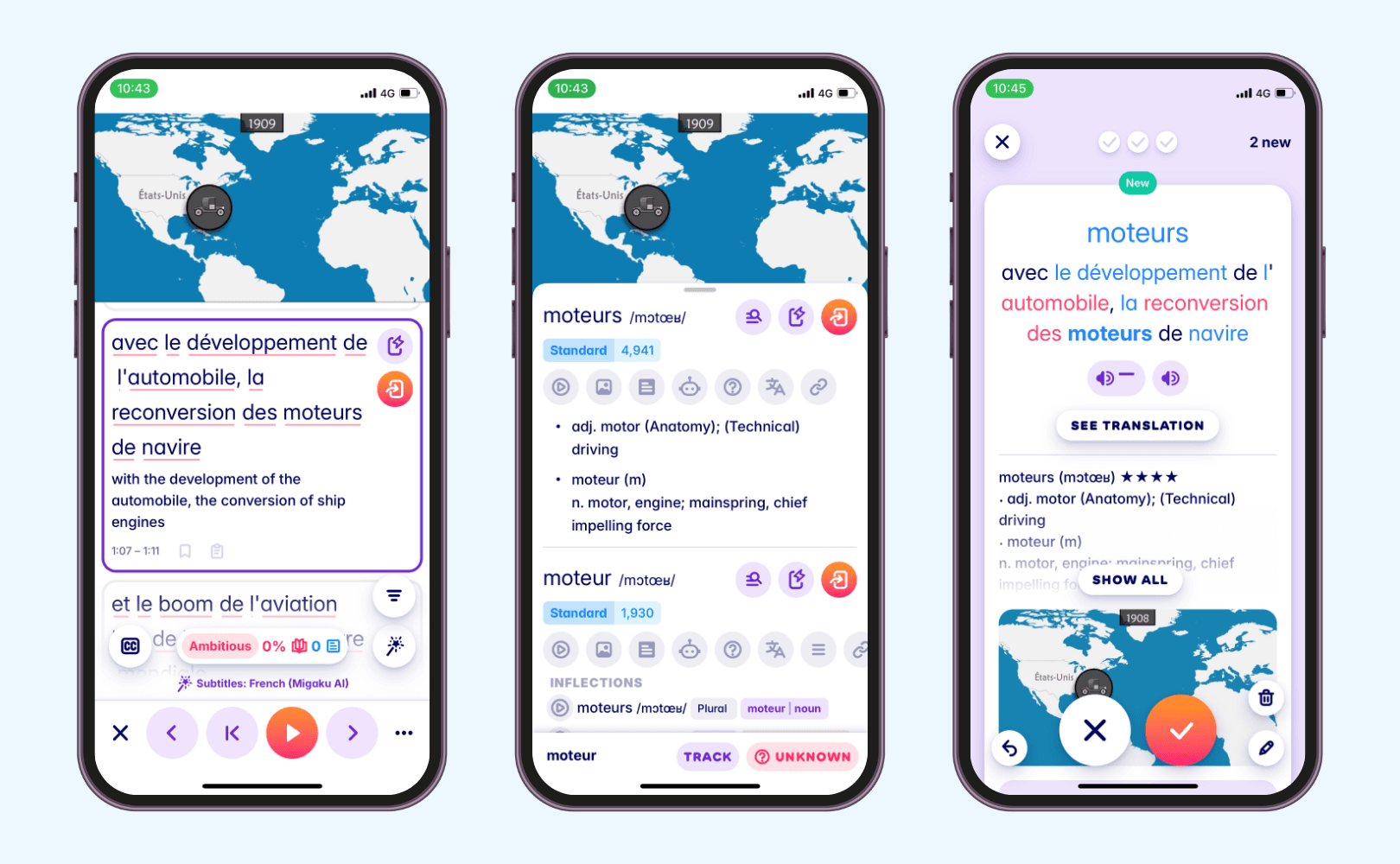
Anyway, if you want to practice reading French with real content, Migaku's browser extension and app let you look up words and see grammar patterns instantly while reading articles or watching videos. Makes learning from authentic material way more practical. There's a 10-day free trial if you want to check it out.
 ---
## FAQs
Nope. "Je vais" is present tense, meaning "I go" or "I am going." The past tense would be "je suis allé(e)" in passé composé or "j'allais" in imparfait. Interestingly, "je vais" can also form the near future tense when followed by an infinitive: "Je vais manger" (I'm going to eat). But "je vais" by itself stays firmly in the present tense.
---
## Acquiring the different past tenses in French this way...
The rules are complicated, but the method of acquisition is simple. Consistently consuming French media and passively listening to these rules applied in real content. As you start out, recall actively when you encounter the examples as well. No need to stress on perfect understanding. Just actively recall the rules for 30% of the examples you encounter.
> If you consume media in French, and you understand at least some of the messages and sentences within that media, you will make progress. _Period_.
Where there is a will, there is a way!
---
## FAQs
Nope. "Je vais" is present tense, meaning "I go" or "I am going." The past tense would be "je suis allé(e)" in passé composé or "j'allais" in imparfait. Interestingly, "je vais" can also form the near future tense when followed by an infinitive: "Je vais manger" (I'm going to eat). But "je vais" by itself stays firmly in the present tense.
---
## Acquiring the different past tenses in French this way...
The rules are complicated, but the method of acquisition is simple. Consistently consuming French media and passively listening to these rules applied in real content. As you start out, recall actively when you encounter the examples as well. No need to stress on perfect understanding. Just actively recall the rules for 30% of the examples you encounter.
> If you consume media in French, and you understand at least some of the messages and sentences within that media, you will make progress. _Period_.
Where there is a will, there is a way!