# French Time Expressions: How to Talk About Time in French
> Learn French time expressions, from basic clock time (Il est...) to daily phrases. Master telling time, using heure, and essential temporal vocabulary.
**URL:** https://migaku.com/blog/language-fun/french-time-expressions
**Last Updated:** 2026-02-13
**Tags:** fundamentals, vocabulary, phrases
---
Learning how to tell time when [studying French](https://migaku.com/learn-french) opens up way more than just asking when your train leaves. [French time expressions](https://migaku.com/blog/language-fun/break-through-language-learning-plateau) follow pretty logical patterns once you get the basics down. Sure, there are a few quirks (like the 24-hour clock being standard), but nothing that'll trip you up for long. Let's walk through everything you need to know about French time expressions, from basic clock reading to those handy phrases for yesterday, tomorrow, and everything in between.🌄
---
## Basic clock time: How to tell time in French
The foundation of telling time in French starts with one simple phrase: **"Il est" (It is)**. You'll use this for pretty much every time statement.
Here's how it works:
- Il est une heure
*It's one o'clock*
- Il est deux heures
*It's two o'clock*
- Il est trois heures
*It's three o'clock*
Notice something? "Heure" becomes "heures" (Plural) for any number except one. This is basic [French grammar](https://migaku.com/blog/language-fun/french-grammar-guide) that applies across the board.
When you want to ask what time it is, you say **"Quelle heure est-il?"** This literally translates to "What hour is it?" and you'll hear it constantly in France.
The numbers themselves are straightforward up through twelve:
| French | English |
| - | - |
| Il est quatre heures | 4:00 |
| Il est cinq heures | 5:00 |
| Il est six heures | 6:00 |
| Il est sept heures | 7:00 |
| Il est huit heures | 8:00 |
| Il est neuf heures | 9:00 |
| Il est dix heures | 10:00 |
| Il est onze heures | 11:00 |
| Il est midi | 12:00 PM (Noon) |
| Il est minuit | 12:00 AM (Midnight) |
One quick note: "Midi" and "minuit" are special cases. You don't say "douze heures" for noon or midnight in everyday conversation.
---
## Minutes and quarters: Adding precision to your time
Once you've got the hours down, adding minutes follows a pretty consistent pattern. You just tack them on after the hour.
**For minutes past the hour**, you simply add the number:
- Il est deux heures cinq (2:05)
- Il est trois heures dix (3:10)
- Il est quatre heures vingt (4:20)
But here's where French gets a bit more interesting. For **quarter hours and half hours**, there are special expressions that native speakers use all the time:
- Il est deux heures et quart (2:15) - Literally "two hours and quarter"
- Il est deux heures et demie (2:30) - Literally "two hours and half"
- Il est trois heures moins le quart (2:45) - Literally "three hours minus the quarter"
That last one trips people up. When you're **within 15 minutes of the next hour**, French speakers typically use "moins" (Minus) and reference the upcoming hour. So 2:45 becomes "three hours minus the quarter."
This pattern continues for other minutes too:
- Il est trois heures moins vingt (2:40) - Three hours minus twenty
- Il est trois heures moins dix (2:50) - Three hours minus ten
- Il est trois heures moins cinq (2:55) - Three hours minus five
Now, if someone asks you how to say 7:45 PM in French, you have options.
1. In casual conversation, you'd say "Il est huit heures moins le quart" (Eight hours minus the quarter).
2. But here's the thing: French people commonly use the 24-hour clock, especially for schedules, appointments, and anything official. So 7:45 PM becomes "Il est dix-neuf heures quarante-cinq" (19:45). The 24-hour format is super practical because it eliminates any AM/PM confusion.
---
## Periods of time: Morning, afternoon, and evening
Knowing the exact time is useful, but you'll also need to talk about general periods of the day. French breaks the day into several chunks:
- le matin (Morning)
- l'après-midi (Afternoon)
- le soir (Evening)
- la nuit (Night)
These combine with times to give more context:
- Il est six heures du matin (6:00 AM)
- Il est deux heures de l'après-midi (2:00 PM)
- Il est huit heures du soir (8:00 PM)
You can also use these periods without specific times:
- Je travaille le matin
*I work in the morning*
- On se voit cet après-midi
*We'll see each other this afternoon*
- Il arrive demain soir
*He's arriving tomorrow evening*
The preposition changes depending on whether you're talking about a habitual action (le matin) or a specific instance (ce matin, hier matin). This is part of [French vocabulary](https://migaku.com/blog/language-fun/french-alphabet-pronunciation-guide) that becomes natural with practice.
---
## Points in the week: Talking about the days during the week
For the week:
- lundi (Monday)
- mardi (Tuesday)
- mercredi (Wednesday)
- jeudi (Thursday)
- vendredi (Friday)
- samedi (Saturday)
- dimanche (Sunday)
When you want to say something happens "on Monday," you use "lundi" without a preposition: "Je pars lundi" (I'm leaving Monday). For recurring events, add the article: "Je travaille le lundi" (I work on Mondays).
---
## Relative time: Learn French yesterday, tomorrow, and beyond
This is where French time expressions get really practical for everyday conversation. You'll use these constantly:
- hier (Yesterday)
- avant-hier (The day before yesterday)
- aujourd'hui (Today)
- demain (Tomorrow)
- après-demain (The day after tomorrow)
You can combine these with periods of the day:
- hier matin (Yesterday morning)
- hier soir (Yesterday evening)
- demain après-midi (Tomorrow afternoon)
- demain soir (Tomorrow evening)
For talking about the past and future more generally:
- la semaine dernière (Last week)
- la semaine prochaine (Next week)
- le mois dernier (Last month)
- le mois prochain (Next month)
- l'année dernière (Last year)
- l'année prochaine (Next year)
These relative time expressions are super useful when making plans or recounting events. You'll hear them in pretty much every conversation about scheduling.
---
## Prepositions for time: À, en, dans, and more
Getting your prepositions right makes a huge difference in sounding natural. Here's how they work with time:
**"À"** indicates a specific time:
- à trois heures (At three o'clock)
- à midi (At noon)
- à minuit (At midnight)
**"En"** indicates duration or a period within which something happens:
- en dix minutes (In ten minutes, as a duration)
- en été (In summer)
- en 2026 (In 2026)
**"Dans"** indicates when something will happen in the future:
- dans dix minutes (In ten minutes, from now)
- dans une heure (In an hour)
- dans deux jours (In two days)
The difference between "en" and "dans" confuses a lot of learners. "En dix minutes" means something takes ten minutes to complete. "Dans dix minutes" means something will happen ten minutes from now.
**"Pendant"** means "during" or "for" a duration:
- pendant une heure (For an hour)
- pendant la journée (During the day)
These prepositions are fundamental to French grammar and you'll use them constantly when discussing time.
---
## Common time phrases and vocabulary
Let's cover some practical expressions you'll actually use in conversation:
| French | English |
| - | - |
| Quelle heure est-il? | What time is it? |
| Il est quelle heure? | What time is it? (More casual) |
| À quelle heure...? | At what time...? |
| Vous avez l'heure? | Do you have the time? |
| Il est tôt | It's early |
| Il est tard | It's late |
| à l'heure | On time |
| en avance | Early, ahead of time |
| en retard | Late |
For talking about how long you've been doing something, you use "depuis":
- J'étudie le français depuis deux ans
*I've been studying French for two years*
- J'habite ici depuis 2024
*I've been living here since 2024*
This construction is different from English because French uses the present tense where English uses present perfect. You're literally saying "I study French since two years."
---
## Learning French time expressions effectively
The key is getting enough exposure and practice. Reading French time expressions in context helps way more than memorizing lists. When you see "Il est huit heures du matin" in a story or article, your brain connects it to the situation, which makes it stick.
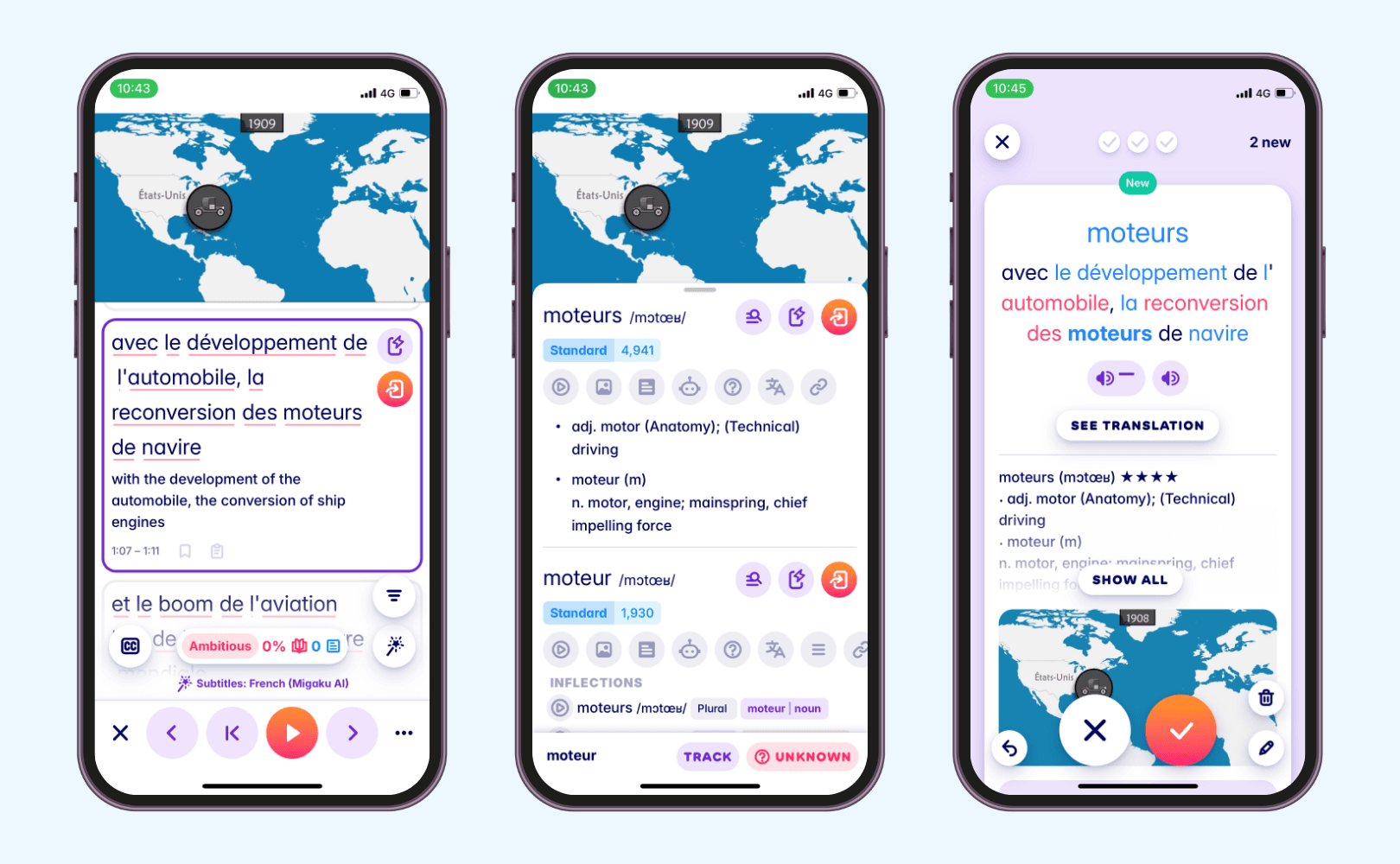
Anyway, if you want to practice these time expressions with real French content, Migaku's browser extension and app let you look up words and phrases instantly while watching French shows or reading French articles. You can build your vocabulary naturally by learning from context instead of just memorizing lists. There's a 10-day free trial if you want to check it out.
 ---
## Should you keep drilling time words and phrases for weeks?
Whether you're just starting or you've been at it for a while, time expressions are something you'll use from day one, but not be able to master without long-term exposure. The stuff we covered here should give you a solid foundation for handling most time-related conversations. Memorize the list to 70%, and then move on to other grammar and vocab. Let media consumption handle the rest.
> If you consume media in French, and you understand at least some of the messages and sentences within that media, you will make progress. _Period_.
There is more than one way to make the memory stick!
---
## Should you keep drilling time words and phrases for weeks?
Whether you're just starting or you've been at it for a while, time expressions are something you'll use from day one, but not be able to master without long-term exposure. The stuff we covered here should give you a solid foundation for handling most time-related conversations. Memorize the list to 70%, and then move on to other grammar and vocab. Let media consumption handle the rest.
> If you consume media in French, and you understand at least some of the messages and sentences within that media, you will make progress. _Period_.
There is more than one way to make the memory stick!