German Future Tense: How to Form and Use Future Tense in German Grammar
Last updated: April 6, 2026
Learning German verb tenses can feel like a maze, but here's some good news: the German future tense is actually one of the easier tenses to master. You've got two main options for talking about future events, and honestly, Germans often skip the formal future tense altogether and just use present tense with time markers. Pretty cool! In this guide, I'll walk you through exactly how to form and use the future tense in German, when you actually need it, and some tricks to make it stick in your brain.
- Does German have future tense
- How to form the German future tense (Futur I)
- German future tense sentence structure
- When to use the future tense
- Das Futur II (future perfect tense) in German grammar
- How German tenses work together
- Common mistakes to avoid
- Practice tips for mastering the future tense in German
Does German have future tense
Yes, German definitely has future tenses. Actually, it has two: Futur I (simple future) and Futur II (future perfect). But here's the thing that confuses a lot of learners: Germans don't always use them the way English speakers use future tenses.
In everyday conversation, you'll hear Germans use the present tense to talk about future events way more often than the formal future tense. They'll just add a time marker like "morgen" (tomorrow) or "nächste Woche" (next week), and boom, everyone understands they're talking about the future.
For example:
- Ich gehe morgen ins Kino.
I'm going to the cinema tomorrow. - Wir fahren nächsten Monat nach Berlin.
We're driving to Berlin next month.
The future tense does exist though, and it serves specific purposes beyond just talking about what's coming next. Germans often use Futur I to express assumptions, predictions, or to add emphasis. So yeah, German has future tenses, but they work a bit differently than you might expect.
How to form the German future tense (Futur I)
The basic German future tense, called Futur I, follows a pretty straightforward formula. You need two components: the auxiliary verb "werden" (to become) and the infinitive form of your main verb.
💡Here's the pattern: Subject + conjugated form of "werden" + infinitive of main verb (at the end of the sentence)
First, let's look at how to conjugate "werden" in the present tense:
- ich werde (I will)
- du wirst (you will, informal singular)
- er/sie/es wird (he/she/it will)
- wir werden (we will)
- ihr werdet (you will, informal plural)
- sie/Sie werden (they/you will, formal)
Once you've got the conjugation of "werden" down, forming future tense sentences becomes pretty mechanical. You conjugate "werden" to match your subject, then stick your main verb in its infinitive form at the end of the sentence.
Let me show you some examples:
- Ich werde morgen arbeiten.
I will work tomorrow. - Du wirst das Buch lesen.
You will read the book. - Sie wird nach Deutschland reisen.
She will travel to Germany. - Wir werden Deutsch lernen.
We will learn German.
The infinitive always goes to the end of the sentence. This word order is super important in German and trips up a lot of beginners who want to keep the verb close to the subject like in English.
German future tense sentence structure
Word order in German can get tricky, especially when you're dealing with different tenses. For the future tense, the basic structure stays consistent, but there are some variations depending on your sentence type.
💡In a standard declarative sentence (just stating a fact), the conjugated form of "werden" takes the second position, and the infinitive of your main verb goes to the end of the sentence.
Germans call this the "verb bracket" or "Verbklammer," and it's a fundamental pattern you'll see across multiple tenses.
Here's a simple sentence:
- Ich werde ein Auto kaufen.
I will buy a car.
Position 1: Subject (Ich)
Position 2: Conjugated werden (werde)
Final position: Infinitive (kaufen)
💡But what if you want to start with a time expression? German has this rule where the verb always stays in second position, even if something else comes first:
- Morgen werde ich ein Auto kaufen.
Tomorrow I will buy a car.
Position 1: Time expression (Morgen)
Position 2: Conjugated werden (werde)
Position 3: Subject (ich)
Final position: Infinitive (kaufen)
Notice how the subject and verb flip when you start with a time marker? That's the V2 rule (verb-second rule) in action.
💡For questions, "werden" moves to the first position:
- Wirst du morgen kommen?
Will you come tomorrow?
💡In subordinate clauses, things change again. The conjugated verb gets kicked to the end:
- Ich weiß, dass du morgen kommen wirst.
I know that you will come tomorrow.
Getting comfortable with these word order patterns takes practice, but once you nail them down, forming future tense sentences becomes automatic.
When to use the future tense
Here's where it gets interesting. Despite having a perfectly good future tense, Germans often skip it. Most of the time, they use the present tense with context or time markers to talk about future events.
So when do you actually need to use Futur I?
For predictions and assumptions
Germans love using the future tense when they're making guesses or predictions about something:
- Er wird wohl zu Hause sein.
He's probably at home. - Das wird schon klappen.
That will work out.
Notice how these express uncertainty or assumption? That's a prime use case for the future tense in German.
For promises and intentions
When you want to emphasize commitment or determination:
- Ich werde dir helfen.
I will help you. - Wir werden das schaffen.
We will manage that.
Using the future tense here adds weight and seriousness to your statement.
For emphasis
Sometimes you just want to stress that something is definitely going to happen:
- Ich werde das machen!
I WILL do that!
The future tense adds that extra punch.
In formal writing
Academic papers, official documents, and formal speeches tend to use the proper future tense more consistently than casual conversation. If you're writing a formal email or essay in German, lean toward using Futur I.
But honestly? In everyday chat, you can use the present tense for most future situations. "Ich gehe morgen ins Kino" works just as well as "Ich werde morgen ins Kino gehen," and it's actually more natural in casual contexts.
Das Futur II (future perfect tense) in German grammar
Alright, so Futur I covers basic future actions. But German also has Futur II, which is the future perfect tense. This one gets used way less frequently, but it's good to know.
Futur II describes actions that will be completed by a certain point in the future. Think of it as "will have done" in English.
💡The formula is: Subject + conjugated "werden" + past participle + "haben" or "sein" (in infinitive form)
Examples:
- Ich werde das Buch gelesen haben.
I will have read the book. - Sie wird angekommen sein.
She will have arrived.
Notice how you need to know whether your verb uses "haben" or "sein" as its auxiliary? Same rules apply as with the perfect tense. Verbs of movement and state changes typically use "sein," while most others use "haben."
Germans also use Futur II for assumptions about the past, which is kind of wild:
- Er wird wohl eingeschlafen sein.
He probably fell asleep.
You're not actually talking about the future here. You're making an assumption about something that already happened. This usage is pretty common in spoken German.
Honestly though, you won't encounter Futur II nearly as much as Futur I. It shows up in formal writing and when people want to sound precise about timing, but in everyday conversation, Germans usually find simpler ways to express these ideas.
How German tenses work together
Understanding the future tense makes way more sense when you see how it fits into the bigger picture of German tenses. German actually has fewer tenses than English, which is good news.
The main tenses you'll use are:
- Präsens (present tense)
- Präteritum (simple past, mostly in writing)
- Perfekt (present perfect, the main spoken past tense)
- Plusquamperfekt (past perfect)
- Futur I (future)
- Futur II (future perfect)
That's six tenses total. Some people count differently and say there are 12 tenses in German if you include all the subjunctive forms (Konjunktiv I and II in various time frames), but for practical everyday use, you're really working with these six main ones.
The present tense
The present tense does double duty in German. You can use the present tense to talk about:
- Current actions: "Ich lerne Deutsch" (I'm learning German)
- Habitual actions: "Ich lerne jeden Tag" (I learn every day)
- Future actions: "Ich lerne morgen" (I'm learning tomorrow)
The perfect tense
The perfect tense is your go-to for past events in conversation:
"Ich habe Deutsch gelernt" (I learned German / I have learned German)
The future tense sentences
And the future tense, as we've covered, often expresses assumptions or emphasis rather than just future time.
Getting comfortable switching between tenses comes with practice and exposure. The more you read and listen to real German content, the more you'll develop an intuition for which tense fits which situation.
Common mistakes to avoid
After working with German learners for years, I've noticed some patterns in the mistakes people make with the future tense. Let me save you some headaches.
- Forgetting to send the infinitive to the end English speakers especially struggle with this because we keep our verbs together. Don't write: "Ich werde gehen morgen" ❌ Write: "Ich werde morgen gehen" ✓
- Using the wrong form of werden "Werden" is irregular, so you can't just add regular endings. Make sure you memorize the conjugation properly. "Ich werdet" doesn't exist. It's "ich werde."
- Overusing the future tense If you're using Futur I for every single future event, you'll sound weirdly formal or robotic. Germans use the present tense with time markers constantly. Mix it up based on context.
- Confusing werden with würden "Würden" is the conditional form (would), not the future tense. "Ich würde gehen" means "I would go," while "Ich werde gehen" means "I will go." Totally different meanings.
- Messing up word order in subordinate clauses Remember that in subordinate clauses, all verbs get kicked to the end. "Ich denke, dass ich morgen gehen werde" (I think that I will go tomorrow) Not: "Ich denke, dass ich werde morgen gehen" ❌
Practice tips for mastering the future tense in German
Knowing the rules is one thing. Actually using the future tense naturally is another. Here are some strategies that actually work.
- Start with werden conjugation Seriously, drill the conjugation of "werden" until it's automatic. Make flashcards, write it out, say it out loud. Once you can conjugate "werden" without thinking, forming future tense sentences becomes way easier.
- Create example sentences about your own life Don't just memorize textbook examples. Write sentences about what you'll actually do tomorrow, next week, next year. "Ich werde morgen Kaffee trinken" means more to you than some random sentence about strangers.
- Pay attention to when natives use it Watch German shows, YouTube videos, or listen to podcasts. Notice when speakers choose the future tense versus the present tense for future events. You'll start picking up on the nuances of when each feels more natural.
- Practice the word order separately The verb-at-the-end thing feels weird at first. Do some exercises where you just focus on putting words in the right order, without worrying about anything else. It'll become second nature eventually.
- Use it in real conversations If you've got language exchange partners or tutors, consciously practice using the future tense when making plans or predictions. Real-time feedback beats solo study every time.
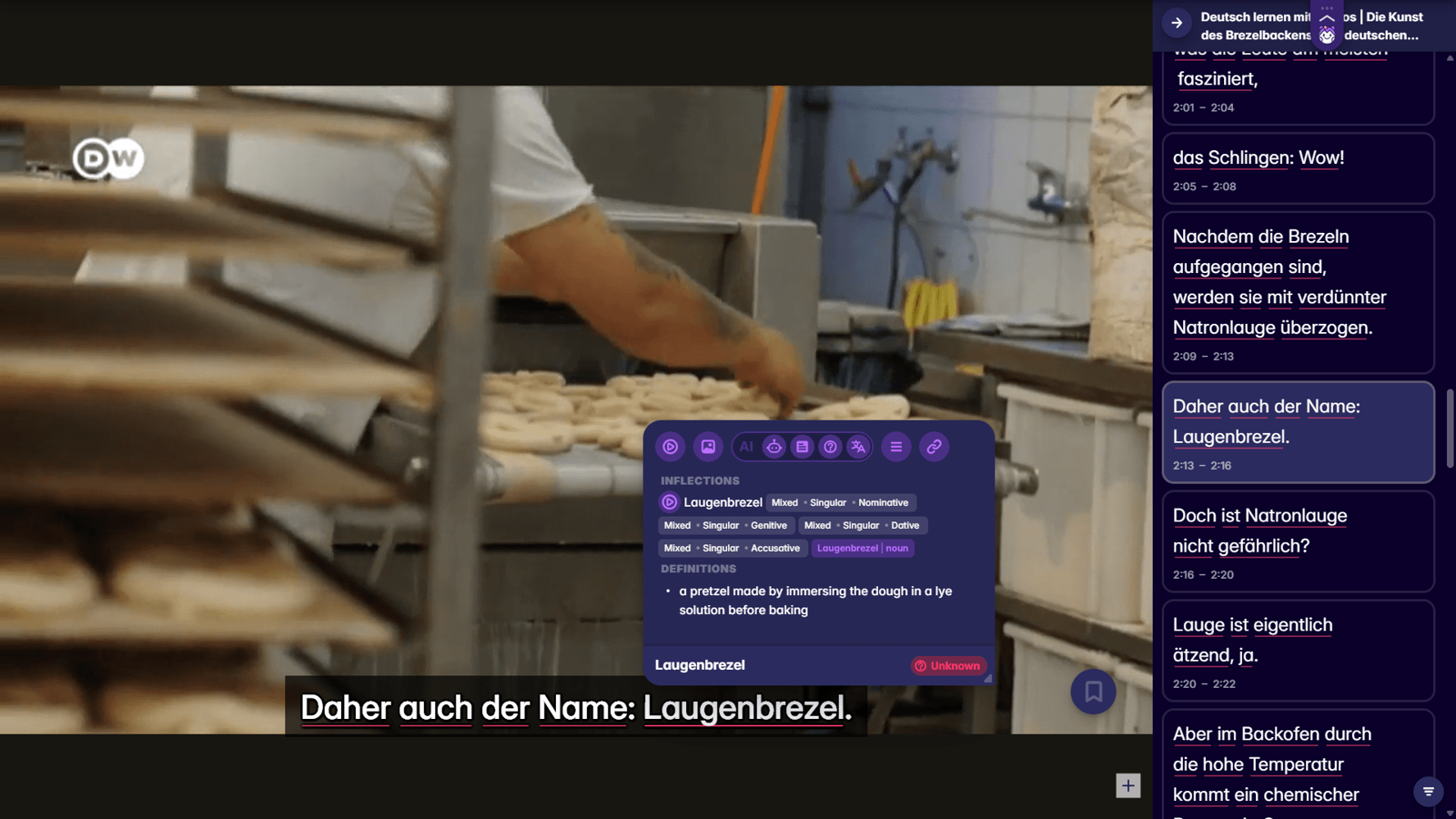
If you're serious about learning German through immersion, Migaku's browser extension and app let you look up words and save sentences instantly while watching German shows or reading articles. Makes the whole process way smoother. There's a 10-day free trial if you want to check it out.
Your knowledge about how to express future actions in German transfers
Once you understand how the future tense works, you've also learned patterns that apply across other German verb constructions. The word order rules, the verb bracket system, the way subordinate clauses work – all of this knowledge transfers. The best way to really nail down the future tense? Immerse yourself in actual German content. Read articles, watch shows, listen to podcasts. You'll see these patterns in context, which beats memorizing rules any day.
If you consume media in German, and you understand at least some of the messages and sentences within that media, you will make progress. Period.
Knowledge grows step by step.💪