# Italian Family Vocabulary: Complete Guide to Family Member Terms
> Talk about family members with your Italian friends this way. Learn Italian family vocabulary from immediate family to in-laws.
**URL:** https://migaku.com/blog/language-fun/italian-family-vocabulary
**Last Updated:** 2026-02-14
**Tags:** vocabulary, phrases
---
Whether you're chatting with locals about your relatives, describing family photos, or just trying to explain why you can't make dinner plans because your sister is visiting, knowing the right family words makes everything easier. Italian family vocabulary comes with some quirks though, especially around gender and plural forms. This [Italian-learning](https://migaku.com/learn-italian) guide breaks down everything you need to know about family member terms in Italian, from immediate family to those tricky in-law relationships.👪
---
## Understanding famiglia: The Italian family structure
The word **famiglia** means family in Italian, and you'll use it constantly when discussing your relatives. When you want to say "the family" specifically, you'd say la famiglia.
Italian families have traditionally been pretty tight-knit, with multiple generations often living close together or even in the same building. This cultural context matters because Italians tend to talk about their families a lot, which means you'll get plenty of practice with these words once you start having real conversations.
One thing that trips up English speakers is that Italian nouns have gender. Every family member term is either masculine or feminine, and this affects the articles and adjectives you use with them. The plural forms also change based on gender, which we'll get into as we go through each category.
---
## Immediate family members in Italian
Let's start with your core family. These are the people you'll reference most often.
Your parents are **i genitori** (Plural). Individually, your father is **padre** or the more casual **papà**, while your mother is **madre** or **mamma**. Most Italians use the informal versions in everyday conversation, just like how English speakers say "mom" and "dad" more often than "mother" and "father."
For siblings, here's where Italian gets interesting. A brother is **fratello**, and a sister is **sorella**. But when you talk about brothers and sisters together as "siblings," Italian uses the masculine plural fratelli. This happens a lot in Italian, where mixed-gender groups default to masculine plural forms.
If someone asks "Do you have any brothers or sisters?" in Italian, they'd say "Hai fratelli?" The masculine plural fratelli can mean brothers specifically, or siblings in general. Context usually makes it clear which meaning applies.
Your children are **i figli** (Another masculine plural that covers both genders). A son is **figlio**, and a daughter is **figlia**. Same pattern as siblings, the masculine plural covers everyone.
Here's a quick example sentence: "La mia famiglia è piccola. Ho una sorella e i miei genitori vivono a Roma." (My family is small. I have a sister and my parents live in Rome.)
---
## Extended family: Grandparents, aunts, uncles, and cousins
Moving beyond your immediate household, let's talk about extended family members.
Grandparents are **i nonni** (Masculine plural). Your grandfather is **nonno**, and your grandmother is **nonna**. These terms also double as affectionate names that grandchildren call their grandparents directly, similar to "Grandma" and "Grandpa" in English.
The next generation down from you includes nipoti, which is honestly one of the more confusing Italian family words. **Nipote** (Singular) can mean nephew, niece, grandson, or granddaughter depending on context. The plural nipoti covers all of them. You usually need to specify with additional context or use the full terms: nipote maschio (Grandson or nephew, male) or nipote femmina (Granddaughter or niece, female).
So if someone asks about your nipoti, they could be asking about your grandchildren or your nieces and nephews. The relationship becomes clear from the conversation context.
Aunts and uncles follow a more straightforward pattern. Your aunt is **zia**, uncle is **zio**, and together they're gli zii (Masculine plural).
Cousins are another nipoti situation... just kidding! Cousins are cugini (Masculine plural), with cugino for a male cousin and cugina for a female cousin. Much simpler.
---
## In-laws and spouses in Italian families
When you get married, you acquire a whole new set of family vocabulary.
Your spouse is fairly straightforward: **marito** means husband, and **moglie** means wife. Together, married couples are gli sposi.
In-law terms in Italian add **"-acquisito/a"** or use specific terms. Your mother-in-law is **suocera**, and your father-in-law is **suocero**. Together they're i suoceri. These are the parents of your spouse.
For your spouse's siblings, brother-in-law is **cognato** and sister-in-law is **cognata**. The plural cognati covers all your in-law siblings regardless of gender.
Your son-in-law is **genero**, and your daughter-in-law is **nuora**.
Do you know how to say "stepchildren" in Italian? This is where it gets a bit tricky because traditional Italian vocabulary didn't have as many specific terms for blended families. The modern term is **figliastro** for stepson and **figliastra** for stepdaughter.
Stepfather is **patrigno** and stepmother is **matrigna**. These words exist but aren't as commonly used in everyday conversation as their English equivalents, partly because blended families are a more recent common phenomenon in Italian culture.
For half-siblings, you'd say **fratellastro** (Half-brother) or **sorellastra** (Half-sister).
---
## Affectionate terms and diminutives
Italian speakers love using diminutives to show affection, and family vocabulary is full of them.
> 🫶Adding "-ino" or "-ina" to the end of family words creates cute, affectionate versions.
Mamma becomes mammina (Mommy), fratello becomes fratellino (Little brother), and sorella becomes sorellina (Little sister).
You'll hear bambino (Little boy) and bambina (Little girl) used for young children, even though bambino technically just means "child."
Older family members might call younger ones tesoro (Treasure) or caro/cara (Dear). These aren't family-specific terms but you'll hear them constantly within Italian families.
The diminutive forms aren't just for talking to kids either. Adults use them to express warmth and closeness. An adult might still refer to their younger sibling as fratellino even if that brother is 40 years old.
---
## Talking about family history and relationships
Beyond just naming relatives, you'll want to discuss family history and relationships.
Useful vocabulary for this includes:
| Italian | English |
| - | - |
| Antenati | Ancestors |
| Discendenti | Descendants |
| Parente | Relative (General term) |
| Parenti | Relatives (Plural) |
| Albero genealogico | Family tree |
| Generazione | Generation |
To talk about family resemblance, you'd say "Assomiglio a mia madre" (I look like my mother) or "Mio figlio ha gli occhi di suo nonno" (My son has his grandfather's eyes).
For family relationships and dynamics:
- Vado d'accordo con mia sorella
*I get along with my sister*
- Siamo molto uniti
*We're very close*
- Ci vediamo spesso
*We see each other often*
- Abitiamo vicini
*We live near each other*
Italian culture places significant emphasis on family connections, so conversations naturally drift toward family topics. Being able to discuss not just who your relatives are, but how you relate to them, makes conversations much richer.
---
## Using possessives with family member vocabulary
Here's something that confuses learners: Italian handles possessives differently with family terms compared to other nouns.
With singular family members, you typically drop the article when using possessives. You'd say "mia madre" (My mother), not "la mia madre." Same goes for "tuo padre" (Your father), "sua sorella" (His/Her sister), and so on.
But there are exceptions. You keep the article with loro (Their): "la loro madre" means "their mother." You also keep it with diminutives and modified family terms: "la mia sorellina" (My little sister) or "il mio caro nonno" (My dear grandfather).
Plural family members always take the article: "i miei genitori" (My parents), "le tue sorelle" (Your sisters).
This rule applies to immediate family only. Extended family keeps the article: "il mio cugino" (My cousin), "la mia zia" (My aunt).
---
## Common phrases and questions about family in Italian
When Italians ask about your family, they might say "Come sta la tua famiglia?" (How is your family?). This is a standard greeting question, especially if they know you have family in another city or country.
Other [common questions include](https://migaku.com/blog/language-fun/italian-grammar-guide):
- Quanti siete in famiglia?
*How many are you in your family?*
- Hai fratelli?
*Do you have siblings?*
- I tuoi genitori dove abitano?
*Where do your parents live?*
- Sei sposato/a?
*Are you married?*
Useful phrases for responding:
- Siamo in quattro
*There are four of us*
- Ho un fratello e una sorella
*I have a brother and a sister*
- Sono figlio unico / Sono figlia unica
*I'm an only child*
- I miei nonni sono ancora vivi
*My grandparents are still alive*
When introducing family members, you'd say "Ti presento mio fratello, Marco" (Let me introduce you to my brother, Marco) or "Questa è mia moglie" (This is my wife).
---
## Resources for practicing Italian family vocabulary
If you're looking for Italian family vocabulary words in a structured format, plenty of resources exist.
1. Language learning sites offer Italian family vocabulary PDF downloads with complete word lists. These typically organize terms by category (Immediate family, extended family, in-laws) with Italian terms, English translations, and sometimes example sentences.
2. You can also find Italian family vocabulary Quizlet sets created by other learners. These flashcard decks let you practice recognition and recall. The quality varies though, some have audio [pronunciation](https://migaku.com/blog/language-fun/italian-pronouns) while others are just text.
When searching for these resources, check that they include:
- Both masculine and feminine forms
- Plural variations
- Example sentences showing proper article usage
- Notes about possessive constructions
The best practice comes from using the vocabulary in context though. Try describing your own family tree in Italian, write journal entries about family events, or practice introducing your relatives in Italian even if just to yourself.
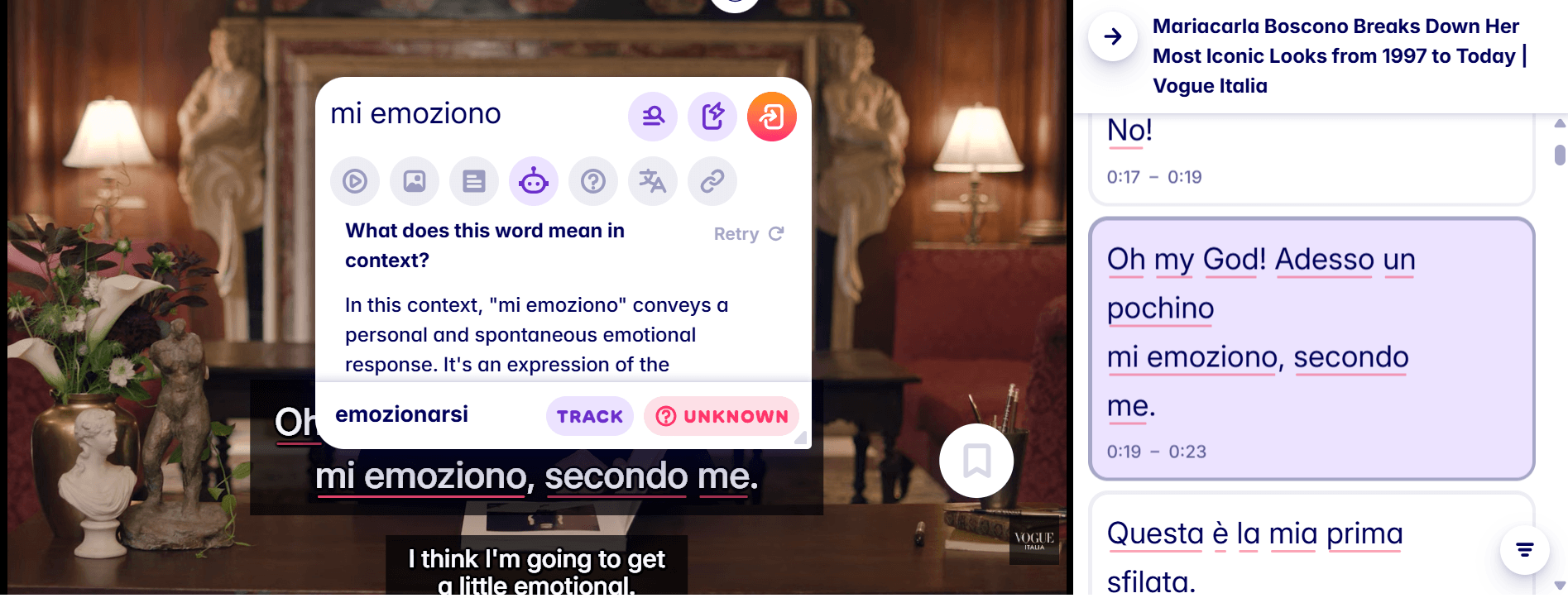
Anyway, if you want to practice this vocabulary with real Italian content, Migaku's browser extension and app let you look up words instantly while watching Italian shows or reading Italian websites. Makes learning from context way more practical. There's a 10-day free trial if you want to check it out.
 ---
## Talk about family with AI, if you're not ready for real conversations yet
You can share stories, explain your background, and make plans around family events with AI, before connecting with Italian speakers on a personal level. Media consumption boosts your training efficiency as well, and helps you acquire the new terms naturally.
> If you consume media in Italian, and you understand at least some of the messages and sentences within that media, you will make progress. _Period_.
Practice until you've made it.
---
## Talk about family with AI, if you're not ready for real conversations yet
You can share stories, explain your background, and make plans around family events with AI, before connecting with Italian speakers on a personal level. Media consumption boosts your training efficiency as well, and helps you acquire the new terms naturally.
> If you consume media in Italian, and you understand at least some of the messages and sentences within that media, you will make progress. _Period_.
Practice until you've made it.