# Italian Weather Vocabulary: Guide to Learn Italian Weather Words
> Learn essential Italian weather vocabulary, from basic terms like piove and temporale to advanced idioms. Master how to talk about the weather naturally.
**URL:** https://migaku.com/blog/language-fun/italian-weather-vocabulary
**Last Updated:** 2026-02-14
**Tags:** vocabulary, phrases
---
If you've spent any time [learning Italian](https://migaku.com/learn-italian), you've probably noticed that Italians love talking about the weather. Whether you're making small talk with a shopkeeper or trying to understand the weather forecast before heading out, knowing how to talk about the weather in Italian is super practical. Plus, Italian weather [vocabulary](https://migaku.com/blog/spanish/italian-vs-spanish) goes way beyond just "sunny" or "rainy." There are some really cool idiomatic expressions that'll make you sound way more natural. Let's get into it.🌞
---
## Basic Italian weather vocabulary you need to know
Before you can chat about whether it's going to rain tomorrow, you need the fundamental weather words. These are the building blocks that'll show up in pretty much every weather conversation.
Here are the essential nouns you'll use constantly:
| Italian | English |
| - | - |
| il sole | Sun |
| la pioggia | Rain |
| la neve | Snow |
| il vento | Wind |
| la nebbia | Fog |
| la nuvola | Cloud |
| il temporale | Thunderstorm |
| la grandine | Hail |
| il fulmine | Lightning |
| il tuono | Thunder |
| la temperatura | Temperature |
| il cielo | Sky |
These Italian words form the foundation of any weather discussion. You'll hear pioggia all the time when people talk about rain, and temporale comes up whenever there's a serious storm brewing.
For adjectives describing weather conditions, you'll want these:
| Italian | English |
| - | - |
| caldo | Hot |
| freddo | Cold |
| fresco | Cool / Fresh |
| mite | Mild |
| umido | Humid |
| secco | Dry |
| nuvoloso | Cloudy |
| sereno | Clear |
| soleggiato | Sunny |
| piovoso | Rainy |
| ventoso | Windy |
| afoso | Muggy / Sultry |
The adjective "afoso" is particularly useful during Italian summers when it gets sticky and oppressive. You'll hear it constantly in July and August.
---
## How to ask and answer about the weather in Italian
> ❔The most common way to ask about the weather is with the phrase **"Che tempo fa?"**
This literally translates to "What weather does it make?" but it means "What's the weather like?"
Another way to ask is "Com'è il tempo?" (How is the weather?) or "Che tempo fa oggi?" (What's the weather like today?). These are all interchangeable and equally common.
You can answer this question using the verb "fare" (To do/make) in a bunch of different ways:
| Italian | English |
| - | - |
| Fa bel tempo | The weather is nice |
| Fa brutto tempo | The weather is bad |
| Fa caldo | It's hot |
| Fa freddo | It's cold |
| Fa fresco | It's cool |
The verb "fare" is your go-to for general weather descriptions. It's super versatile and you'll use it constantly when discussing il tempo.
When you want to describe specific weather phenomena, you'll use different verb patterns. For rain, you use "piovere" (To rain):
- Piove (It's raining)
- Pioveva (It was raining)
- Pioverà (It will rain)
The word piove is something you'll hear constantly, especially if you're visiting Italy in autumn or spring. Same goes for snow with "nevicare":
- Nevica (It's snowing)
- Nevicava (It was snowing)
---
## Using "c'è" and "ci sono" for weather-related descriptions
Here's something that trips up a lot of learners. You can also describe weather using **"c'è"** (There is) and **"ci sono"** (There are). This construction is super common in everyday Italian weather conversations.
Examples with ci sono:
- Ci sono le nuvole
*There are clouds*
- Ci sono i tuoni
*There are thunders*
- Ci sono 20 gradi
*It's 20 degrees*
Examples with c'è:
- C'è il sole
*There's sun / It's sunny*
- C'è nebbia
*There's fog / It's foggy*
- C'è vento
*There's wind / It's windy*
- C'è un temporale
*There's a thunderstorm*
This pattern feels more natural than you might expect. Instead of saying "it's foggy," Italians often say "c'è nebbia" (There is fog). It's just how the language works, and once you get used to it, it'll feel completely normal.
---
## Weather expressions in Italian to check the weather forecast
When you want to talk about the weather forecast, the phrase is "le previsioni del tempo" or simply "le previsioni." If you're planning a trip or outdoor activity, you'll definitely want to know how to understand a weather forecast in Italian.
Common phrases you'll encounter:
- Secondo le previsioni... (According to the forecast...)
- Le previsioni dicono che... (The forecast says that...)
- Domani dovrebbe piovere (Tomorrow it should rain)
- Questa settimana farà bel tempo (This week the weather will be nice)
You might also hear weather conditions described using these expressions:
- Tempo variabile (Variable weather)
- Cielo coperto (Overcast sky)
- Schiarite (Clearings/Sunny spells)
- Precipitazioni (Precipitation)
- Rovesci (Showers)
The word "rovesci" is particularly useful because it refers to those sudden, heavy showers that come and go quickly. Very different from steady rain.
---
## Seasonal weather terms in Italian
Italian weather varies dramatically by season, and Italians definitely talk about it differently depending on the time of year.
**Spring** (primavera) weather:
- In primavera il tempo è variabile
*In spring the weather is variable*
- Piove spesso in aprile
*It rains often in April*
- Le temperature sono miti
*The temperatures are mild*
**Summer** (estate) weather:
- D'estate fa molto caldo
*In summer it's very hot*
- C'è il sole tutti i giorni
*There's sun every day*
- A volte è afoso
*Sometimes it's muggy*
- Ci sono temporali pomeridiani
*There are afternoon thunderstorms*
**Autumn** (autunno) weather:
- In autunno piove frequentemente
*In autumn it rains frequently*
- Fa fresco
*It's cool*
- C'è nebbia al mattino
*There's fog in the morning*
**Winter** (inverno) weather:
- D'inverno fa freddo
*In winter it's cold*
- Nevica in montagna
*It snows in the mountains*
- Le giornate sono corte
*The days are short*
Regional differences matter too. The weather in Milan is completely different from the weather in Sicily. Northern Italy gets way more rain and fog, while southern regions stay warmer and drier.
---
## Advanced Italian weather words and idioms
This is where things get fun. If you really want to sound like an Italian when you talk about the weather, you need to know these idiomatic expressions. They're not just vocabulary, they're cultural insights.
- "Tempo da lupi" literally means "wolf weather" but it describes really nasty, harsh weather. You'd use this when it's cold, rainy, and miserable outside. Pretty cool expression, right?
- "Piove a catinelle" translates to "it's raining buckets" or "it's pouring." The word "catinelle" refers to basins or tubs, so the image is of rain falling in huge quantities.
- "Fa un freddo cane" means "it's dog cold" or "it's freezing cold." This is super colloquial and you'll hear it all the time in winter.
- "Un fulmine a ciel sereno" (Lightning in a clear sky) describes something completely unexpected, like a bolt from the blue in English.
- "Dopo la pioggia viene il sereno" (After the rain comes clear weather) is the Italian equivalent of "every cloud has a silver lining."
- "Pioggia di primavera" (Spring rain) can refer to actual spring rain, but it's also used metaphorically for something refreshing or renewing.
When someone greets you with "Bella giornata, vero?" or "Che bella giornata, vero?" they're saying "Beautiful day, right?" This is a classic Italian conversation starter, especially when the weather actually is nice. The "vero?" at the end is asking for confirmation, kind of like "isn't it?" in English.
Before we take a rain check, why don't we throw in a few other useful Italian weather terms? Here are some expressions that don't fit neatly into other categories but come up regularly:
| Italian | English |
| - | - |
| Gocciola | It's drizzling |
| Diluvia | It's pouring |
| Tira vento | The wind is blowing |
| Gela | It's freezing |
| Scotta | It's scorching |
---
## Talk about the weather variations across Italy regions
Italy's geography creates some seriously diverse weather patterns, and Italians from different regions have their own ways of talking about local conditions.
In northern regions like Lombardy and Veneto, you'll hear a lot about "la nebbia padana" (Po Valley fog). This thick fog is famous for blanketing the northern plains, especially in autumn and winter. People from Milan will tell you all about it.
The Adriatic coast has its own weather phenomenon called "la bora," a fierce northeasterly wind that can reach crazy speeds. If you're in Trieste, you'll definitely hear about this.
Southern Italy and the islands deal with "lo scirocco," a hot wind from Africa that brings dust and high temperatures. It can make the weather feel oppressive and sticky.
The Alps obviously get discussed differently. You'll hear phrases like:
- C'è tanta neve in montagna
*There's lots of snow in the mountains*
- Le piste sono aperte
*The slopes are open*
- Rischio valanghe
*Avalanche risk*
Coastal areas have their own vocabulary too. "Mare mosso" (Rough sea) and "mare calmo" (Calm sea) are essential if you're anywhere near the water.
---
## Common mistakes learners make with Italian weather vocabulary
One thing that confuses people is when to use "fare" versus "essere" as your verb. Generally, "fare" works for most weather conditions (fa caldo, fa freddo, fa bel tempo), while "essere" gets used with adjectives describing the sky or conditions (è nuvoloso, è sereno).
Another common mistake is forgetting that weather verbs like "piovere" and "nevicare" only exist in third person. You can't conjugate them for different subjects because weather doesn't have a subject. It just rains or snows.
People also mix up "pioggia" (The noun for rain) with "piove" (The verb meaning it's raining). You'd say "c'è pioggia" or simply "piove," but not "c'è piove."
The expression "che tempo fa" sometimes gets confused with "quanto tempo fa" (How long ago). Completely different meanings, so watch out for that.
---
## Weather talks in real conversations in Italian language
Let's look at how these elements combine in actual dialogue. Imagine you're meeting an Italian friend:
- Friend: "Che tempo fa oggi?"
- You: "Fa brutto tempo. Piove e c'è vento."
- Friend: "Sì, le previsioni dicono che pioverà tutto il weekend."
- You: "Peccato! Speravo di andare al mare."
That's a totally natural exchange using multiple patterns we've covered.
Or maybe you're planning an outing:
- You: "Secondo te, domani farà bel tempo?"
- Friend: "Dovrebbe essere sereno al mattino, ma ci sono temporali nel pomeriggio."
- You: "Allora usciamo presto!"
See how the weather forecast vocabulary fits naturally into planning?
Here's a more advanced conversation:
- Friend: "Che bella giornata, vero?"
- You: "Sì, finalmente! Dopo giorni di pioggia a catinelle."
- Friend: "Eh sì, era un tempo da lupi. Ma sai come si dice, dopo la pioggia viene il sereno!"
This uses multiple idiomatic expressions and sounds way more natural than just basic vocabulary.
---
## Resources for practicing weather vocabulary lists
The best way to practice is by actually [checking Italian weather forecasts](https://migaku.com/blog/language-fun/break-through-language-learning-plateau).
1. Websites like [ilmeteo.it](https://www.ilmeteo.it/) provide daily forecasts for every Italian city, and you can read them to reinforce vocabulary.
2. Italian news programs always include weather segments. Watching these on YouTube gives you real [pronunciation](https://migaku.com/blog/language-fun/italian-pronouns) and natural usage of all the terms we've covered.
3. You can also practice by describing the weather where you live in Italian every morning. Just take 30 seconds to say out loud what the conditions are. "Oggi fa freddo e c'è vento" or "È una bella giornata, c'è il sole."
4. Language exchange partners are perfect for this because weather is such an easy, natural topic. Start your conversations with "Che tempo fa da te?" and you've got instant practice.
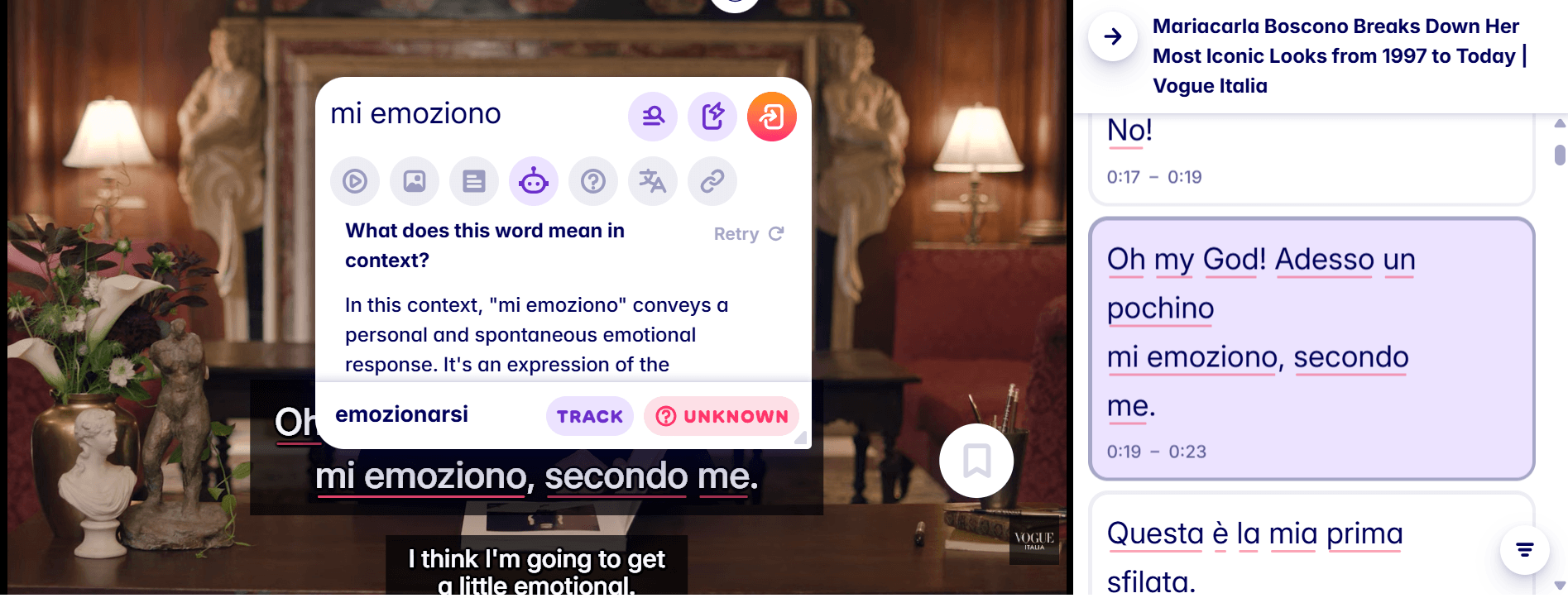
If you want to level up your Italian learning with real content, Migaku's browser extension and app let you look up words instantly while watching Italian shows or reading news articles about the weather. Makes immersion learning way more practical, and there's a 10-day free trial if you want to check it out.
 ---
## Start a conversation in Italian with basic topics you're comfortable with
It doesn't have to be about the weather. Small talks can be about your travel experience, [food](https://migaku.com/blog/language-fun/italian-food-vocabulary-essential-dining-phrases) preference, and comments on other things. General topics like these are common in reality shows and drama as well, allowing you to practice your basic vocab.
> If you consume media in Italian, and you understand at least some of the messages and sentences within that media, you will make progress. _Period_.
No matter how long the rain lasts, there will be a rainbow in the end.🌈
---
## Start a conversation in Italian with basic topics you're comfortable with
It doesn't have to be about the weather. Small talks can be about your travel experience, [food](https://migaku.com/blog/language-fun/italian-food-vocabulary-essential-dining-phrases) preference, and comments on other things. General topics like these are common in reality shows and drama as well, allowing you to practice your basic vocab.
> If you consume media in Italian, and you understand at least some of the messages and sentences within that media, you will make progress. _Period_.
No matter how long the rain lasts, there will be a rainbow in the end.🌈