10 Iconic Ads from Japanese Brands
Last updated: January 31, 2026
10 Iconic Ads from Japanese Brands That Conquered Western Markets
Japanese brands have produced some of the most memorable advertising campaigns ever to air on Western television. But here's the thing most people don't realize: these weren't Japanese ads. They were made by Western agencies, for Western audiences, adapting Japanese brand values into something that would resonate in the UK, US, and Europe.
And they absolutely crushed it.
What makes these campaigns fascinating for language learners and cultural observers is how they translate Japanese corporate philosophy into Western visual language. The patience, the craftsmanship, the restraint—all distinctly Japanese values—filtered through British and American creative minds.
~
1. Honda – The Cog (2003)
Two minutes. 606 takes. Zero CGI.
Wieden+Kennedy London created this Rube Goldberg machine using real Honda Accord parts—transmission bearings rolling into synchro hubs, windshield wipers "walking" across floors, tires rolling uphill through careful weighting. The production budget hit £1 million, with the full campaign costing £6 million.
The ad aired just 10 times on British television, debuting during ITV's coverage of the 2003 Brazilian Grand Prix on April 6th. Yet it became one of the most awarded commercials in advertising history.
Here's what makes this Japanese-at-heart: the concept of monozukuri (ものづくり)—the Japanese philosophy of making things with precision and care. Honda couldn't use that word in a British car commercial. So Wieden+Kennedy translated it visually: obsessive attention to process, patience over speed, trusting the viewer to appreciate craftsmanship.
The tagline—"Isn't it nice when things just work?"—spoken by Garrison Keillor over "Rapper's Delight" by the Sugarhill Gang. Very un-Japanese. But the underlying philosophy? Pure Japan.
~
2. Sony Bravia – Balls (2005)
Fallon London wanted to demonstrate Sony's color technology. Their solution: release 250,000 bouncy balls down the hills of San Francisco.
Director Nicolai Fuglsig, a Danish photographer obsessed with the movie "Bullitt," chose San Francisco's Filbert Street. The production team bought every bouncy ball west of the Mississippi—literally emptied the supply chain for months. Kids across America found empty machines in arcades.
The crew wore Kevlar armor, riot shields, and helmets. Some balls reached speeds of 130 mph. The final bill for broken windows: $74,000.
Set to José González's cover of "Heartbeats," the ad premiered November 6, 2005, on Sky Sports 1 before Manchester United vs. Chelsea. It never aired in America—this was made specifically for British audiences.
The campaign's tagline: "Colour Like No Other." No specifications, no comparison charts, no hard sell. Just pure visual experience communicating product quality. That restraint? Japanese. The execution? Completely Western chaos.
~
3. Sony Bravia – Paint (2006)

Sony followed Balls with something even more ambitious: 70,000 liters of environmentally friendly paint detonated across a condemned tower block in Toryglen, Glasgow.
Director Jonathan Glazer (of Sexy Beast and Under the Skin fame) orchestrated 1,700 detonators, 358 bottle bombs, and 268 mortars. The 23-story Queen's Court building—once home to Simple Minds' Jim Kerr—stood covered in rainbow explosions synchronized to Rossini's "Thieving Magpie."
250 personnel. Ten days of filming. A clown in a suit running for cover through paint rain.
The building was demolished January 21, 2007, months after filming. The commercial won Campaign of the Year and Best Commercial at the 2007 British Television Advertising Awards.
Again: Western chaos, Japanese philosophy. Sony committed to practical over digital effects because they believed in honmono (本物)—authenticity, the real thing. They just couldn't say that to British consumers. So they showed it instead.
~
4. Toyota – Start Your Impossible (2017–ongoing)
Toyota's first-ever global marketing campaign launched in October 2017 and marked something revolutionary: a car company that stopped advertising cars.
Created jointly by Saatchi & Saatchi (Los Angeles and Dallas) and Dentsu (Tokyo), the campaign supports Toyota's eight-year sponsorship of the Olympic and Paralympic Games. The first spot, "Mobility For All," featured 100 real-life stories of athletes and everyday people overcoming limitations.
Cars appear in the background. The focus stays on human stories.
Toyota's Japanese philosophy of gambaru (頑張る)—persistent effort through adversity—runs through every frame. But the execution targets global audiences with Paralympic athletes like Tatyana McFadden (17 Paralympic medals) and refugee swimmer Rami Anis.
The campaign won a Cannes Lions award in 2018. Toyota's global hybrid sales surged 30% between 2017 and 2020. Their North American market share climbed from 13.9% to 14.3%.
This is what successful cultural translation looks like: taking a Japanese concept (movement as a human right, continuous improvement) and expressing it through stories that resonate worldwide.
~
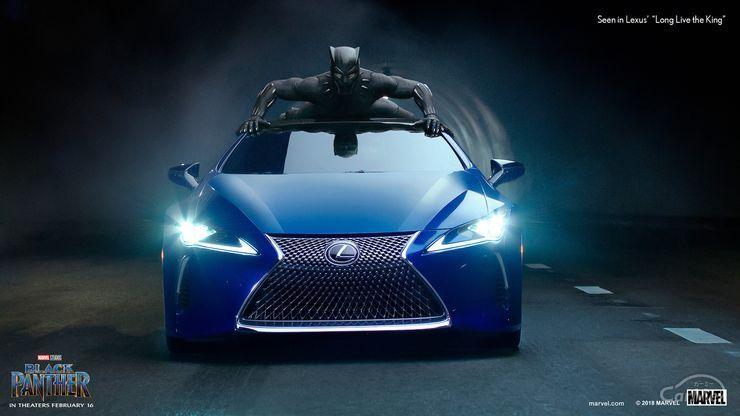
5. Lexus – Black Panther (2018)
Lexus needed to launch their redesigned LS 500 F Sport flagship sedan. Marvel Studios was about to release the most anticipated superhero film in years. Walton Isaacson, Lexus's multicultural agency, connected the dots.
The result: "Long Live the King," a Super Bowl LII spot featuring Chadwick Boseman as T'Challa recovering stolen vibranium while racing to a world leadership conference. The 30-second version aired during the third quarter of Super Bowl LII on February 4, 2018.
Director Samuel Bayer shot in Los Angeles using actual costumes from the film. Director Ryan Coogler reportedly jumped up and down on the hood of a prototype LS 500 worth over $1 million during pre-production. The car survived.
Music: "Legend Has It" by Run the Jewels.
Тhe ad generated more than 4.3 million social media views after airing, extending its impact far beyond the 30-second TV slot.
This campaign understood something about Japanese luxury that Western consumers don't consciously process: Lexus doesn't shout about features. They communicate status through association. The Lexus LC also appeared in the actual film, embedding the brand into cultural moments rather than interrupting them with specifications.
~
6. Nintendo – Wii Would Like to Play (2006)
Every other gaming company was advertising processing power and graphics. Nintendo showed grandparents playing tennis with their grandchildren.
Leo Burnett Chicago created the campaign, directed by Academy Award winner Stephen Gaghan (director of Syriana). The budget exceeded $200 million for the launch year alone—more than most Hollywood blockbusters.
The concept: two Japanese businessmen in a Smart car driving across America, knocking on doors, and introducing families to the Wii. Suburban homes, Hispanic families, farmers—everyone playing together.
Music: "Kodo (Inside the Sun Remix)" by the Yoshida Brothers, performing traditional Japanese shamisen.
The campaign won the 2008 Effie Award for New Product or Service. The Wii sold over 100 million units.
Here's the Japanese philosophy at work: wa (和), harmony and togetherness. Nintendo president Satoru Iwata said they weren't "fighting Sony"—they were expanding who gets to play. The Wii controller shaped like a TV remote deliberately mimicked something familiar to non-gamers.
The Western execution made this accessible. The Japanese philosophy made it revolutionary.
~
7. Uniqlo – Uniqlock (2007)
Before TikTok, before Instagram Reels, before viral content had a name—Uniqlo created a website with dancers moving to a clock.
Launched June 15, 2007, Uniqlock combined a functional digital clock with looping dance videos and catchy music by Fantastic Plastic Machine (Tomoyuki Tanaka). Dancers wore seasonal Uniqlo clothing—polo shirts in summer, cashmere in winter. At midnight, they slept.
This wasn't Western advertising. This was genuinely Japanese, created by Projector Inc. for global blog audiences. The idea: MUSIC×DANCE×CLOCK—communication that transcends language barriers.
By October 2007, 33,481 blog widgets had been installed across 73 countries. Uniqlock won the Grand Prix at Cannes and Best of Show at One Show Interactive 2008.
The campaign ran for six seasons until early 2017, when Adobe Flash's decline forced it offline.
This is the purest example of Japanese brand philosophy successfully exported: hypnotic, restrained, trusting the viewer to be captivated without aggressive messaging.
~
8. Nissan – Shift (2002–ongoing)
In 2002, Nissan abandoned their "Driven" tagline for something more ambitious: "Shift_"
TBWA/Chiat/Day in Playa del Rey, California created a unified global campaign with regional variations. In the US: "Shift passion," "Shift dreams." In Europe: "Shift expectations." In Japan: "Shift the future."
The underscore wasn't a typo—it signaled incompleteness, invitation, possibility.
Nissan's VP of Marketing Steve Wilhite explained: "Shift is more than a tagline. It represents both an invitation to consumers and a challenge to Nissan employees to never be satisfied with the status quo."
The campaign repositioned Nissan from reliable-but-boring to confident and forward-thinking. The advertising emphasized motion and emotion over direct competitive claims.
The Japanese concept here: kaizen (改善), continuous improvement. Nissan couldn't use that word in American advertising. So they expressed it through "Shift"—always moving, never settling.
~
9. Muji – Anti-Brand Advertising (ongoing)
Muji's advertising strategy is iconic precisely because it barely looks like advertising.
Founded in 1980, Muji (short for Mujirushi Ryohin, meaning "no brand quality goods") spends almost nothing on traditional marketing. Their success comes from word of mouth and store experience.
When Kenya Hara became art director in 2001, he created the "Horizon" campaign (2003-2009): print ads featuring vast landscapes with tiny human figures. No products. No taglines. Just emptiness.
Hara explained this as providing "an empty vessel for the audience to supply the meaning themselves." The Japanese concept: ku (空), emptiness—a space for possibility rather than absence.
This genuinely Japanese approach worked globally because minimalism had become an international aesthetic language. Muji didn't adapt for Western markets. Western consumers adapted to Muji.
Products designed by Jasper Morrison, Naoto Fukasawa, and Konstantin Grcic stayed anonymous—no designer credits, no brand logos. The philosophy: products should inspire "acceptance" ("This will do") rather than "appetite" ("This is what I want").
~
10. Panasonic – Ideas for Life (2003–2013)
In 2003, after unprecedented financial losses, Panasonic unified its global brands under one name and one slogan: "Ideas for life."
The campaign framed technology as an enabler of everyday living rather than the hero. Ads focused on families, communities, and progress. Products appeared, but they weren't the point.
This philosophy came directly from founder Konosuke Matsushita, who believed business should have a spiritual dimension and contribute to societal well-being. "Ideas for life" translated his Japanese corporate philosophy into globally accessible language.
The slogan ran for ten years until replaced by "A Better Life, A Better World" in 2013.
The campaign's consistency helped Panasonic maintain relevance across rapidly changing technology cycles—from plasma TVs to solar panels to electric vehicle batteries.
~
Why This Matters for Language Learners
These campaigns share something important: they prove that Japanese concepts can resonate globally when translated thoughtfully.
If you're learning Japanese, understanding these cultural concepts—monozukuri, honmono, wa, kaizen, ku—helps you understand why Japanese brands communicate the way they do. The patience, the restraint, the trust in the audience—these aren't marketing tactics. They're cultural values.
When you watch Japanese ads, anime, or variety shows, you'll see these same principles at work. The preference for showing over telling. The comfort with empty space. The emphasis on process alongside outcome.
Understanding Japanese advertising philosophy is understanding Japanese communication patterns. And that understanding makes everything click faster when you're actually studying the language.
~
If you're ready to actually learn Japanese through real content—commercials, shows, YouTube videos, whatever interests you—Migaku's browser extension lets you look up words instantly and build vocabulary from anything you watch. Makes the whole immersion process way more practical. There's a 10-day free trial if you want to try it out.