# Portuguese Past Tense: Preterito vs Imperfeito Explained With Conjugation Guide
> Let's talk about the past. Learn when to use pretérito perfeito vs imperfeito in Portuguese. Clear conjugation patterns with practical tips.
**URL:** https://migaku.com/blog/language-fun/portuguese-past-tense-preterito-imperfeito
**Last Updated:** 2026-02-14
**Tags:** fundamentals, vocabulary, grammar
---
If you're [learning Portuguese](https://migaku.com/learn-portuguese), you've probably hit that point where you realize there are two main past tenses that seem to do similar things. The pretérito perfeito and the pretérito imperfeito both talk about stuff that happened before now, but knowing when to use which one can feel confusing at first. Here's the thing though: once you understand the logic behind each tense, it actually makes a lot of sense. This guide will walk you through everything you need to know about these two Portuguese past tenses, with clear examples and conjugation patterns that'll help you use them correctly.🚀
---
## Understanding the two main Portuguese past tenses
Portuguese has several ways to talk about the past, but the two you'll use most often are the **pretérito perfeito** and the **pretérito imperfeito**.
- Think of the pretérito perfeito as the "completed action" tense. You use it when something happened and finished at a specific moment.
- The pretérito imperfeito, on the other hand, describes actions that were ongoing, habitual, or serve as background information.
The pretérito perfeito answers questions like "What happened?" while the pretérito imperfeito answers "What was happening?" or "What used to happen?" This distinction exists in both European and [Brazilian](https://migaku.com/blog/language-fun/brazilian-vs-european-portuguese) Portuguese, though there are some minor pronunciation differences between the variants.
### What makes pretérito perfeito special: Simple past tense
The pretérito perfeito (also called the simple past) handles completed actions that happened at definite moments in time. When you say "Eu comi pizza ontem" (I ate pizza yesterday), you're using pretérito perfeito because the action of eating pizza happened and ended yesterday.
This tense works for single events, sequences of events, and anything that has a clear beginning and end. You'll use it to tell stories about what happened, describe a series of actions, or talk about something that occurred at a specific time.
### When pretérito imperfeito comes into play: Imperfect tense
The pretérito imperfeito describes actions that were in progress, repeated regularly, or provide background context. If you say "Eu comia pizza todos os dias" (I used to eat pizza every day), you're using imperfeito because it describes a habit that happened repeatedly over time.
This tense also describes physical or emotional states in the past, sets the scene for stories, and talks about what was happening when something else occurred. Pretty much any time you'd say "used to" or "was doing" in English, you're looking at an imperfeito situation in Portuguese.
---
## How to conjugate regular verbs in pretérito perfeito
Let's get into the actual verb conjugation patterns.
> For regular verbs in pretérito perfeito, you'll follow consistent patterns based on whether the verb ends in -ar, -er, or -ir.
For -ar verbs like "falar" (To speak):
- Eu falei (I spoke)
- Tu falaste (You spoke)
- Ele/ela falou (He/she spoke)
- Nós falamos (We spoke)
- Vós falastes (You all spoke)
- Eles/elas falaram (They spoke)
For -er verbs like "comer" (To eat):
- Eu comi (I ate)
- Tu comeste (You ate)
- Ele/ela comeu (He/she ate)
- Nós comemos (We ate)
- Vós comestes (You all ate)
- Eles/elas comeram (They ate)
For -ir verbs like "partir" (To leave):
- Eu parti (I left)
- Tu partiste (You left)
- Ele/ela partiu (He/she left)
- Nós partimos (We left)
- Vós partistes (You all left)
- Eles/elas partiram (They left)
Notice how the nós form of -ar and -ir verbs looks identical to the present tense. Context usually makes it clear which tense you mean.
---
## Conjugating regular verbs in pretérito imperfeito in Portuguese grammar
The imperfeito has super regular patterns that are honestly easier to learn than the pretérito perfeito. Regular verbs follow these patterns:
For -ar verbs like "falar":
- Eu falava (I used to speak/was speaking)
- Tu falavas (You used to speak/were speaking)
- Ele/ela falava (He/she used to speak/was speaking)
- Nós falávamos (We used to speak/were speaking)
- Vós faláveis (You all used to speak/were speaking)
- Eles/elas falavam (They used to speak/were speaking)
For -er and -ir verbs like "comer" and "partir":
- Eu comia/partia
- Tu comias/partias
- Ele/ela comia/partia
- Nós comíamos/partíamos
- Vós comíeis/partíeis
- Eles/elas comiam/partiam
The imperfeito is one of the most regular tenses in Portuguese. Once you learn these patterns, you can apply them to almost any verb.
---
## Irregular verbs you need to know
Some verbs don't follow the regular patterns, and you'll use these irregular verbs constantly when speaking Portuguese.
### The verb "ser" (To be)
In pretérito perfeito:
- Eu fui, tu foste, ele/ela foi, nós fomos, vós fostes, eles/elas foram
In pretérito imperfeito:
- Eu era, tu eras, ele/ela era, nós éramos, vós éreis, eles/elas eram
### The verb "ter" (To have)
In pretérito perfeito:
- Eu tive, tu tiveste, ele/ela teve, nós tivemos, vós tivestes, eles/elas tiveram
In pretérito imperfeito:
- Eu tinha, tu tinhas, ele/ela tinha, nós tínhamos, vós tínheis, eles/elas tinham
### The verb "ir" (To go)
Here's something interesting: the pretérito perfeito of "ir" is identical to "ser." Both use fui, foste, foi, fomos, fostes, foram. You figure out which verb it is from context.
In pretérito imperfeito:
- Eu ia, tu ias, ele/ela ia, nós íamos, vós íeis, eles/elas iam
The past tense of ir in Portuguese follows these patterns consistently, making it easier to learn once you've memorized the forms.
---
## Time expressions that signal which tense to use
Certain words and phrases work as clues for which past tense you should use. Learning these helps you pick the right tense automatically.
Pretérito perfeito indicators:
- Ontem (Yesterday)
- Anteontem (The day before yesterday)
- Na semana passada (Last week)
- No ano passado (Last year)
- Em 2020 (In 2020)
- Uma vez (One time)
- De repente (Suddenly)
Pretérito imperfeito indicators:
- Sempre (Always)
- Todos os dias (Every day)
- Geralmente (Usually)
- Frequentemente (Frequently)
- Naquela época (At that time)
- Quando era criança (When I was a child)
- Enquanto (While)
These aren't absolute rules, but they're helpful guideposts when you're deciding between tenses.
---
## Using both tenses together
In real Portuguese conversations and writing, you'll often use both past tenses in the same sentence or story. The imperfeito sets the scene, and the perfeito describes what happened within that scene.
Example:
- Eu lia um livro quando o telefone tocou.
*I was reading a book when the phone rang.*
Here, "lia" is imperfeito because reading was the ongoing background action. "Tocou" is perfeito because the phone ringing was a completed action that interrupted the reading.
Another example:
- Quando eu era jovem, viajei para o Brasil.
*When I was young, I traveled to Brazil.*
"Era" describes your state of being young (Background context), while "viajei" describes the specific completed action of traveling.
This combination creates richer, more nuanced descriptions of past events. You'll see this pattern constantly in Portuguese storytelling.
---
## Common mistakes and how to avoid them
1. One mistake learners make is using pretérito perfeito for habitual actions. If something happened regularly or repeatedly, you need imperfeito. Saying "Eu comi pizza todos os dias" sounds weird because perfeito suggests a single completed action, but "todos os dias" indicates repetition.
2. Another common error is mixing up descriptions with actions. Physical descriptions, weather, time, and emotional states in the past typically use imperfeito. "Estava frio" (It was cold), "Eu tinha medo" (I was afraid), "Eram três horas" (It was three o'clock).
3. Some learners also struggle with the ongoing action concept. If you're describing what was in progress when something else happened, the ongoing action needs imperfeito. "Eu estudava quando você chegou" (I was studying when you arrived).
---
## The four types of past tense in Portuguese
While this guide focuses on the two main past tenses, Portuguese actually has four ways to express past actions. Besides pretérito perfeito and pretérito imperfeito, there's also the pretérito perfeito composto (Present perfect) and the pretérito mais-que-perfeito (Pluperfect).
- The pretérito perfeito composto uses "ter" plus the past participle: "Eu tenho estudado" (I have been studying). This describes actions that started in the past and continue to the present.
- The pretérito mais-que-perfeito describes actions that happened before other past actions: "Eu tinha comido antes de sair" (I had eaten before leaving). You'll see this less frequently in everyday conversation, especially in Brazilian Portuguese, where people often use the simple past instead.
---
## Practical tips for mastering Portuguese past tenses
The best way to internalize these tenses is through exposure and practice.
1. Read Portuguese texts and pay attention to which tense appears in different contexts. When you see a past tense verb, ask yourself why the writer chose that specific tense.
2. Listen to native speakers tell stories. Notice how they naturally switch between perfeito and imperfeito as they describe what happened and what was happening. Podcasts, YouTube videos, and Portuguese TV shows give you tons of examples.
3. Practice writing your own stories or diary entries in Portuguese. Describe your day using pretérito perfeito for the things you did, and imperfeito for how you felt or what was happening around you. This active practice helps the patterns stick.
4. Try translating simple English stories into Portuguese. When you see "I was walking," you'll practice using imperfeito. When you see "I walked," you'll use perfeito. This translation exercise reinforces the distinctions between the tenses.
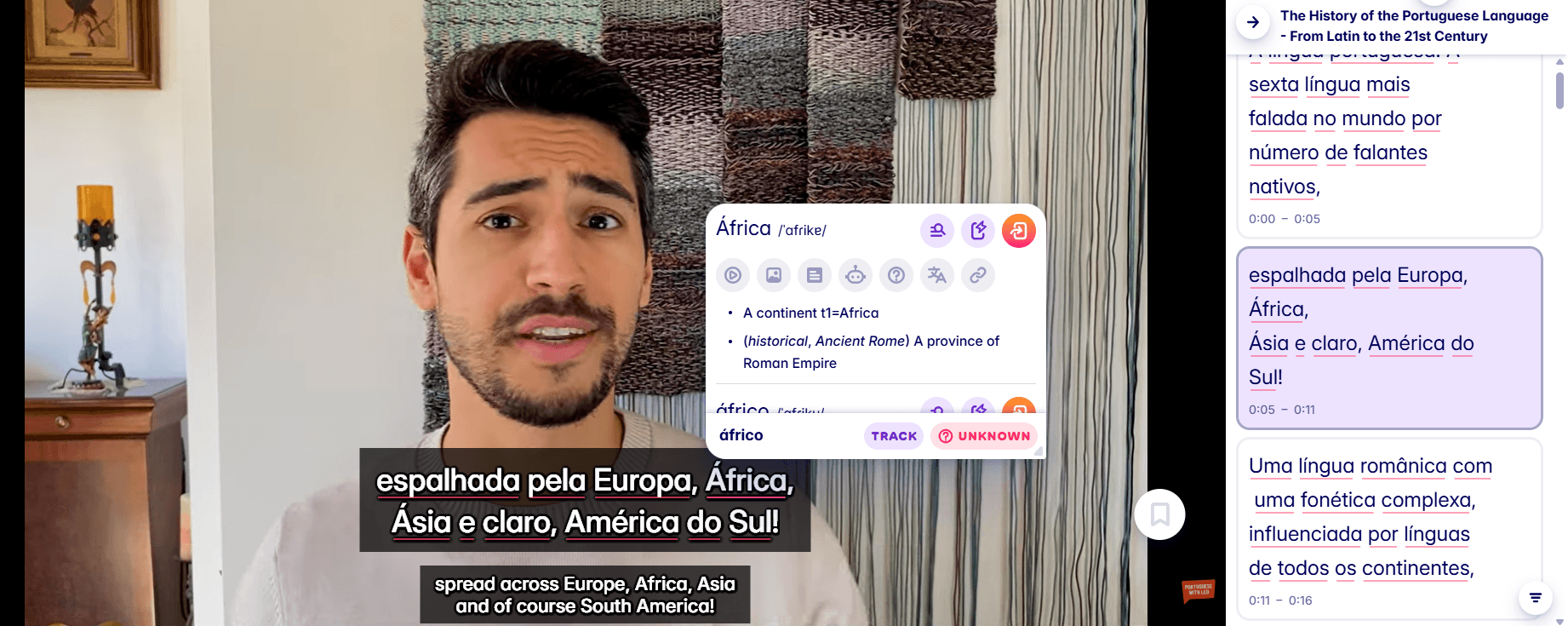
If you want to actually practice these tenses with real Portuguese content, Migaku's browser extension and app let you look up verb forms instantly while reading articles or watching videos. You can see these past tenses in context and build your understanding naturally. There's a 10-day free trial if you want to check it out.
 ---
## The chance to talk about what happened in the past...
Understanding past tenses opens up so much of the language. You can tell stories about your experiences, ask people about their histories, read Portuguese literature, and follow along when native speakers share anecdotes. Both European and Brazilian Portuguese use these same fundamental tense distinctions, so learning them helps you communicate across different Portuguese-speaking regions.
> If you consume media in Portuguese, and you understand at least some of the messages and sentences within that media, you will make progress. _Period_.
What happened in the past shapes the future.
---
## The chance to talk about what happened in the past...
Understanding past tenses opens up so much of the language. You can tell stories about your experiences, ask people about their histories, read Portuguese literature, and follow along when native speakers share anecdotes. Both European and Brazilian Portuguese use these same fundamental tense distinctions, so learning them helps you communicate across different Portuguese-speaking regions.
> If you consume media in Portuguese, and you understand at least some of the messages and sentences within that media, you will make progress. _Period_.
What happened in the past shapes the future.