# Portuguese Question Words: How to Ask Questions Naturally
> Curious about how to form natural Portuguese questions? Learn Portuguese question words (quem, que, quando, onde) with examples and common mistakes.
**URL:** https://migaku.com/blog/language-fun/portuguese-question-words
**Last Updated:** 2026-02-06
**Tags:** fundamentals, vocabulary, phrases, grammar
---
You can't really have a back-and-forth without knowing how to ask where something is, who someone's talking about, or why they're doing something. That tells the importance of knowing question words when [learning Portuguese](https://migaku.com/learn-portuguese).🤔 Portuguese question words follow pretty logical patterns once you understand the basics. This lesson will walk you through all the essential interrogative words, how to use them in sentences, and some quirks that trip up learners.
---
## The essential Portuguese question words you need to know
Let's start with the core question words you'll use constantly. These work in both Brazilian Portuguese and European Portuguese, though we'll get into some regional differences later.
1. **Quem** means "who" and it's your go-to for asking about people. "Quem é você?" means "Who are you?" Pretty straightforward. The word stays the same whether you're asking about one person or multiple people.
2. **Que** (or o que) means "what" and you'll see this one everywhere. It's probably the most common question word in Portuguese. "Que horas são?" asks "What time is it?" You can also say "O que você quer?" for "What do you want?" The "o" before "que" is optional in many contexts, but Brazilians tend to use it more often in casual speech.
3. **Quando** means "when" and works exactly like you'd expect. "Quando você chega?" means "When do you arrive?" Simple enough.
4. **Onde** means "where" and it's essential for navigation. "Onde fica o banheiro?" translates to "Where is the bathroom?" You'll use this constantly as a beginner.
5. **Como** means "how" and also doubles as "what" in certain contexts. "Como você está?" means "How are you?" but "Como?" by itself can mean "What?" when you didn't hear something clearly, similar to saying "Huh?" in English.
6. **Por que** means "why" when [asking questions](https://migaku.com/blog/language-fun/best-portuguese-grammar-guide). Here's where Portuguese gets a bit tricky because there are four different versions of "why/because" depending on usage. "Por que você estuda português?" means "Why do you study Portuguese?"
7. **Qual** (and its plural form quais) means "which" or "what" when choosing between options. "Qual é o seu nome?" literally translates to "Which is your name?" but means "What is your name?" This is a major difference from English usage.
8. **Quanto** means "how much" or "how many" and it changes based on gender and number. You get quanto (Masculine singular), quanta (Feminine singular), quantos (Masculine plural), and quantas (Feminine plural). "Quanto custa?" means "How much does it cost?" while "Quantas pessoas vêm?" means "How many people are coming?"
---
## How to form questions in Portuguese
The basic structure for questions in Portuguese is pretty flexible.
> You can often just raise your intonation at the end of a statement to turn it into a question, especially in casual Brazilian Portuguese.
"Você fala inglês." (Statement) becomes "Você fala inglês?" (Question) just by changing your tone. Super common in everyday conversation.
> For questions with interrogative words, the typical pattern puts the question word at the beginning: **question word + verb + subject**.
"Onde você mora?" follows this pattern: where + you live. But Portuguese is flexible, so "Você mora onde?" also works and sounds natural in Brazilian Portuguese.
One thing that confuses learners is that Portuguese doesn't really use the auxiliary "do/does" construction that English relies on. You don't say the equivalent of "Do you speak Portuguese?" You just say "Você fala português?" The [verb conjugation](https://migaku.com/blog/language-fun/portuguese-verb-conjugation) and intonation carry the question meaning.
---
## The é que construction that makes everything sound more natural
> Here's something you'll hear constantly in Brazilian Portuguese: adding **"é que"** after question words.
It doesn't change the meaning, but it makes questions sound more conversational and natural.
- "Onde você mora?" becomes "Onde é que você mora?" Both mean "Where do you live?" but the second version flows better in casual speech.
- "Com quem você está aprendendo português?" means "With whom are you learning Portuguese?" Add é que and you get "Com quem é que você está aprendendo português?" Same meaning, just sounds more natural.
This construction works with pretty much any question word. "Quando é que a gente vai?" (When are we going?), "Por que é que ele não veio?" (Why didn't he come?), "Qual é que você prefere?" (Which one do you prefer?). You'll sound way more Brazilian if you use this pattern regularly.
---
## Understanding que vs. qual (this trips everyone up)
The difference between que and qual confuses the hell out of learners because it doesn't map directly to English usage. Both can translate to "what" but they're used differently.
1. **Que asks for definitions or explanations.** "Que é isso?" means "What is this?" when you want someone to explain what something is. You're asking for information about the nature or identity of something.
2. **Qual asks you to specify or choose from options.** "Qual é o seu telefone?" means "What is your phone number?" You're asking someone to specify which number is theirs from all possible numbers.
Here's a practical example: "Que dia é hoje?" (What day is today?) uses que because you're asking for the identity of the day. But "Qual é a data de hoje?" (What is today's date?) uses qual because you're specifying which date from the calendar.
The [grammar](https://migaku.com/blog/language-fun/best-portuguese-grammar-guide) rule: que typically comes before verbs or stands alone, while qual usually comes before "é" or other forms of the verb ser. But honestly, you'll internalize this better through exposure than memorizing rules.
---
## The four versions of "why" and "because" (porque, por que, porquê, por quê)
This is genuinely annoying but you need to know it for proper written Portuguese. Spoken language is more forgiving, but written Portuguese distinguishes four versions.
1. Por que (Two words, no accent) is used in questions. "Por que você está triste?" means "Why are you sad?"
2. Porque (One word, no accent) means "because" in answers. "Porque estou cansado." means "Because I'm tired."
3. Por quê (Two words, with accent) is used at the end of sentences or when the word stands alone. "Você não veio por quê?" means "You didn't come why?" or if someone asks "Você está chorando?" and you respond "Por quê?" you're saying "Why (do you ask)?"
4. Porquê (One word, with accent) is a noun meaning "the reason." "Eu não entendo o porquê." means "I don't understand the reason."
In casual spoken Brazilian Portuguese, honestly, people don't stress about these distinctions. But for writing and formal situations, getting them right matters.
---
## Direct vs. indirect questions (and why it matters)
1. Direct questions are straightforward: you're asking someone directly. "Onde você trabalha?" (Where do you work?) is a direct question.
2. Indirect questions embed the question inside a statement or another question. "Eu não sei onde você trabalha." (I don't know where you work.) The question "onde você trabalha" is now part of a larger sentence.
The word order stays pretty similar in Portuguese, which is nice. In English, indirect questions flip the structure (Where do you work? vs. I don't know where you work), but Portuguese keeps the same pattern.
One common indirect question starter is "Você sabe..." (Do you know...). "Você sabe que horas são?" means "Do you know what time it is?" The embedded question "que horas são" keeps its normal structure.
---
## Open-ended questions vs. yes/no questions
1. Open-ended questions use interrogative words and require detailed answers. "Como foi o seu dia?" (How was your day?) needs more than a yes or no response. These questions gather information and keep conversations flowing.
2. Yes/no questions in Portuguese are super simple. Just add a question mark and raise your intonation. "Você gosta de café?" (Do you like coffee?) expects a sim or não answer.
For open-ended questions, you're almost always using one of the question words we covered earlier. "Quem vai à festa?" (Who's going to the party?), "Quando começa o filme?" (When does the movie start?), "Onde compramos os ingressos?" (Where do we buy tickets?). These all require specific information in the response.
---
## Brazilian Portuguese vs. European Portuguese differences
The core question words are the same across variants, but usage differs quite a bit. Brazilian Portuguese tends to be more flexible with word order and uses "você" as the standard second-person pronoun.
European Portuguese uses "tu" more commonly in informal situations. So Brazilians say "Onde você mora?" while Portuguese people might say "Onde moras?" (Notice the different verb conjugation and no subject pronoun).
The é que construction is way more common in Brazilian Portuguese. You'll hear it constantly in Brazil but less frequently in Portugal.
European Portuguese also tends to place object pronouns differently and uses more formal structures overall. A Brazilian might say "O que você quer fazer?" while a Portuguese person might say "O que queres fazer?" or even "Que queres fazer?"
For learners, pick one variant and stick with it. Brazilian Portuguese is more widely spoken globally and generally considered easier for beginners due to clearer pronunciation and simpler pronoun usage.
---
## Common question patterns you'll use constantly
Some question formulas come up over and over in daily conversation. Learning these as chunks makes speaking faster.
| Portuguese | English |
| - | - |
| Que horas são? | What time is it? |
| Que dia é hoje? | What day is today? |
| Quanto custa? | How much does it cost? |
| Quanto tempo? | How long/How much time? |
| Como se diz... em português? | How do you say... in Portuguese? |
| Qual é o seu...? | What is your...? |
| Onde fica...? | Where is...? |
---
## Common mistakes learners make (and how to avoid them)
1. Using "fazer" (To do/Make) like English uses "do" in questions. Portuguese doesn't work this way. Don't say the equivalent of "Do you speak Portuguese?" Just say "Você fala português?"
2. Mixing up que and qual. Remember: que for definitions and explanations, qual for specifications and choices. "Que é isso?" (What is this thing?), "Qual você quer?" (Which one do you want?).
3. Forgetting that quanto changes for gender and number. You need to match it to what you're asking about. "Quanto dinheiro?" (How much money, masculine), "Quanta água?" (How much water, feminine), "Quantos livros?" (How many books, masculine plural), "Quantas pessoas?" (How many people, feminine plural).
4. Stressing about word order too much. Portuguese is flexible, especially Brazilian Portuguese. "Você vai onde?" and "Onde você vai?" both work perfectly fine.
5. Using European Portuguese structures when learning Brazilian Portuguese (or vice versa). Pick a variant and stick with it. Mixing them sounds weird to native speakers.
---
## Tips for sounding natural when asking questions
1. Don't overthink the grammar at first. Brazilians especially are super flexible with question formation. If you get the question word right and use reasonable intonation, people will understand you.
2. Use é que liberally in Brazilian Portuguese. It's a crutch that makes everything sound better. "Onde você mora?" works fine, but "Onde é que você mora?" sounds like you actually speak the language.
3. Pay attention to which prepositions go with which question words. "Com quem" (With whom), "para onde" (To where), "de onde" (From where), "por que" (For what reason/Why). These combinations are super common.
4. Don't worry too much about the four versions of porque/por que in spoken language. Focus on getting "por que" for questions and "porque" for answers right. The other two are mainly for writing.
5. Listen to how native speakers actually form questions in natural conversation. You'll notice they often drop subject pronouns, use shortened forms, and rely heavily on context. "Vai onde?" (Going where?) is totally normal even though it's missing the subject "você."
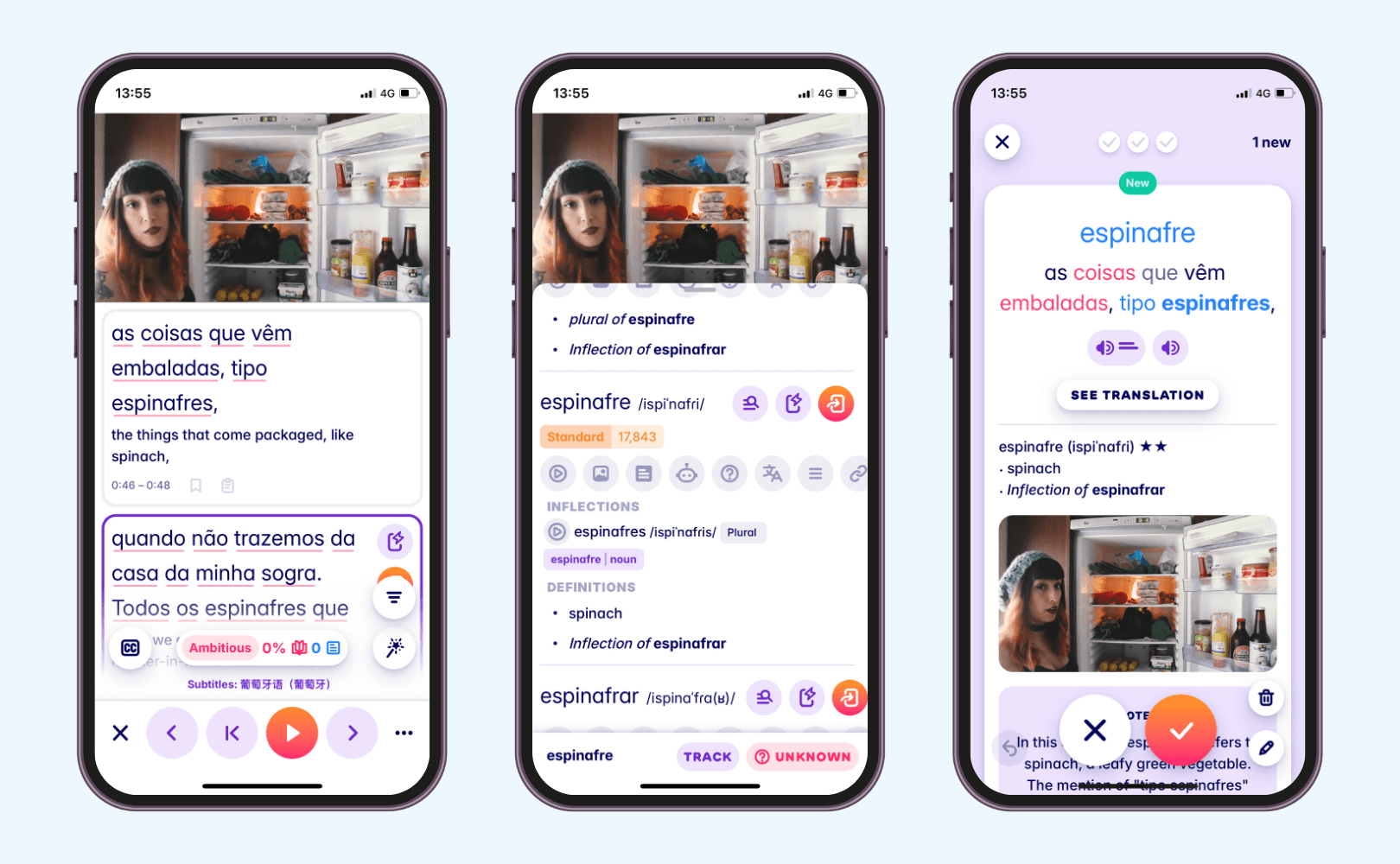
Anyway, if you want to practice these question words with real Portuguese content, Migaku's browser extension and app let you look up words instantly while watching shows or reading articles. Makes [immersion](https://migaku.com/blog/language-fun/best-portuguese-textbooks) learning way more practical. There's a 10-day free trial if you want to check it out.
 ---
## There are so many Portuguese questions to learn on the Internet...
The real key is exposure, and you will certainly not be disappointed with how many Portuguese questions you can see in one episode of any drama. You'll internalize these patterns way faster by hearing them in context than by memorizing grammar rules. Watch Brazilian shows, listen to podcasts, talk to native speakers, and pay attention to how they actually form questions in real conversations.
> If you consume media in Portuguese, and you understand at least some of the messages and sentences within that media, you will make progress. _Period_.
Relax and learn!
---
## There are so many Portuguese questions to learn on the Internet...
The real key is exposure, and you will certainly not be disappointed with how many Portuguese questions you can see in one episode of any drama. You'll internalize these patterns way faster by hearing them in context than by memorizing grammar rules. Watch Brazilian shows, listen to podcasts, talk to native speakers, and pay attention to how they actually form questions in real conversations.
> If you consume media in Portuguese, and you understand at least some of the messages and sentences within that media, you will make progress. _Period_.
Relax and learn!