Spanish Verb Conjugation Guide for Beginners (2026)
Last updated: April 13, 2026

So you're learning Spanish and just realized that verbs change depending on who's doing the action? Yeah, welcome to conjugation. It sounds way scarier than it actually is, but I get it. When I first started learning Spanish, I looked at a conjugation chart and thought, "There's no way I'm memorizing all this." Here's the thing though. Spanish verb conjugation follows patterns. This guide breaks down everything you need to know about Spanish conjugation as a beginner. We'll cover what conjugation actually means, the main verb types, essential tenses, and how to handle those annoying irregular verbs that don't follow the rules.
- What are conjugations in Spanish
- The three main Spanish verb types
- Understanding Spanish verb tenses and moods
- Essential tenses for beginners
- The subjunctive mood: When reality gets fuzzy
- The most important irregular verbs
- How to conjugate Spanish verbs: Practical steps
- Common mistakes to avoid
- Practical tips for learning Spanish verb conjugations
What are conjugations in Spanish
💡 Definition 💡
Conjugation is the process of changing a verb to match who's doing the action and when it happens . In English, we do this too, but Spanish takes it way further.
Look at the English verb "to speak." We say "I speak," "you speak," "he speaks," "we speak." Only one form changes (speaks). In Spanish, the verb hablar (to speak) changes for every single person:
- Yo hablo (I speak)
- Tú hablas (you speak, informal)
- Él/ella habla (he/she speaks)
- Nosotros hablamos (we speak)
- Vosotros habláis (you all speak, Spain)
- Ellos/ellas hablan (they speak)
Each verb form tells you who's doing the action, which is why Spanish speakers often drop the subject pronoun. You don't need to say "yo" before "hablo" because the verb ending already tells you it's "I."
The three main Spanish verb types
Spanish verbs fall into three categories based on their infinitive ending. The infinitive is the base form of the verb (like "to speak" in English).
- AR verbs end in -ar. These are the most common. Examples include hablar (to speak), caminar (to walk), estudiar (to study), and trabajar (to work). About 80% of Spanish verbs are AR verbs.
- ER verbs end in -er. Common ones include comer (to eat), beber (to drink), leer (to read), and correr (to run).
- IR verbs end in -ir. Examples are vivir (to live), escribir (to write), abrir (to open), and recibir (to receive).
Why does this matter? Because each verb type follows its own conjugation pattern. Once you learn the pattern for AR verbs, you can conjugate any regular AR verb. Same goes for ER and IR verbs.
Understanding Spanish verb tenses and moods
Spanish has way more tenses than English. The exact count depends on how you categorize them, but most grammar books list around 14 different tenses (including simple and compound forms).
The 12 tenses in Spanish
When people ask about the 12 tenses, they're usually referring to the main simple and compound tenses in the indicative and subjunctive moods. Here's the breakdown:
Indicative Mood (statements of fact):
- Present (presente)
- Preterite (pretérito)
- Imperfect (imperfecto)
- Future (futuro)
- Conditional (condicional)
- Present perfect (pretérito perfecto)
- Past perfect/pluperfect (pluscuamperfecto)
- Future perfect (futuro perfecto)
Subjunctive Mood (doubt, wishes, hypotheticals):
9. Present subjunctive (presente de subjuntivo)
10. Imperfect subjunctive (imperfecto de subjuntivo)
11. Present perfect subjunctive (pretérito perfecto de subjuntivo)
12. Past perfect subjunctive (pluscuamperfecto de subjuntivo)
Don't freak out. As a beginner, you'll focus on maybe four or five of these tenses initially.
Essential tenses for beginners
You don't need to learn all verb tenses at once. Here are the ones you should prioritize.
Present tense conjugation: Your starting point
The present tense is where everyone starts when they learn Spanish. You'll use it constantly for actions happening now, habits, and general truths.
Regular AR verbs in present tense
Let's use hablar (to speak) as our example. Remove the -ar ending to get the stem: habl. Then add these endings:
- Yo hablo
- Tú hablas
- Él/ella/usted habla
- Nosotros/nosotras hablamos
- Vosotros/vosotras habláis
- Ellos/ellas/ustedes hablan
Every regular AR verb follows this exact pattern. Take trabajar (to work): trabajo, trabajas, trabaja, trabajamos, trabajáis, trabajan. See? Same endings.
Regular ER verbs in present tense
For comer (to eat), remove the -er to get the stem com, then add:
- Yo como
- Tú comes
- Él/ella/usted come
- Nosotros/nosotras comemos
- Vosotros/vosotras coméis
- Ellos/ellas/ustedes comen
Regular IR verbs in present tense
For vivir (to live), the stem is viv:
- Yo vivo
- Tú vives
- Él/ella/usted vive
- Nosotros/nosotras vivimos
- Vosotros/vosotras vivís
- Ellos/ellas/ustedes viven
Notice that ER and IR verbs have identical endings except for nosotros and vosotros forms.
Preterite tense
The preterite describes completed actions in the past. Think of it as the simple past tense.
For hablar:
- Yo hablé
- Tú hablaste
- Él/ella/usted habló
- Nosotros/nosotras hablamos
- Vosotros/vosotras hablasteis
- Ellos/ellas/ustedes hablaron
Use it for "Ayer hablé con mi madre" (Yesterday I spoke with my mother).
Imperfect tense
The imperfect describes ongoing or habitual actions in the past. It's like saying "used to" or "was doing" in English.
For hablar:
- Yo hablaba
- Tú hablabas
- Él/ella/usted hablaba
- Nosotros/nosotras hablábamos
- Vosotros/vosotras hablabais
- Ellos/ellas/ustedes hablaban
Use it for "Cuando era niño, hablaba mucho" (When I was a child, I used to talk a lot).
The difference between preterite and imperfect trips up tons of learners. Preterite is for specific completed actions. Imperfect is for background information, ongoing actions, or repeated habits.
Future tense
Spanish has two ways to express future actions. The simple future tense and the "going to" construction (ir + a + infinitive).
The simple future for hablar:
- Yo hablaré
- Tú hablarás
- Él/ella/usted hablará
- Nosotros/nosotras hablaremos
- Vosotros/vosotras hablaréis
- Ellos/ellas/ustedes hablarán
But honestly? Most Spanish speakers use "ir + a + infinitive" in conversation: "Voy a hablar con él mañana" (I'm going to speak with him tomorrow).
The subjunctive mood: When reality gets fuzzy
The subjunctive isn't a tense. It's a mood, which is a whole different category in Spanish grammar. The indicative mood states facts. The subjunctive expresses doubt, wishes, emotions, possibilities, and commands.
English has a subjunctive too. You see it in phrases like "I wish I were rich" (not "was"). Spanish uses the subjunctive constantly.
The present subjunctive for hablar:
- Yo hable
- Tú hables
- Él/ella/usted hable
- Nosotros/nosotras hablemos
- Vosotros/vosotras habléis
- Ellos/ellas/ustedes hablen
You'll use it after certain trigger phrases:
- Espero que hables español.
I hope you speak Spanish. - Dudo que él hable inglés.
I doubt he speaks English. - Es importante que hablemos.
It's important that we speak.
The subjunctive is probably the trickiest part of Spanish verb conjugations for English speakers. You'll get it wrong a lot at first. That's totally normal.
The most important irregular verbs
Some verbs just refuse to follow the rules. These irregular verbs are super common, so you'll need to memorize them. The good news? You'll use them so often that they'll stick pretty fast.
Ser and estar: Both mean “to be”
Spanish has two verbs for "to be," and yes, you need both.
Ser describes permanent characteristics, identity, origin, and time:
- Yo soy
- Tú eres
- Él/ella/usted es
- Nosotros/nosotras somos
- Vosotros/vosotras sois
- Ellos/ellas/ustedes son
Use ser for things like "Soy estudiante" (I am a student) or "Ella es de México" (She is from Mexico).
Estar describes temporary states, locations, and conditions:
- Yo estoy
- Tú estás
- Él/ella/usted está
- Nosotros/nosotras estamos
- Vosotros/vosotras estáis
- Ellos/ellas/ustedes están
Use estar for "Estoy cansado" (I am tired) or "Estamos en casa" (We are at home).
The super 7 verbs in Spanish
Language teachers often talk about the "super 7" verbs because they're the most frequently used in Spanish. Different teachers have slightly different lists, but here's the most common version:
- Ser (to be, permanent)
- Estar (to be, temporary)
- Tener (to have)
- Ir (to go)
- Hacer (to do/make)
- Decir (to say/tell)
- Ver (to see)
These verbs appear in almost every conversation. They're all irregular, but you'll encounter them so often that learning them becomes easier through repetition.
How to conjugate Spanish verbs: Practical steps
Here's my actual process for conjugating any Spanish verb:
- Step 1: Identify the infinitive ending (ar, er, or ir).
- Step 2: Remove the ending to find the stem.
- Step 3: Determine the tense and mood you need.
- Step 4: Add the appropriate ending for that tense, mood, and subject.
- Step 5: Check if the verb is irregular. If it is, adjust accordingly.
Let's walk through an example. Say you want to say "we eat" in Spanish.
The infinitive is comer (to eat). It's an ER verb. The stem is com. You need present tense. For nosotros with ER verbs, the ending is -emos. So: comemos.
Now try "they lived" (preterite). The infinitive is vivir (to live). It's an IR verb. Stem is viv. Preterite tense, ellos form. The ending is -ieron. So: vivieron.
Common mistakes to avoid
- Mixing up ser and estar. Both mean "to be," but they're used in different situations. Ser is for permanent things. Estar is for temporary states and locations.
- Forgetting stem changes. Verbs like querer, poder, and jugar change their stems in certain forms. These aren't truly irregular, they just follow a different pattern.
- Overusing subject pronouns. In Spanish, the verb ending tells you who's doing the action. You don't always need to say yo, tú, él, etc. Native speakers often drop them.
- Confusing preterite and imperfect. This takes time to master. Preterite is for specific completed actions. Imperfect is for ongoing or habitual past actions.
- Ignoring the subjunctive. Yeah, it's hard. But you can't avoid it. Spanish speakers use the subjunctive constantly, especially in everyday expressions.
Practical tips for learning Spanish verb conjugations
Memorizing charts is inefficient. I tried that method and forgot everything within a week. Here's what actually works:
- Focus on high-frequency verbs first. Learn the super 7 verbs plus common regulars like hablar, comer, and vivir. These will cover most of your conversations.
- Learn in context, not isolation. Create full sentences instead of just conjugating verbs. "Yo hablo español" sticks better than "hablo, hablas, habla..."
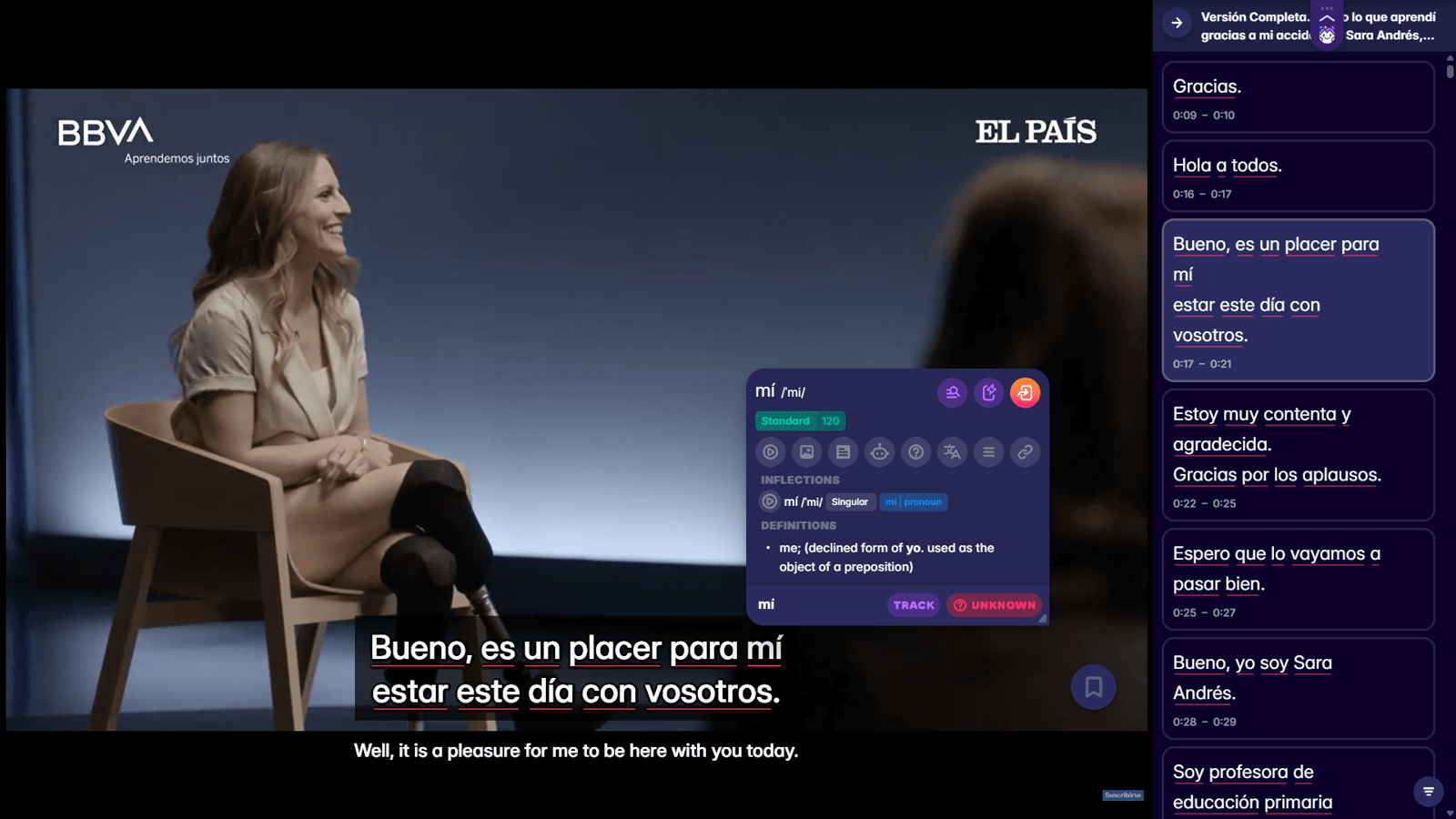
- Practice with real content. Read Spanish articles, watch shows with subtitles, or listen to podcasts. You'll see verb conjugations used naturally, which helps them stick.
- Use spaced repetition. Review conjugations at increasing intervals. This is way more effective than cramming.
- Group similar verbs together. When you learn hablar, also practice with other AR verbs like trabajar, estudiar, and caminar. The pattern reinforcement helps.
Anyway, if you want to learn Spanish through immersion with real content, Migaku's browser extension and app let you look up words and see conjugations instantly while watching Spanish shows or reading articles. Makes learning verb forms way more natural than staring at charts. There's a 10-day free trial if you want to check it out.
Learning Spanish verb conjugation takes time
You won't master it in a week or even a month. But if you focus on the most common verbs and tenses first, you'll be able to have real conversations pretty quickly. The key is consistent practice with real Spanish content. Textbook exercises help, but nothing beats seeing these conjugations used in actual sentences by native speakers.
If you consume media in Spanish, and you understand at least some of the messages and sentences within that media, you will make progress. Period.
The most fluent speakers are the ones who never gave up.