# Spanish Demonstrative Adjectives: Complete Guide to Este, Ese, Aquel in Spanish Grammar
> Learn how to use este, ese, and aquel correctly in Spanish. Complete guide to demonstrative adjectives with distance rules, gender agreement, and examples.
**URL:** https://migaku.com/blog/spanish/spanish-demonstrative-adjectives-este-ese-aquel
**Last Updated:** 2026-02-19
**Tags:** fundamentals, vocabulary, phrases, grammar
---
[Learning Spanish](https://migaku.com/learn-spanish) demonstrative adjectives can feel a bit overwhelming at first, especially when you're trying to figure out whether to use este, ese, or aquel. However, once you understand the distance system and how these words change based on gender and number, it becomes pretty straightforward. Spanish demonstrative adjectives work differently than English "this" and "that" because Spanish has three levels of distance instead of just two. Let me walk you through everything you need to know to use these correctly.
---
## What are demonstrative adjectives in Spanish
> ➡️Demonstrative adjectives in Spanish are words that point out specific nouns and show how close or far they are from the speaker.
In English, we only have "this" and "that" (Plus their plurals "these" and "those"). Spanish gives you three options based on distance:
1. este for things close to you,
2. ese for things near the person you're talking to,
3. and aquel for things far from both of you.
Here's the thing, these aren't just random words you stick in front of nouns. Spanish demonstrative adjectives must agree with the noun they modify in both **gender** and **number**. That means if you're talking about a feminine plural noun, you need the feminine plural form of the demonstrative.
The **12 forms** might sound like a lot to memorize, but they follow a predictable pattern. Each of the three distance levels (este, ese, aquel) has four forms:
1. masculine singular,
2. feminine singular,
3. masculine plural,
4. and feminine plural.
---
## The three distance levels explained
The distance system is what makes Spanish demonstratives unique. Think of it like zones around you when you're having a conversation.
1. **Este ** refers to things in your immediate zone, close enough to touch. If you're holding a book or standing right next to a car, you'd use este (or its other forms). The related adverb is aquí, meaning "here."
2. **Ese ** points to things in the listener's zone or at a medium distance. Maybe the book is on a table near the person you're talking to, or the car is parked across the street. The adverb that goes with this is ahí, meaning "there" (Near you, the listener).
3. **Aquel ** indicates things far from both speaker and listener. That car way down the street, or those mountains in the distance. The adverb is allí or allá, both meaning "over there" (Far away).
---
## Complete table of Spanish demonstrative adjectives
Let me break down all 12 forms for you in a way that's easy to reference.
For **este** (This, close to speaker):
- Masculine singular: este
- Feminine singular: esta
- Masculine plural: estos
- Feminine plural: estas
For **ese** (That, near listener):
- Masculine singular: ese
- Feminine singular: esa
- Masculine plural: esos
- Feminine plural: esas
For **aquel** (That over there, far from both):
- Masculine singular: aquel
- Feminine singular: aquella
- Masculine plural: aquellos
- Feminine plural: aquellas
Notice the pattern? The masculine singular forms end in -e or -el, while feminine forms swap that for -a. Plural forms add -s or -as. Once you see the pattern, it becomes way easier to remember.
---
## How to use demonstrative adjectives in sentences
> Spanish demonstrative adjectives always go **directly before the noun** they're describing in the [grammar](https://migaku.com/blog/spanish/spanish-grammar-guide). You can't separate them with other words like you sometimes can in English.
Let's look at some practical examples:
- Este libro es interesante
*This book is interesting* (The book is right there with you, maybe in your hands)
- Esa casa es grande
*That house is big* (The house is at a medium distance, perhaps the one near the person you're talking to)
- Aquellos árboles son altos
*Those trees over there are tall* (The trees are far away from both of you)
Here's a sentence using all three:
- Este perro es mío, ese perro es tuyo, y aquel perro es de María
*This dog is mine, that dog is yours, and that dog over there is María's* (You can see how the distance changes the meaning completely)
The gender agreement matters a lot. If you're talking about "this table" (esta mesa), you need the feminine form because mesa is feminine. For "these books" (estos libros), you need masculine plural because libros is masculine.
---
## Demonstrative adjectives vs demonstrative [pronouns](https://migaku.com/blog/spanish/spanish-pronouns)
This deserves its own section because it trips people up.
> Demonstrative adjectives **accompany** a noun, while demonstrative pronouns **replace** the noun entirely.
When you say "este libro" (This book), "este" is an adjective because it's modifying "libro." But if you just say "este" (This one), you're using it as a pronoun because it's standing in for the noun.
The forms are identical. You might see some older Spanish texts with accent marks on pronouns (éste, ése, aquél) to distinguish them from adjectives, but the Real Academia Española officially dropped this requirement in 2010. Most Spanish speakers don't use those accents anymore in 2026.
Here's an example: "Este coche es rápido, pero ese es más rápido" means "This car is fast, but that one is faster." The first "este" is an adjective (este coche), while "ese" at the end is a pronoun (Replacing "ese coche").
---
## Common examples with different nouns
Let me give you 10 solid examples that show how these work in real contexts:
| Spanish | English | Explanation |
| - | - | - |
| Esta manzana está deliciosa | This apple is delicious | Feminine singular, close |
| Estos zapatos son cómodos | These shoes are comfortable | Masculine plural, close |
| Ese restaurante tiene buena comida | That restaurant has good food | Masculine singular, medium distance |
| Esas flores son bonitas | Those flowers are pretty | Feminine plural, medium distance |
| Aquel edificio es muy alto | That building over there is very tall | Masculine singular, far |
| Aquella montaña es peligrosa | That mountain over there is dangerous | Feminine singular, far |
| Este café está caliente | This coffee is hot | Masculine singular, close |
| Estas sillas son nuevas | These chairs are new | Feminine plural, close |
| Esos niños juegan en el parque | Those children play in the park | Masculine plural, medium distance |
| Aquellas estrellas brillan mucho | Those stars over there shine a lot | Feminine plural, far |
---
## Common mistakes
[Common mistakes learners make](https://migaku.com/blog/spanish/spanish-hard-to-learn) include forgetting gender agreement (saying "este mesa" instead of "esta mesa"), mixing up the distance levels (using ese when you mean este), and trying to use English word order.
Another frequent error is using demonstrative pronouns when you need adjectives, or vice versa. If there's a noun right after, you need the adjective form. If you're replacing the noun, you're using it as a pronoun.
Some learners also struggle with plural forms, especially remembering that masculine plural is -os and feminine plural is -as. "Estos libros" and "estas mesas" follow the same pattern as regular plural nouns.
---
## Regional variations and practical usage
While the basic rules for Spanish demonstrative adjectives stay consistent across Spanish-speaking regions, you'll notice some practical differences in how people use them conversationally.
In Spain, speakers tend to use aquel and its forms more frequently in everyday speech. In many Latin American countries, ese often covers both medium and far distances in casual conversation, with aquel reserved for emphasis or very distant objects.
The adverbs that go with these demonstratives also vary. In Latin America, you'll hear "allá" more often than "allí" for far distance, while in Spain both are common.
When you're watching Spanish content or talking with native speakers, pay attention to how they use these in context. Distance is somewhat subjective. What one speaker considers "medium distance" (ese) might be "far" (aquel) to another depending on the situation.
In writing, you'll see more precise use of all three levels. In speech, especially casual conversation, people often stick to este and ese for most situations.
---
## Tips for mastering demonstrative adjectives
1. Start by focusing on the distance concept. Before you even worry about gender and number, get comfortable with when to use este versus ese versus aquel. Stand in a room and point at objects, saying which demonstrative you'd use based on where they are.
2. Learn the pattern of endings. Once you know that masculine singular ends in -e/-el, feminine in -a, masculine plural in -os, and feminine plural in -as, you can generate any form you need.
3. Practice with real objects around you. Pick up your phone and say "este teléfono." Point at a chair across the room and say "esa silla." Look out the window at a distant building and say "aquel edificio."
4. Create your own example sentences using nouns you encounter regularly. The more you personalize your practice, the better these will stick.
5. Read Spanish texts and notice how demonstratives are used. News articles, stories, and even social media posts will show you natural usage patterns.
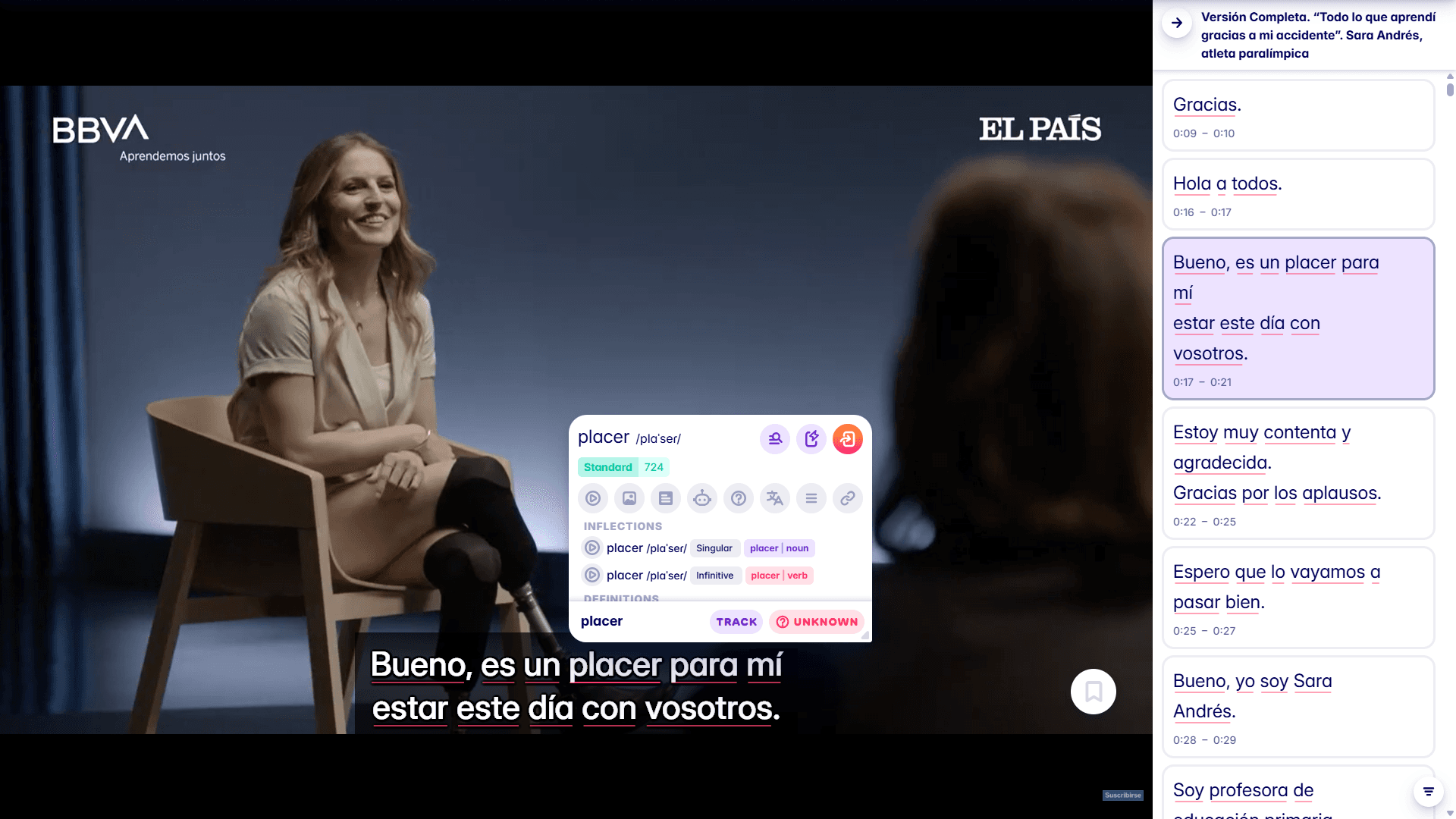
Anyway, if you're serious about getting fluent in Spanish, Migaku's browser extension and app make it super easy to learn these grammar patterns from real content. You can watch Spanish shows and instantly look up any word or phrase you don't know, building your understanding naturally. There's a 10-day free trial if you want to see how much faster you can pick this stuff up.
 ---
## Demonstrative adjectives are indispensable in Spanish grammar
Understanding demonstrative adjectives gives you a foundation for other Spanish grammar concepts. The agreement rules you learn here apply to regular adjectives too. As long as you can establish your own grammar learning routine, picking up the demonstrative adjectives would also be just a part of your daily Spanish studying. Another grammar point conquered, another step towards fluency, another day closer to understanding Spanish content!
> If you consume media in Spanish, and you understand at least some of the messages and sentences within that media, you will make progress. _Period_.
Make your time count!
---
## Demonstrative adjectives are indispensable in Spanish grammar
Understanding demonstrative adjectives gives you a foundation for other Spanish grammar concepts. The agreement rules you learn here apply to regular adjectives too. As long as you can establish your own grammar learning routine, picking up the demonstrative adjectives would also be just a part of your daily Spanish studying. Another grammar point conquered, another step towards fluency, another day closer to understanding Spanish content!
> If you consume media in Spanish, and you understand at least some of the messages and sentences within that media, you will make progress. _Period_.
Make your time count!