# Spanish Sentence Structure: Guide to Spanish Sentence Structure and Word Order
> Structuring a sentence is like building Lego! Learn Spanish sentence structure from basic SVO patterns to advanced word order.
**URL:** https://migaku.com/blog/spanish/spanish-sentence-structure-grammar-rules
**Last Updated:** 2026-02-02
**Tags:** fundamentals, deepdive, grammar
---
[Learning Spanish](https://migaku.com/learn-spanish) grammar can feel overwhelming at first, but understanding how Spanish sentence structure works makes everything click into place faster. The good news? Spanish follows pretty consistent patterns once you know the basics. Getting comfortable with how words fit together in Spanish sentences will help you sound more natural and actually understand what native speakers are saying.
Let's break down everything from basic SVO patterns to the trickier stuff like object pronouns and complex clauses.🤔
---
## What is the Spanish sentence structure: SVO
> Spanish sentence structure follows an **SVO** (Subject-Verb-Object) pattern, just like English. This means the subject comes first, then the verb, then the object.
For example: "María come manzanas" (María eats apples). The subject is María, the verb is "come" (Eats), and the object is "manzanas" (Apples).
Here's the thing though. Spanish has way more flexibility with word order than English does. You can move things around for emphasis or style without breaking grammar rules. English gets rigid pretty quickly, but Spanish lets you play with placement while still being grammatically correct.
---
## Understanding basic Spanish sentences
When you're building simple declarative sentences in Spanish, you'll follow that SVO pattern. But there's a cool feature in Spanish that makes things different from English: you can actually drop the subject pronoun most of the time.
In English, you always need to say "I eat" or "she runs." In Spanish, the [verb conjugation](https://migaku.com/blog/spanish/spanish-grammar-guide) tells you who's doing the action, so you can just say "como" (I eat) or "corre" (she runs) without the pronouns "yo" or "ella." The conjugation does the work.
This happens because Spanish verbs conjugate differently for each subject pronoun. When you conjugate verbs properly, the ending tells you everything:
- Como (I eat)
- Comes (You eat)
- Come (He/She eats)
- Comemos (We eat)
- Coméis (You all eat, Spain)
- Comen (They eat)
Each ending is unique, so native speakers know exactly who's doing what without needing the subject stated explicitly.
---
## The 4 types of sentences in Spanish
Spanish has four main sentence types you'll use constantly:
### 1. Declarative sentences
These are your basic statements. They follow the standard SVO pattern and make up most of what you'll say in Spanish.
- El gato duerme en el sofá.
*The cat sleeps on the sofa.*
- Mi hermana trabaja en Madrid.
*My sister works in Madrid.*
### 2. Interrogative sentences (questions)
[Questions](https://migaku.com/blog/spanish/spanish-question-words) in Spanish can be formed by simply changing your intonation, or by inverting the subject and verb. An important distinction when writing question sentences in Spanish is that we use two question marks (¿?) at the beginning and end.
- ¿Hablas español?
*Do you speak Spanish?*
- ¿Dónde vive tu familia?
*Where does your family live?*
You don't need helper verbs like "do" or "does" in Spanish questions. Just flip the word order or use [question words](https://migaku.com/blog/spanish/spanish-question-words) like "qué," "dónde," "cuándo," "por qué," or "cómo."
### 3. Negative sentences
Making negative sentences in Spanish is super straightforward. Put "no" right before the verb.
- No tengo tiempo.
*I don't have time.*
- Ella no come carne.
*She doesn't eat meat.*
Spanish also uses double negatives, which is different from English. You can say "no tengo nada" (Literally "I don't have nothing") and it's completely correct. The double negatives actually reinforce the negation instead of canceling it out like they would in English.
Other negative words include "nunca" (Never), "nadie" (Nobody), "ninguno" (None), and "tampoco" (Neither).
### 4. Exclamatory sentences
These express strong emotion and use inverted exclamation points (¡!) just like question marks.
- ¡Qué bonito!
*How beautiful!*
- ¡Me encanta esta canción!
*I love this song!*
---
## Word order flexibility in Spanish
Spanish gives you way more freedom with word order than English does. You can rearrange sentence structures for emphasis, style, or rhythm without sounding wrong.
For example, all of these are correct:
- Juan compró el libro (Juan bought the book) - standard SVO
- El libro lo compró Juan (The book, Juan bought it) - emphasizes the book
- Compró Juan el libro (Bought Juan the book) - emphasizes the action
The flexibility comes from verb conjugation and context making the meaning clear even when you move things around. In English, "the dog bit the man" means something totally different from "the man bit the dog." In Spanish, you can play with order more because the [verb endings](https://migaku.com/blog/spanish/spanish-present-tense) and context keep things clear.
That said, stick with SVO when you're learning Spanish. Once you get comfortable, you can experiment with variations to sound more natural or emphasize different parts of your message.
---
## Pronouns in Spanish and where they go
[Pronouns](https://migaku.com/blog/spanish/spanish-pronouns) work differently in Spanish compared to English, and they affect sentence structure in important ways.
### Subject pronouns
As mentioned earlier, subject pronouns (yo, tú, él, ella, nosotros, vosotros, ellos, ellas) are usually optional because the verb conjugation tells you who's doing the action. You only include them for emphasis or clarity.
- Yo hablo español (I speak Spanish) - emphasizing "I" specifically
- Hablo español (I speak Spanish) - normal, casual
### Object pronouns
This is where things get interesting. Object pronouns in Spanish come BEFORE the conjugated verb, which feels backward if you're used to English.
> Direct object pronouns (me, te, lo, la, nos, os, los, las) replace the direct object:
- Veo la película → La veo
*I see the movie → I see it*
- Compro los libros → Los compro
*I buy the books → I buy them*
> Indirect object pronouns (me, te, le, nos, os, les) work similarly:
- Doy el regalo a María → Le doy el regalo
*I give the gift to María → I give her the gift*
> When you have both direct and indirect object pronouns, the indirect comes first, and "le" or "les" changes to "se":
- Doy el libro a ella → Se lo doy
*I give the book to her → I give it to her*
> With infinitive verbs or gerunds, you can attach the pronouns to the end instead:
- Voy a verla
*I'm going to see her*
- Estoy viéndola
*I'm seeing her*
---
## Spanish adjectives and noun agreement
> Spanish adjectives usually come AFTER the noun they modify, which is opposite from English.
The adjective also has to match the noun in gender (Masculine/Feminine) and number (Singular/Plural).
- Un coche rojo (A red car) - Masculine singular
- Una casa roja (A red house) - Feminine singular
- Coches rojos (Red cars) - Masculine plural
- Casas rojas (Red houses) - Feminine plural
Can adjectives be placed before nouns in Spanish? Yeah, sometimes. Certain adjectives change meaning depending on position, and some just sound better before the noun for stylistic reasons.
- Un gran hombre (A great man) - "Gran" before means "great"
- Un hombre grande (A big man) - "Grande" after means "large"
Common adjectives that often go before the noun include "bueno," "malo," "grande," "pequeño," and "viejo" when used figuratively.
---
## Complex sentences with "que"
As you get more advanced, you'll start building complex sentences that connect multiple clauses. The word "que" (That, which, who) is your best friend here.
- Creo que es importante
*I think that it's important*
- El libro que leí es interesante
*The book that I read is interesting*
- La mujer que trabaja aquí es mi tía
*The woman who works here is my aunt*
You can stack multiple clauses together:
- Sé que María dijo que Juan compró el coche que vimos ayer
*I know that María said that Juan bought the car that we saw yesterday*
This gets you into more natural, flowing Spanish sentences instead of just simple statements.
---
## Practical tips for mastering Spanish sentences
1. Start with simple declarative sentences and get comfortable with verb conjugation. Seriously, conjugation is everything in Spanish. When you can conjugate verbs automatically, sentence structure becomes way easier because you're not constantly thinking about endings.
2. Practice dropping subject pronouns once you're confident with conjugations. This makes your Spanish sound more natural. Native speakers rarely say "yo" or "tú" unless they're emphasizing something.
3. Pay attention to object pronoun placement. It feels weird at first to put them before the verb, but it becomes automatic with practice. Make up example sentences and say them out loud until the order feels natural.
4. Read Spanish content and notice how native speakers structure their sentences. You'll pick up on the rhythm and flow that makes Spanish sound natural. Pay attention to when writers use standard SVO and when they mix it up for emphasis.
5. Don't stress too much about word order flexibility until you're comfortable with the basics. Stick with SVO patterns while you're building your foundation, then experiment with variations as you get more advanced.
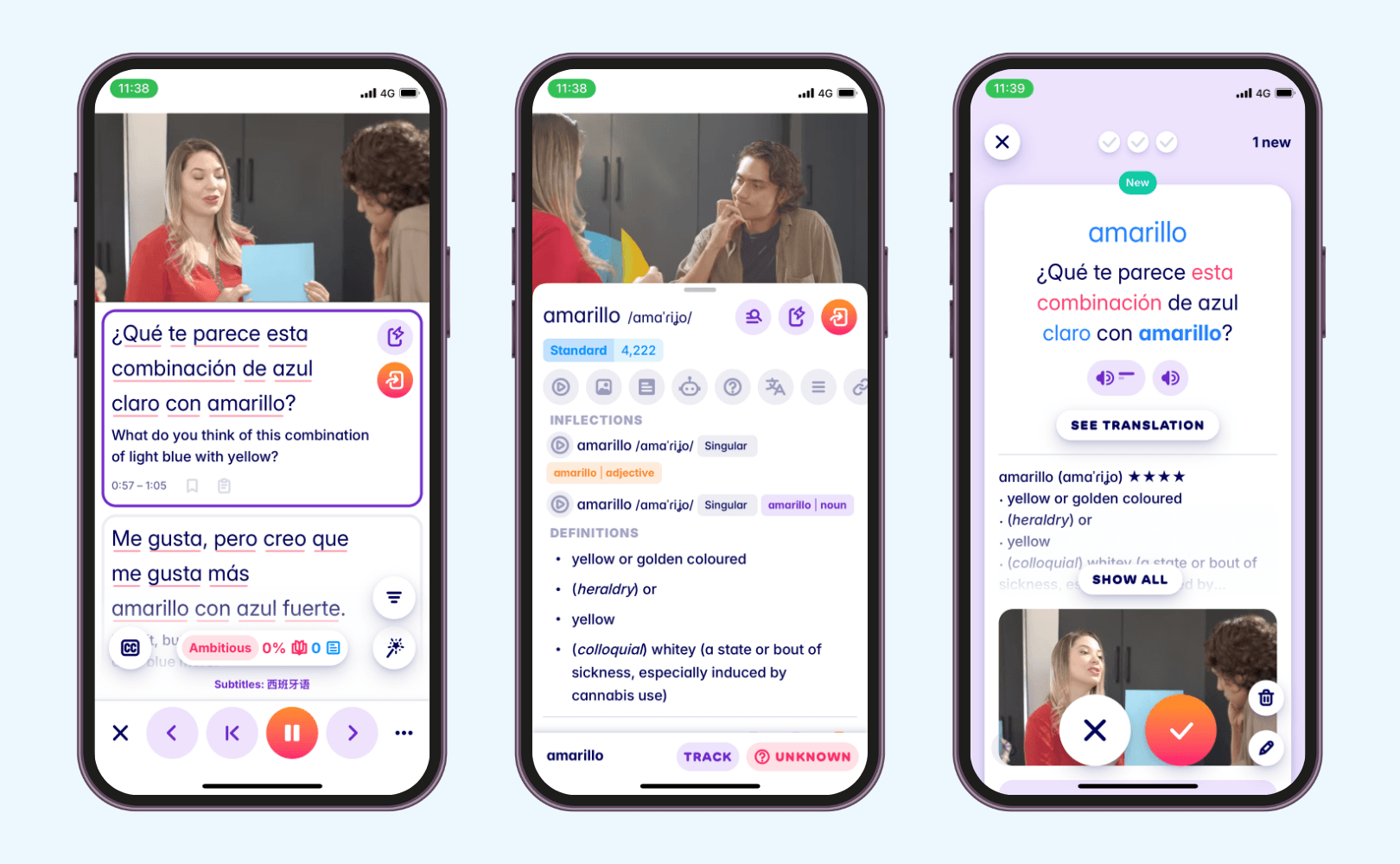
If you want to actually practice these sentence structures with real Spanish content, Migaku's browser extension and app let you look up words and see grammar in context while watching shows or reading articles. You can save examples of different sentence types and review them later. There's a 10-day free trial if you want to check it out.
 ---
## FAQs
Spanish dialects across Latin America and Spain mostly follow the same basic sentence structures. The SVO pattern holds everywhere. But yeah, there are some regional differences in how people use pronouns and certain constructions. In Spain, they use "vosotros" for informal plural "you," while Latin America uses "ustedes" for all plural situations. Some regions use "vos" instead of "tú" (like in Argentina and parts of Central America), which changes verb conjugations slightly.
The app teaches you sentence structures through repetition and pattern recognition, which works for understanding the basics. But real fluency comes from using Spanish in actual conversations, consuming native content like shows and books, and practicing output through speaking and writing.
---
## Sentence structures are the blueprints of a language
Once you know the basic vocabulary and the sentence structures, you will gradually understand simple Spanish dialogues and texts. Spanish speakers in daily conversation usually don't adopt long sentences, and casual talkings involve many broken sentences and short phrases. For understanding Spanish further, you can take dramas, short videos, and movies as your starting point, and observe how people talk in real life.
> If you consume media in Spanish, and you understand at least some of the messages and sentences within that media, you will make progress. _Period_.
Choose a clip to start!
---
## FAQs
Spanish dialects across Latin America and Spain mostly follow the same basic sentence structures. The SVO pattern holds everywhere. But yeah, there are some regional differences in how people use pronouns and certain constructions. In Spain, they use "vosotros" for informal plural "you," while Latin America uses "ustedes" for all plural situations. Some regions use "vos" instead of "tú" (like in Argentina and parts of Central America), which changes verb conjugations slightly.
The app teaches you sentence structures through repetition and pattern recognition, which works for understanding the basics. But real fluency comes from using Spanish in actual conversations, consuming native content like shows and books, and practicing output through speaking and writing.
---
## Sentence structures are the blueprints of a language
Once you know the basic vocabulary and the sentence structures, you will gradually understand simple Spanish dialogues and texts. Spanish speakers in daily conversation usually don't adopt long sentences, and casual talkings involve many broken sentences and short phrases. For understanding Spanish further, you can take dramas, short videos, and movies as your starting point, and observe how people talk in real life.
> If you consume media in Spanish, and you understand at least some of the messages and sentences within that media, you will make progress. _Period_.
Choose a clip to start!