Cantonese Comparatives: How to Compare Things Naturally
Last updated: March 29, 2026

Learning how to make comparisons in Cantonese is one of those grammar topics that sounds scary at first but actually makes a lot of sense once you see the patterns. Whether you're trying to say your coffee is stronger than your friend's or that Hong Kong summers are way hotter than London summers, you'll need these structures. The good news? Cantonese comparison grammar is pretty straightforward, and once you get the hang of the main particle 過, you'll be comparing everything around you. Let's break down exactly how these structures work, from basic comparisons to the more advanced patterns you'll need to know when learning Cantonese.
Basic comparisons with 過
Here's the thing about Cantonese comparatives: the most common and essential structure uses the particle 過 (gwo3), which literally means "to surpass" or "to exceed." This is your bread and butter for making comparisons, and you'll hear it constantly in natural speech.
💡The basic pattern looks like this: A + adjective + 過 + B.
So if you want to say "I'm taller than you," you'd say 我高過你 (ngo5 gou1 gwo3 nei5). The adjective comes first, then 過, then the thing you're comparing to. Pretty straightforward, right?
Let me give you some real examples:
- 呢個貴過嗰個。
This one is more expensive than that one. - 佢大過我。
He/She is older than me. - 今日熱過尋日。
Today is hotter than yesterday.
The word order might feel backwards if you're used to English "more than" or even Mandarin's 比 structure, but once you internalize that the adjective comes before 過, it becomes second nature.
One thing that trips people up: you don't need a separate word for "more" like in English. The 過 particle handles all of that. So you're literally saying "I tall surpass you" which becomes "I'm taller than you." Makes sense when you think about it that way.
Degree modifiers: 啲, 仲, and 更加
Sometimes you don't just want to say something is bigger or smaller. You want to emphasize HOW MUCH bigger or smaller. That's where degree modifiers come in, and Cantonese has some pretty useful ones.
- The particle 啲 (di1) means "a bit" or "a little," and it goes right after the adjective. So 大啲 (daai6 di1) means "a bit bigger" and 平啲 (peng4 di1) means "a bit cheaper." You'll hear this constantly in markets and shops when people are negotiating or making requests. For example: 可唔可以平啲呀?(ho2 m4 ho2 yi5 peng4 di1 aa3?) = Can it be a bit cheaper? This is probably one of the most useful phrases you can learn if you're shopping in Hong Kong or Guangzhou.
- When you want to say "even more" or "still more," you use 仲 (zung6). This one adds emphasis and often translates to "even" in English. So 仲大 (zung6 daai6) means "even bigger" or "still bigger." You can combine it with 過 too: 佢仲高過我 (keoi5 zung6 gou1 gwo3 ngo5) = He's even taller than me.
- Then there's 更加 (gang3 gaa1), which is a bit more formal and means "even more" or "all the more." You'll see this more in written Cantonese or formal speech. For instance, 更加困難 (gang3 gaa1 kwan3 naan4) = even more difficult.
These modifiers stack with your basic 過 comparisons to give you way more nuance. Instead of just saying something is bigger, you can specify it's a tiny bit bigger or dramatically bigger.
Advanced comparison structures
Alright, now we're getting into the structures that make you sound like you actually know what you're doing with Cantonese grammar.
💡The 有……咁 (jau5...gam3) pattern is used for "as...as" comparisons, expressing equality. The structure is: A + 有 + B + 咁 + adjective.
For example, 我有佢咁高 (ngo5 jau5 keoi5 gam3 gou1) = I'm as tall as him/her. Literally, you're saying "I have him/her so tall," which sounds weird in English but works perfectly in Cantonese.
The negative version uses 冇 (mou5) instead of 有: 我冇佢咁高 (ngo5 mou5 keoi5 gam3 gou1) = I'm not as tall as him/her. This is super common for making comparisons where something falls short of the standard.
Now here's where it gets interesting. Cantonese also has 比 (bei2), which you might recognize from Mandarin Chinese. In Mandarin, 比 is the main comparison particle, but in Cantonese, it's used differently and less frequently than 過. When you do use 比 in Cantonese, it often appears in more formal contexts or written language.
💡The pattern with 比 is: A + 比 + B + adjective.
So 我比你高 (ngo5 bei2 nei5 gou1) = I'm taller than you. Notice the adjective comes after 比 and the comparison object, which is the opposite of the 過 structure.
There's also 比較 (bei2 gaau3), which means "comparatively" or "relatively." This is more of an adverb that modifies the whole sentence: 呢個比較好 (ni1 go3 bei2 gaau3 hou2) = This one is comparatively better. You'll hear this when people are weighing options or making recommendations.
Superlatives and expressing extremes
So we've covered comparatives, but what about when you want to say something is the best, the biggest, or the most expensive? Cantonese handles superlatives a bit differently than English.
💡The most common way to express a superlative is using 最 (zeoi3), which means "most" or "-est." This works just like English in terms of position: 最 + adjective.
So 最好 (zeoi3 hou2) = best, 最大 (zeoi3 daai6) = biggest, 最貴 (zeoi3 gwai3) = most expensive.
You can combine this with comparison structures too. For instance, 佢係最高嘅 (keoi5 hai6 zeoi3 gou1 ge3) = He/She is the tallest one. The particle 嘅 (ge3) at the end turns it into a noun phrase.
💡Another way to express extremes is using 好 (hou2) as an intensifier before the adjective.
好大 (hou2 daai6) means "very big," and you'll hear this constantly. If you want to go even further, you can say 好好 (hou2 hou2) + adjective, like 好好食 (hou2 hou2 sik6) = very very delicious.
There's also 非常 (fei1 soeng4) for "extremely" or "extraordinarily," though this leans formal. In everyday speech, people tend to stack 好 or use other intensifiers like 超 (ciu1) which comes from "super" and sounds pretty casual and modern.
Common mistakes learners make
Let me tell you about the mistakes I see all the time, because avoiding these will save you from sounding awkward.
- First mistake: putting 過 in the wrong position. People learning Cantonese often want to say 我過你高 because they're thinking of English "more than" or Mandarin 比. But that's wrong. The adjective must come before 過. It's always adjective + 過 + comparison object.
- Second mistake: using 比 when you should use 過 in casual speech. While 比 works and people will understand you, it sounds formal or even like you're translating from Mandarin. If you're having a normal conversation, stick with 過.
- Third mistake: overusing 更加 (gang3 gaa1) in casual conversation. This modifier is formal, and if you're chatting with friends, you'll sound weirdly stiff. Use 仲 (zung6) instead for everyday situations.
- Fourth mistake: mixing up 有……咁 and 冇……咁. Remember, 有 (jau5) is the positive "as...as" and 冇 (mou5) is the negative "not as...as." Swapping these completely reverses your meaning.
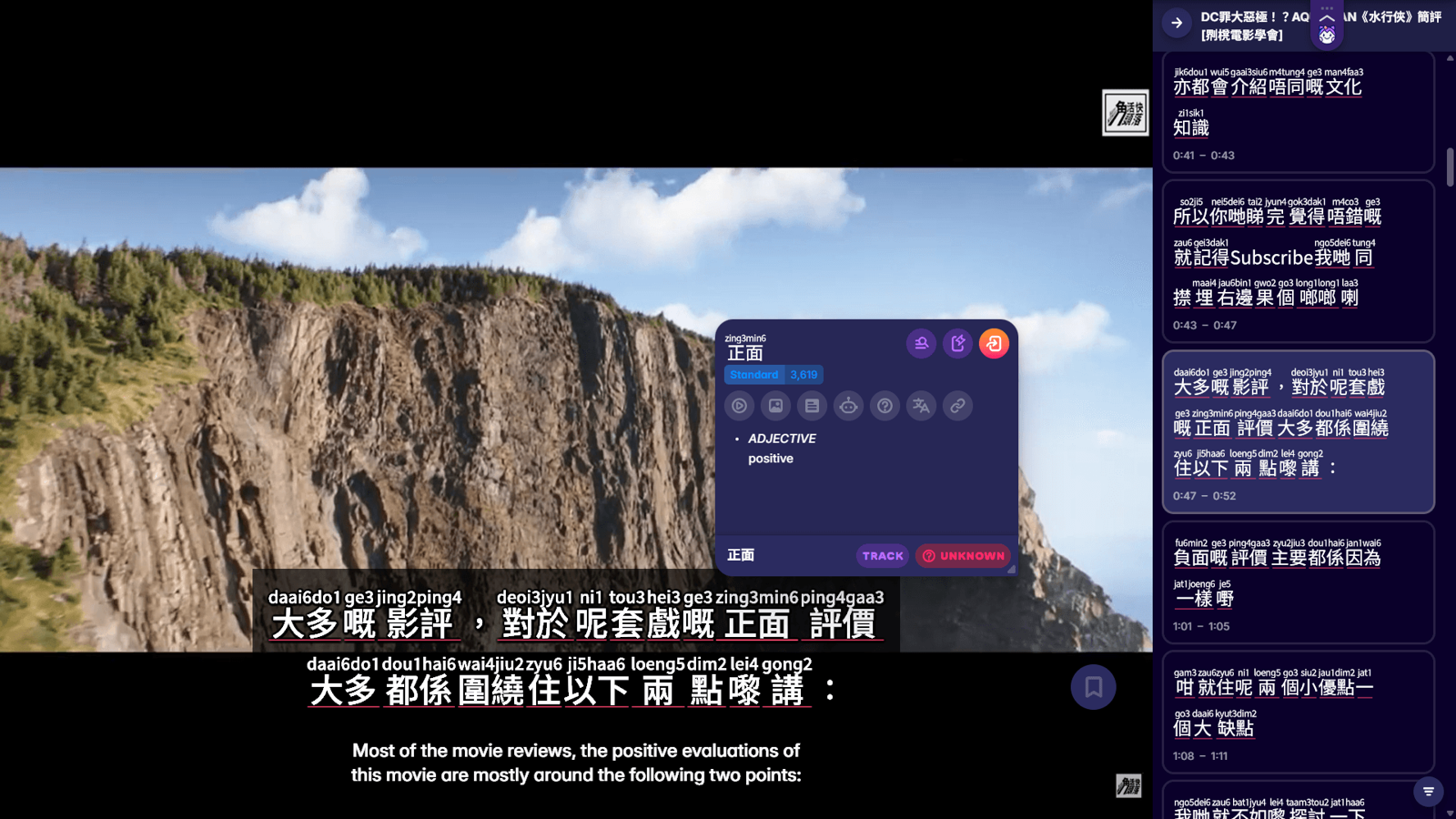
If you're serious about getting these comparison structures down, Migaku's browser extension and app let you look up Cantonese words and save example sentences while you're watching shows or reading articles. Makes it way easier to collect real examples of 過, 有……咁, and all the other patterns we covered. There's a 10-day free trial if you want to see how it works with actual content.
Start using the comparison words!
The best way to get comfortable with Cantonese comparatives is honestly just to start using them. Compare your breakfast to yesterday's breakfast. Compare your commute time to your friend's. Compare the weather today to last week. Making these structures automatic takes exposure and practice. You need to hear them, read them, and use them in real situations. Grammar explanations help you understand the logic, but immersion makes them stick.
If you consume media in Cantonese, and you understand at least some of the messages and sentences within that media, you will make progress. Period.
We learn what we like by comparing things.💜