# Chinese Chengyu: Useful Chengyu That Build the Bridge Between Chinese Language and Culture
> A crafty rabbit has three burrows? What does that mean? Understand Mandarin Chinese chengyu and idiom here. They are more than the observation of nature!
**URL:** https://migaku.com/blog/chinese/chinese-chengyu
**Last Updated:** 2026-01-29
**Tags:** vocabulary, culture, phrases
---
OK, remember I mentioned in the description? The phrase offers you a glimpse of what Chinese chengyu is like: they’re four-character idioms, each one a compressed story or historical lesson. - for example: A crafty rabbit has three burrows (which is true in nature). 🐇🕳️
The truth is, using these Chinese idioms is like adding secret spices to your speech in Mandarin. They make you sound insightful, eloquent, and like you genuinely get the Chinese culture. Let's discuss some more commonly used 成语 (Chengyu) to embellish your speech!
---
## What exactly is a chengyu? A guide to Chinese idioms
> So far as grammar is concerned, a chengyu is a fixed phrase, usually four characters. You can't swap the words or change the order.
Think of them like idioms in English, such as "break the ice" or "spill the beans," but with a much deeper historical or literary origin story baked in. Chengyu literally means "become language" — set phrases that have become entrenched in the spoken and written Chinese.
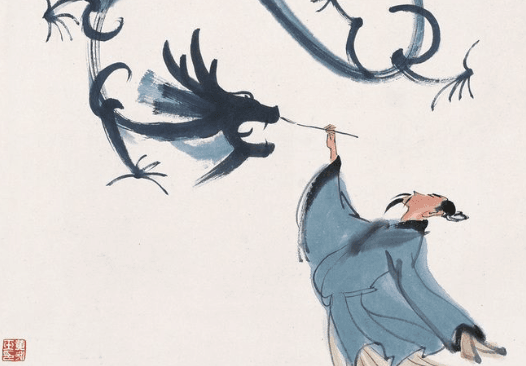
As to the meanings, each one is a tiny window into Chinese history, literature, or philosophy. For example, (Draw the eyes on the dragon) comes from an old tale about a painter who brought his dragon to life with one final brushstroke. Today, it means to add the crucial finishing touch that makes something complete.
The upside to this is immense cultural insight; the downside is you can't just guess the meaning from the characters alone. You have to know the story behind this chengyu. The literal meaning of this chengyu won’t help you.
- Imagine a designer adding the perfect final detail to a room and a friend saying, (This decoration really is draw the eyes on the dragon).
- Or a writer finding the ideal closing line: (This final sentence has the effect of draw the eyes on the dragon).
It’s about that moment of perfect completion.
 ---
## Why bother learning Chinese idioms? The power of four characters
What if I told you that mastering a few dozen common chengyu could dramatically upgrade your comprehension and expression? It’s true. In other words, they’re a shortcut to sounding sophisticated in the Chinese language. In a language that values conciseness and resonance, a well-placed Chinese idiom does the work of a whole sentence. A good mastery of Chinese idioms is a hallmark of advanced proficiency.
Let me give you a personal example from when I started learning Chinese. Early on, I described a complicated situation with a basic word. It was fine. But later, I learned the chengyu (A single word cannot explain it). The second I used it with a Chinese friend, their face lit up. It wasn't just more accurate — it was more relatable, more human.
---
## The anatomy of a 成语: Stories in miniature
Most chengyu come from a few key sources in classical Chinese and ancient literature, and knowing this helps you categorize them.
> First, you’ve got the historical stories, often from texts like Records of the Grand Historian.
Take (Break the woks and sink the boats). It describes an ancient general who ordered this to show his troops there was no retreat — only victory or death. Today, it means to burn your bridges, to commit to something fully. This is a great example of a chengyu derived from a specific historical event.
For example:
- 。
---
## Why bother learning Chinese idioms? The power of four characters
What if I told you that mastering a few dozen common chengyu could dramatically upgrade your comprehension and expression? It’s true. In other words, they’re a shortcut to sounding sophisticated in the Chinese language. In a language that values conciseness and resonance, a well-placed Chinese idiom does the work of a whole sentence. A good mastery of Chinese idioms is a hallmark of advanced proficiency.
Let me give you a personal example from when I started learning Chinese. Early on, I described a complicated situation with a basic word. It was fine. But later, I learned the chengyu (A single word cannot explain it). The second I used it with a Chinese friend, their face lit up. It wasn't just more accurate — it was more relatable, more human.
---
## The anatomy of a 成语: Stories in miniature
Most chengyu come from a few key sources in classical Chinese and ancient literature, and knowing this helps you categorize them.
> First, you’ve got the historical stories, often from texts like Records of the Grand Historian.
Take (Break the woks and sink the boats). It describes an ancient general who ordered this to show his troops there was no retreat — only victory or death. Today, it means to burn your bridges, to commit to something fully. This is a great example of a chengyu derived from a specific historical event.
For example:
- 。
*Concerning how things are going, we need to have the courage of breaking the woks and sinking the boats.*
> Then there are the literary and philosophical ones, the wisdom of the Chinese encapsulated.
Chengyu (The old man at the frontier lost his horse) is a classic Taoist parable from classical literature.
The story shows how a seeming misfortune (Losing a horse) can bring good fortune (The horse returns with more horses), and vice versa. It’s used to describe the idea that bad luck may be a blessing in disguise. Basically, it’s a whole philosophy lesson in four Chinese characters. Understanding these stories behind the phrases is key.
You might say this chengyu to encourage people in distress:
- 。
*Don't be discouraged, the old man at the frontier lost his horse, how do you know it's not a blessing.*
- 。
*We didn't get to go this time, but I found a new job, it really is the old man at the frontier lost his horse.*
---
## Walking through history: Chengyu as cultural time capsules
As mentioned in the previous section, many chengyu are direct snapshots of famous historical events or figures. Using one isn't just a linguistic choice; it's a subtle nod to a shared cultural memory that stretches back thousands of years. They are a direct link to Chinese history.
Let's look at (Surrounded by Chu songs). This comes from the power struggle between Liu Bang and Xiang Yu at the end of the Qin dynasty. Xiang Yu’s army was trapped, and Liu Bang’s soldiers sang Chu folk songs to make them believe their homeland was lost, destroying their morale. Today, it describes being isolated and besieged on all sides.
You'll hear these commonly used Chinese idioms in all sorts of contexts. A startup cut off by competitors is:
- 。
*In a situation of surrounded by Chu songs.*
Another idiom, (Three calls at the thatched cottage), refers to Liu Bei's three visits to recruit the strategist Zhuge Liang. Now it means to repeatedly and sincerely invite someone to help.
To recruit a top expert, a CEO might show:
- 。
*The sincerity of three calls at the thatched cottage.*
And you have (Discuss war on paper), from a story about a general’s son who could talk strategy perfectly but failed in real battle. It’s the perfect way to describe empty theorizing.
And a plan with no practical grounding is dismissed as:
- 。
*Completely discuss the war on paper.*
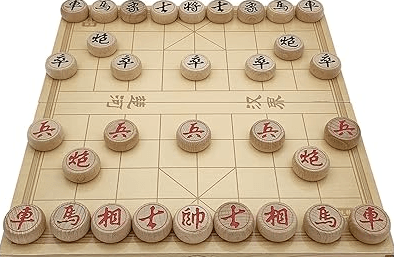
(Do you know that the Chinese chess game is also based on the history story of ? The frontier and refers back to the war between Xiang Yu and Liu Bang.)
 ---
## A zoo of meaning: Animal chengyu in Mandarin
Animals are everywhere in chengyu, and they're never just about the animal. They're symbols — for traits, fortunes, or foolishness.
- The dragon represents power and excellence
- The tiger might be fierceness or danger
- The rabbit can be speed or, as we've seen, sheer luck and craftiness.
These four-character idioms use animals to convey a figurative meaning about human nature.
Take (The fox borrows the tiger's might). In the fable, a fox walks ahead of a tiger, making other animals flee in fear of the tiger behind it. It’s used to describe someone who bullies others by flaunting their powerful connections. You might complain about a coworker:
- 。
---
## A zoo of meaning: Animal chengyu in Mandarin
Animals are everywhere in chengyu, and they're never just about the animal. They're symbols — for traits, fortunes, or foolishness.
- The dragon represents power and excellence
- The tiger might be fierceness or danger
- The rabbit can be speed or, as we've seen, sheer luck and craftiness.
These four-character idioms use animals to convey a figurative meaning about human nature.
Take (The fox borrows the tiger's might). In the fable, a fox walks ahead of a tiger, making other animals flee in fear of the tiger behind it. It’s used to describe someone who bullies others by flaunting their powerful connections. You might complain about a coworker:
- 。
*He's just the fox borrows the tiger's might, don't be afraid of him.*
Then there’s (Play the lute to a cow), a beautifully blunt way to say you’re wasting eloquent words on an incapable listener — the literal meaning paints the perfect picture. Trying to explain a complex idea to a stubborn person feels like:
- 。
*It's simply play the lute to a cow.*
And my personal favorite for its imagery: (A horse that harms the herd). It’s the go-to phrase for that one person who causes trouble for an entire group. And a manager might say,
- 。
*Having one horse that harms the herd in the team will affect everyone.*
 ---
## The moral compass: Chéngyǔ and traditional Chinese values
If you want to understand Chinese culture at a deeper level, listen to its proverbs. Chengyu are a direct line to the Confucian, Taoist, and Buddhist values that shaped society for millennia. They don't just describe actions; they prescribe proper behavior and warn against vice.
Look at (Respect the teacher and value the doctrine). It encapsulates the entire Confucian value of reverence for education and tradition. A good student is praised for:
- 。
---
## The moral compass: Chéngyǔ and traditional Chinese values
If you want to understand Chinese culture at a deeper level, listen to its proverbs. Chengyu are a direct line to the Confucian, Taoist, and Buddhist values that shaped society for millennia. They don't just describe actions; they prescribe proper behavior and warn against vice.
Look at (Respect the teacher and value the doctrine). It encapsulates the entire Confucian value of reverence for education and tradition. A good student is praised for:
- 。
*Understanding respect the teacher and value the doctrine.*
On the flip side, (See profit and forget righteousness) is a sharp critique of someone who abandons principles for gain—it has a clear negative connotation. A corrupt official is condemned for:
- 。
*See profit and forget righteousness, betraying the people.*
The value of perseverance is perfectly captured in (Dripping water pierces stone), emphasizing that persistent effort, however small, overcomes any obstacle. These are actually useful phrases in everyday moral discourse. And parents encourage children with:
- 。
*You must have the spirit of dripping water pierces stone to succeed.*
---
## Common pitfalls: When not to use these idiomatic expressions
Okay, time for some straight talk. The downside to this powerful tool is that misusing it makes you stick out.
1. The most common mistake is using lots of chengyu too often or in the wrong context. If you sprinkle them into every sentence, you’ll sound like a pompous novel from the 1800s. They are frequently used, but with precision.
2. Another huge error is using them literally. Let’s look at (Seven up, eight down). If you take it literally, it’s nonsense. But its actual meaning is to be anxious or have one’s mind in turmoil.
---
## How to learn and remember useful chengyu with the help of a dictionary
Let’s get practical. Here are a few tips I wish I’d known when I started, born from plenty of my own failures in my journey to learn Chinese.
1. First, learn the story. This is non-negotiable. Our brains are wired for narratives. Before you try to memorize (Guard the stump and wait for a rabbit), read the fable. The Chinese idiom stories are the [memory hook](https://migaku.com/blog/chinese/chinese-character-mnemonics). There are interesting stories behind most commonly used chengyu.
2. Second, focus on high-frequency, actually useful chengyu. Don’t start with obscure literary phrases. Go for the workhorses you’ll actually hear: things like (One sail, smooth wind) for plain sailing. I made lists from Chinese TV dialogue and everyday Chinese conversation, not from literary Chinese texts. For [HSK](https://migaku.com/blog/chinese/hsk-vocabulary-lists) and other level Chinese exams, they often test frequently used ones.
3. Third, learn them in pairs of opposites or themes. For example, pair (One heart, one mind) with (Three hearts, two minds). The contrast makes both stickier.
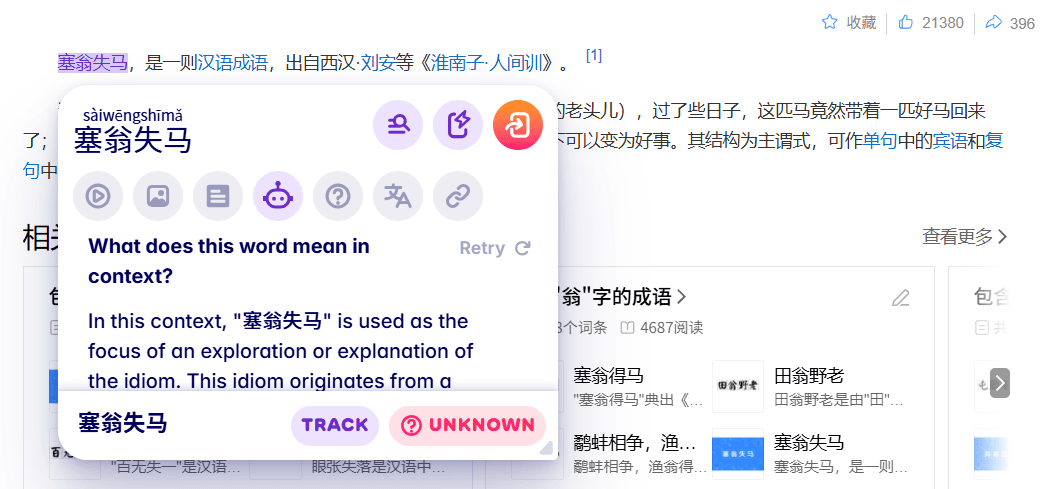
4. Finally, use the chengyu or lose them. Collect chengyu from your reading materials and use a dictionary to look them up. Migaku's browser extension and app let you look up words instantly while reading actual Chinese websites or watching shows. Makes learning from real content way more practical. There's a 10-day free trial if you want to check it out.
 ---
## FAQs
A chengyu is a traditional Chinese idiom, typically a four-character phrase. These idiomatic expressions pack a story or historical lesson into just a few Chinese characters. Learning these common chengyu is a key part of mastering the Chinese language and understanding Chinese culture, as they are used constantly in both written and spoken Chinese.
---
## From learning to living: Your next step in Chinese language and culture
So you’ve got a handful of useful chengyu in your pocket. Now what? The bridge from study to natural use is [immersion](https://migaku.com/blog/chinese/chinese-immersion-learning). Listen for these idioms in Chinese media — in the dialogue of modern TV dramas, spot them in news headlines, and notice how they are used for emphasis.
> If you consume media in Chinese, and you understand at least some of the messages and sentences within that media, you will make progress. _Period_.
This is where Chinese chengyu start living in your mind as real, usable language!
---
## FAQs
A chengyu is a traditional Chinese idiom, typically a four-character phrase. These idiomatic expressions pack a story or historical lesson into just a few Chinese characters. Learning these common chengyu is a key part of mastering the Chinese language and understanding Chinese culture, as they are used constantly in both written and spoken Chinese.
---
## From learning to living: Your next step in Chinese language and culture
So you’ve got a handful of useful chengyu in your pocket. Now what? The bridge from study to natural use is [immersion](https://migaku.com/blog/chinese/chinese-immersion-learning). Listen for these idioms in Chinese media — in the dialogue of modern TV dramas, spot them in news headlines, and notice how they are used for emphasis.
> If you consume media in Chinese, and you understand at least some of the messages and sentences within that media, you will make progress. _Period_.
This is where Chinese chengyu start living in your mind as real, usable language!