Chinese Transport Vocabulary: Useful Words and Phrases for Travel
Last updated: March 25, 2026

Getting around in China means you'll need to know how to talk about different ways of getting from point A to point B. Whether you're hopping on a metro in Shanghai, catching a taxi in Beijing, or just trying to ask for directions, learning Chinese transport vocabulary makes everything smoother. This guide covers all the essential words and phrases you'll need for navigating transportation in Chinese, from basic vehicle names to practical phrases.
- The basics: Understanding chē in Chinese
- Land vehicles you'll use daily
- Rail transportation in Chinese vocabulary
- Air transport in Chinese
- Water transport words and phrases
- Traffic and road vocabulary
- Measure words for transportation
- Essential phrases for getting around
- Ride-sharing and modern transport
- Regional variations and context
The basics: Understanding chē in Chinese
Here's something interesting about Chinese transport vocabulary: most vehicle words use the character 车 (chē), which means "vehicle" or "wheeled transport." You'll see this pop up everywhere when talking about transportation.
The cool thing is that once you know 车 (chē), you can start recognizing patterns. 汽车 (qìchē) is a car, 火车 (huǒchē) is a train (literally "fire vehicle"), and 自行车 (zìxíngchē) is a bicycle. The character 车 acts like a building block that tells you "hey, this is some kind of vehicle."
This pattern makes learning Chinese vocabulary way easier than memorizing random words with no connection to each other. When you see 车 in a word, you immediately know you're dealing with some form of transport.
Land vehicles you'll use daily
Cars and taxis
Let's start with the most common land transport options.
Chinese | Pinyin | English |
|---|---|---|
汽车 | qìchē | Car - 汽 means "steam" or "gas," so literally "gas vehicle" |
出租车 | chūzūchē | Taxi - breaks down to "rent out vehicle" |
的士 | dīshì | Taxi - borrowed from the English word "taxi" (used in bigger cities) |
私家车 | sījiāchē | Private car |
Buses and public transport
Chinese | Pinyin | English |
|---|---|---|
公共汽车 | gōnggòng qìchē | Bus — literally "public together gas vehicle" (full version) |
公交车 | gōngjiāochē | Bus — shortened version, most common |
巴士 | bāshì | Bus — borrowed from English, used in casual conversation |
长途汽车 | chángtú qìchē | Long-distance bus — 长途 means "long distance" |
Bikes and scooters
Chinese | Pinyin | English |
|---|---|---|
自行车 | zìxíngchē | Bicycle — 自行 means "self-propelled" |
电动车 | diàndòngchē | Electric scooter — literally "electric powered vehicle" |
摩托车 | mótuōchē | Motorcycle — phonetic borrowing from "motor" |
Rail transportation in Chinese vocabulary
Train vocabulary
China has an incredible train system, so you'll definitely need these words.
Chinese | Pinyin | English |
|---|---|---|
火车 | huǒchē | Train — literally "fire vehicle" (referring to old steam engines) |
高铁 | gāotiě | High-speed train — literally "high rail" (speeds over 300 km/h) |
动车 | dòngchē | High-speed train / Bullet train (slightly slower than 高铁, also common) |
普通火车 | pǔtōng huǒchē | Regular train — to distinguish from high-speed trains |
火车站 | huǒchēzhàn | Train station — 站 means "station" or "stop" |
Metro and subway systems
Chinese | Pinyin | English |
|---|---|---|
地铁 | dìtiě | Metro / Subway — literally "ground rail" or "underground rail" |
地铁站 | dìtiězhàn | Metro station |
地铁线 | dìtiěxiàn | Metro line |
几号线 | jǐ hào xiàn | Which metro line? |
站 | zhàn | Station / Stop (used for any kind of station, very versatile) |
Air transport in Chinese
Planes and airports
Chinese | Pinyin | English |
|---|---|---|
飞机 | fēijī | Airplane — literally "flying machine" (飞 = to fly, 机 = machine) |
机场 | jīchǎng | Airport — literally "machine field" / "aircraft field" |
直升机 | zhíshēngjī | Helicopter — literally "straight-up aircraft" (直升 = straight up) |
Water transport words and phrases
Boats and ships
Chinese | Pinyin | English |
|---|---|---|
船 | chuán | Boat — basic word for water transportation |
轮船 | lúnchuán | Ship — 轮 refers to the wheel or paddle wheel |
渡船 | dùchuán | Ferry — 渡 means "to cross" in water |
小船 | xiǎochuán | Small boat |
帆船 | fānchuán | Sailboat — 帆 means "sail" |
Traffic and road vocabulary
Road infrastructure
Do you know how to say "traffic light", "crosswalk", or "traffic jam" in Chinese? These come up all the time in daily conversation.
Chinese | Pinyin | English |
|---|---|---|
红绿灯 | hónglǜdēng | Traffic light — literally "red green light" |
人行横道 | rénxíng héngdào | Crosswalk |
斑马线 | bānmǎxiàn | Crosswalk — literally "zebra crossing" (more common in casual speech) |
堵车 | dǔchē | Traffic jam — used in casual speech |
交通堵塞 | jiāotōng dǔsè | Traffic jam (more formal) |
Common road terms
Chinese | Pinyin | English |
|---|---|---|
路 | lù | Road |
街 | jiē | Street |
高速公路 | gāosù gōnglù | Highway — literally "high-speed public road" |
路口 | lùkǒu | Intersection |
桥 | qiáo | Bridge |
左转 | zuǒ zhuǎn | Turn left |
右转 | yòu zhuǎn | Turn right |
Measure words for transportation
Here's something that trips up a lot of learners: Chinese uses measure words (also called classifiers) when counting things. Each type of vehicle has its preferred measure word.
- For most vehicles like cars, buses, and bikes, you use 辆 (liàng). So "one car" is 一辆车 (yī liàng chē), and "three buses" is 三辆公交车 (sān liàng gōngjiāochē).
- Trains and ships typically use 列 (liè) or 艘 (sōu). A train would be 一列火车 (yī liè huǒchē), while a ship is 一艘船 (yī sōu chuán).
- Planes use 架 (jià), so "one airplane" is 一架飞机 (yī jià fēijī). These measure words matter because saying the number without the right classifier sounds really off to native speakers.
Essential phrases for getting around
Buying tickets and boarding
Chinese | Pinyin | English |
|---|---|---|
买票 | mǎi piào | To buy a ticket |
票 | piào | Ticket |
单程票 | dānchéng piào | One-way ticket |
往返票 | wǎngfǎn piào | Round-trip ticket |
上车 | shàng chē | To get on (land transport) |
上船 | shàng chuán | To get on (boats) |
上飞机 | shàng fēijī | To get on (planes) |
下车 | xià chē | To get off (land transport) |
下船 | xià chuán | To get off (boats) |
下飞机 | xià fēijī | To get off (planes) |
Asking for directions
- "How do I get to..." is 怎么去…… (zěnme qù...). Follow it with your destination. For example, "How do I get to the train station?" is 怎么去火车站? (zěnme qù huǒchēzhàn?)
- If you want to ask which bus to take, say 坐几路公交车? (zuò jǐ lù gōngjiāochē?), which means "Which bus should I take?"
- To ask how long it takes, use 要多长时间? (yào duō cháng shíjiān?) or the simpler 要多久? (yào duōjiǔ?).
Ride-sharing and modern transport
China's transportation landscape has changed a lot in recent years. Ride-sharing apps like Didi (滴滴 ) dominate the market, and bike-sharing programs are everywhere.
When using these apps, you'll see terms like:
Chinese | Pinyin | English |
|---|---|---|
快车 | kuàichē | Express car |
专车 | zhuānchē | Premium ride |
拼车 | pīnchē | Carpooling |
共享单车 | gòngxiǎng dānchē | Shared bicycle (literally "shared bicycle") — unlocked with phone, pay per ride |
Regional variations and context
Transportation vocabulary in China can vary by region.
In Hong Kong, people use different terms influenced by Cantonese. The metro there is called 港铁 (gǎngtiě) instead of 地铁.
Taiwan also has some vocabulary differences. They often say 捷运 (jiéyùn) for metro systems instead of 地铁. These regional variations are good to know if you're traveling to different Chinese-speaking areas.
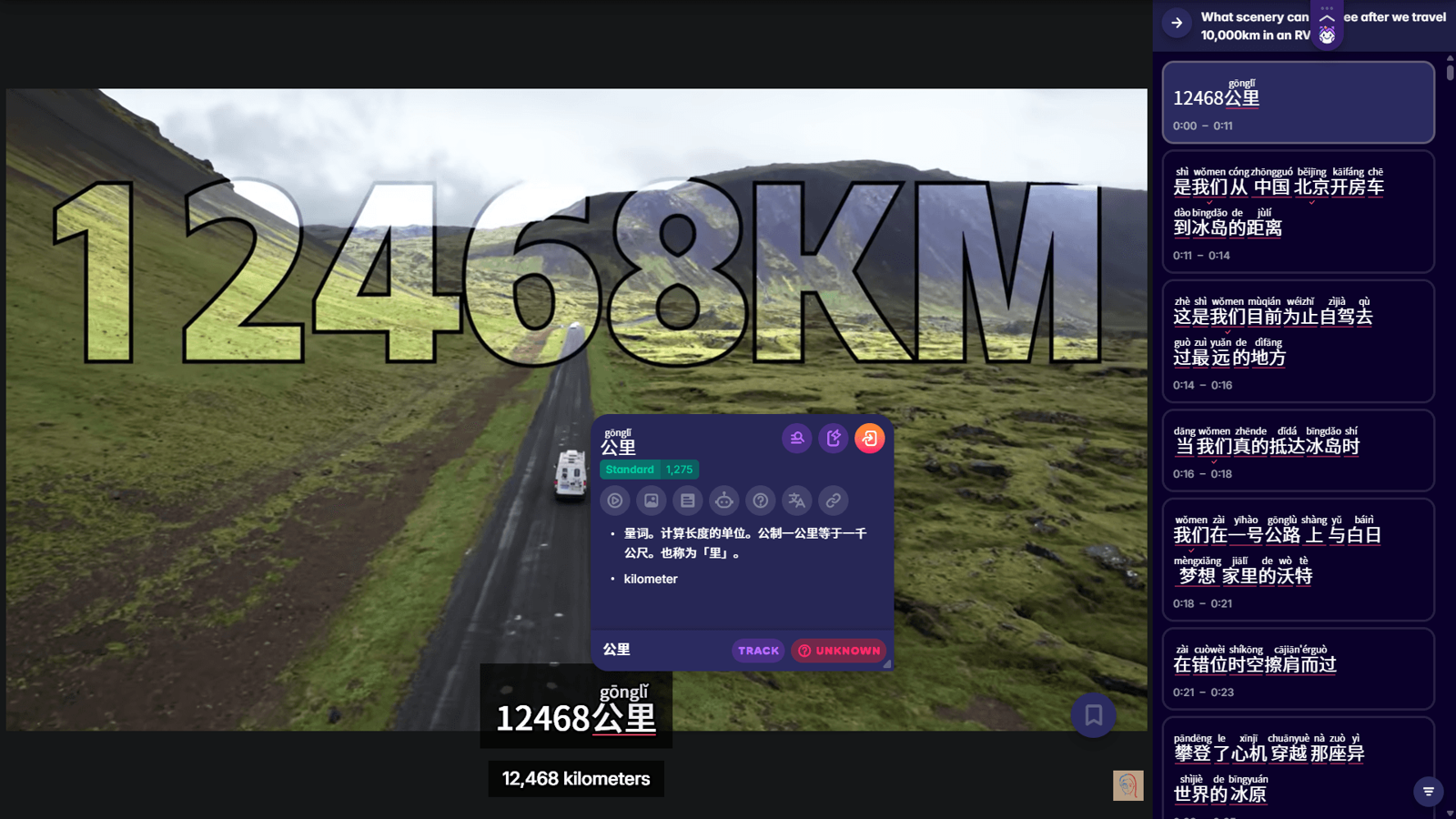
Anyway, if you want to practice this vocabulary with real Chinese content, Migaku's browser extension and app let you look up any word instantly while watching shows or reading articles. Makes learning from native content way more practical. There's a 10-day free trial if you want to check it out.
Learn the grammar patterns, and pay attention to context
Learning Chinese transport vocabulary works best when you see the patterns. Notice how 车 appears in land vehicles, how 站 means station for any type of transport, and how measure words change based on the vehicle type. When Chinese transport vocabulary words come up in conversation or media, pay attention to how these words appear in context. You'll start noticing the patterns, and the words will stick better than just memorizing lists.
If you consume media in Chinese, and you understand at least some of the messages and sentences within that media, you will make progress. Period.
Textbooks give you the words; media teach you how to use them.