# Japanese Casual Form: When to Use Casual Forms in Japanese
> When to use Japanese casual forms vs polite speech? Covers verb conjugation, social rules, and how to avoid sounding rude or overly formal.
**URL:** https://migaku.com/blog/japanese/japanese-casual-form
**Last Updated:** 2025-12-31
**Tags:** fundamentals, vocabulary, phrases, grammar
---
If you've been [learning Japanese](https://migaku.com/learn-japanese) for a while, and you've probably noticed that your textbook keeps throwing these ます (masu) endings at you for every verb. Then you watch an anime or Japanese drama, and suddenly nobody's using those [polite form](https://migaku.com/blog/japanese/japanese-keigo-honorific-language-guide)s anymore. What gives? This guide breaks down exactly when to use casual forms (also called plain form or dictionary form) versus polite forms in Japanese. We'll cover [verb conjugation](https://migaku.com/blog/japanese/japanese-verb-conjugation-complete-guide) differences, the social situations where each form works best, and how to avoid accidentally offending someone.
---
## What is Japanese plain form?
The plain form, sometimes called casual form or dictionary form, is the most basic way to express verbs, adjectives, and nouns in Japanese.
When you look up a verb in a dictionary, you'll find it in plain form: (taberu, to eat), (iku, to go), or (miru, to see).
But plain form does more than just show up in dictionaries. It's the foundation of casual Japanese conversation, the form you'll use with friends, family, and people close to you. It's also what you'll hear constantly in Japanese media, from movies to manga.
What is casual Japanese called? In Japanese, it's often referred to as タメ口 (tameguchi) or (futsūtai), meaning "plain style." This contrasts with (teineigo), the polite form that uses です (desu) and ます (masu).
Understanding the relationship between formal vs casual speech is crucial for anyone serious about learning Japanese beyond textbook basics.
---
## When to use casual forms: The social rules
Okay, so you know how to conjugate casual forms. But when should you actually use them? This is where things get culturally specific.
**Use casual forms with:**
1. Close friends your age: Once you've established a friendship with someone around your age, casual forms are the norm. Using polite forms constantly with close friends can create distance and make you seem standoffish.
2. [Family members](https://migaku.com/blog/japanese/japanese-family-words-complete-guide): Parents, siblings, cousins. Casual Japanese dominates family conversations, though some families use polite forms with grandparents or elder relatives.
3. People younger than you in informal settings: If you're significantly older or in a senior position, you might use casual forms with younger people, though they'll likely use polite forms back to you.
4. Close colleagues you've built rapport with: This one's tricky. Even if you're friends with coworkers, you might use polite forms at work and casual forms outside of work. Read the room.
5. In your own thoughts and writing: Diaries, personal notes, and internal monologue use plain form. This is why manga and novels often use casual Japanese for narration.
**Use polite forms with:**
1. Strangers: Always start with polite forms when meeting someone new. You can switch to casual later if they suggest it or if the relationship develops.
2. Customers and service workers: Retail, restaurants, hotels. Everyone uses polite forms in service contexts.
3. Teachers and professors: Even if you're friendly with them, stick to polite forms unless they explicitly tell you otherwise.
4. Bosses and superiors: This is non-negotiable in most Japanese workplaces. Use polite forms, possibly even keigo (honorific language).
5. Older people you don't know well: Age hierarchy matters in Japanese culture. When in doubt with older people, use polite forms.
6. Professional settings: Business meetings, interviews, formal presentations. Polite forms are the standard.
7. When introducing yourself in Japanese, you'll almost always start with polite forms unless you're in an explicitly casual setting like meeting friends of friends at a party.
---
## Verb conjugation: Masu form vs plain form
Let's get into the mechanics. The polite form of Japanese verbs uses the ます ending. The plain form drops this entirely and uses the verb stem in different ways depending on the tense.
**Present/Future tense:**
- Polite: (tabemasu) - eat/will eat
- Plain: (taberu) - eat/will eat
- Polite: (ikimasu) - go/will go
- Plain: (iku) - go/will go
**Past tense:**
- Polite: (tabemashita) - ate
- Plain: (tabeta) - ate
- Polite: (ikimashita) - went
- Plain: (itta) - went
**Negative present:**
- Polite: (tabemasen) - don't eat
- Plain: (tabenai) - don't eat
- Polite: (ikimasen) - don't go
- Plain: (ikanai) - don't go
**Negative past:**
- Polite: (tabemasendeshita) - didn't eat
- Plain: (tabenakatta) - didn't eat
The conjugation patterns differ significantly between verb types. Japanese verbs fall into three categories: ru-verbs (ichidan), u-verbs (godan), and irregular verbs. Curious to learn more about RU, U, and irregular verbs? Each type follows specific conjugation rules that you'll need to memorize.
---
## Adjectives and nouns: Desu vs da
Verbs aren't the only words that change between polite and casual forms. Adjectives and nouns get in on the action too.
**[I-adjectives](https://migaku.com/blog/japanese/japanese-adjective-conjugation) (adjectives ending in い):**
- Polite: (ōkii desu) - is big
- Plain: (ōkii) - is big
- Polite: (oishii desu) - is delicious
- Plain: (oishii) - is delicious
With i-adjectives, you can drop です entirely in casual speech since the adjective already functions as a complete predicate.
**Na-adjectives and nouns:**
- Polite: (shizuka desu) - is quiet
- Plain: (shizuka da) - is quiet
- Polite: (gakusei desu) - is a student
- Plain: (gakusei da) - is a student
The copula だ (da) replaces です (desu) in casual Japanese. You'll hear だ constantly in casual conversation, though sometimes speakers drop it entirely in certain contexts.
**Past tense with nouns:**
- Polite: (gakusei deshita) - was a student
- Plain: (gakusei datta) - was a student
---
## Pronouns change with formality too
The pronouns you use shift depending on whether you're speaking casually or politely. This adds another layer to the casual vs polite distinction.
**First-person pronouns:**
1. (watashi): polite, gender-neutral
2. (boku): casual, typically male
3. (ore): very casual, masculine
4. あたし (atashi): casual, feminine
**Second-person pronouns:** In polite Japanese, you often avoid second-person pronouns entirely and use the person's name instead. In casual Japanese, you might use:
1. (omae): casual, can be rude depending on context
2. あんた (anta): casual, somewhat rough
3. (kimi): casual, gentle
---
## Mixing forms: Questions and sentence-final particles
Here's where things get interesting. Japanese speakers don't always stick to one form throughout an entire conversation. You might use plain form verbs but add polite sentence-final particles, or vice versa.
**Questions in casual form:** Instead of using the polite か (ka) particle, casual questions often use rising intonation or casual particles:
1. ?
*Coming tomorrow?*
2. ?
*Did you eat this?*
3. ?
*Where are you going?*
The の (no) particle at the end softens questions and makes them more casual. You'll also hear んだ (nda) or just ん (n) used this way.
**Mixing polite and casual:** Sometimes you'll hear Japanese speakers use plain form verbs with です at the end:
。
*I'm going tomorrow.* (Explanatory tone)
This creates a middle ground between fully casual and fully polite speech.
Understanding Japanese particles helps you navigate these subtle variations in casual conversation.
---
## Common casual expressions and slang
Casual Japanese comes with its own set of expressions that you won't find in polite speech. These make your Japanese sound more natural and less textbook-y.
**Common casual contractions:**
1. ている (te iru) becomes てる (teru): (tabeteru) instead of (tabete iru) - eating
2. ては (te wa) becomes ちゃ (cha): (tabechau) instead of (tabete shimau) - end up eating
3. れば (reba) becomes りゃ (rya): (ikerya) instead of (ikeba) - if I can go
**Casual sentence endings:**
1. じゃん (jan): casual confirmation, like "right?" or "isn't it?"
2. っけ (kke): trying to remember something
3. な (na): masculine casual assertion
4. ね (ne): seeking agreement (used in both polite and casual)
---
## Regional variations in casual speech
Casual Japanese varies significantly by region. The Kansai dialect (, Kansai-ben) uses different verb endings and expressions than standard Tokyo Japanese.
**Kansai casual examples:**
1. (tabehen) instead of (tabenai) - don't eat
2. おる (oru) instead of いる (iru) - to be (for people/animals)
3. やん (yan) instead of じゃん (jan) - right?/isn't it?
Other regions have their own casual forms too. Osaka, Kyoto, Hiroshima, and Fukuoka all have distinct dialects that affect how people speak casually.
---
## Common mistakes learners make
**Using casual forms too early:** The biggest mistake is switching to casual Japanese before the relationship warrants it. When in doubt, stick with polite forms. Let the other person initiate the switch to casual.
**Mixing up verb types:** Conjugating a u-verb like a ru-verb (or vice versa) creates incorrect forms. (iku) becomes (ikanai), not .
**Forgetting the social context:** Using casual forms in a business email or job interview is a disaster. Always consider who you're talking to and where you are.
**Overusing textbook Japanese:** If you only ever use です/ます forms with friends, you'll sound stiff and overly formal. Practice casual conjugation.
**Not listening to native speakers:** The best way to learn when to use casual forms is by consuming Japanese media and paying attention to who uses which forms with whom.
---
## Practicing casual forms
How do you actually get comfortable with casual Japanese? Immersion is key.
**Watch Japanese shows and anime:** Pay attention to how characters speak to each other. Notice how they use casual forms with friends but switch to polite forms with teachers or strangers.
**Read manga:** Manga dialogue is almost entirely in casual form, making it perfect practice material. You'll see natural casual conversations with all the contractions and slang.
**Practice with language exchange partners:** Once you've built rapport with a language partner, ask if you can practice casual forms together. Most Japanese people are happy to help learners practice.
**Listen to podcasts and YouTube videos:** Casual Japanese podcasts give you hours of natural casual speech to absorb.
**Use comprehensible input:** Consuming content slightly above your level helps you internalize casual patterns naturally.
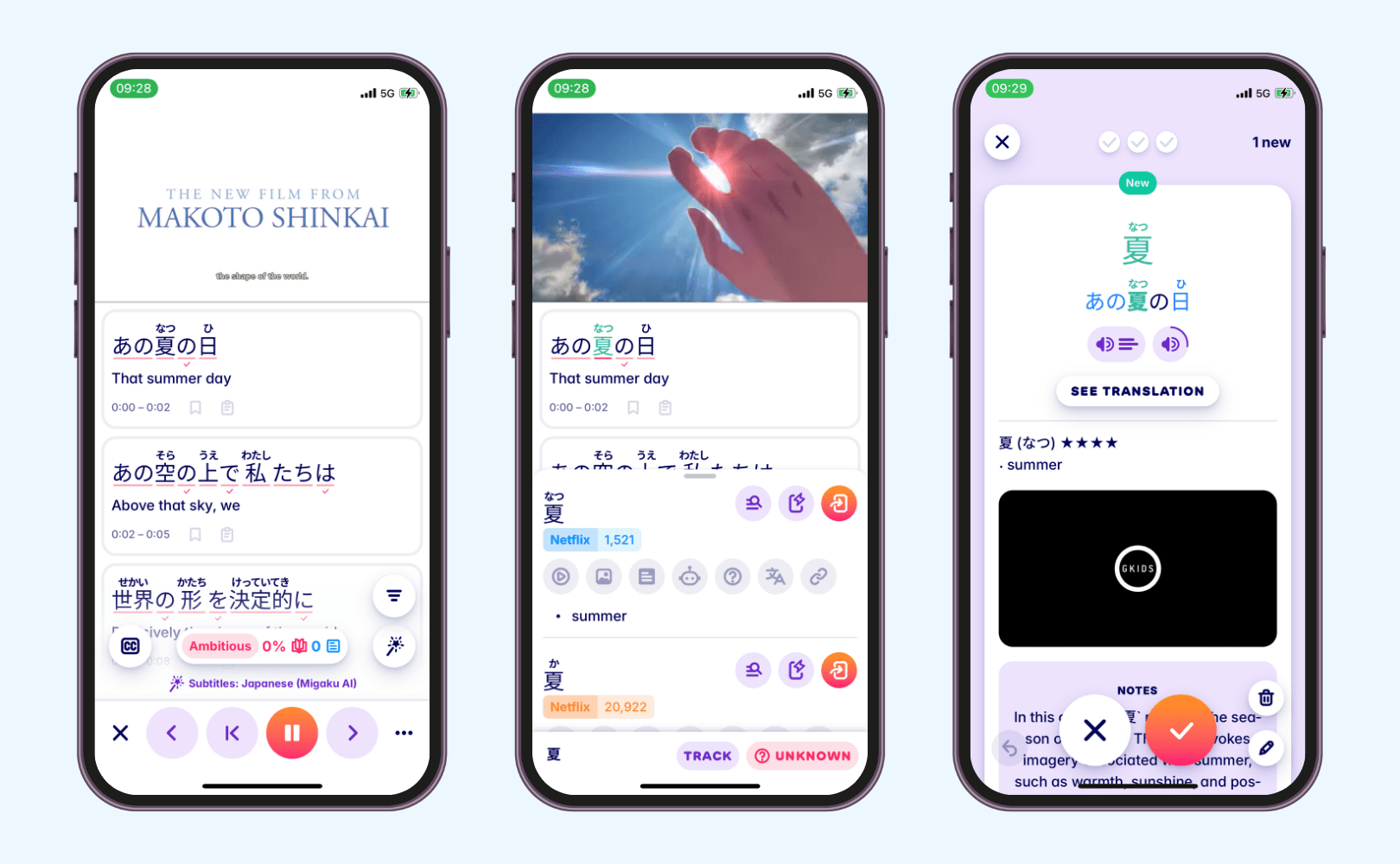
Anyway, if you want to actually practice these forms with real Japanese content, Migaku's browser extension and app let you look up words and save sentences while watching Japanese shows or reading articles. You'll see both casual and polite forms in context, which makes learning the differences way more natural. There's a 10-day free trial if you want to check it out.
 ---
## FAQs
Japanese follows sov (subject-object-verb) [word order](https://migaku.com/blog/japanese/japanese-word-order-basic-to-advanced-guide), unlike English which uses svo. This affects how casual sentences flow: , literally "I sushi eat".
Here's a specific example: bitter in Japanese casual form would be (nigai). The i-adjective already functions as a complete predicate in casual speech, so you don't need to add anything.
---
## Japanese casual forms draw you and your friends closer
Casual forms in Japanese are essential for natural conversation, but using them appropriately requires cultural awareness. The plain form shows up everywhere: in grammar structures, relative clauses, casual conversation, and Japanese media. You can't avoid it even if you wanted to. So embrace it, practice it, and pay attention to how native speakers use it in different contexts.
> If you consume media in Japanese, and you understand at least some of the messages and sentences within that media, you will make progress. _Period_.
Cherish and stay close!
---
## FAQs
Japanese follows sov (subject-object-verb) [word order](https://migaku.com/blog/japanese/japanese-word-order-basic-to-advanced-guide), unlike English which uses svo. This affects how casual sentences flow: , literally "I sushi eat".
Here's a specific example: bitter in Japanese casual form would be (nigai). The i-adjective already functions as a complete predicate in casual speech, so you don't need to add anything.
---
## Japanese casual forms draw you and your friends closer
Casual forms in Japanese are essential for natural conversation, but using them appropriately requires cultural awareness. The plain form shows up everywhere: in grammar structures, relative clauses, casual conversation, and Japanese media. You can't avoid it even if you wanted to. So embrace it, practice it, and pay attention to how native speakers use it in different contexts.
> If you consume media in Japanese, and you understand at least some of the messages and sentences within that media, you will make progress. _Period_.
Cherish and stay close!