# Japanese Counters List: Must-Know Counter Words With Examples
> Complete Japanese counters list with pronunciation, examples, and usage rules. Learn the essential counters for objects, animals, and time in Japanese.
**URL:** https://migaku.com/blog/japanese/japanese-counters-list
**Last Updated:** 2026-02-07
**Tags:** fundamentals, vocabulary, phrases, grammar
---
If you've been [learning Japanese](https://migaku.com/learn-japanese) for even a little while, you've probably noticed that counting things gets weird fast. You can't just say "three" and point at something. Japanese uses different counters depending on what you're counting, and honestly, it feels overwhelming at first. But here's the good news: most Japanese speakers use maybe 20-30 counters regularly, and you can get pretty far with even fewer. This guide breaks down the essential Japanese counters you'll actually use, with clear examples and pronunciation help to make learning them way less painful.😎
---
## How Japanese counters work
The Japanese language handles counting completely differently from English. Instead of saying "three dogs" or "two books," you need to use a specific counter word that matches what you're counting.
> The basic pattern goes: number + counter + object.
For example, to say "three dogs," you'd say 三匹. The counter is specifically for small animals. Change what you're counting to books, and you need a different counter: 三冊, where counts bound objects.
The tricky part? Japanese has somewhere between 300 to 500 different counters depending on who's counting. Some sources claim there are even more if you include archaic or super specialized ones. But before you freak out, remember that native speakers don't use most of these either. You'll cover 80% of daily situations with about 15 common counters.
---
## The generic counter: つ (tsu)
Thank goodness this exists. When you're starting to [learn Japanese](https://migaku.com/blog/japanese/how-to-learn-japanese-vocabulary) or just can't remember the specific counter for something, works as your safety net. It's a native Japanese counting system that goes from 1 to 10.
Here's how it works:
- (hitotsu) - One thing
- (futatsu) - Two things
- (mittsu) - Three things
- (yottsu) - Four things
- (itsutsu) - Five things
- (muttsu) - Six things
- (nanatsu) - Seven things
- (yattsu) - Eight things
- (kokonotsu) - Nine things
- (too) - Ten things
This counter saves you constantly. Ordering at a restaurant? "Mittsu kudasai" (Three, please) works fine. The pronunciation is straightforward compared to other counters, which makes it perfect for beginners. Past ten, you'll need to switch to specific counters, but honestly, this tsu system handles a ton of everyday situations.
---
## Basic counters you'll use constantly
### 個 (ko): Small, round-ish objects
The counter 個 is probably the most versatile specific counter you'll learn. It's used to count small, relatively compact objects that don't fit neatly into other categories. Think fruits, erasers, balls, eggs, basically anything smallish and roughly three-dimensional.
Examples:
- (ringo ni-ko) - Two apples
- (booru go-ko) - Five balls
- (keshigomu ikko) - One eraser
Notice how "ichi-ko" becomes "ikko"? That's a sound change that happens with certain numbers. The pronunciation shifts to make it easier to say. You'll see this pattern with many counters.
### 枚 (mai): Flat objects
Anything thin and flat gets counted with 枚. Paper, photographs, shirts, plates, pizza slices, tickets, you get the idea. If it's basically two-dimensional or sheet-like, mai is your counter.
Examples:
- (kami san-mai) - Three sheets of paper
- (shashin juu-mai) - Ten photographs
- (T-shatsu ni-mai) - Two T-shirts
This counter is super useful because so many everyday items are flat. Once you get comfortable with mai, you'll use it constantly.
### 本 (hon): Long, cylindrical objects
The counter 本 handles anything long and cylindrical. Bottles, pens, umbrellas, bananas, trees, even rivers and roads. The key is the elongated shape.
Examples:
- (pen ippon) - One pen
- (biiru ni-hon) - Two bottles of beer
- (kasa san-bon) - Three umbrellas
Here's where pronunciation gets interesting. Hon changes to pon or bon depending on the number. One is ippon, two is ni-hon, three is san-bon. These sound changes follow patterns, but honestly, you'll pick them up naturally with practice.
### 人 (nin): Counting people
When you need to count people, 人 is your counter. But watch out, because the first two numbers are completely irregular. After that, it follows a pattern.
Examples:
- (hitori) - One person
- (futari) - Two people
- (san-nin) - Three people
- (yo-nin) - Four people
The counter for Japanese people (or any people, really) starts with these irregular forms that just need memorization. You'll hear hitori and futari constantly in daily conversation, so they stick pretty quickly.
### 冊 (satsu): Bound objects and books
Books, magazines, notebooks, and anything bound together use 冊. This one's pretty straightforward in terms of what it counts.
Examples:
- (hon is-satsu) - One book
- (zasshi ni-satsu) - Two magazines
- (nooto san-satsu) - Three notebooks
Notice "ichi-satsu" becomes "is-satsu." These pronunciation changes happen to make the words flow better, and you'll get used to them as you practice.
---
## Counters for living things
### 匹 (hiki): Small animals
This counter handles most small animals like dogs, cats, fish, insects, basically anything that's not huge and not a bird. The pronunciation shifts between hiki, piki, and biki depending on the number.
Examples:
- 犬一匹 (inu ip-piki) - One dog
- 猫二匹 (neko ni-hiki) - Two cats
- 魚三匹 (sakana san-biki) - Three fish
When you're talking about pets or small animals, this is the counter you need. It's one of the most common ones for living creatures.
### 羽 (wa): Birds and rabbits
Birds get their own counter, and weirdly, so do rabbits (apparently because of some old Buddhist thing about classifying them as birds to get around eating restrictions). The counter is 羽, pronounced "wa."
Examples:
- 鳥一羽 (tori ichi-wa) - One bird
- 鶏五羽 (tori go-wa) - Five chickens
- 兎二羽 (usagi ni-wa) - Two rabbits
This is a pretty specialized counter, but if you're talking about birds or happen to discuss rabbits, you'll need it.
### 頭 (tou): Large animals
Big animals like horses, cows, elephants, lions get counted with 頭. It literally means "head," which makes sense when you think about counting livestock.
Examples:
- 馬一頭 (uma it-tou) - one horse
- 牛二頭 (ushi ni-tou) - two cows
- 象三頭 (zou san-tou) - three elephants
You won't use this daily unless you work on a farm or at a zoo, but it's good to know the different counter exists for larger animals.
---
## Time-related counters
### 回 (kai): Occurrences and frequency
When you want to say how many times something happens, 回 is the counter. "Three times a week," "once a day," that kind of thing.
Examples:
- (ik-kai) - One time
- (ni-kai) - Two times
- (nan-kai) - How many times
This counter shows up constantly when discussing routines, habits, or frequency of events.
### 分 (fun/pun): Minutes
Counting minutes uses 分, which alternates between "fun" and "pun" pronunciation depending on the number. It's one of those counters where the sound changes feel random at first.
Examples:
- (ip-pun) - One minute
- (ni-fun) - Two minutes
- (san-pun) - Three minutes
- (jup-pun) - Ten minutes
You'll use this counter every time you talk about duration or tell time, so it becomes second nature pretty fast.
### Days of the month
Counting days gets messy because Japanese uses different words for many dates rather than a consistent counter pattern. The day of the month doesn't follow the normal counting rules for most dates.
Examples:
- (tsuitachi) - 1st day
- (futsuka) - 2nd day
- (mikka) - 3rd day
- (juuyokka) - 14th day
These are basically vocabulary words you memorize rather than a counter you can construct logically. They're irregular and just need practice.
---
## Useful counters for specific situations
### 台 (dai): Machines and vehicles
Cars, computers, bicycles, appliances, basically any mechanical or electronic device gets counted with 台.
Examples:
- 車一台 (kuruma ichi-dai) - One car
- パソコン二台 (pasokon ni-dai) - Two computers
- 自転車三台 (jitensha san-dai) - Three bicycles
This counter comes up whenever you're talking about technology or transportation.
### 杯 (hai/pai/bai): Cups and glasses
Drinks in containers use 杯. Coffee, beer, water, anything in a cup or glass.
Examples:
- コーヒー一杯 (koohii ip-pai) - One cup of coffee
- ビール二杯 (biiru ni-hai) - Two glasses of beer
- 水三杯 (mizu san-bai) - Three glasses of water
Ordering drinks at a restaurant? This is your counter.
### 階 (kai): Floors of a building
When talking about building floors, 階 counts them. The pronunciation stays pretty consistent as "kai."
Examples:
- (ik-kai) - First floor
- (ni-kai) - Second floor
- (go-kai) - Fifth floor
You'll need this for giving directions, talking about where offices are located, or navigating department stores.
### 足 (soku): Pairs of footwear
Shoes, socks, anything you wear on your feet in pairs gets counted with 足.
Examples:
- 靴一足 (kutsu is-soku) - one pair of shoes
- 靴下二足 (kutsushita ni-soku) - two pairs of socks
Shopping for shoes? You'll hear this counter at every store.
---
## Learning Japanese counters without losing your mind
Here's the thing about counters: you don't need to memorize all 300+ of them. Focus on maybe 15-20 common counters and you'll handle most situations. The rest you can pick up gradually as you encounter them.
1. Start with the generic tsu counter and 個 (ko) since they're the most forgiving.
2. Then add counters based on what you actually talk about. If you love cooking, learn food-related counters. Into sports? Learn the ball and game counters.
3. Pronunciation changes feel random at first, but patterns emerge. Numbers like 1, 6, 8, and 10 often trigger sound changes (ichi becomes ip-, roku becomes rop-, etc.). You'll internalize these through exposure rather than memorization.
4. Practice with real content helps way more than drilling lists. When you're watching Japanese shows or reading articles and you see counters in context, they make way more sense.
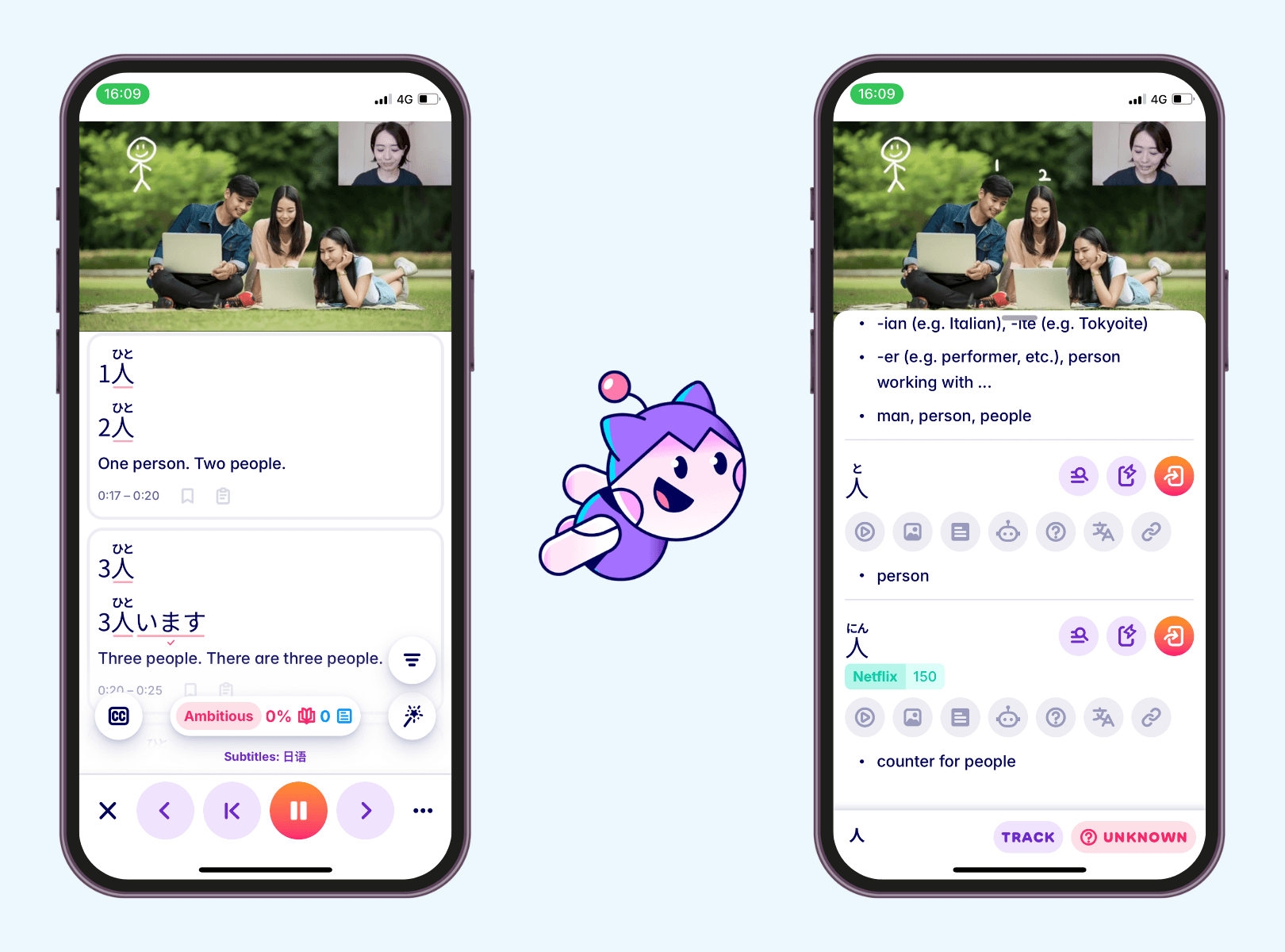
Anyway, if you want to practice counters with actual Japanese content, Migaku's browser extension and app let you look up unfamiliar counter words instantly while watching videos or reading. Sometimes the AI-generated subtitles do not show the pronunciation change, but the dictionary will display the correct hiragana for counters. There's a 10-day free trial if you want to check it out.
 ---
## Do you know that many Japanese counters are very similar to the Chinese ones?
Japanese and Chinese share many similarities in kanji, Chinese characters, pronunciation, and counters, of course. But the similarity can also be [false friends](https://migaku.com/blog/chinese/chinese-false-friends) that trick you badly! While 个/個 has the same usage in Chinese, 枚 is mostly for small objects like a brooch. By consuming more media, you will get more used to the range of use of each counter, but knowing Chinese definitely gives you a head start.
> If you consume media in Japanese, and you understand at least some of the messages and sentences within that media, you will make progress. _Period_.
Immersion beats rote memorization!
---
## Do you know that many Japanese counters are very similar to the Chinese ones?
Japanese and Chinese share many similarities in kanji, Chinese characters, pronunciation, and counters, of course. But the similarity can also be [false friends](https://migaku.com/blog/chinese/chinese-false-friends) that trick you badly! While 个/個 has the same usage in Chinese, 枚 is mostly for small objects like a brooch. By consuming more media, you will get more used to the range of use of each counter, but knowing Chinese definitely gives you a head start.
> If you consume media in Japanese, and you understand at least some of the messages and sentences within that media, you will make progress. _Period_.
Immersion beats rote memorization!