# Japanese Particle へ (E): How to Use Particle E and What’s Its Difference With Particle に
> The Japanese particle へ (e) is for direction and destination. Learn it with clear examples, comparison with に, and practical usage with motion verbs here.
**URL:** https://migaku.com/blog/japanese/japanese-particle-e-guide
**Last Updated:** 2026-01-16
**Tags:** fundamentals, vocabulary, phrases, grammar
---
You've stumbled across this weird particle that looks like it should say "he" but actually says "e" when [learning Japanese](https://migaku.com/learn-japanese)? Yeah, that's へ, and honestly, it confused the hell out of me when I first started learning Japanese too. The particle へ shows up constantly in everyday Japanese, especially when you're talking about going places. If you want to say you're heading to Tokyo, going home, or walking toward a store, you'll need へ. Let's break down exactly how to use it.
---
## What is the particle e in Japanese
The particle へ is pronounced as "e" (Like the "e" in "bed"), even though it's written with the [hiragana](https://migaku.com/blog/japanese/how-to-learn-japanese-for-beginners) character that normally says "he." This is one of those quirky Japanese grammar things you just have to memorize. When へ appears as a particle in a sentence, you always pronounce it as "e."
What is e used for in Japanese? The main job of へ is to indicate direction or destination. When you attach へ to a place name or location, you're saying "toward" or "to" that place. It works with motion [verbs](https://migaku.com/blog/japanese/japanese-verb-conjugation-complete-guide), those verbs that involve moving from one place to another.
Let me give you some concrete examples:
- 。
*I go to school.*
- 。
*I return home.*
- 。
*I came to Japan.*
See how へ sits right after the destination and before the verb? That's the standard pattern. The particle tells you which direction the action is heading.
---
## The motion verbs that work with へ
The particle へ pairs up with **motion verbs**. These are verbs that describe movement from point A to point B. The three most common ones you'll see are:
1. **Iku** () means "to go." This is probably the verb you'll use most with へ. Example: Tokyo e iku () means "to go to Tokyo."
2. **Kuru** () means "to come." When someone is moving toward the speaker's location, you use this. Example: Koko e kite kudasai () means "Please come here."
3. **Kaeru** () means "to return" or "to go home." Example: Ie e kaeru () means "to return home."
But へ works with tons of other motion verbs too. **Aruku** () means "to walk," **hashiru** () means "to run," **tobu** () means "to fly." Basically, if the verb involves moving toward somewhere, へ can indicate where you're headed.
---
## The real nuance of へ and に: Direction over destination
Alright, here's where it gets interesting.
### The emphasis of particle へ
> The particle へ emphasizes the direction you're moving rather than the specific endpoint.
It's about the path or trajectory toward something.
When you say umi e iku (), meaning "go to the ocean," you're emphasizing that you're heading in that direction. The focus is on the movement toward the ocean, the journey aspect of it.
This becomes super relevant when you compare へ to its cousin particle に, which we'll get into next. But just know that へ has this directional flavor to it. You're pointing yourself toward something and moving that way.
### The emphasis of particle に
What is に used for? The particle に (ni) also indicates destination, and this is where things get confusing for learners. Both へ and に can translate to "to" in English, and in many sentences, you can use either one.
> The particle に focuses more on the specific destination or endpoint.
It's about arriving at a particular location. When you use に, you're emphasizing where you end up, the target location itself.
Compare these two sentences:
- 。
*I'm going to Tokyo.* (With emphasis on heading in Tokyo's direction.)
- 。
*I'm going to Tokyo.* (With emphasis on Tokyo as the destination point.)
Honestly? In casual conversation, Japanese people use both pretty interchangeably when talking about going places. The difference is subtle, and most of the time, either particle works fine. But understanding the nuance helps you sound more natural and pick up on subtle meaning differences when listening.
There are some cases where you can only use に though. The particle に has way more functions than へ. You use に for:
1. [Time expressions](https://migaku.com/blog/japanese/japanese-time-expressions): Goji ni () means "at 5 o'clock." You can't use へ here.
2. Existence location: Tokyo ni sunde imasu () means "I live in Tokyo." The verb sumu () isn't a motion verb, so you need に.
3. Purpose: Eiga o mi ni ikimasu () means "I go to watch a movie." That に after the verb shows purpose.
4. Indirect objects: Tomodachi ni ageru () means "give to a friend."
The particle に does a ton of grammatical heavy lifting in Japanese. Meanwhile, へ pretty much just does the direction thing. So に is way more versatile, but へ has that specific directional meaning that に doesn't quite capture.
---
## Combining へ with other particles: は (wa) and の (no)
Sometimes you'll see へ combined with the topic particle は (wa). This happens when you want to make the destination the topic of your sentence.
- 。
*To Kyoto, I go by train.* (The combination へは puts extra emphasis on Kyoto as the destination being discussed.)
You might also see へ with the possessive particle の (no). For example, gakkou e no michi () means "the road to school." The の connects へ to the noun michi () meaning "road."
---
## Why へ matters for real Japanese
The particle へ shows up constantly in everyday Japanese conversation. Any time someone talks about going somewhere, coming from somewhere, or heading in a direction, you'll hear it.
1. It appears in train announcements: Shibuya e mairimasu () means "We're heading to Shibuya." The verb mairu () is a humble form of "to go."
2. You'll see it in written directions and instructions. Signs might say kita e () meaning "toward north" or deguchi e () meaning "toward the exit."
3. In casual conversation, people use へ all the time: Doko e iku no? (?) means "Where are you going?" This is probably one of the most common questions you'll hear in Japanese.
Understanding へ also helps you parse more complex grammar structures as you advance. The particle combines with other elements to create new meanings, and having that solid foundation makes everything easier.
---
## Common mistakes learners make
1. One mistake I see all the time is people trying to use へ with verbs that aren't motion verbs. Remember, へ works specifically with movement toward a place.
2. Another mistake is forgetting to pronounce へ as "e" when reading. I definitely said "he" for way too long when I started learning. When you see へ in a sentence, your brain needs to automatically switch to the "e" sound.
3. Some learners also overthink the へ vs に choice. Yeah, there's a nuance, but in most everyday situations, both work fine. Don't stress too much about picking the "perfect" particle. As you read and listen to more Japanese, you'll naturally develop a feel for which one sounds better in different contexts.
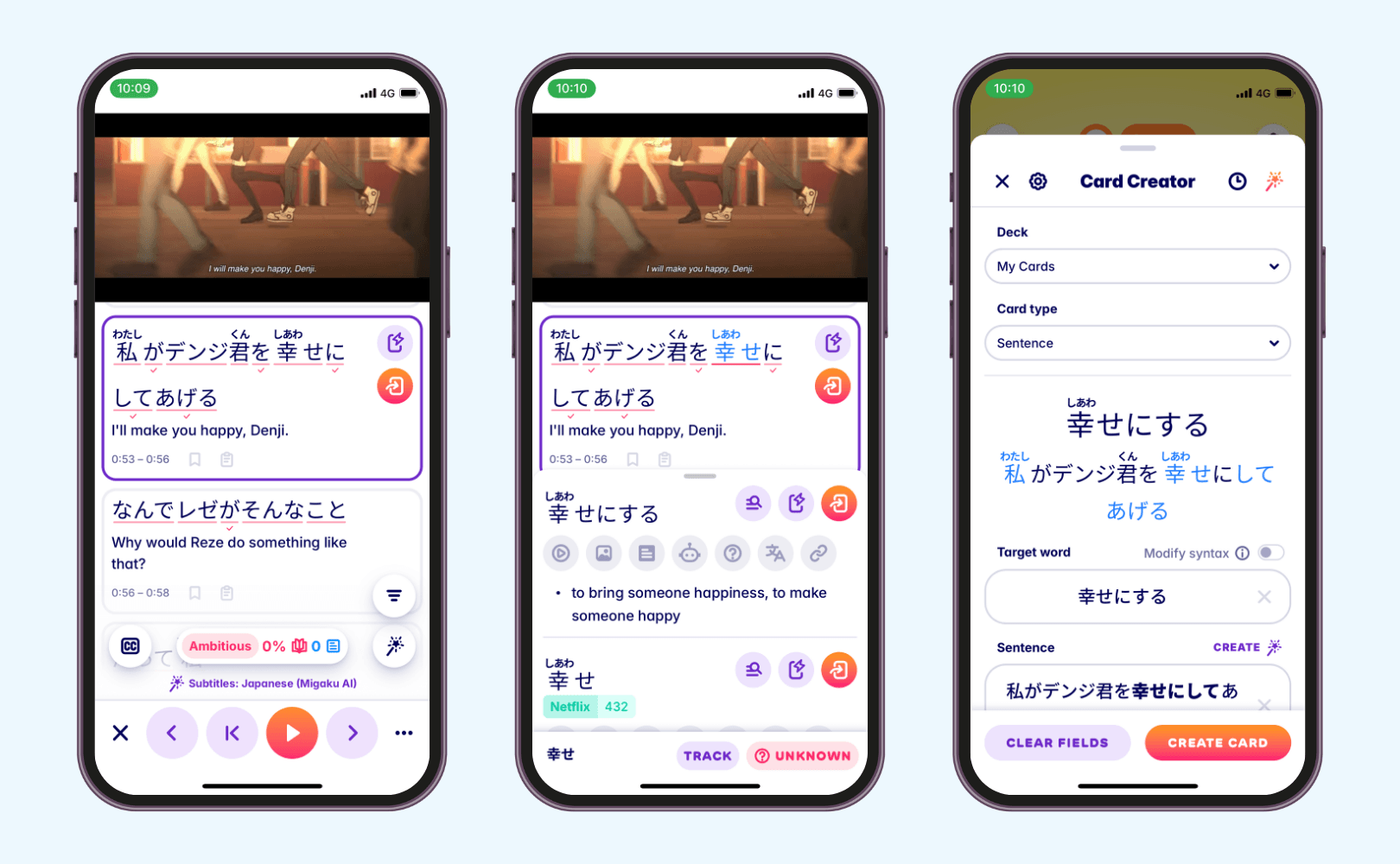
Anyway, if you want to actually practice with real Japanese content, Migaku's browser extension and app let you look up words and grammar points instantly while watching shows or reading articles. You can see particles like へ in context and save example sentences. There's a 10-day free trial if you want to check it out.
 ---
## Want to master Japanese particles? Follow your one and only teacher!
Honestly, the best way to master へ and all the other particles is just massive exposure to real Japanese. Grammar explanations help you understand the logic, but seeing the patterns over and over in actual use is what makes them stick. Media is your one and only teacher in the long run.
> If you consume media in Japanese, and you understand at least some of the messages and sentences within that media, you will make progress. _Period_.
Stick to immersion, no matter what your side-strategy is.
---
## Want to master Japanese particles? Follow your one and only teacher!
Honestly, the best way to master へ and all the other particles is just massive exposure to real Japanese. Grammar explanations help you understand the logic, but seeing the patterns over and over in actual use is what makes them stick. Media is your one and only teacher in the long run.
> If you consume media in Japanese, and you understand at least some of the messages and sentences within that media, you will make progress. _Period_.
Stick to immersion, no matter what your side-strategy is.