# Japanese Pronunciation Mistakes That Japanese Learners Should Avoid
> Careful with the most common Japanese pronunciation mistakes that trip up learners, from vowel length to pitch accent. Fix these and sound more natural.
**URL:** https://migaku.com/blog/japanese/japanese-pronunciation-mistakes
**Last Updated:** 2026-01-14
**Tags:** fundamentals, vocabulary, phrases, grammar
---
Are you making these Japanese pronunciation mistakes without even knowing it? Most [Japanese learners](https://migaku.com/learn-japanese) have no idea they're making these mistakes. Your brain fills in the gaps with sounds from English, and unless someone specifically points out what you're doing wrong, you'll keep reinforcing bad habits every time you practice. Let's break down the most common pronunciation mistakes that trip up beginners and intermediate learners alike. Some of these might surprise you, especially if you've been studying for a while.
---
## The Japanese r sound that confuses everyone
Did you pronounce れ correctly? If you're like most English speakers learning Japanese, probably not at first.
The Japanese R (ら, り, る, れ,ろ) causes endless confusion because it sounds nothing like the English R. When Japanese learners hear native speakers say words like ramen (ラーメン) or arigatou (ありがとう) - thank you, they often try to pronounce it with that hard American R sound. That's completely wrong.
The Japanese R sits somewhere between an English R, L, and D sound. When you pronounce it, your tongue should do a quick tap against the ridge behind your upper teeth, similar to the quick D sound in the American pronunciation of "ladder" or "butter."
> Think of it as a super light tap, almost like a soft L but with your tongue hitting that spot just once.
Regarding R and L, is the Japanese sound the same as the ㄹ in Korean? They're pretty similar, actually. Both involve that quick tap against the alveolar ridge. Korean learners often have an easier time with the Japanese R because of this similarity, while English speakers struggle since we don't have this exact sound in our language.
Try this: say "lotta" really fast in English. That middle sound where your tongue taps is close to the Japanese R. Now practice with ra (ら ), ri (り ), ru (る ), re (れ ), ro (ろ ). Your tongue should barely touch the roof of your mouth before pulling away.
---
## Vowel length actually matters
English speakers mess this up constantly because vowel length in English doesn't change word meanings. In Japanese? Totally different story.
Japanese has five basic vowel sounds: a (あ), i (い), u (う), e (え), o (お). Each vowel can be short or long, and getting this wrong will confuse native speakers or completely change what you're saying.
Take obasan (おばさん) - aunt, versus obaasan (おばあさん) - grandmother. The only difference is that long vowel sound in the middle. Say the wrong one at a family gathering and you've just called someone's aunt their grandmother. Awkward.
Or consider koko (ここ) - here, versus kouko () - high school. That extended o sound completely changes the meaning. When you see a long vowel marked in [hiragana](https://migaku.com/blog/japanese/how-to-learn-japanese) (Usually with an extra あ, い, or う), you need to hold that sound for exactly twice as long as a short vowel.
The problem is that English speakers tend to rush through vowels or add stress patterns that don't exist in Japanese. We're used to emphasizing certain syllables in words, but Japanese maintains relatively even stress across all syllables. Every vowel gets its proper length, no more, no less.
> Practice this: say "ah" for one beat, then "aah" for two beats.
Feel that difference? Apply that same principle to every long vowel you encounter. Words like sensei () - teacher, suugaku () - mathematics, and oneesan () - older sister all have long vowels that you need to hold.
---
## The silent u that isn’t silent
Here's where things get weird. The u vowel in Japanese gets devoiced (Whispered) in certain positions, particularly between voiceless consonants or at the end of words after voiceless consonants.
Words like desu (です) - to be (polite), and masu (ます) - polite verb ending, are pronounced more like "des" and "mas" by native speakers. That u sound barely registers. Same with sukiyaki () - a type of hot pot, where the first su gets devoiced.
> But here's what trips people up: the u isn't completely silent. There's still a tiny breath of sound there, just barely voiced.
Japanese learners either over-pronounce it ("deSU" with a full u sound) or drop it entirely, which sounds equally unnatural.
The i vowel does this too. In words like shita () - below/under, or kitte () - stamp, that i between the sh and t gets devoiced. Native speakers say something closer to "shta" and "kitte" with a whispered i.
This happens automatically for native speakers based on phonetic rules, but as a learner, you need to consciously practice it until it becomes natural. Listen carefully to how Japanese people actually pronounce common words like arigatou gozaimasu (ありがとうございます ) - thank you very much (Formal). That su at the end? Barely there.
---
## Consonant sounds you’re probably getting wrong
Japanese consonants seem straightforward at first, but several of them have subtle differences from English that learners miss.
The F sound in Japanese (ふ - fu) doesn't involve your teeth touching your lower lip like the English F. Instead, you make the sound by **blowing air between both lips**, almost like you're blowing out a candle gently. It's closer to a soft H sound with rounded lips. Try saying Fuji (富士 ) - Mount Fuji, with this technique. It should feel different from how you'd say "food" in English.
The H sound itself varies depending on the vowel that follows. Before i (ひ - hi), it becomes more of **a soft "sh" sound**, almost like the German "ich." This is why some Japanese learners struggle with words like hito (人 ) - person, or hidoi (ひどい ) - terrible.
Then there's the tsu (つ) sound, which doesn't exist in English as an initial consonant. English speakers want to say "tsu" as two separate sounds, like "t-su," but in Japanese it's one smooth sound. Your tongue position **for the t immediately releases into the s sound**. Practice with words like tsukue (机 ) - desk, and tsunami (津波 ) - tidal wave.
The n sound has a special case too. When ん appears at the end of a word or before certain consonants, it becomes **a moraic nasal**, meaning it takes up a full syllable beat but the exact sound changes based on what comes after it. In hon (本 ) - book, it sounds different from the n in konbanwa (今晩は ) - good evening. This syllable timing trips up learners who treat ん like a quick English n sound.
---
## [Pitch accent](https://migaku.com/blog/japanese/japanese-pitch-accent): The thing nobody tells you about
Most Japanese textbooks completely ignore pitch accent, which is a huge mistake. Japanese uses pitch (High or low) to distinguish between words that otherwise sound identical.
Take hashi (箸 ) - chopsticks, versus hashi (橋 ) - bridge, versus hashi (端 ) - edge. All three use the same syllables, but the pitch pattern differs for each one. In standard Tokyo Japanese, chopsticks starts low and goes high (LH), bridge starts high and goes low (HL), and edge is low-high as well (LH).
English speakers struggle with this because English uses stress accent (Louder/Longer syllables) rather than pitch accent. We make certain syllables louder and longer, while Japanese makes certain syllables higher or lower in pitch while keeping them roughly the same length and volume.
The good news? You can be understood without perfect pitch accent. The bad news? You'll always sound foreign without it, and occasionally you'll confuse people when context doesn't make your meaning clear.
Some common pitch accent mistakes: saying ame (雨 ) - rain, with the same pattern as ame (飴 ) - candy, or pronouncing sake (酒 ) - alcohol, the same as sake (鮭 ) - salmon. Native speakers figure it out from context most of the time, but learning the correct pitch patterns makes you sound way more natural.
---
## Double consonants need double time
> When you see a small tsu (っ) before a consonant, that indicates a geminate consonant, basically a pause before the next sound.
English speakers either ignore this completely or don't hold it long enough.
Compare kite (来て ) - please come, with kitte (切手 ) - stamp. That っ creates a distinct pause before the t sound. You should be able to count it as a full beat in the rhythm of the word.
Same with words like gakkou (学校 ) - school. Or kippu (切符 ) - ticket, where you pause before releasing the p sound.
The rhythm of Japanese depends on each mora (Sound unit) getting equal time. When you rush through or skip that geminate consonant pause, you throw off the entire rhythm of the sentence. Native speakers count beats unconsciously, and when yours don't match, it sounds off even if they can't immediately explain why.
---
## How to practice correct Japanese pronunciation
1. Fixing pronunciation mistakes requires consistent practice with native audio. You can't just read about these issues and expect to improve. You need to hear the differences, mimic them, and get feedback.
2. Start by recording yourself reading simple Japanese sentences, then compare your recording to native speaker audio. The differences will be obvious once you listen critically. Pay attention to vowel length, pitch patterns, and rhythm.
3. Shadow native speakers by playing audio and speaking along with it simultaneously. This forces you to match their speed, rhythm, and intonation patterns. Start with slow, clear speech from language learning resources, then gradually move to natural conversational speed.
4. Focus on minimal pairs, words that differ by only one sound. Practice hashi (Chopsticks) versus hashi (Bridge), or kitte (Stamp) versus kite (Come). Being able to hear and produce these distinctions will dramatically improve your overall pronunciation.
5. Use the IPA (International Phonetic Alphabet) to understand exactly how each Japanese sound should be produced. Knowing where your tongue should be and how air should flow gives you concrete targets to aim for instead of just guessing.
6. Don't ignore pitch accent just because it seems hard. Even learning the basic patterns for common words will make you sound more natural. Resources like online pitch accent dictionaries can show you the patterns for thousands of words.
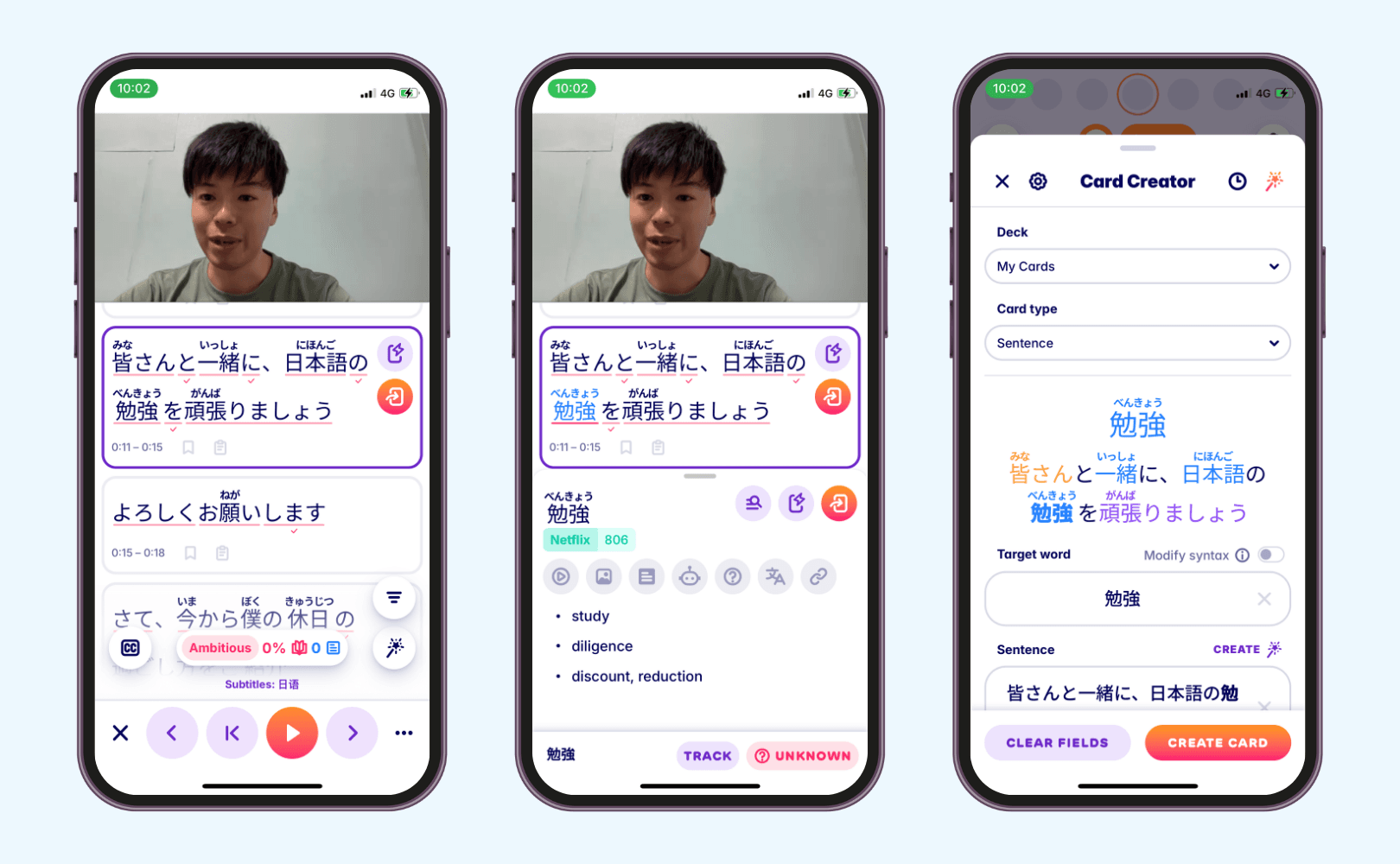
Anyway, if you want to actually practice these pronunciation patterns with real Japanese content, Migaku's browser extension and app let you look up words instantly while watching shows or reading articles, and you can hear native pronunciation for every word. Makes immersion learning way more practical. There's a 10-day free trial if you want to check it out.
 ---
## FAQs
Beyond individual sounds, learners make systematic mistakes in how they approach Japanese pronunciation overall. One huge issue: applying English stress patterns to Japanese words. Learners also tend to over-articulate in Japanese. They pronounce every sound very clearly and distinctly, which actually sounds unnatural.
---
## Pronunciation matters to not just speaking Japanese...
And here's something most learners don't realize: your listening ability and pronunciation ability are directly connected. The better you get at hearing the distinctions between sounds, the better you'll get at producing them. [Immersion](https://migaku.com/blog/japanese/japanese-immersion-learning) with native content trains your ear, which trains your mouth. The better you know the pronunciation, the faster you can catch sounds with your ears as well! That's why immersion with Japanese content matters!
> If you consume media in Japanese, and you understand at least some of the messages and sentences within that media, you will make progress. _Period_.
Better your pronunciation, and sharpen your ears!
---
## FAQs
Beyond individual sounds, learners make systematic mistakes in how they approach Japanese pronunciation overall. One huge issue: applying English stress patterns to Japanese words. Learners also tend to over-articulate in Japanese. They pronounce every sound very clearly and distinctly, which actually sounds unnatural.
---
## Pronunciation matters to not just speaking Japanese...
And here's something most learners don't realize: your listening ability and pronunciation ability are directly connected. The better you get at hearing the distinctions between sounds, the better you'll get at producing them. [Immersion](https://migaku.com/blog/japanese/japanese-immersion-learning) with native content trains your ear, which trains your mouth. The better you know the pronunciation, the faster you can catch sounds with your ears as well! That's why immersion with Japanese content matters!
> If you consume media in Japanese, and you understand at least some of the messages and sentences within that media, you will make progress. _Period_.
Better your pronunciation, and sharpen your ears!