Alien Registration Card in Korea: How to Get One as a Foreigner
Last updated: May 25, 2026
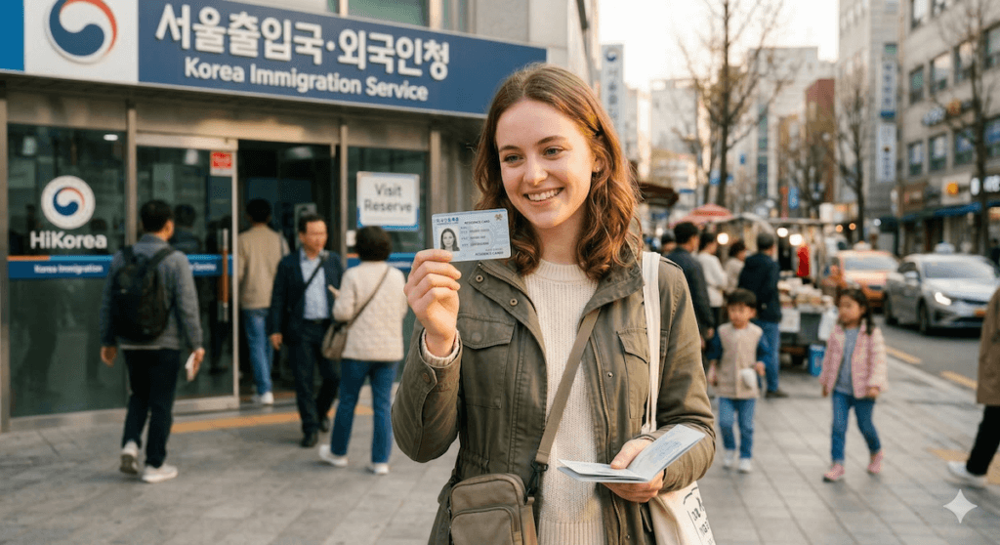
If you are staying in South Korea for more than 90 days, you must register with immigration and obtain a Residence Card (the document long known as the Alien Registration Card, or ARC). The process is handled by the Korea Immigration Service, costs KRW 30,000 in the standard case, and must be completed within 90 days of your arrival.
Last updated: May 25, 2026
What the ARC Actually Is in 2026
The document most foreigners still call the "Alien Registration Card" was officially renamed the Residence Card in January 2021, when the Ministry of Justice removed the word "alien" from the title. Most expats, landlords, banks, and HR departments still use the old name interchangeably, and the function is the same: it is your legal ID inside Korea, tied to your visa status, and required for almost every adult task you can think of.
With a Residence Card you can:
- Open a Korean bank account in your own name
- Sign a phone contract on a postpaid plan
- Register for National Health Insurance
- Sign a lease (jeonse or wolse)
- Verify your identity at hospitals, government offices, and online services that require a Korean ID number
- Buy train tickets, pick up packages, and use convenience-store ID-required services
Since January 2025, cards issued by immigration come embedded with an IC chip, and Korea also offers a free Mobile Residence Card through the official Mobile IDentification app on iOS and Android. The digital version has the same legal weight as the plastic card.
Who Needs a Residence Card (and Who Doesn't)
You must register if you hold a long-stay visa and plan to live in Korea for more than 90 days. This includes the common categories:
- D-2 / D-4 (student)
- E-1 through E-7 (professor, language instructor, specialty professional, etc.)
- F-2, F-4, F-5, F-6 (residence, overseas Korean, permanent resident, marriage)
- D-8, D-10 (corporate investor, job seeker)
- H-1, H-2 (working holiday, work-and-visit)
You are exempt if you hold one of the following diplomatic categories:
- A-1 (Diplomat)
- A-2 (Government official)
- A-3 (SOFA / treaty)
Tourists on visa-free entry or short-term C visas do not register, because they cannot legally stay past 90 days in the first place.
If you are coming on a specialty professional track, see our companion guide to the E-7 Specialty Visa in Korea for the visa-side requirements that feed into your ARC application.
The 90-Day Clock
You have 90 days from your date of entry to file your Residence Card application. The 90 days is counted from the entry stamp in your passport, not from the day you signed your lease or started your job.
Missing the deadline is not a small matter. Under the Korean Immigration Act, staying without registering can be penalized with fines up to KRW 10 million and, in serious cases, imprisonment of up to one year. In practice, late filers usually receive an administrative fine rather than criminal charges, but the fine scales with how late you are and how many previous violations are on your record. For the current penalty schedule, confirm with the Immigration Contact Center at 1345 or the official portal at immigration.go.kr.
A practical rule: book your immigration appointment within your first two weeks in Korea. Slots in Seoul fill up fast.
Document Checklist
The core documents are the same across visa types. Visa-specific add-ons vary.
For everyone:
- Completed application form (Form 34, available at the immigration office or downloadable from HiKorea)
- Original passport
- One color passport photo, 3.5 cm × 4.5 cm, taken within the last 6 months
- Proof of Korean address (lease contract, dorm certificate, or a hosting confirmation if you are staying with family or an employer)
- KRW 30,000 fee, paid by Government Revenue Stamp purchased at the office or a nearby bank
- Optional: KRW 3,000 extra if you want the card mailed to your address rather than picking it up
Additional documents by visa type:
Visa | Extra documents |
|---|---|
D-2 / D-4 (student) | Certificate of enrollment, tuition payment receipt |
E-1 / E-2 / E-3 / E-4 / E-5 | Employment contract, employer's business registration, diploma, criminal background check |
E-2 (language instructor) | Health check including drug test from a Ministry of Justice–designated medical institution |
E-7 (specialty) | Employment contract, company business registration, degree/experience proof |
F-4 (overseas Korean) | Proof of Korean heritage, family relationship documents |
F-6 (marriage) | Marriage certificate, spouse's Korean ID, family relation certificate |
F-5 (permanent resident) | Asset/income proof, integration test results, etc. |
Tuberculosis certificate. Nationals of 35 high-TB-burden countries (including China, Vietnam, the Philippines, Indonesia, Nepal, India, Pakistan, Russia, and others) must submit a TB (chest X-ray) certificate issued by a designated hospital. Children under 6 and pregnant women are exempt. The list is maintained by the Ministry of Foreign Affairs, and Korean designated hospitals are the easiest place to get the exam done after arrival.
How to Book and Apply: Step by Step
Walk-ins are generally not accepted at Korean immigration offices in 2026. You must book an appointment first.
Step 1: Create a HiKorea account
Go to www.hikorea.go.kr, switch the language to English in the top-right, and create an account using your passport number and entry information. HiKorea is the e-government portal of the Korea Immigration Service.
Step 2: Reserve a visit
From your HiKorea dashboard, choose "Reservation" and select:
- Office (pick the one with jurisdiction over your registered address, not the closest one to your job)
- Service type: "Foreign Registration"
- Date and time
In Seoul, the main immigration office is in Yangcheon-gu (Mok-dong). Other major offices include Suwon, Incheon, Busan, and Daegu. Provincial offices generally have shorter wait times than central Seoul.
Step 3: Get your photo and TB check done in advance
Korean photo studios near university districts will print 3.5 × 4.5 cm photos for around KRW 10,000. If you need a TB certificate, designated hospitals turn results around in 2–5 business days, so do this before your appointment.
Step 4: Pay the fee and submit at the office
At the immigration office, you will buy a Government Revenue Stamp (수입인지, suip-inji) for KRW 30,000 at the office or a partnered bank counter, fill out the final paperwork, hand over your passport-sized photo, and submit everything to the officer. You will receive a receipt and a tracking number.
Step 5: Wait for issuance
- Standard processing: approximately 4 weeks
- Student visa (D-2 / D-4) processing: approximately 5–6 weeks
During the waiting period, you cannot leave Korea, because your passport will be processed and you will not yet hold the new card. If you must travel, you need to apply for a re-entry permit, which is a separate procedure.
When the card is ready, you can collect it at the office or have it mailed for the extra KRW 3,000.
Fees at a Glance
Item | Cost (KRW) |
|---|---|
Standard Residence Card issuance | 30,000 |
Postal delivery (optional) | +3,000 |
IC-chip upgrade (for holders of pre-2025 cards) | 35,000 |
Mobile Residence Card via app | Free |
Visa extension (varies by category) | 60,000–120,000 |
Fees are paid by Korean Government Revenue Stamp, not cash to the officer. Bring a debit card or cash in won to buy the stamp on-site.
The Mobile Residence Card
Since January 2025, Korea has issued a free Mobile Residence Card to foreign residents aged 14 and over who hold a Korean smartphone contract registered in their own name.
- Download the Mobile IDentification App from the App Store or Google Play
- If your physical card was issued after January 1, 2025, the IC chip lets you activate the mobile version simply by tapping the card to your phone
- If your card was issued before 2025, you must visit an immigration office and scan a QR code to register the digital version
The mobile card is legally accepted at public institutions, hospitals, banks, convenience stores, and most ID-required transactions. Many expats now leave the plastic card at home for daily errands, though carrying the physical card is still required when traveling near border areas or when specifically requested by police.
After You Get the Card: What You Must Keep Updated
The Residence Card is valid for one year in most cases, with longer validity for permanent residents (F-5 cards are valid for 10 years and must be reissued before expiry).
You are legally required to report changes within strict deadlines:
- Address change: report within 14 days, either at the local district office (gu/si/eup-myeon) or via HiKorea
- Passport renewal: report within 14 days
- Workplace change (for work visas): report within 14 days
- Lost or damaged card: apply for reissuance within 14 days
Visa extensions can be filed up to 4 months before expiry on HiKorea. Do not wait until the final week; processing can take several weeks and overstay is treated harshly.
Common Pitfalls
- Booking the wrong office. Your application must be filed at the office covering your registered address. Booking the closest office to your workplace is a frequent mistake that ends in a rejected appointment.
- Wrong photo size. Korean immigration is strict about the 3.5 × 4.5 cm format and recent date. Photos from your home country often do not meet the standard.
- Missing the TB certificate. If you are from one of the 35 high-TB-burden countries and arrive without a certificate, you will be sent away to get one and rebook.
- Letting the 90-day window close. Even being a few days late triggers a fine.
- Trying to leave Korea during processing. Without a re-entry permit and with your passport in the system, you can be denied boarding.
- Assuming a tourist SIM is enough for the mobile card. The Mobile Residence Card requires a postpaid phone contract registered under your own name, which itself requires the physical Residence Card first.
FAQs
Can I apply before I have a permanent address?
No. You need a registered Korean address. If you are between apartments, use your employer's address, your university dorm, or a long-stay guesthouse that will issue a residence confirmation.
Can my employer or school apply on my behalf?
For some visa categories (notably E-series sponsored by larger companies and universities), an authorized representative can submit on your behalf with a power of attorney. You will still need to provide biometric photos and your passport.
Do I need to speak Korean for the appointment?
Most officers at major offices have basic English. Forms are available in English on HiKorea. For complex cases, bring a Korean-speaking friend or call 1345, which offers interpretation in multiple languages including English, Chinese, Vietnamese, Mongolian, and Russian.
What is the difference between the Residence Card and an F-5?
The F-5 is a visa category (permanent residency). When you hold an F-5, you still receive a physical Residence Card, but it is valid for 10 years and your conditions of stay are far less restrictive than on a work or student visa.
Can I drive on my home country's license while I wait?
A short-term international driving permit may cover you for up to one year depending on your country, but if you are staying long term you will eventually need to swap. See our guide on how to exchange a foreign driver's license in Korea.
Will I need my ARC to ride public transit?
No, the T-money card is anonymous. But knowing your way around the system helps; the Seoul Subway Guide for Foreign Visitors is a useful starting point.
Where do I check the official rules if something here conflicts with what an officer tells me?
The officer is always the final authority for your file. For published rules, the Korea Immigration Service at immigration.go.kr and HiKorea at hikorea.go.kr are the primary sources. The 1345 hotline is the fastest way to get a current answer.
Living in Korea is much smoother when you can actually read the paperwork in front of you, ask follow-up questions at the immigration counter, and understand what your landlord is saying. If you are settling in for the long haul, Migaku for Korean is built to help you learn from the kind of real Korean you will see every day.