# French Weather Vocabulary: Learn French Weather Terms as a Beginner
> Describe French weather like a pro! Learn French weather terms with essential patterns and talk about the weather confidently.
**URL:** https://migaku.com/blog/language-fun/french-weather-vocabulary
**Last Updated:** 2026-02-04
**Tags:** fundamentals, vocabulary, phrases, grammar
---
Talking about the weather in [French learning](https://migaku.com/learn-french) is one of those super practical skills that come up constantly in real conversations. Whether you're making small talk with locals, planning outdoor activities, or just trying to understand why everyone's complaining about the cold, you'll need this [vocabulary](https://migaku.com/blog/language-fun/3-things-to-learn-a-language). Let's break down everything you need to describe weather conditions like a native speaker.☂️
---
## Understanding French weather expressions
Here's the thing about weather in French: it works differently than English. You can't just translate "it's cold" word for word and expect it to sound right. French uses specific grammatical patterns that might feel weird at first, but they become second nature with practice.
1. The most common structure you'll use is "il fait " followed by an adjective or noun. This literally translates to "it makes" but functions as "it is" when talking about weather. So "il fait froid" means "it's cold" (Literally "it makes cold"). This pattern handles most basic weather descriptions you'll need as a beginner.
2. Another common pattern uses "il y a " (There is/There are) for weather phenomena like fog or wind.
3. You'll also encounter impersonal verbs like "il pleut " (It's raining) and "il neige " (It's snowing).
These three structures cover about 90% of weather conversations.
---
## Basic weather conditions with il fait
The "il fait" construction is your bread and butter for [french weather vocabulary](https://migaku.com/blog/language-fun/french-grammar-guide). You'll use this pattern constantly, so it's worth memorizing the most common combinations.
For nice weather, you'd say "il fait beau " (It's nice/beautiful). This is probably the most cheerful weather phrase you'll learn. When the sun's shining and everything feels perfect, that's your go-to expression. You might also hear "il fait bon " which means the temperature is pleasant, not too hot or cold.
When temperatures drop, "il fait froid " describes cold weather. In winter, you'll hear this constantly in France. The opposite is "il fait chaud" for hot weather, which you'll definitely need during summer months, especially in southern France where temperatures can get intense.
For other conditions, you've got "il fait frais " (It's cool/chilly), "il fait doux " (It's mild), and "il fait lourd " (It's humid/heavy). That last one is particularly useful because humid heat feels completely different from dry heat, and French speakers make that distinction.
---
## Key French weather terms using il y a
The expression "il y a " works for weather phenomena that you can think of as existing rather than being a condition. This might sound confusing, but the pattern is actually pretty straightforward.
"Il y a du vent " means "it's windy" (Literally "there is wind"). Same goes for "il y a du brouillard " (It's foggy), "il y a des nuages " (It's cloudy), and "il y a du soleil " (It's sunny).
Notice how you need the partitive article "du" or "de la" with uncountable nouns, and "des" with plural countable nouns.
You can combine these patterns too. Someone might say "il fait beau mais il y a du vent" (It's nice but windy). This flexibility lets you describe complex weather conditions accurately.
---
## Verbs to talk about the weather
Some weather conditions use specific [verbs](https://migaku.com/blog/language-fun/french-verb-conjugation) instead of the "il fait" pattern. These are impersonal verbs that only work with "il" as the subject.
The verb "pleuvoir " (To rain) becomes "il pleut " (It's raining). You'll hear this one all the time, especially if you're spending time in northern France or Paris.
Similarly, "neiger " (To snow) becomes "il neige " (It's snowing). These verbs conjugate normally in different tenses, so "il pleuvait" means "it was raining" and "il va pleuvoir" means "it's going to rain."
Other useful weather verbs include "briller " for shining, as in "le soleil brille" (The sun is shining).
The verb "souffler " means to blow, so "le vent souffle" describes windy conditions. You can also say "il vente" as an impersonal verb for "it's windy," though this is less common than using "il y a du vent."
---
## Essential French weather vocabulary
Let me give you a solid list of weather-related nouns you'll actually use. These French weather terms come up in forecasts, conversations, and everyday situations.
### Common weather nouns
Basic weather nouns include:
| French | English |
| - | - |
| le soleil | Sun |
| la pluie | Rain |
| la neige | Snow |
| le vent | Wind |
| le nuage | Cloud |
| le brouillard | Fog |
| l'orage | Storm |
| la grêle | Hail |
| le verglas | Black ice |
| la bruine | Drizzle |
### Talk about temperatures with French words
Temperature vocabulary matters too. The word "la température " works the same as English, but you'll often hear "les degrés " when discussing specific numbers.
In France, everything uses Celsius, so "il fait 25 degrés" means it's 25 degrees Celsius (About 77 Fahrenheit). The phrase "Combien de degrés fait-il?" asks "What's the temperature?" literally "How many degrees does it make?"
### French vocabulary for sky conditions
Sky conditions include "le ciel " (Sky), which can be "dégagé " (Clear), "couvert " (Overcast), or "nuageux " (Cloudy). You might hear "le ciel est bleu" (The sky is blue) on beautiful days.
---
## Extreme weather and specialized vocabulary with pronunciation
When you're ready to move beyond basic conditions, French weather terms for extreme weather become useful. These weather phrases might not come up daily, but you'll see them in news reports and weather warnings.
| French | English | Explanation |
| - | - | - |
| la tempête | Storm | |
| l'ouragan | Hurricane | |
| le typhon | Typhoon | |
| la tornade | Tornado | Tornado, which are rare in France but not unheard of |
| la tempête de neige | Snowstorm | Winter storm name |
| le blizzard | Blizzard | Works similarly to English |
| l'inondation | Flooding | |
| la sécheresse | Drought | |
| la canicule | Heat wave | A big deal in France where air conditioning isn't universal |
| la vague de froid | Cold snap | |
| l'avalanche | Avalanche | |
| la coulée de boue | Mudslide | |
| la grêle | Hail | When it's severe enough to cause damage |
---
## Asking about the weather in French
The most common question is "Quel temps fait-il?" which means "What's the weather like?" You'll hear this constantly, and it's the standard way to ask about current conditions. Notice it uses "[quel](https://migaku.com/blog/language-fun/french-question-words-how-to-form-questions)" (Which/What) with "temps" (Weather) and the "fait-il" inversion for the question form.
For checking the forecast, you'd ask "Quel temps fait-il demain?" (What's the weather like tomorrow?) or "Quelles sont les prévisions?" (What's the forecast?). The phrase "la météo " is the casual word for weather forecast, so "Tu as vu la météo?" means "Did you see the forecast?"
Temperature questions use "Combien de degrés fait-il?" as mentioned earlier. You might also hear "Il fait combien?" as a casual way to ask the same thing. For checking if it's cold, hot, or nice, people often just ask "Il fait froid?" or "Il fait beau?" with rising intonation.
---
## Weather expressions and idioms
French has some colorful idioms related to weather that don't translate literally. These phrases make you sound more natural and help you understand native speakers better.
1. "Il fait un temps de chien " literally means "it's dog weather" but actually describes terrible, miserable weather. You'd use this when it's cold, rainy, and generally awful outside. Pretty different from English dog-related idioms!
2. "Il pleut des cordes " translates to "it's raining ropes" and means it's raining heavily. The English equivalent would be "it's raining cats and dogs." Another heavy rain expression is "il pleut à verse" (It's pouring).
3. "Un temps pourri " describes rotten weather, the kind of day where you just want to stay inside. "Il fait un froid de canard" literally says "it's duck cold" and means it's freezing, bitterly cold.
4. For good weather, you might hear "Il fait un temps magnifique " (The weather is magnificent) or "Il fait un temps splendide ." These are more enthusiastic than just saying "il fait beau."
---
## What is the regional weather like
While standard French weather expressions work everywhere, some regions have specific terms worth knowing. This gets into more advanced territory but shows how rich the language can be.
1. In southern France, you'll hear about "le mistral ," a strong cold wind that blows down the Rhône valley. It's such a specific phenomenon that it has its own name. Similarly, "la tramontane " is a northern wind in the Mediterranean region.
2. Mountain regions use terms like "la poudreuse " for powder snow, important for skiing conditions. "Le redoux " describes a warming period in winter when snow starts to melt.
3. Coastal areas might use "la marée " (Tide) in weather discussions, though that's technically oceanography rather than meteorology. "La mer est calme" (The sea is calm) or "la mer est agitée" (The sea is rough) matter for sailors and beachgoers.
---
## Learn to describe the weather in French efficiently
If you're serious about learning French, weather vocabulary is a great place to start because you'll use it constantly. The patterns are consistent, so once you've got "il fait" down, you can plug in different adjectives easily.
1. Start with the five most common conditions: "il fait beau," "il fait froid," "il fait chaud," "il pleut," and "il y a du vent." These cover probably 80% of weather conversations. Practice them until they feel automatic.
2. Then add temperature vocabulary and the question "Quel temps fait-il?" so you can actually have basic exchanges. From there, build out with more specific conditions, extreme weather terms, and eventually idioms.
3. French course and French teachers often introduce weather vocabulary early because it's so practical. As a beginner, you can have real conversations about weather within your first few weeks of study. That's pretty motivating compared to more abstract grammar topics.
4. The verb patterns matter more than memorizing huge lists. Understanding when to use "il fait" versus "il y a" versus an impersonal verb will serve you better than knowing fifty weather words you can't use correctly.
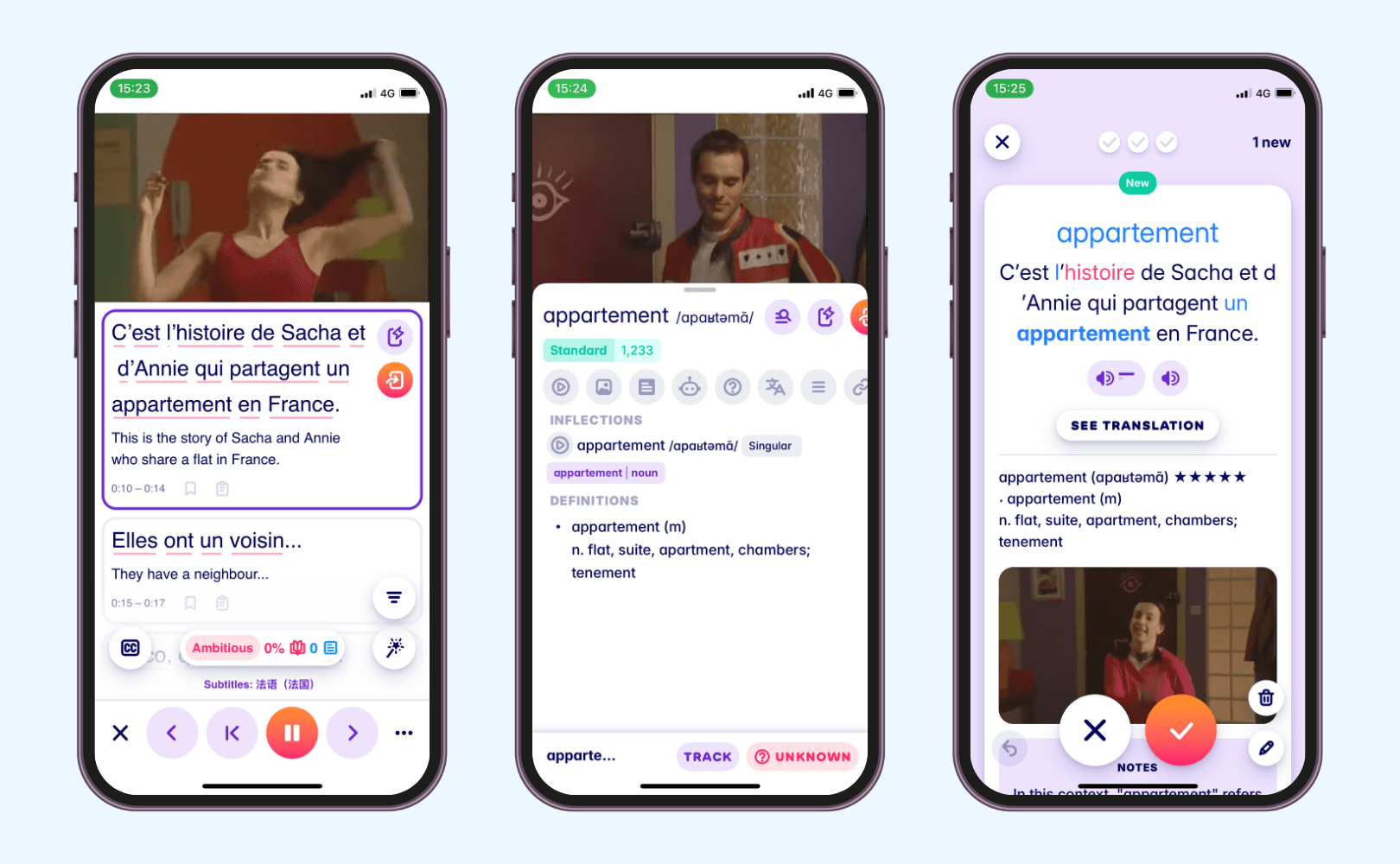
Anyway, if you want to actually practice this vocabulary with real French content, Migaku's browser extension and app let you look up words instantly while watching shows or reading articles. Makes immersion learning way more practical. There's a 10-day free trial if you want to check it out.
 ---
## Have you tried to learn French online via immersion?
If you're watching French TV shows or movies, pay attention to weather-related small talk. It comes up constantly in everyday scenes. You'll notice patterns in how native speakers actually use these expressions, which is different from [textbook](https://migaku.com/blog/language-fun/best-french-textbooks) and French lesson teaching examples sometimes.
> If you consume media in French, and you understand at least some of the messages and sentences within that media, you will make progress. _Period_.
Weather discussion is a powerful icebreaker!
---
## Have you tried to learn French online via immersion?
If you're watching French TV shows or movies, pay attention to weather-related small talk. It comes up constantly in everyday scenes. You'll notice patterns in how native speakers actually use these expressions, which is different from [textbook](https://migaku.com/blog/language-fun/best-french-textbooks) and French lesson teaching examples sometimes.
> If you consume media in French, and you understand at least some of the messages and sentences within that media, you will make progress. _Period_.
Weather discussion is a powerful icebreaker!