# Master These 3 Essentials for Language Learning Success
> Learning a new language doesn’t have to be complicated. Discover the only 3 essential steps you need to follow to achieve fluency efficiently and effectively."
**URL:** https://migaku.com/blog/language-fun/3-things-to-learn-a-language
**Last Updated:** 2025-01-15
**Tags:** discussion, fundamentals
---
Learning a language is actually really simple:

> When you consume media in a foreign language, and understand the messages within that media, you get better at the language. _Period_.

There's just one problem:

The best way to make money as a language learning company is by sabotaging learners—the slower people learn, the longer they remain as paying customers.

If you've tried several language learning apps but don't feel like you're making progress, the problem might not be you.

Here's what you need to do to learn a language:

<toc></toc>

<prose-button href="/pricing?utm_source=native&utm_medium=blog&utm_campaign=3-steps" text="See how Migaku helps"></prose-button>

---

## 1. Build a foundation _(this isn't what you think)_

The one and only goal of your first app or textbook should be to enable you to begin consuming content in the language you're learning.

1. Pick an app/textbook that seems useful and accessible
2. Skim it—don't worry about remembering everything
3. At least once a week, try to read or watch something in the language you're learning
4. When it feels even slightly doable, move on to step #2

> ❌ **Myth** ❌<br>You study, become fluent, then begin doing cool things in your language<br><br>
> ✅ **Reality** ✅<br>You take steps toward fluency by doing cool things in your language

The _real_ progress comes from simply interacting with your language, so don't overthink this.

Further reading:

- [The most common ~1,500 words make up ~80% of text in all media](/blog/japanese/how-to-learn-japanese-vocabulary)
- [How to overcome the absolute-beginner stage](/blog/language-fun/stages-of-language-learning)

<accordion heading="If you're learning Japanese or Mandarin...">

We spent over 10,000 hours making a super-optimized course to take you from zero to understanding most of Netflix in Japanese and Mandarin. Details here:

<custom-iframe src="https://www.youtube.com/embed/gFvZMZlUYfc?si=Dk1EG8yc9Qpag2kd"></custom-iframe>

<prose-button href="/" text="Try Migaku's courses for free"></prose-button>

</accordion>

## 2. Consume content you understand (and hopefully enjoy)

The #1 reason most learners fail to make progress in a foreign language is that they don't interact with it enough.

- If your goal is to get good at reading books, the metric that matters is _pages read_
- If your goal is to watch TV shows, the metric that matters is _minutes watched_
- These metrics are still important even if your goal is to talk well—you can't have a conversation if you can't understand what you hear

Or, more simply:

> What all successful language learners have in common is that they spent a massive amount of time interacting with the language they learned.

That's why Migaku's primary goal is to enable you to consume content in another language as early and efficiently as possible.
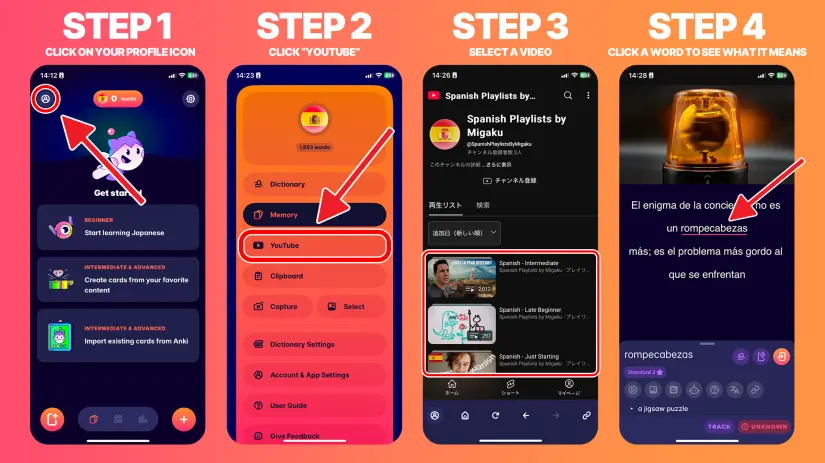
<img src="/assets/blog/migaku-flashcards-2.webp" width="1650" height="926" alt="A screenshot showing how Migaku enhances subtitles to help people learn foreign languages" />

<prose-button href="/pricing?utm_source=native&utm_medium=blog&utm_campaign=3-steps" text="Try Migaku for free"></prose-button>

Simply consume content and click on words you don't know. Migaku will show you what they mean, give you AI breakdowns of how the sentence works, and more.

<img src="/assets/blog/migaku-stages-dual-subtitles.jpeg" width="2880" height="1800" alt="A screenshot of an anime episode, showing Migaku's ability to display subtitles in two languages at once.." />

You'd be surprised how early you can begin consuming real media in the language you're learning when it takes less than a second to look up new words.

Further reading:

- [How to overcome the beginner and intermediate stages](/blog/language-fun/stages-of-language-learning)
- [How to learn Japanese by watching Netflix](/blog/japanese/learn-japanese-with-netflix) or [reading manga](/blog/japanese/learn-japanese-with-manga)
- [How to learn Spanish by watching telenovelas](/blog/language-fun/best-spanish-shows-guide)

## 3. Use flashcards to review the useful words you find in that content

I know, nobody wants to review. [But check this out](https://www.researchgate.net/profile/Stephen_Stahl2/publication/249008560_416-MPP_PlayItAgain/links/02e7e51e1f044483b7000000.pdf):

<img src="/assets/blog/migaku-forgetting-curve.jpeg" width="1984" height="1532" alt="A representation of the forgetting curve, or the lifespan of a piece of information we never review." />

If you don't periodically review what you learn, you're letting over 90% of your effort go to waste. Thankfully, [a bit of review goes a long ways](https://en.wikipedia.org/wiki/Forgetting_curve)!

<img src="/assets/blog/MigakuForgettingCurve.jpeg" width="1370" height="1190" alt="A chart showing how the forgetting curve flattens out if you periodically review information, sourced from Wikipedia" />

In fact, [simply spacing out your learning instead of cramming ("massed" review") leads to dramatically better retention of information](https://pmc.ncbi.nlm.nih.gov/articles/PMC3399982/):

<img src="/assets/blog/migaku-spaced-repetition-effectiveness.jpeg" width="1790" height="1380" alt="A chart showing the results generated by cramming learning, chunking it, and spacing it out." />

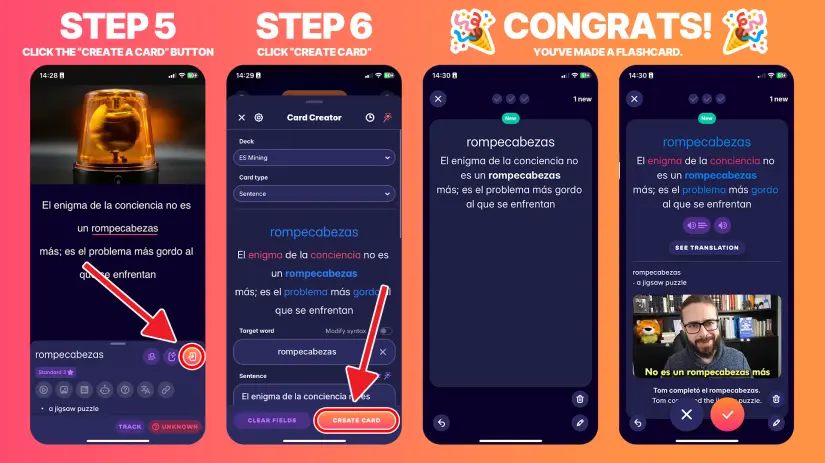
Research makes the importance of periodic review overwhelmingly clear, so we've designed Migaku to make doing review overwhelmingly easy:
<img src="/assets/blog/migaku-flashcards-3.webp" width="1650" height="926" alt="A screenshot showing how Migaku makes it easy to create flashcards out of the content you're consuming in another language" />

<prose-button href="/pricing?utm_source=native&utm_medium=blog&utm_campaign=3-steps" text="Try Migaku for free"></prose-button>

Click new words you see. If they seem useful, click another button to make a flashcard. Migaku's algorithms automatically figure out what you should learn next and when you should review old information.

Further reading:

- [A deep dive into research on memory and review](/blog/language-fun/spaced-repetition-language-learning)
- [A university student's goal to learn 4,000 Spanish words in four months](/blog/language-fun/how-a-premed-student-learns-spanish-fast)

---

## In summary

Once you establish your foundation, learning a language boils down to three things:

1. Consume content that you understand
2. Improve as a byproduct of enjoying yourself
3. Repeat

You can do that on your own, totally free, without any applications... but Migaku has been designed specifically to make this process as easy as possible.

<prose-button href="/blog/japanese/migaku-japanese-learning-discord" text="Ask 9k+ learners if Migaku is any good"></prose-button>

<CenteredText> or </CenteredText>

<prose-button href="/pricing?utm_source=native&utm_medium=blog&utm_campaign=3-steps" text="Try Migaku for free"></prose-button>

<CenteredText> Good luck 💪 </CenteredText>