# German vs French: Which Language Is Easier to Learn?
> Comparing French vs German for language learners. Find out which is easier, better for careers, and which challenges you'll be facing.
**URL:** https://migaku.com/blog/language-fun/german-vs-french
**Last Updated:** 2026-04-01
**Tags:** discussion, deepdive
---
So you're trying to decide between [German](https://migaku.com/learn-german) and [French](https://migaku.com/learn-french)? Both languages open up huge opportunities across Europe, and honestly, they're both worth learning. But if you're trying to pick just one to start with, there are some real differences that might make your choice easier. French tends to feel more familiar to English speakers at first, while German has this reputation for being super logical once you crack the code. Let's break down what makes each language tick and which one might be the better fit for you.
----
## Why this comparison matters for language learners
Here's the thing: German and French are two of the most popular languages to learn in Europe, and for good reason.
- French is spoken by over 275 million people worldwide and serves as an official language in 29 countries.
- German has around 130 million speakers, concentrated mainly in Germany, Austria, Switzerland, and parts of Belgium.
Both languages give you access to incredible literature, media, and career opportunities.
The practical benefits are pretty clear. If you're into international relations or diplomacy, French has historically been the language of choice. German, on the other hand, dominates in engineering, science, and business within Europe. Switzerland actually uses both French and German as official languages depending on the region, which shows how valuable both can be.
For an English speaker, the choice often comes down to which challenges you're willing to tackle first. Do you want to wrestle with pronunciation early on but enjoy familiar vocabulary? That's French. Or would you rather master some complex grammar rules upfront while getting clearer pronunciation? That's German.
----
## Grammar complexity: Cases vs gender
Let's talk grammar because this is where things get interesting.
### Cases in German grammar
German has four grammatical cases (nominative, accusative, dative, and genitive), which means the articles and adjective endings change depending on how a noun is used in a sentence. Yeah, it's a lot to track at first. You'll need to memorize which verbs take which cases, and the adjective declension tables can feel overwhelming when you're starting out.
### French vs German gender
French grammar is generally more straightforward for English speakers. It has two grammatical genders (masculine and feminine) instead of German's three (masculine, feminine, and neuter).
Both languages require you to memorize the gender of every single noun you learn. There's no way around it. In German, you absolutely need to know whether it's der, die, or das because that affects everything else in the sentence. In French, it's le or la. Pro tip: always learn the article with the noun from day one.
### French and German verbs
The verb conjugations in French are extensive, though. You've got multiple tenses and moods to learn, and irregular verbs pop up constantly.
German verbs are actually more predictable once you learn the patterns. The separable prefix verbs are weird at first (the prefix literally splits off and goes to the end of the sentence), but they follow consistent rules. German also has this thing where the verb goes to the end in subordinate clauses, which takes some getting used to.
----
## Which pronunciation is easy to learn
French pronunciation is famously tricky. You've got nasal vowels that don't exist in English, the uvular R sound that comes from the back of your throat, and a ton of silent letters. Words like "beaucoup" look nothing like they sound. The rhythm and intonation are completely different from English, too. You need to hear a lot of spoken French to start picking up the patterns.
German pronunciation is way more consistent. Once you learn the basic rules, you can usually figure out how to pronounce a word just by looking at it. The umlauts (ä, ö, ü) take some practice, and the "ch" sound has two variations depending on the vowels around it, but overall it's pretty logical. The R sound in German can be rolled or guttural depending on the region, but both are acceptable.
That said, German has some consonant clusters that English speakers find challenging. Words like "Schlittschuh" (ice skate) or "Streichholzschächtelchen" (little matchbox) are tongue twisters. But at least you know exactly which letters to pronounce, unlike French where half the letters in a word might be silent.
Learning French means you'll probably sound pretty rough for a while before things click. With German, you can achieve decent pronunciation earlier, even if you don't sound native.
----
## Vocabulary and cognates with English
This is where French has a massive advantage. English borrowed thousands of words from French after the Norman Conquest in 1066. Words related to law, government, art, and cuisine are often nearly identical. "Restaurant," "table," "important," "different," these are all cognates that make learning French vocabulary feel easier at first.
German is a Germanic language, just like English, so you'd think there would be tons of cognates, right? There are, but they're often disguised. "Haus" and "house" are obvious, but "Krankenhaus" (hospital, literally "sick house") requires you to break down the compound. German loves creating compound words by smashing existing words together, which is actually pretty cool once you get the hang of it.
The false friends in French can trip you up, though. "Actuellement" doesn't mean "actually," it means "currently." "Attendre" means "to wait," not "to attend." German has fewer of these traps for English speakers.
For building vocabulary quickly, French gives you more instant recognition. But German's compound system means you can often figure out what a new word means by breaking it into parts. Both approaches have their perks.
----
## Word order and sentence structure
French follows a **subject-verb-object** pattern, just like English. "Je mange une pomme" (I eat an apple) has the exact same structure as the English sentence. This makes constructing basic sentences pretty intuitive when you're starting out.
German word order is **more flexible and context-dependent**.
- In main clauses, it's usually subject-verb-object, but the verb has to be in the second position. If you start with a time expression or adverb, the subject and verb flip.
- Then in subordinate clauses, the verb goes all the way to the end. It sounds complicated, and honestly, it takes a while to internalize.
Questions in German also follow different rules. The verb typically moves to the first position for yes/no questions, which is similar to English. But the whole "verb at the end of subordinate clauses" thing means longer sentences can get confusing fast.
French keeps things simpler structurally. You add question words or use inversion for questions, but the basic framework stays consistent. This is one reason why learning French often feels easier in the beginning.
----
## Travel and career opportunities
French opens doors across multiple continents. It's widely spoken in Africa, parts of Asia, the Caribbean, and Canada. If you're interested in international organizations, French is one of the official languages of the UN, EU, and NATO. The language carries weight in diplomacy and international development.
German is more regionally concentrated but economically powerful. Germany has the largest economy in Europe, and German language skills are valuable for careers in engineering, automotive, pharmaceuticals, and finance. Austria and the German-speaking parts of Switzerland also offer great opportunities.
For travel within Europe, both languages are useful.
- French gets you through France, Belgium, Luxembourg, Monaco, and parts of Switzerland.
- German covers Germany, Austria, most of Switzerland, Liechtenstein, and parts of Belgium. Neither is as universally useful as English, but both expand your options significantly.
If you want to work for the EU institutions, knowing both French and German is actually ideal since they're two of the main working languages. But if you had to pick one for career purposes, think about your specific field. Tech and engineering lean German, international relations and culture lean French.
----
## Cultural access and media
French cinema, literature, and music have global influence. You can watch films from directors like François Truffaut or read Victor Hugo and Albert Camus in the original language. French rap and pop music have massive followings. The media landscape is rich and diverse.
German gives you access to philosophers like Kant and Nietzsche, writers like Goethe and Kafka (who wrote in German), and a thriving [modern film industry](https://migaku.com/blog/language-fun/best-german-shows-for-language-learners). [German YouTube and podcast scenes](https://migaku.com/blog/language-fun/best-german-podcasts) are huge. Plus, understanding German opens up Austrian and Swiss German media too, though Swiss German dialects are pretty different from standard German.
Both languages have excellent resources for learners. You can find tons of movies, shows, podcasts, and books to immerse yourself in. Netflix has good content in both languages, and YouTube channels for learners are plentiful.
The question is what kind of media you're drawn to. If you're into philosophy and classical music, German might appeal more. If you love cooking shows and fashion, French could be your thing. Honestly, both cultures offer so much that you can't go wrong.
----
## Whether you should learn French or German: The verdict for English speakers
If we're being honest, most English speakers find French slightly easier to learn initially. The vocabulary overlap gives you a head start, and the grammar, while not simple, doesn't require learning case systems. Pronunciation is tough, but the sentence structure feels familiar.
German requires more upfront effort with grammar. Those case endings and three genders demand serious memorization. But here's what's cool about German: once the rules click, they're incredibly consistent. The language has a logical structure that rewards systematic learning.
French stays challenging throughout because irregular verbs never stop coming, and the pronunciation-to-spelling relationship is unpredictable. You can study French for years and still encounter words you can't pronounce correctly on the first try.
The Foreign Service Institute ranks French in Category I (easiest languages for English speakers) and German in Category II. So we're talking maybe a 10-15% difference in difficulty, not a huge gap.
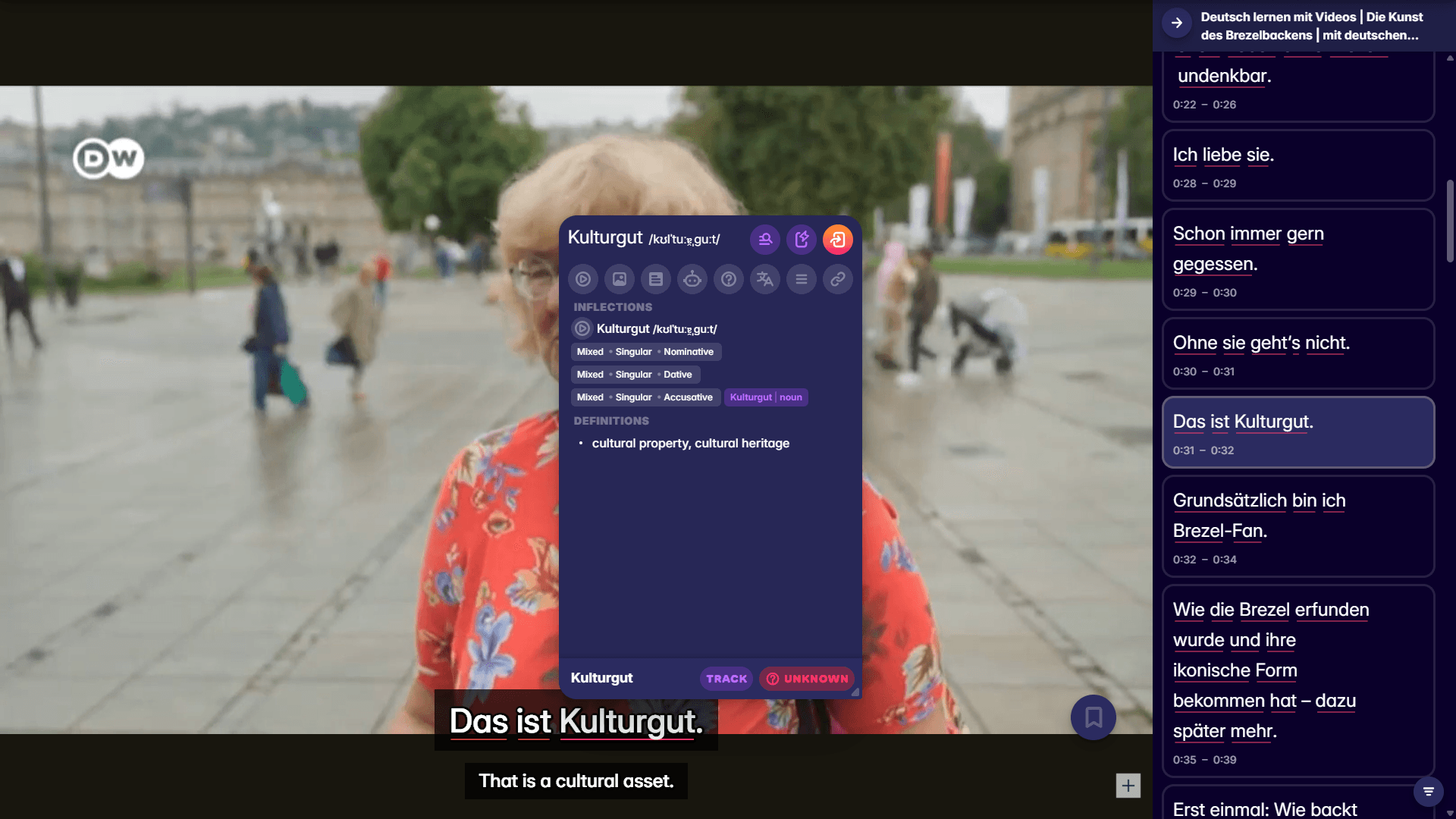
Migaku's browser extension and app actually make immersion way easier for both French and German. You can look up words instantly while watching shows or reading news articles, and save them directly to your flashcards with context. There's a 10-day free trial if you want to see how it works with real content.
 ----
## You're choosing a second language that will genuinely expand your world!
French gives you that romantic pronunciation challenge and opens up multiple continents. German offers logical grammar patterns and economic opportunities in Central Europe. Both will frustrate you at times, and both will eventually click if you put in consistent effort. The real secret? Immersion works for both languages. [Watch shows](https://migaku.com/blog/language-fun/best-french-shows-language-learners), read articles, [listen to podcasts](https://migaku.com/blog/language-fun/best-french-podcasts), and most importantly, save the words and phrases you encounter into your flashcards. That's how you go from textbook knowledge to actual fluent communication.
> If you consume media in German or French, and you understand at least some of the messages and sentences within that media, you will make progress. *Period*.
Consistent effort matters more than perfect choices!
----
## You're choosing a second language that will genuinely expand your world!
French gives you that romantic pronunciation challenge and opens up multiple continents. German offers logical grammar patterns and economic opportunities in Central Europe. Both will frustrate you at times, and both will eventually click if you put in consistent effort. The real secret? Immersion works for both languages. [Watch shows](https://migaku.com/blog/language-fun/best-french-shows-language-learners), read articles, [listen to podcasts](https://migaku.com/blog/language-fun/best-french-podcasts), and most importantly, save the words and phrases you encounter into your flashcards. That's how you go from textbook knowledge to actual fluent communication.
> If you consume media in German or French, and you understand at least some of the messages and sentences within that media, you will make progress. *Period*.
Consistent effort matters more than perfect choices!