Practice Saying Good Morning in Portuguese (Bom Dia & More)
Last updated: March 19, 2026

Learning how to greet someone properly in Portuguese opens up genuine connections, whether you're planning a trip to Brazil, chatting with Portuguese-speaking friends, or just expanding your language skills. The most common way to say good morning in Portuguese is "Bom dia," but there's a lot more to Portuguese greetings than just this one phrase. The timing, pronunciation, and regional differences all matter when you want to sound natural. Let me walk you through everything you need to know about saying good morning and other essential greetings in Portuguese.
- Understanding "Bom dia" (Good morning)
- Other essential time-based greetings
- Informal greetings in Portuguese language
- Combining greetings with follow-up phrases
- Using greetings in written Portuguese
- Cultural context for greetings
- Common mistakes English speakers make
- Practice tips for saying Portuguese greetings
Understanding "Bom dia" (Good morning)
The direct translation of good morning in Portuguese is "Bom dia." This phrase breaks down pretty simply: "bom" means good, and "dia" means day. You'll use this greeting from when you wake up until around noon or early afternoon.
Here's the thing about pronunciation. "Bom dia" sounds like "bohn DEE-ah" in English phonetics. The "o" in "bom" has a nasal quality that doesn't quite exist in English. Think of it like you're saying "bone" but cutting it short and adding that nasal sound. The "dia" part is more straightforward, with the emphasis on the second syllable.
One question people ask all the time: is it "bon dia" or "bom dia"? The correct spelling is definitely "bom dia" with an "m." Sometimes you might see "bon" in informal writing or texts, but that's just casual shorthand. The proper Portuguese term uses "bom."
Other essential time-based greetings
Learning Portuguese means understanding the full cycle of daily greetings. Each time of day has its own specific phrase.
Boa tarde (Good afternoon)
After the morning passes, you'll switch to "Boa tarde." This translates directly to good afternoon. The pronunciation sounds like "BOH-ah TAR-djee." Notice that "boa" is the feminine form of "bom" because "tarde" is a feminine noun in Portuguese.
You'd use "Boa tarde" roughly from noon or 1 PM until the evening starts, usually around 6 PM or when the sun begins setting. In Brazil, where the sun sets earlier in some seasons, people might switch to evening greetings a bit sooner.
Boa noite (Good evening/Good night)
"Boa noite" serves double duty in Portuguese. It means both good evening and good night. The pronunciation is "BOH-ah NOY-tchee." You'll use this greeting from early evening onwards, and also when saying goodbye at night.
This differs from English, where we distinguish between "good evening" (a greeting) and "good night" (typically a farewell). In Portuguese, "Boa noite" covers both situations. When you arrive somewhere after 6 PM, you say "Boa noite." When you leave at night, you also say "Boa noite."
Informal greetings in Portuguese language
Beyond the time-specific greetings, Portuguese has several casual ways to say hello that work any time of day.
Olá
"Olá" is the standard informal hello in Portuguese. It sounds like "oh-LAH" with a slight emphasis on the second syllable. You can use this greeting at any hour, making it super convenient when you're not sure which time-based greeting to use.
This term works great in casual conversations with friends, family, or people your age. It's less formal than "Bom dia" but still perfectly polite.
Oi
Even more casual than "Olá" is "Oi," which sounds like the English word "oy." This is extremely common in Brazilian Portuguese. You'll hear it constantly in Brazil, from kids greeting each other to friends meeting up.
In Portugal, "Olá" is more common than "Oi," though younger Portuguese people do use "Oi" sometimes. Regional variations like this make the language interesting to learn.
Combining greetings with follow-up phrases
When you greet someone in Portuguese, you'll often want to ask how they're doing right after. Here are the most common phrases you'll hear and use.
Tudo bem?
This literally translates to "everything well?" but functions as "how are you?" in conversation. The pronunciation is "TOO-doo bayn." You'll hear this phrase everywhere in Brazil.
A typical exchange might go:
- "Bom dia! Tudo bem?"
- "Tudo bem, e você?"
This means "Good morning! How are you?" followed by "I'm well, and you?"
Como vai?
Another way to ask how someone is doing is "Como vai?" which means "how goes it?" This is slightly more formal than "Tudo bem?" and you'll hear it more often in Portugal or in formal Brazilian contexts.
The pronunciation sounds like "KOH-moo vai." You might also hear "Como você está?" which is the full formal version meaning "how are you?"
E aí?
In very casual Brazilian Portuguese, friends might greet each other with "E aí?" which roughly translates to "what's up?" This is super informal and you'd only use it with people you know well. It sounds like "ee eye."
Using greetings in written Portuguese
When you're texting or writing in Portuguese, greetings can get abbreviated. You might see "Bom dia" shortened to "Bd" or "Boa noite" to "Bn" in very casual contexts.
In emails, you'd typically use the full greeting. A professional email might start with "Bom dia" or "Olá" followed by the person's name. The formality level depends on your relationship with the recipient.
Social media posts often use these greetings too. You'll see people posting "Bom dia" with a morning photo or "Boa noite" before logging off for the evening.
Cultural context for greetings
Understanding the culture behind greetings helps you use them more naturally.
In Brazil and Portugal, people tend to be warm and friendly with greetings. You'll often see people greeting everyone when they enter a room, even strangers in an elevator or waiting room.
Physical contact is common too.
- In Brazil, friends typically greet each other with kisses on the cheek (usually two, sometimes one depending on the region).
- In Portugal, it's often two kisses as well. Men might shake hands or do a handshake-hug combination with close friends.
In professional settings, handshakes are standard for first meetings. As you get to know colleagues better, greetings might become warmer with cheek kisses or friendly hugs.
The key thing is that greetings matter in Portuguese-speaking cultures. Taking a moment to properly greet someone shows respect and friendliness. Don't rush through your "Bom dia" or skip greeting people you encounter.
Common mistakes English speakers make
When learning to greet people in Portuguese, English speakers tend to make a few predictable mistakes.
- The nasal sounds in Portuguese don't exist in English, so words like "bom" can be tricky. English speakers often pronounce it like "bomb" instead of giving it that nasal quality. Practice by holding your nose slightly closed when saying these words.
- Another mistake is using greetings at the wrong time of day. Some learners stick with "Bom dia" all day long because it's the first phrase they learned. Remember to switch to "Boa tarde" after noon and "Boa noite" in the evening.
- Some people also confuse "bom" and "boa." Remember that "bom" is masculine and "boa" is feminine. You say "Bom dia" because "dia" is masculine, but "Boa tarde" and "Boa noite" because "tarde" and "noite" are feminine nouns.
Practice tips for saying Portuguese greetings
Getting comfortable with these greetings takes practice. Here's what actually works.
- Start by using these phrases with native speakers whenever possible. Language exchange partners, tutors, or Portuguese-speaking friends give you real practice with pronunciation and timing.
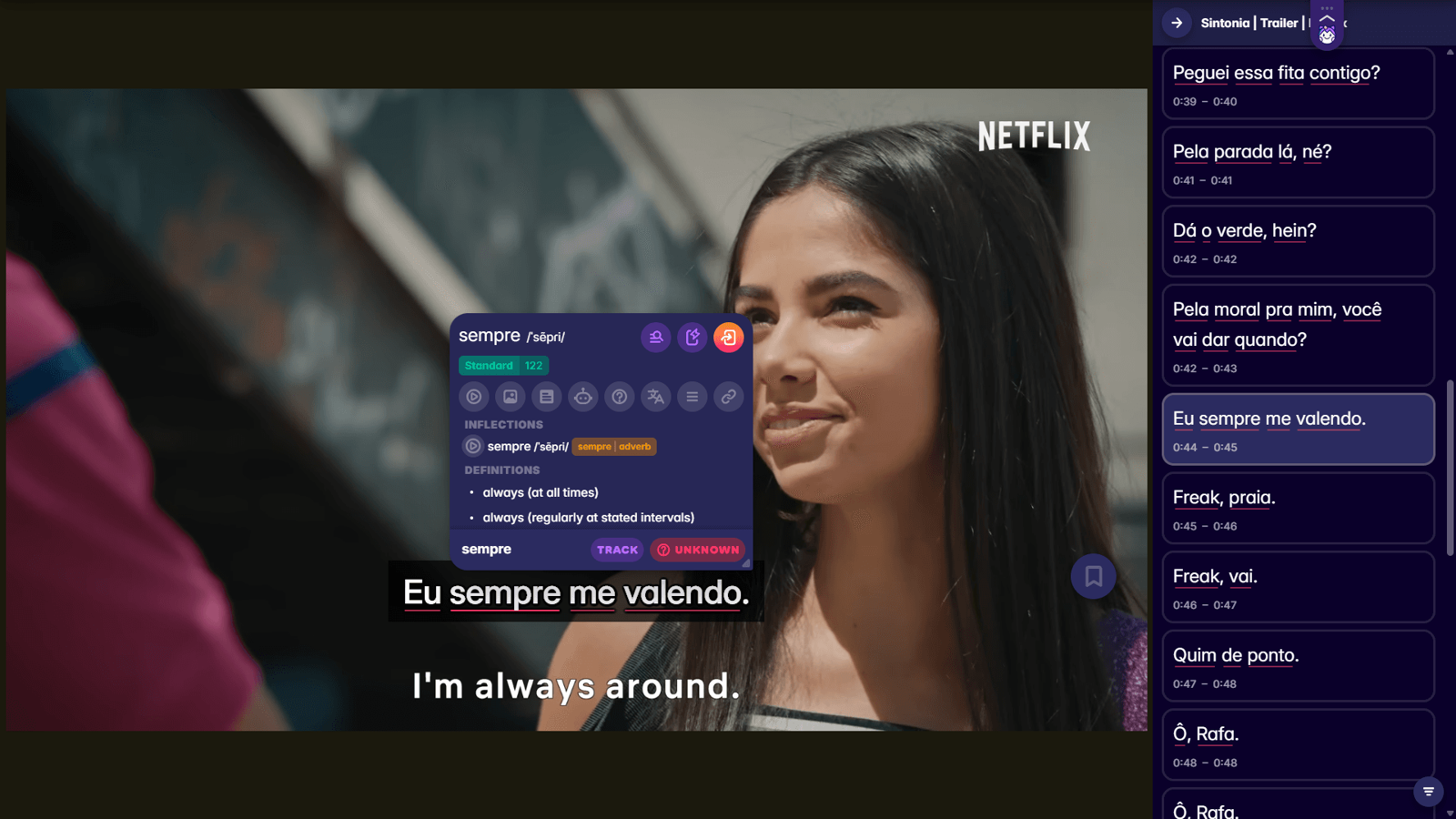
- Watch Portuguese content and pay attention to how people greet each other. Brazilian telenovelas, Portuguese films, or YouTube videos in Portuguese show you natural greeting patterns. You'll notice when people switch from "Bom dia" to "Boa tarde" and how they combine greetings with other phrases.
- Practice the pronunciation out loud, even if you feel silly. The nasal sounds and rhythm of Portuguese won't click until you actually say the words yourself. Record yourself and compare it to native speakers.
- Try to internalize the time-based pattern. Think about what greeting you'd use right now based on the time of day. This mental practice helps the phrases become automatic.
If you're serious about learning Portuguese, immersing yourself in real content makes a huge difference. Migaku's browser extension and app let you look up Portuguese words instantly while watching Brazilian shows or reading Portuguese articles, so you can learn greetings and vocabulary in actual context. There's a 10-day free trial if you want to see how much faster you pick up natural phrases when you're learning from real content.
Learning how to say good morning in Portuguese goes beyond just memorizing "Bom dia"
You're learning a whole system of time-based greetings that reflect how Portuguese speakers structure their day and interact with each other. And consistent exposure and practice is the way until you get comfortable with these phrases and their context.
If you consume media in Portuguese, and you understand at least some of the messages and sentences within that media, you will make progress. Period.
Another morning, another day of learning!☕☀️