# How Many Words to Be Fluent in a Foreign Language? (Real Numbers)
> How many words do you need for fluency? Spoiler: way less than you think. Get specific numbers for Spanish, Japanese, Chinese, German, and more.
**URL:** https://migaku.com/blog/language-fun/how-many-words-to-be-fluent
**Last Updated:** 2026-02-19
**Tags:** fundamentals, vocabulary, phrases, discussion
---
You're [learning a new language](https://migaku.com/) and wondering how many words you actually need to memorize before you can call yourself fluent. Good news: you don't need to know every word in the dictionary. The answer depends on what level you're aiming for and which language you're tackling, but most learners hit conversational fluency somewhere between 2,000 and 5,000 words. Native speakers might know 20,000+ words, but you definitely don't need that many to have real conversations or enjoy content in your target language.🎯
---
## What fluency means
Here's the thing: fluency means different things to different people. Some learners call themselves fluent when they can order food and ask for directions. Others won't use that word until they can debate philosophy or crack jokes naturally.
> ✅For most language learners, fluency means:
> - You can handle everyday conversations without constantly searching for words or translating in your head.
> - You understand most of what you hear.
> - You can express your thoughts clearly, and you're comfortable using the language in real situations.
The Common European Framework of Reference (CEFR) breaks language proficiency into six levels: A1, A2, B1, B2, C1, and C2. Most people consider **B2** the beginning of fluency, while **C1** gets you close to native-level proficiency. Each level requires a different vocabulary size.
### How to assess your vocabulary level
Wondering where you currently stand? Vocabulary size tests exist for most major languages. These tests sample words across different frequency ranges and estimate your total vocabulary based on which words you recognize.
For English, tests like the Vocabulary Size Test or TestYourVocab.com give you a decent estimate in about 5 minutes. Similar tests exist for Spanish, French, German, Japanese, and Chinese.
You can also estimate roughly based on what you can do with the language. If you can handle basic conversations about familiar topics, you probably know 2,000-3,000 words. If you can read news articles with minimal dictionary lookups, you're probably at 5,000-8,000 words.
---
## Vocabulary needed for each proficiency level
Let's break down how many words you need at each stage. These numbers come from linguistic research, though they vary slightly depending on which study you look at.
### Beginner level (A1-A2)
At the beginner stage, you need about **500 to 1,000 words**. This gets you through basic interactions like introducing yourself, ordering at restaurants, and asking simple questions. You'll recognize common greetings, numbers, colors, and everyday objects.
With 1,000 high-frequency words, you can understand roughly 70-80% of basic written texts and simple conversations. That might sound like a lot, but you'll still struggle with anything beyond survival-level communication.
### Conversational level (B1)
Around **2,000 to 3,000 words** puts you at conversational fluency. This is where things get interesting. You can discuss your hobbies, share opinions, tell stories about your day, and handle most travel situations without major problems.
Is 3000 words enough to speak a language? Yeah, actually. You won't sound sophisticated, but you can communicate effectively about familiar topics. Most everyday conversations use a surprisingly limited vocabulary, so 3,000 words covers the majority of what you'll encounter in casual settings.
### Advanced level (B2-C1)
B2 level requires about **4,000 to 6,000 words**. At this point, you can discuss abstract concepts, understand news broadcasts, read novels (with occasional dictionary lookups), and participate in professional discussions.
How many words does a C1 speaker know? Usually between 8,000 and 10,000 words. C1 is where you're approaching native-like fluency. You understand nuanced language, idioms, cultural references, and specialized vocabulary in your areas of interest. You can watch movies without subtitles and read complex texts with minimal difficulty.
### Native level (C2)
Native speakers typically know between **15,000 and 30,000 words**, depending on their education level and reading habits. A well-educated native speaker might recognize 30,000+ words passively, though they only use maybe 10,000 regularly in conversation.
You don't need to reach this level to be considered fluent. Plenty of successful language learners stop at C1 and live completely functional lives in their target language.
---
## Active vs. passive words in your target language
Your vocabulary splits into two categories: **active** and **passive**.
- Active vocabulary includes words you can recall and use spontaneously in conversation or writing.
- Passive vocabulary covers words you recognize and understand when you see or hear them, but wouldn't naturally use yourself.
Most learners have a passive vocabulary about 2-3 times larger than their active vocabulary. You might recognize 6,000 words when reading but only use 2,000 comfortably in conversation. That's completely normal.
The gap between active and passive vocabulary matters when you're evaluating your fluency level. If someone asks how many words you know, they probably mean active vocabulary since that determines what you can actually do with the language.
---
## High-frequency vs. uncommon number of words needed
Not all words carry equal weight.
- The 1,000 most common words in any language account for roughly 80-85% of everyday speech and informal writing. Learn those first, and you'll understand the majority of basic conversations.
- The next 1,000 words (Words 1,001-2,000) add maybe another 5-7% coverage. After that, you get diminishing returns. Each additional thousand words contributes less to your overall comprehension.
This is why experienced language learners focus on high-frequency vocabulary first. Learning the word "table" helps you way more than learning "chrysanthemum" in your first year of study.
Grammar words (like prepositions, conjunctions, and pronouns) make up a huge chunk of those high-frequency words. Words like "the," "and," "is," "to," and "in" appear constantly. You can't build sentences without them, so they're non-negotiable for any learner.
Meaning words (Nouns, verbs, adjectives, adverbs) carry the specific content of what you're saying. These vary more depending on your personal interests and the situations you find yourself in.
---
## Language-specific number of words you need
Different languages require different vocabulary sizes to reach the same functional level. The structure of the language matters a lot here.
### How many words do you need to be fluent [in Spanish](https://migaku.com/learn-spanish)
Spanish is pretty efficient. You can reach conversational fluency with about 2,000-3,000 words because Spanish uses a lot of cognates with English (if you're an English speaker) and has regular verb conjugation patterns. The grammar handles a lot of the heavy lifting.
### How many words do you need to be fluent [in Italian](https://migaku.com/learn-italian)
Italian sits in a similar range as Spanish, around 2,000-3,500 words for solid conversational ability. Italian also shares tons of cognates with English and other Romance languages, which speeds up the learning process.
### How many words do you need to be fluent [in German](https://migaku.com/learn-german)
German requires maybe 3,000-5,000 words for conversational fluency. The language builds compound words like "Geschwindigkeitsbegrenzung" (Speed limit), which technically counts as one word but contains multiple meaning units. This makes counting tricky.
German also has gendered nouns and case systems that add complexity beyond just memorizing vocabulary. You need to learn each noun with its gender and plural form, which effectively triples your memorization load for nouns.
### How many words to be fluent [in Japanese](https://migaku.com/learn-japanese)
Japanese is interesting because the writing system complicates things. You need about 3,000-5,000 words for conversational fluency, but you also need to learn around 2,000 kanji characters to read comfortably.
The Japanese-Language Proficiency Test (JLPT) estimates that N2 level (Roughly equivalent to B2/C1) requires about 6,000 words and 1,000 kanji. N1 level (Advanced) requires about 10,000 words and 2,000 kanji.
Japanese also relies heavily on context and particles to convey meaning, so raw vocabulary numbers don't tell the whole story. You need to understand how words combine with particles like , , , and to actually use the language.
### How many words to be fluent [in Chinese](https://migaku.com/learn-chinese)
Chinese requires about 3,000-5,000 words for conversational fluency. The HSK 9 exam (the highest level of the standard Chinese proficiency test) requires knowledge of about 10,000 words.
Chinese grammar is relatively simple compared to languages with complex conjugation systems, but the tonal nature of the language and the character-based writing system add different challenges. Each character might have multiple pronunciations and meanings depending on context.
---
## Context-based word learning to become fluent in a language
Learning words in isolation sucks. Your brain remembers vocabulary way better when you encounter words in meaningful contexts.
If you memorize that "run" means a type of movement, you might miss that it also means to operate something ("Run a business"), to flow ("The river runs"), or to extend ("The road runs north"). Context teaches you these nuances naturally.
Sentence mining, where you save entire sentences containing new words, works better than traditional vocabulary lists. You learn the word plus how native speakers actually use it. This approach also teaches you collocations (Words that commonly appear together) and natural phrasing.
Reading and listening to content slightly above your current level exposes you to new vocabulary in context. You can usually guess meanings from surrounding words, and the repetition across different texts reinforces what you've learned.
---
## Practical learning strategies to learn the words fast
So how do you actually build up your vocabulary to these numbers?
### Focus on frequency lists
Start with frequency lists of the most common 1,000-2,000 words in your target language. These lists exist for pretty much every major language. Learn these words first before branching out into specialized vocabulary.
### Specialized vocabulary
The numbers we've discussed focus on general vocabulary for everyday life. If you need your foreign language for specific purposes like business, medicine, or academic research, you'll need additional specialized vocabulary on top of the base.
Medical professionals might need an extra 2,000-5,000 medical terms. Business professionals need industry-specific jargon. Academic reading requires knowledge of formal vocabulary and technical terms in your field.
The good news is that specialized vocabulary builds on top of your general vocabulary foundation. Once you have solid conversational fluency, adding specialized terms is relatively straightforward because you already understand the grammar and basic structure of the language.
### Use spaced repetition
[Spaced repetition systems (SRS)](https://en.wikipedia.org/wiki/Spaced_repetition) like Anki help you review vocabulary at optimal intervals to maximize retention. You'll remember way more words with less total study time compared to cramming or random review.
The science behind spaced repetition shows that reviewing material right before you're about to forget it creates stronger memory traces. SRS software automates this scheduling for you.
### Learn word families
Instead of learning "write," "writer," "writing," and "written" as four separate words, learn them as a family. This multiplies your vocabulary faster because you're recognizing patterns rather than memorizing everything individually.
Many languages build words through prefixes and suffixes. Learning these building blocks lets you decode new words even when you haven't seen them before.
### Immerse yourself
Watching shows, reading books, and listening to podcasts in your target language exposes you to vocabulary in natural contexts. You'll see the same words repeated across different situations, which reinforces learning.
[Immersion](https://migaku.com/blog/language-fun/comprehensible-input-method-language-learning) also teaches you which words actually matter. Textbooks love teaching vocabulary for "pencil sharpener" and "stapler," but real content shows you what native speakers actually talk about.
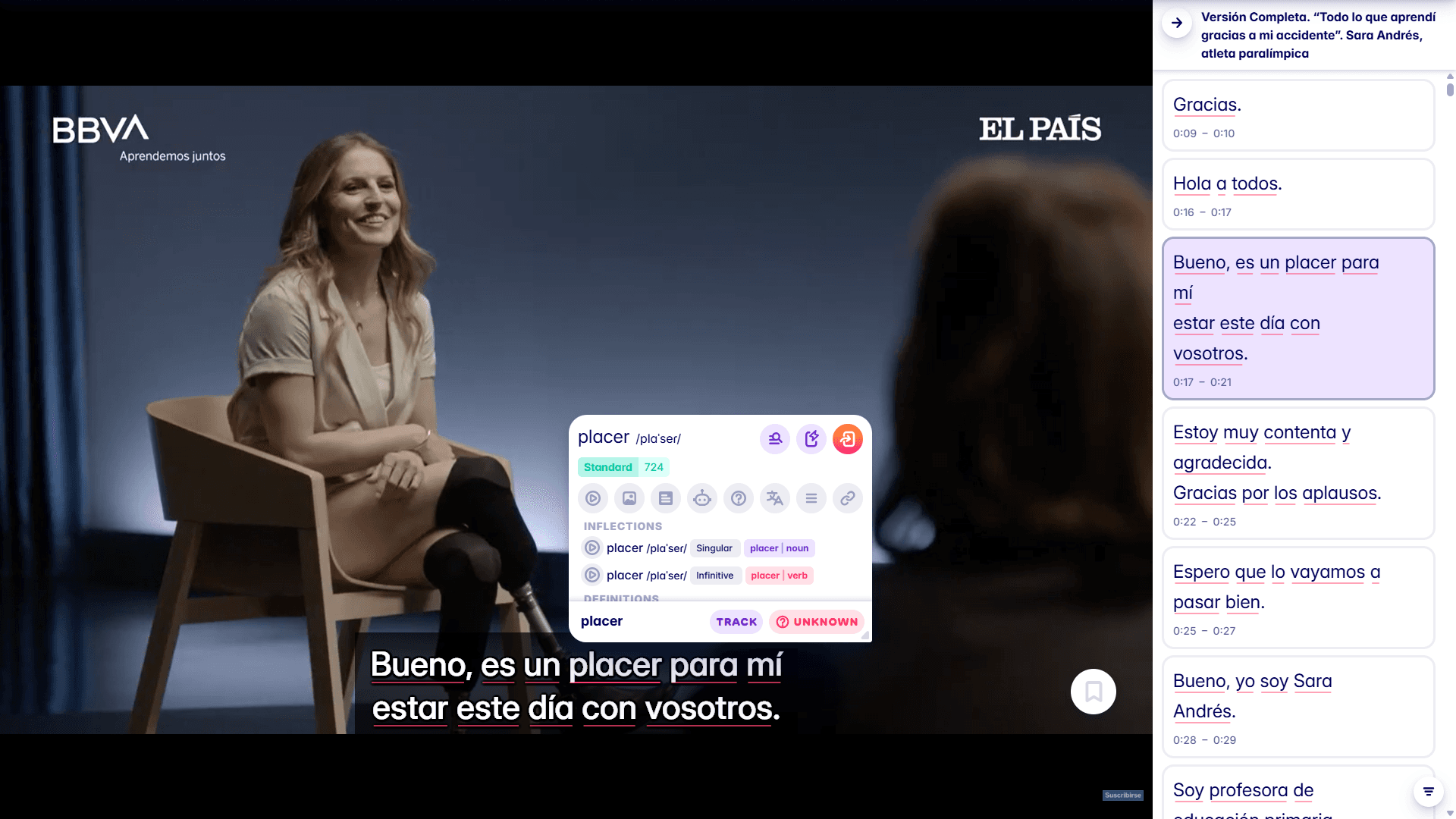
Anyway, if you want to build vocabulary faster through immersion, Migaku's browser extension and app let you look up words instantly while watching shows or reading articles in your target language. You can save words directly to your SRS decks with context included. There's a 10-day free trial if you want to check it out.
 ---
## There is no end to vocabulary acquisition in language learning
Is fluency the end of your vocabulary learning journey? The answer is no. Even after you know thousands of words, you still need to learn more words when you encounter ones that you don't know. Instead of looking for an end goal, you need to set milestones for learning another language, such as 1000 words, 5000 words, 10000 words, and so on. After you reach C2 fluency, vocab drills will be totally replaced by immersion and dictionary look-up.
> If you consume media in the language you're learning, and you understand at least some of the messages and sentences within that media, you will make progress. _Period_.
Focus on the progress, not the end.👣
---
## There is no end to vocabulary acquisition in language learning
Is fluency the end of your vocabulary learning journey? The answer is no. Even after you know thousands of words, you still need to learn more words when you encounter ones that you don't know. Instead of looking for an end goal, you need to set milestones for learning another language, such as 1000 words, 5000 words, 10000 words, and so on. After you reach C2 fluency, vocab drills will be totally replaced by immersion and dictionary look-up.
> If you consume media in the language you're learning, and you understand at least some of the messages and sentences within that media, you will make progress. _Period_.
Focus on the progress, not the end.👣