# Italian Articles Guide: Italian Partitive, Definite and Indefinite Articles Explained
> Why do Italian articles take time to learn? Understand il, la, lo, le, gli, un, una and master definite and indefinite articles fast.
**URL:** https://migaku.com/blog/language-fun/italian-articles-guide
**Last Updated:** 2026-02-14
**Tags:** fundamentals, vocabulary, grammar
---
Italian articles can seem confusing at first because there are so many of them compared to English. We've got il, la, lo, le, gli, un, una, and more, for [Italian learners](https://migaku.com/learn-italian). But here's the good news: once you understand the pattern behind which article to use, it becomes pretty straightforward. This guide will walk you through everything you need to know about Italian articles so you can stop guessing and start using them correctly.
---
## What are articles in Italian
Articles are those small words that come before nouns. In English, we only have a few: "the", "a", and "an". Italian [grammar](https://migaku.com/blog/language-fun/italian-grammar-guide) works differently because articles change based on the gender and number of the noun they're attached to, plus the sound that starts the noun.
> Italian has two main types of articles: definite articles (like "the" in English) and indefinite articles (like "a" or "an").
The definite article refers to a specific thing, while the indefinite article refers to any one thing from a group.
The tricky part? Italian has seven different forms of the definite article and four forms of the indefinite article. Yeah, I know. But stick with me because there's actually a logic to it.
### Why learning how to use Italian articles is important
Italian articles carry information about the noun they modify.
When you hear "gli" at the start of a phrase, you immediately know the noun is masculine, plural, and starts with either a vowel or one of those special consonant combinations. That's a lot of information packed into a tiny word.
Articles also help with the rhythm and flow of Italian speech. The language has a musical quality, and articles contribute to that by creating smooth transitions between words.
Plus, getting articles right makes you sound more fluent. Native speakers notice when articles are wrong because it disrupts the natural flow of the language. On the flip side, using articles correctly makes your Italian sound much more natural, even if you make mistakes elsewhere.
---
## Italian definite articles explained
> 💡The definite article in Italian changes based on three factors:
> 1. Whether the noun is masculine or feminine
> 2. Whether it's singular or plural
> 3. What letter or sound the noun starts with.
### Masculine definite articles
> For masculine singular nouns, you'll use either **"il"** or **"lo"**.
Use "il" for masculine singular nouns that start with most consonants. This is the most common one you'll see. Examples: il libro (The book), il gatto (The cat), il tavolo (The table).
Use "lo" for masculine singular nouns that start with specific sounds: **z, s + consonant (like "sc", "st", "sp"), gn, pn, ps, or x.** Also use "lo" before masculine nouns that start with **a vowel,** though in this case it becomes "l'" with an apostrophe. Examples: lo studente (The student), lo zaino (The backpack), lo psicologo (The psychologist), l'amico (The friend), l'albero (The tree).
> For masculine plural nouns, you'll use either **"i"** or **"gli"**.
Use "i" for masculine plural nouns that would take "il" in the singular. Examples: i libri (The books), i gatti (The cats), i tavoli (The tables).
Use "gli" for masculine plural nouns that would take "lo" in the singular. Examples: gli studenti (The students), gli zaini (The backpacks), gli amici (The friends), gli alberi (The trees).
### Feminine definite articles
The feminine articles are actually simpler than the masculine ones.
> For feminine singular nouns, you'll use **"la"** before consonants and **"l'"** before vowels.
Examples: la casa (The house), la ragazza (The girl), l'amica (The friend), l'acqua (The water).
> For feminine plural nouns, you always use **"le"** regardless of what letter the noun starts with.
Examples: le case (The houses), le ragazze (The girls), le amiche (The friends), le acque (The waters).
---
## Italian indefinite articles
The indefinite article in Italian also changes based on gender and the starting sound of the noun, but there's no plural form because you can't say "some ones" in a way that makes sense. Instead, Italian uses partitive articles for plural indefinite meanings, which I'll cover later.
### Masculine indefinite articles in Italian
> For masculine singular nouns, you'll use either **"un"** or **"uno"**.
Use "un" for masculine nouns that start with most consonants or vowels. Examples: un libro (A book), un gatto (A cat), un amico (A friend), un albero (A tree).
Use "uno" for masculine nouns that start with those same special sounds as "lo": z, s + consonant, gn, pn, ps, or x. Examples: uno studente (A student), uno zaino (A backpack), uno psicologo (A psychologist).
### Feminine indefinite articles
> For feminine singular nouns, you'll use either **"una"** or **"un'"**.
Use "una" for feminine nouns that start with consonants. Examples: una casa (A house), una ragazza (A girl).
Use "un'" (With an apostrophe) for feminine nouns that start with vowels. Examples: un'amica (A friend), un'acqua (A water).
---
## Partitive articles in Italian language
> Partitive articles are used when you want to say "some" or an unspecified quantity of something.
In English, we might say "I want some water" or just "I want water". Italian typically uses partitive articles in these situations.
You form partitive articles by combining the preposition "di" (of) with the definite article. So you get: del, dello, dell', della, dei, degli, delle.
The same rules apply as with regular definite articles.
- "Del" goes with masculine singular nouns that would take "il".
- "Dello" goes with masculine singular nouns that would take "lo".
- "Dell'" goes before vowels.
- "Della" goes with feminine singular nouns starting with consonants.
- "Dei" is the masculine plural for nouns that would take "i".
- "Gli" becomes "degli" in the partitive.
- "Delle" is the feminine plural.
Examples: del pane (Some bread), dello zucchero (Some sugar), dell'acqua (Some water), della pasta (Some pasta), dei libri (Some books), degli studenti (Some students), delle ragazze (Some girls).
---
## How to know which types of articles to use in Italian
The biggest question everyone has is: how do you know which article to use? Here's my practical approach.
1. First, you need to know if the noun is masculine or feminine. There's no way around this. Italian nouns have grammatical gender, and you just have to learn it along with the word. Generally, nouns ending in -o are masculine and nouns ending in -a are feminine, but there are plenty of exceptions. Nouns ending in -e can be either masculine or feminine.
2. Second, figure out if the noun is singular or plural. Plural nouns typically end in -i (For masculine) or -e (For feminine).
3. Third, look at the first letter or sound of the noun. Is it a consonant, a vowel, or one of those special consonant combinations (z, s + consonant, gn, pn, ps, x)?
Once you've got those three pieces of information, you can pick the right article. It sounds like a lot, but after some practice, it becomes automatic.
---
## What's the easiest way to learn Italian definite and indefinite articles
Honestly? [Exposure and practice](https://migaku.com/blog/language-fun/bilingual-brain-benefits). You can memorize the rules all you want, but until you start seeing and using these articles in context, they won't stick.
1. Read Italian content and pay attention to the articles. When you see "lo studente", notice that it's "lo" because "studente" starts with "st". When you see "gli amici", notice that it's "gli" because "amici" starts with a vowel and is plural.
2. Practice by doing exercises where you fill in the correct article. There are tons of these online, and they're actually pretty helpful for building that automatic recognition.
3. [Learn the noun](https://migaku.com/blog/language-fun/comprehensible-input-method-language-learning) with its article from the start. When you're adding new vocabulary, don't just learn "libro" means book. Learn "il libro" as a unit. This way, you're training your brain to associate the correct article with each noun automatically.
4. Listen to Italian speakers and notice which articles they use. Podcasts, videos, movies... whatever you can get your hands on. The more you hear the patterns, the more natural they'll become.
---
## Common mistakes with articles in Italian grammar
One mistake I see all the time is using "il" before words that start with "s + consonant". People say "il studente" instead of "lo studente". Your ear will eventually catch this because it sounds weird, but in the beginning, you've got to consciously remember that rule.
Another common error is forgetting to change the article when a noun becomes plural. You can't say "il libri". It has to be "i libri" because the noun is now plural.
People also mess up the apostrophe forms. Remember that "l'" is used before vowels for both masculine and feminine singular, but "un'" (With apostrophe) is only for feminine. Masculine uses "un" (No apostrophe) even before vowels.
Mixing up masculine and feminine is probably the biggest challenge. If you think a noun is masculine when it's actually feminine, you'll use the wrong article. This is why learning the gender along with the noun is so important.
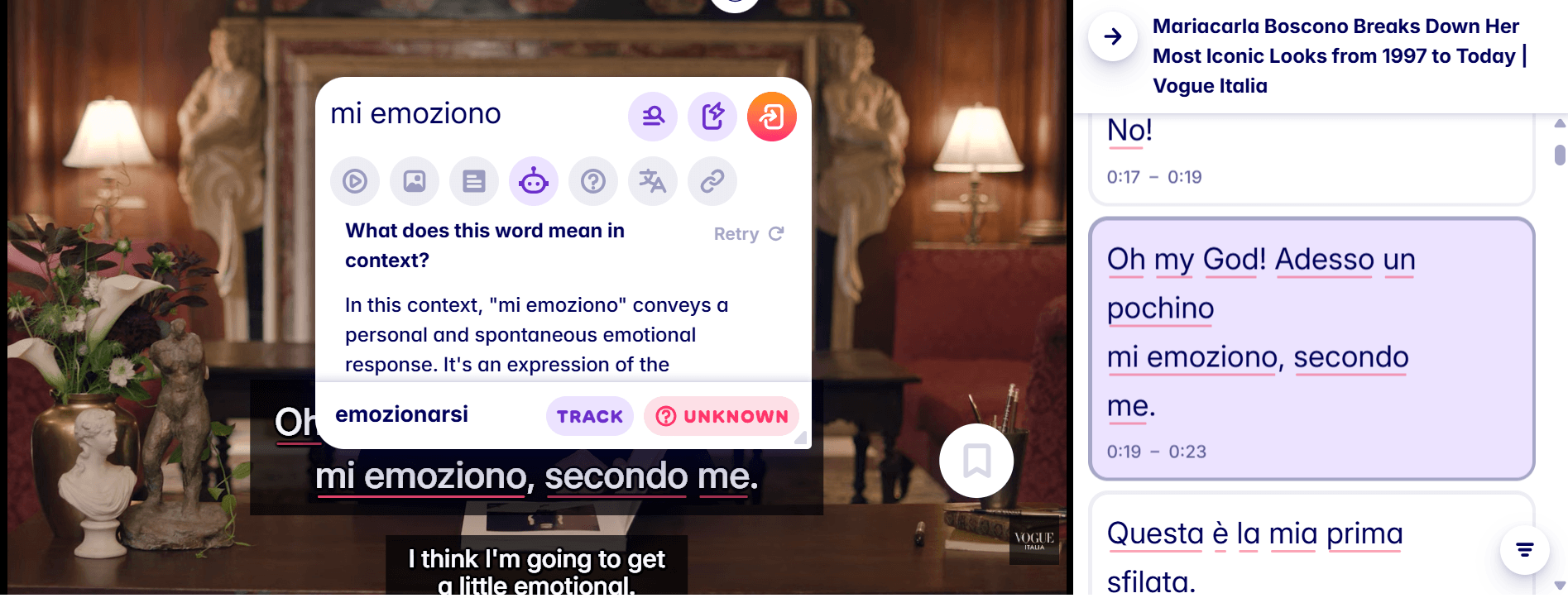
Anyway, if you want to practice Italian articles with real content, Migaku's browser extension and app let you look up words and see them in context while watching shows or reading articles. You'll see how native speakers actually use these articles naturally. There's a 10-day free trial if you want to check it out.
 ---
## Use articles in Italian like a pro
Learning articles in Italian takes time, but it's totally doable. The rules might seem complicated at first, but they're consistent. Once you understand the pattern, you can apply it to any noun you encounter. After enough repetition in training and extensive exposure to native content, you won't even have to think about it anymore.
> If you consume media in Italian, and you understand at least some of the messages and sentences within that media, you will make progress. _Period_.
Invest in yourself!
---
## Use articles in Italian like a pro
Learning articles in Italian takes time, but it's totally doable. The rules might seem complicated at first, but they're consistent. Once you understand the pattern, you can apply it to any noun you encounter. After enough repetition in training and extensive exposure to native content, you won't even have to think about it anymore.
> If you consume media in Italian, and you understand at least some of the messages and sentences within that media, you will make progress. _Period_.
Invest in yourself!