# Italian Colors: Vocabulary and Grammar Rules of Italian Color Palette Explained
> What do the colors in Italian flag represent? Unlock the complete palette of Italian colors with pronunciation tips and grammar for adjective agreement.
**URL:** https://migaku.com/blog/language-fun/italian-colors-vocabulary-grammar-guide
**Last Updated:** 2026-02-05
**Tags:** fundamentals, vocabulary, phrases
---
Whether you're describing what you're wearing, ordering food, or just trying to compliment someone's car, you'll need these color words constantly when [learning Italian](https://migaku.com/learn-italian). The good news? Italian color vocabulary follows pretty logical patterns once you understand the basic [grammar](https://migaku.com/blog/language-fun/italian-grammar-guide) rules. Here's everything you need to know about using colors in Italian, from the simple stuff to the trickier grammar bits that trip people up.
---
## The word for "color" in Italian
Let's start with the simplest element: how do you say "color" in Italian? The word is "**colore**" (Masculine, singular). When you're talking about multiple colors, it becomes "colori."
You'll see this word pop up everywhere. "Di che colore è?" means "What color is it?" And if someone asks you "Qual è il tuo colore preferito?" they're asking what your favorite color is. Pretty straightforward.
The pronunciation is koh-LOH-reh, with the stress on the second syllable. English speakers sometimes want to say it like the English "color," but remember that final "e" gets pronounced in Italian.
---
## Basic Italian hues
Here are the essential colors you'll use most often:
| Italian | English |
| - | - |
| Rosso | Red |
| Blu | Blue |
| Verde | Green |
| Giallo | Yellow |
| Arancione | Orange |
| Viola | Purple |
| Nero | Black |
| Bianco | White |
| Grigio | Gray |
| Marrone | Brown |
| Rosa | Pink |
These cover about 90% of your daily color needs. You can describe most things with just this list. The tricky part isn't memorizing them, it's using them correctly in [sentences](https://migaku.com/blog/language-fun/italian-sentence-structure). That's where the grammar stuff comes in.
---
## Advanced color vocabulary
Once you've got the basics down, you can expand into more specific shades:
| Italian | English |
| - | - |
| Turchese | Turquoise |
| Bordeaux | Burgundy/Maroon |
| Lilla | Lilac |
| Beige | Beige |
| Oro | Gold |
| Argento | Silver |
| Bronzo | Bronze |
Metallic colors like oro, argento, and bronzo are usually invariable. You say "scarpe oro" (Gold shoes) without changing oro.
For describing patterns and combinations:
| Italian | English |
| - | - |
| A righe | Striped |
| A pois | Polka-dotted |
| A quadri | Checkered |
| Multicolore | Multicolored |
"Una camicia a righe blu e bianche" (A blue and white striped shirt) is the kind of detailed description you can build once you know your colors and patterns.
---
## How colors agree with nouns in Italian
Here's the thing that makes Italian colors different from English: they change based on what you're describing. In English, you just say "red car" or "red cars" and the word "red" stays the same.
> In Italian, the color has to match the gender and number of the noun.
Most Italian colors follow standard adjective agreement rules. They have four forms:
- Masculine singular: rosso (a red book = un libro rosso)
- Feminine singular: rossa (a red car = una macchina rossa)
- Masculine plural: rossi (red books = libri rossi)
- Feminine plural: rosse (red cars = macchine rosse)
This pattern works for: rosso, nero, bianco, grigio, giallo, and a few others. You change the ending based on what you're describing.
So if you want to say "the white house," you'd say "la casa bianca" because casa is feminine. But "the white wine" is "il vino bianco" because vino is masculine. The color shifts to match.
---
## Invariable colors that never change in Italian vocabulary
Some Italian colors are what we call invariable. They stay exactly the same no matter what you're describing. This actually makes them easier to use once you know which ones they are.
The main invariable colors are:
- Blu (Blue)
- Rosa (Pink)
- Viola (Purple)
- Arancione (Orange)
- Marrone (Brown)
Why don't these change? Blu came from French. Rosa and viola are actually nouns (The rose flower and the violet flower) that got turned into color adjectives. Arancione comes from "arancia" (Orange fruit). Marrone comes from "marrone" (Chestnut). When nouns become color words, they typically don't change form.
So you can say "una macchina blu" (A blue car) or "due macchine blu" (Two blue cars), and blu stays the same. Same with "un fiore rosa" or "fiori rosa." The color word doesn't budge.
This trips people up because they expect all adjectives to follow the same rules. They don't. You just have to memorize which colors are invariable.
---
## Verde and other regular colors that only have two forms
Or verde, green? This one follows the normal pattern, but only partially. Verde has just two forms instead of four:
- Verde (Masculine and feminine singular)
- Verdi (Masculine and feminine plural)
So "un libro verde" and "una casa verde" both use the same singular form. But when you go plural, you get "libri verdi" and "case verdi."
This two-form pattern also applies to:
- Celeste (Light blue/Sky blue)
Actually, most colors that end in "e" work like verde. They have the same form for masculine and feminine singular, then add an "i" for plural.
---
## Shades and modifiers in Italian color palette
When you want to be more specific about a shade, Italian has some handy modifiers you can add:
Chiaro (Light) and scuro (Dark) are the most common. These come after the color and agree with the noun:
- Blu chiaro (Light blue)
- Verde scuro (Dark green)
- Rosso scuro (Dark red)
You can also use "acceso" (Bright) or "brillante" (Brilliant) for vivid colors, and "pallido" (Pale) or "sbiadito" (Faded) for washed-out ones.
For specific shades, Italians often use compound terms:
- Verde bottiglia (Bottle green)
- Rosso ciliegia (Cherry red)
- Blu navy (Navy blue)
- Grigio perla (Pearl gray)
These compound colors are usually invariable. You wouldn't change "verde bottiglia" based on what you're describing. It stays as is.
---
## Speaking Italian rainbow colors in order
If you want to list the rainbow colors in Italian, here's the standard order:
1. Rosso (Red)
2. Arancione (Orange)
3. Giallo (Yellow)
4. Verde (Green)
5. Blu (Blue)
6. Indaco (Indigo)
7. Viola (Violet)
Italians use the same rainbow sequence as English speakers. The mnemonic device is different though. In English, we have "Roy G. Biv." Italians sometimes use phrases to remember the order, but there isn't one standard version everyone learns.
Indaco (Indigo) is worth noting because you won't use it much in everyday conversation. Most people just say blu or viola and skip indaco entirely.
---
## What are traditional Italian colors: Flag of Italy and other cultures
When people ask about traditional Italian colors, they usually mean the colors associated with Italy culturally. The Italian flag gives you the big three: verde (Green), bianco (White), and rosso (Red).
These colors show up everywhere in Italian culture. The green represents the plains and hills, white represents the snow-capped Alps, and red represents the blood spilled during the wars of Italian independence. That's the patriotic interpretation anyway.
Beyond the flag, certain colors have strong associations in Italy:
- Azzurro (A specific shade of blue) represents Italian national sports teams. When Italy plays soccer, they wear azzurro jerseys.
- Giallo (Yellow) is associated with mystery novels because early Italian detective books had yellow covers. A mystery novel is called "un giallo."
- Nero (Black) has political associations from the fascist era, though obviously it's also just a regular color word.
What is the color that represents Italy? If you had to pick one, azzurro probably wins. It's the color of the national teams, and Italians are passionate about it.
---
## Common phrases and idiomatic expressions with colors
Italian has some great color idioms that don't translate directly to English:
| Italian Idiom | Literal Translation | Meaning |
| - | - | - |
| Vedere tutto nero | To see everything black | To be pessimistic about everything |
| Essere al verde | To be at the green | To be broke, out of money. The origin is debated, but it might come from candles burning down to the green wax at the bottom. |
| Cronaca nera | Black chronicle | Refers to crime news. The crime section of a newspaper is the cronaca nera. |
| Passare una notte in bianco | To pass a white night | To have a sleepless night |
| Diventare rosso | To become red | To blush or turn red from embarrassment |
| Avere il pollice verde | To have a green thumb | The same thing as in English, someone good with plants |
These expressions come up in normal conversation, so they're worth learning beyond just the basic color vocabulary.
---
## Tips for remembering Italian colors
Here are some practical ways to lock these into your memory:
1. Associate colors with common Italian things. Rosso with Ferrari, verde with pesto, arancione with Aperol Spritz, nero with espresso. These mental links help.
2. Practice with objects around you. Look at something and describe its color in Italian. "La mia tazza è bianca." "Il mio telefono è nero." Make it a habit.
3. Pay attention to which colors are invariable. That's the part that trips people up most. Make a mental note: blu, rosa, viola, arancione, marrone don't change.
4. Use the colors in complete sentences, not just as isolated words. Your brain remembers better when words are in context.
5. Watch Italian content and listen for color words. You'll start noticing how native speakers use them naturally.
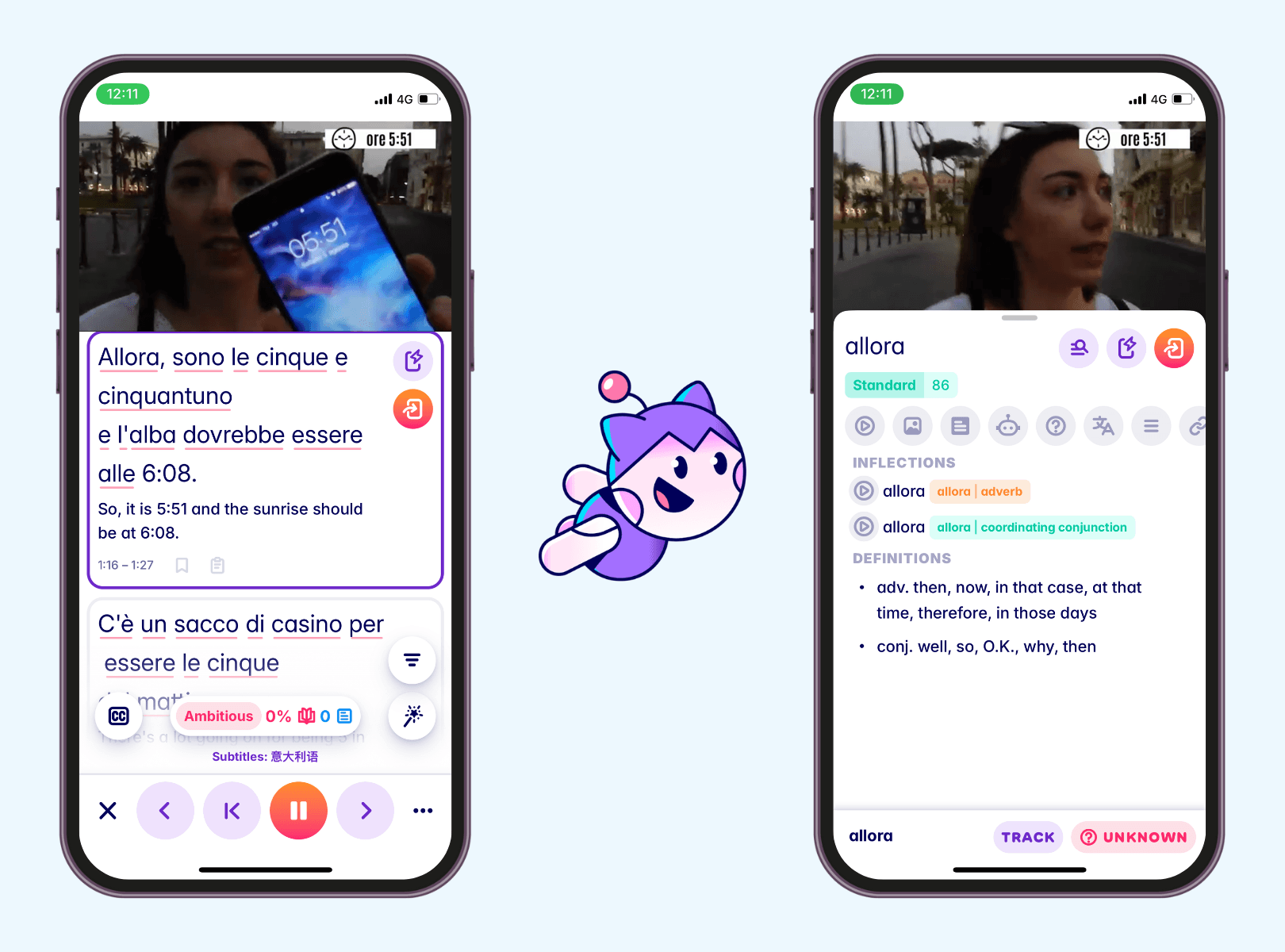
If you want to practice using Italian colors with real content, Migaku's browser extension and app let you look up words instantly while watching Italian shows or reading articles. You can see how colors are actually used in context, which beats memorizing lists any day. There's a 10-day free trial if you want to check it out.
 ---
## An efficient way to learn [Italian food](https://migaku.com/blog/language-fun/italian-food-vocabulary-essential-dining-phrases) and colors at the same time?
Learning Italian colors gives you a surprising amount of conversational power. You can describe what you want to buy, what you're wearing, what you see around you. Combined with basic[ nouns and verbs](https://migaku.com/blog/language-fun/italian-verb-conjugation), colors let you express tons of practical information. Not just that. Food documentary ususually includes vivid descriptions of texture and colors. Find the right one, and you can learn both food vocabulary and color vocabulary at the same time!
> If you consume media in Italian, and you understand at least some of the messages and sentences within that media, you will make progress. _Period_.
Learn smartly, and save your energy!
---
## An efficient way to learn [Italian food](https://migaku.com/blog/language-fun/italian-food-vocabulary-essential-dining-phrases) and colors at the same time?
Learning Italian colors gives you a surprising amount of conversational power. You can describe what you want to buy, what you're wearing, what you see around you. Combined with basic[ nouns and verbs](https://migaku.com/blog/language-fun/italian-verb-conjugation), colors let you express tons of practical information. Not just that. Food documentary ususually includes vivid descriptions of texture and colors. Find the right one, and you can learn both food vocabulary and color vocabulary at the same time!
> If you consume media in Italian, and you understand at least some of the messages and sentences within that media, you will make progress. _Period_.
Learn smartly, and save your energy!