Italian Relative Pronouns: Che, Cui, and Quale Explained
Last updated: April 6, 2026

Italian relative pronouns might sound intimidating at first, but they're actually the glue that holds complex Italian sentences together. If you've been studying Italian for a while, you've probably noticed words like che, cui, and quale popping up everywhere. These little connectors let you combine ideas smoothly instead of chopping everything into baby sentences. Understanding how they work will seriously level up your Italian, making you sound way more natural when you speak or write.
- What is a relative pronoun anyway
- The workhorse: che
- When prepositions enter the chat: cui
- The formal option: quale
- The mysterious chi
- Combining relative pronouns with quello
- Subject pronouns versus relative pronouns
- Twenty examples of relative pronouns in action
- Practice makes progress with Italian relative pronouns
What is a relative pronoun anyway
💡 Definition 💡
A relative pronoun connects two clauses together , turning choppy sentences into smooth, flowing thoughts. In English, we use words like "who," "which," "that," and "whom" all the time without thinking about it. Same deal in Italian.
Here's a quick example in English: "I know the woman. She lives next door." You'd naturally combine these as "I know the woman who lives next door." That "who" is doing the heavy lifting, connecting both ideas into one sentence.
Italian works the same way, but the language gives you several options depending on what you're trying to say. The main players are che, cui, quale, and chi. Each one has specific jobs, and mixing them up can make your Italian sound pretty weird to native speakers.
The workhorse: che
Che is hands down the most common relative pronoun in Italian. You'll see it everywhere, and honestly, if you only learned one, this would be it. Che works as both "who" and "which" in English, covering subjects and direct objects.
When che refers to the subject of the clause, it's doing the action:
- La ragazza che parla italiano è mia sorella.
The girl who speaks Italian is my sister. - Il libro che è sul tavolo è interessante.
The book that is on the table is interesting.
When che refers to a direct object, it's receiving the action:
- Il film che abbiamo visto era noioso.
The film that we saw was boring. - La pizza che mangio è deliziosa.
The pizza that I'm eating is delicious.
The beauty of che is its simplicity. You don't need to worry about gender or number. It stays the same whether you're talking about one person or a hundred things. Pretty convenient, right?
One thing to remember: che can never follow a preposition. If you need a preposition before your relative pronoun, you've got to use cui instead. This trips up a lot of learners at first.
When prepositions enter the chat: cui
Cui is your go-to relative pronoun whenever you need to stick a preposition in front. Think of phrases like "to whom," "with which," "about whom" in English. That's cui territory in Italian.
The basic formula is: preposition + cui. Here are some real examples:
- La persona a cui ho scritto è mia zia.
The person to whom I wrote is my aunt. - La città in cui vivo è piccola.
The city in which I live is small. - L'amico con cui studio è bravo.
The friend with whom I study is good. - Il motivo per cui sono qui è importante.
The reason for which I'm here is important.
Common prepositions you'll see with cui include a (to), di (of/about), da (from/by), con (with), per (for), su (on), and in (in). The preposition always comes right before cui, never after.
There's one special case where cui appears without a preposition: when it shows possession. You stick cui between an article and a noun to mean "whose":
- La ragazza i cui genitori sono italiani.
The girl whose parents are Italian. - L'uomo la cui casa è grande.
The man whose house is big.
Notice how the article (i, la) agrees with the noun that follows (genitori, casa), not with the person you're talking about. This construction feels formal, and in everyday conversation, Italians often find ways around it.
The formal option: quale
Quale (and its forms il quale, la quale, i quali, le quali) is basically a fancier version of che and cui. You'll find it more in written Italian, formal speech, or when you need to avoid confusion.
Unlike che, quale changes based on gender and number. You match it to the noun it refers to:
- il quale (masculine singular)
- la quale (feminine singular)
- i quali (masculine plural)
- le quali (feminine plural)
The article is part of the package. You always use it with quale in this context.
When would you actually use quale? Mainly in two situations.
First, in formal writing or official documents:
- Ho incontrato il direttore, il quale mi ha dato le informazioni.
I met the director, who gave me the information.
Second, when a sentence could be ambiguous with che:
- Ho parlato con la madre di Marco, la quale era molto gentile.
I spoke with Marco's mother, who was very kind.
Using la quale here makes it crystal clear you're talking about the mother, not Marco. If you'd said "che era molto gentile," it could technically refer to either one.
You can also use quale with prepositions, similar to cui:
- La conferenza alla quale ho partecipato era interessante.
The conference in which I participated was interesting.
Most Italian learners can get by without using quale much in conversation. Native speakers use it, sure, but che and cui will cover probably 90% of your needs.
The mysterious chi
Chi is kind of different from the other relative pronouns. It means "who," "whom," or "whoever," but it doesn't refer back to a specific noun. Instead, it introduces a whole new subject.
Think of chi as combining "the person who" or "those who" into one word:
- Chi dorme non piglia pesci.
Who sleeps doesn't catch fish (basically "you snooze, you lose"). - Chi va piano va sano e va lontano.
Who goes slowly goes safely and goes far. - Non so chi ha chiamato.
I don't know who called.
You'll see chi a lot in Italian proverbs and sayings. It's also super common in questions and when you're talking about unknown or unspecified people:
- Chi è?
Who is it? - Invita chi vuoi.
Invite whoever you want. - Chi parla troppo dice sciocchezze.
Whoever talks too much says foolish things.
Chi can work with prepositions too:
- A chi parli?
To whom are you speaking? - Con chi esci stasera?
With whom are you going out tonight? - Di chi parli?
About whom are you speaking?
The grammar gets interesting because chi is always treated as third person singular, even if it logically refers to multiple people. The verb following chi always conjugates in the third person singular form.
Combining relative pronouns with quello
Here's something that confuses learners: quello che (or quel che). This combination means "what" in the sense of "that which" or "the thing that." It's not asking a question, it's making a statement about something.
Examples make this clearer:
- Quello che dici è vero.
What you say is true / That which you say is true. - Non capisco quello che vuoi.
I don't understand what you want. - Quello che mi piace di più è la pasta.
What I like most is pasta.
You can also say ciò che, which means exactly the same thing as quello che. It's maybe slightly more formal:
- Ciò che penso è importante.
What I think is important.
Both quello che and ciò che refer to abstract ideas, situations, or things rather than specific nouns. You're talking about a concept, not a particular object.
Subject pronouns versus relative pronouns
Quick clarification because this trips people up: relative pronouns are totally different from subject pronouns.
- The nine subject pronouns in Italian are io, tu, lui/lei, noi, voi, loro, Lei (formal you), egli, and ella. These tell you who's doing the action.
- Relative pronouns (che, cui, quale, chi) connect clauses and refer back to nouns already mentioned. They're linking words, not subjects themselves, though they can function as subjects within their clause.
Compare these:
- Lui parla italiano.
He speaks Italian. (lui is a subject pronoun) - L'uomo che parla italiano.
The man who speaks Italian. (che is a relative pronoun referring to "l'uomo")
Getting these mixed up will definitely confuse your Italian sentences, so keep them separate in your mind.
Twenty examples of relative pronouns in action
Here's a solid list showing relative pronouns doing their thing in Italian:
- Il ragazzo che studia è intelligente.
The boy who studies is intelligent. - La casa che vedo è bella.
The house that I see is beautiful. - L'amico a cui telefono vive lontano.
The friend to whom I'm calling lives far away. - La città in cui abito è grande.
The city in which I live is big. - Il libro di cui parlo è famoso.
The book about which I'm speaking is famous. - Chi troppo vuole nulla stringe.
Who wants too much gets nothing. - La signora la quale abita qui è simpatica.
The lady who lives here is nice. - I ragazzi i quali giocano sono giovani.
The boys who are playing are young. - Non so chi sia.
I don't know who it is. - Quello che dici è interessante.
What you say is interesting. - Il motivo per cui sono qui.
The reason for which I'm here. - La donna con cui lavoro.
The woman with whom I work. - Chi dorme non piglia pesci.
Who sleeps doesn't catch fish. - Il film che abbiamo guardato.
The film that we watched. - La ragazza i cui genitori sono medici.
The girl whose parents are doctors. - Ciò che penso è importante.
What I think is important. - L'uomo del quale parlavo.
The man about whom I was speaking. - Chi cerca trova.
Who seeks finds. - Il ristorante in cui mangiamo.
The restaurant in which we eat. - Le persone che conosco sono gentili.
The people whom I know are kind.
These examples show how relative pronouns work in different contexts. Reading through them a few times helps the patterns stick.
Practice makes progress with Italian relative pronouns
So where can you actually practice this stuff? Honestly, the best practice comes from reading and listening to real Italian.
- When you're watching Italian shows, reading articles, or listening to podcasts, you'll see these relative pronouns constantly.
- For structured practice, you can find Italian relative pronouns exercises online. Many Italian learning websites offer fill-in-the-blank exercises where you choose the right relative pronoun. Some even have downloadable PDF worksheets if you prefer working offline.
- Grammar textbooks usually have a whole lesson dedicated to relative pronouns with practice exercises at the end. Working through these helps cement the rules, but real-world exposure matters more in the long run.
- Try creating your own sentences too. Take simple sentences and combine them using relative pronouns. "Ho un amico. Lui vive a Roma." becomes "Ho un amico che vive a Roma." Start simple and gradually make your sentences more complex.
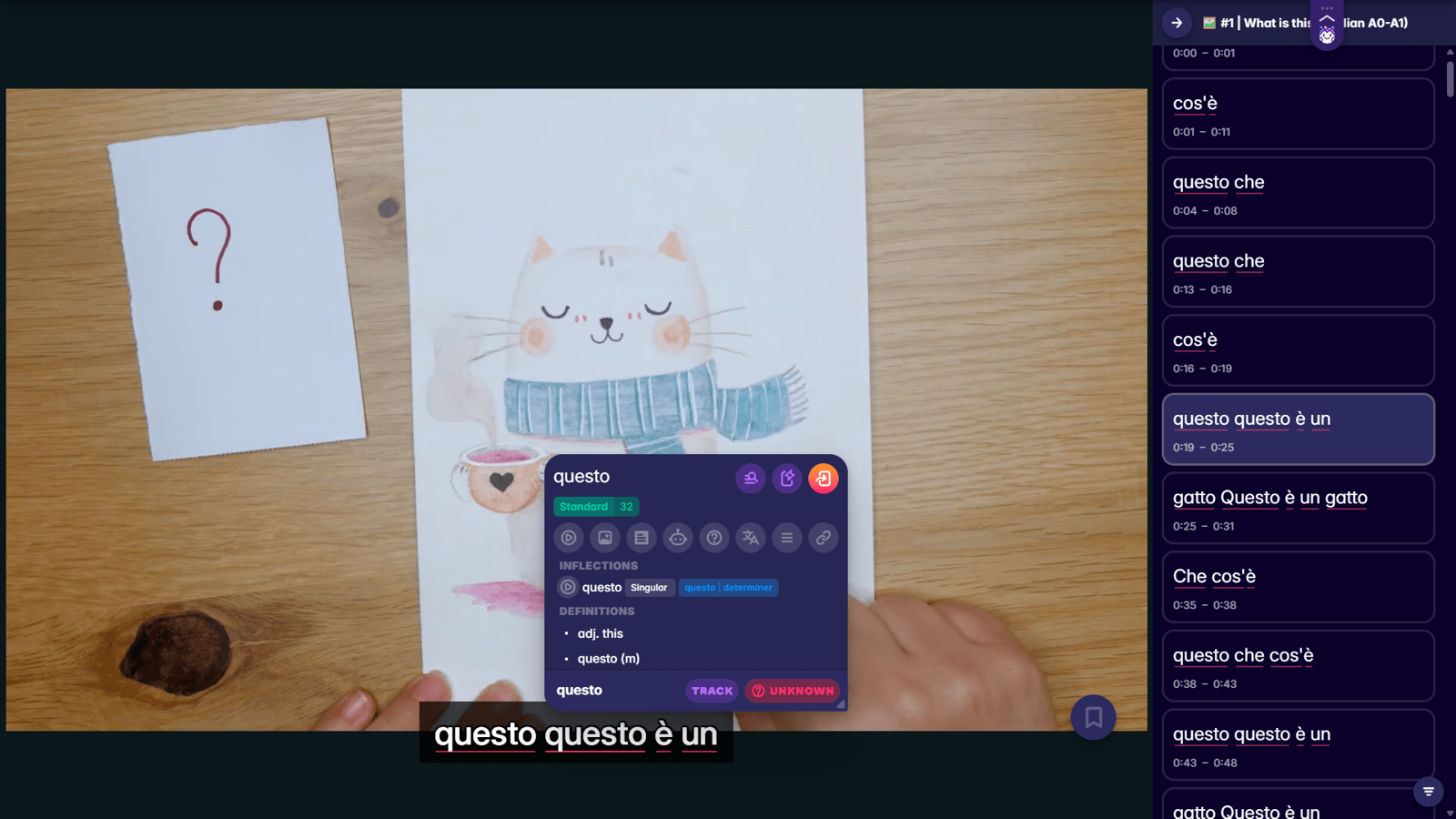
Anyway, if you want to actually practice with real Italian content, Migaku's browser extension and app let you look up words and save sentences instantly while watching shows or reading articles. Makes immersion learning way more practical. There's a 10-day free trial if you want to check it out.
Level up your language fluency beyond Italian lessons
Getting comfortable with che, cui, quale, and chi takes time, and you may need to do extra studies after learning the rules from any Italian lesson, but it's totally doable. These relative pronouns show up constantly in real Italian, so you'll get plenty of exposure if you're consuming Italian media regularly. The more you read, listen, and practice, the more natural they'll feel.
If you consume media in Italian, and you understand at least some of the messages and sentences within that media, you will make progress. Period.
Certain grammar points speed up fluency, and relative pronouns are one of them!