Language Learning With Podcasts: How to Use Podcasts to Learn a Language
Last updated: March 26, 2026

Podcasts are everywhere these days, and if you're learning a language, you've probably wondered whether they actually work for building fluency. The short answer is yes, but only if you use them the right way. Too many language learners just hit play and zone out, hoping the foreign words will magically stick. That doesn't work. This guide will show you exactly how to use podcasts effectively so you can improve your listening skills, expand your vocabulary, and maybe even start thinking in your new language.
- How podcasts help with language learning
- Choosing the right language learning podcasts for your level
- How to actively listen (because passive listening doesn't work)
- Using transcripts to supercharge your learning
- The best podcast formats for different learning goals
- Creating a sustainable podcast learning routine
- Combining podcasts with other learning methods
- Common mistakes that waste your time
How podcasts help with language learning
Here's the thing: podcasts work, but they're not a magic solution. If you're a complete beginner who doesn't know any words yet, jumping straight into native content will just frustrate you. You'll hear noise, not language.
But once you have even a basic foundation (think A2 level or around 500-1000 words), podcasts become incredibly useful. They expose you to natural speech patterns, common phrases, and real pronunciation that textbooks can't capture. You hear how native speakers talk, with all the filler words, contractions, and casual grammar that make a language feel alive.
I've seen people go from struggling with basic conversations to understanding movies, mostly because they committed to regular podcast listening. The key word there is "regular." Listening once a week won't cut it. You need consistent exposure, ideally 20-30 minutes daily.
Choosing the right language learning podcasts for your level
Not all podcasts are useful to your study, and picking the wrong one for your level is the fastest way to waste your time.
Beginner podcasts (A1-A2)
When you're just starting out, you need podcasts specifically designed for language learners. These shows speak slowly, use simple vocabulary, and often repeat key phrases. They might feel painfully slow, but that's exactly what you need.
For example, if you want to learn Spanish, Coffee Break Spanish is a solid podcast series that starts from absolute zero. Each episode introduces new vocabulary and grammar in digestible chunks. The hosts speak clearly and explain everything in English when needed.
Language Transfer is another free option that works more like audio lessons. The host walks you through building sentences from scratch using cognates and logical patterns. Pretty effective for getting that initial foundation.
Intermediate podcasts (B1-B2)
This is where things get interesting. You know enough to understand context, but native speed still feels overwhelming. You need podcasts that bridge the gap.
News in Slow Spanish (or French, German, Italian) gives you real news stories at reduced speed. You're hearing authentic content about current events, culture, and society, just at a pace you can actually follow. Each episode includes explanations of difficult words and cultural context.
Duolingo's Spanish Podcast tells true stories in a mix of English and Spanish. The narrator speaks English, but the main characters tell their stories in Spanish. This gives your brain breaks while still challenging your listening skills. The production quality is excellent, too.
Advanced podcasts (C1-C2)
Once you hit advanced levels, you should be listening to the same podcasts that native speakers enjoy. This exposes you to slang, regional accents, humor, and cultural references that textbooks never cover.
The goal here is to learn a language the way native speakers actually use it. Pick topics you genuinely care about. If you're into true crime, find a true crime podcast in your target language. Love cooking? Find a cooking show. Your interest in the content will carry you through the difficult parts.
How to actively listen (because passive listening doesn't work)
Passive listening is when you play a podcast in the background while doing dishes or commuting, hoping something will stick. Spoiler: it won't. Not at beginner or intermediate levels anyway.
Active listening means you're fully engaged with the content. Here's how to do it right:
The first listen: Comprehension check
Play a 5-10 minute segment without pausing. Don't stress about catching every word. Just try to understand the main idea. What's the topic? What's the speaker's attitude? Can you follow the general flow?
If you understood less than 50%, the content is too difficult. Drop down a level.
The second listen: Catch the details
Now replay that same segment, but this time pause whenever you hear an unfamiliar word or phrase. Look it up. Write it down. Understanding how it's used in context is way more valuable than memorizing isolated vocabulary lists.
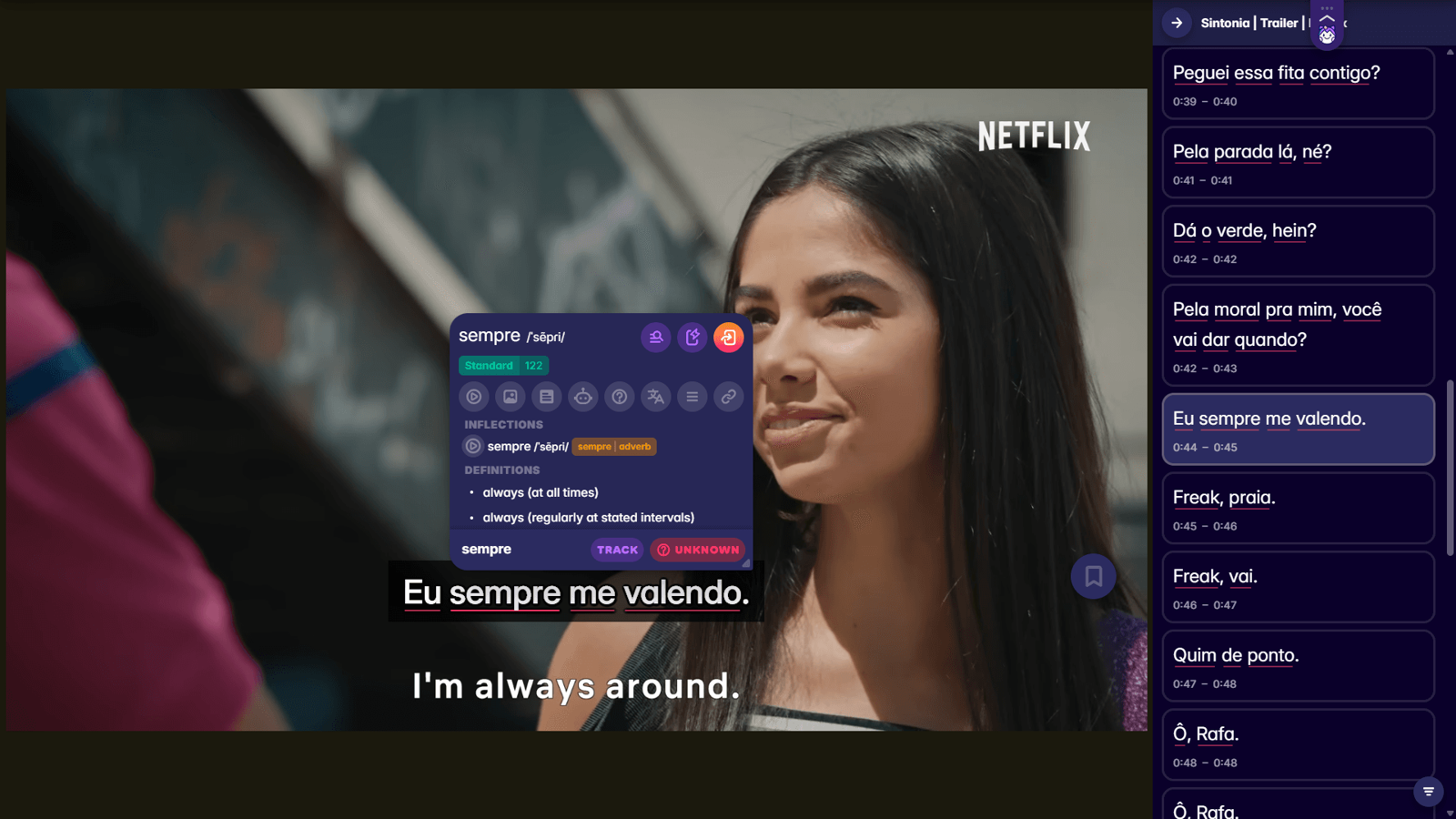
This is where a tool like Migaku's browser extension becomes useful if you're using podcast transcripts. You can click words instantly to see definitions without breaking your flow.
The third listen: Shadow the speaker
Play the segment again and try to repeat what the speaker says in real time, matching their speed and intonation. This technique, called shadowing, is insanely effective for improving pronunciation and training your mouth muscles to form foreign sounds.
It feels awkward at first. You'll stumble over words and fall behind. That's normal. Keep practicing and you'll notice your accent improving within weeks.

Using transcripts to supercharge your learning
Most language learning podcasts provide transcripts, and you should absolutely use them. Reading while listening connects the sounds you hear with the written words, which helps your brain process the language faster.
Here's my workflow:
- First, listen without the transcript.
- Then listen again while reading along. Circle or highlight words you don't know.
- After the episode, review those words and add them to your flashcard system.
Some podcasts on Apple Podcasts now include interactive transcripts that highlight each word as it's spoken. This visual tracking helps you follow along even when the speaker talks quickly.
For podcasts without official transcripts, you can sometimes find fan-made versions online or use automatic transcription tools. The accuracy varies, but even an imperfect transcript is better than nothing.
The best podcast formats for different learning goals
Different podcast formats serve different purposes. Knowing what you need helps you pick the right shows.
Interview podcasts for natural conversation
Interview shows expose you to multiple speakers with different accents and speaking styles. You hear natural back-and-forth conversation, interruptions, laughter, and all the messy reality of how people talk.
These help you learn how to follow conversations in real life, where people don't speak in neat, complete sentences like textbooks pretend they do.
Story-based podcasts for narrative skills
Story podcasts teach you how to follow a plot, understand chronology, and pick up on emotional nuance. They use more descriptive language and varied vocabulary than interview shows.
If you're learning a language for reading novels or watching films, story podcasts build those narrative comprehension skills.
News podcasts for formal language
News shows use more formal vocabulary and sentence structures. They're great if you need professional-level language for work or academic purposes. You'll learn how to discuss serious topics, understand complex ideas, and use sophisticated grammar.
Creating a sustainable podcast learning routine
Here's a realistic routine that can help you learn a language:
- 🌄Morning: Listen to a 10-15 minute news podcast while getting ready. This wakes up your brain in your target language and keeps you current with what's happening in countries where that language is spoken.
- 🚋Commute: If you drive or take public transit, use that time for a longer podcast episode. You're stuck there anyway, might as well make it productive.
- 🌇Evening: Spend 15-20 minutes doing active listening with transcripts. This is your focused study time where you look up words and practice shadowing.
Don't try to understand everything perfectly. If you catch 70-80% of the content, you're in the sweet spot for learning. That remaining 20-30% of unknown material is what pushes your skills forward.
Combining podcasts with other learning methods
Podcasts are powerful, but they shouldn't be your only tool. They mainly develop listening skills, so you need to balance them with speaking, reading, and writing practice.
- Use vocabulary from podcasts in your speaking practice. If you have a language exchange partner or tutor, mention something you heard on a podcast and discuss it. This moves words from passive recognition to active use.
- Create flashcards from podcast vocabulary. When you encounter a useful phrase, add it to your spaced repetition system. Seeing and reviewing these words in different contexts helps them stick.
- Read articles or books on the same topics as your favorite podcasts. If you listen to a history podcast, read history articles in that language. This reinforcement from multiple angles accelerates learning.
Common mistakes that waste your time
- The biggest mistake is listening to content that's way too difficult. If you understand less than 40-50%, you're not learning, you're just hearing noise. Your brain can't extract patterns from incomprehensible input.
- Another trap is only listening to podcast lessons and never graduating to real content. Those learner podcasts are training wheels. Eventually, you need to take them off and ride on your own.
- Some people collect podcasts like Pokemon but never actually listen to them. You don't need 47 subscriptions. Find 3-5 shows you genuinely enjoy and stick with them. Depth beats breadth.
- Lastly, don't ignore pronunciation from day one. If you only read transcripts without listening, you'll develop a reading knowledge but struggle to understand spoken language. The sounds matter just as much as the words.
Anyway, if you want to level up your podcast learning even more, Migaku's browser extension and app work great with podcast transcripts online. You can click any word for instant definitions and save vocabulary directly to your review system. There's a 10-day free trial if you want to check it out.
Pick one podcast right now. Not five, just one.
Choose something at your level that covers a topic you care about. Download three episodes. Listen to the first episode tomorrow during a time you identified in your schedule. Don't wait for the perfect moment or the perfect setup. Just start. The language learner who listens to podcasts consistently for six months will make more progress than someone who studies grammar rules for the same period without listening practice.
If you consume media in the language you want to learn, and you understand at least some of the messages and sentences within that media, you will make progress. Period.
Real improvement comes from exposure to real language.