Portuguese Connectors: Link Sentences Like a Native Speaker
Last updated: April 5, 2026

Learning Portuguese means more than just memorizing vocabulary and conjugating verbs. You need to string your ideas together smoothly, and that's where Portuguese connectors come in. These linking words help you build complex sentences, express relationships between ideas, and sound way more natural when speaking or writing. Whether you're learning Brazilian Portuguese or European Portuguese, mastering these connectors will seriously level up your fluency.
- What are Portuguese connectors and why you need them
- Coordinating connectors that connect equal ideas
- Subordinating conjunctions for complex sentences
- Portuguese connectors that show cause and effect
- Time connectors for sequencing events
- Contrast and concession connectors
- Addition and emphasis connectors
- Where Portuguese connectors go in sentences
- How to practice Portuguese connectors effectively
What are Portuguese connectors and why you need them
💡 Definition 💡
Portuguese connectors are words or phrases that link sentences, clauses, and ideas together . Think of them as the glue that holds your thoughts together when you're expressing something more complicated than "I like coffee."
In Portuguese grammar, these connectors fall into different categories depending on what they do. Some add information, others show contrast, and some explain cause and effect. Without them, you'd sound choppy and robotic, like you're reading from a beginner's phrasebook.
Here's the thing: native speakers use these all the time without thinking about it. When you learn Portuguese, you need to actively practice them until they become second nature. The good news? Once you get comfortable with the most common ones, your Portuguese will flow much more naturally.
Coordinating connectors that connect equal ideas
Coordinating conjunctions in Portuguese connect two independent clauses or ideas that have equal grammatical weight. These are probably the easiest connectors to start with because they work similarly to English.
- The most basic one is "e" (and). You'll use this constantly to add information or list things. For example: "Eu gosto de café e ela gosta de chá" (I like coffee and she likes tea).
- Then there's "mas" (but), which introduces contrast: "Eu quero ir, mas estou cansado" (I want to go, but I'm tired). Pretty straightforward.
- "Ou" means "or" and gives alternatives: "Você quer café ou chá?" (Do you want coffee or tea?).
- For more formal or literary Portuguese, you might encounter "porém" (however) or "contudo" (nevertheless). These work like "mas" but sound more sophisticated. Brazilians tend to use "mas" in everyday conversation, saving "porém" for writing or formal speech.
- Another useful one is "pois" when it means "because" or "for." This one's tricky because "pois" can appear in different positions and mean different things depending on context. When it comes after the main clause, it explains the reason: "Fiquei em casa, pois estava chovendo" (I stayed home, for it was raining).
Subordinating conjunctions for complex sentences
Subordinating conjunctions connect a main clause with a dependent clause. These let you build more sophisticated sentences that show relationships like cause, time, condition, or purpose.
- "Porque" (because) is probably the most common one. You use it to introduce a reason: "Não fui à festa porque estava doente" (I didn't go to the party because I was sick). In spoken Brazilian Portuguese, people often say "pq" in text messages, just like "bc" in English.
- "Se" (if) introduces conditions: "Se chover, vou ficar em casa" (If it rains, I'll stay home). Conditional sentences in Portuguese follow specific verb patterns, but the connector itself is simple enough.
- "Quando" (when) shows time relationships: "Quando eu chegar, vamos jantar" (When I arrive, we'll have dinner).
- "Embora" or "ainda que" mean "although" or "even though" and introduce contrast: "Embora esteja cansado, vou terminar o trabalho" (Although I'm tired, I'll finish the work). These require the subjunctive mood in Portuguese, which is a whole other grammar topic.
- "Para que" or "a fim de que" mean "so that" or "in order that" and express purpose. These also trigger the subjunctive: "Estudo português para que possa viajar ao Brasil" (I study Portuguese so that I can travel to Brazil).
Portuguese connectors that show cause and effect
These connectors help you explain why something happened or what resulted from an action. They're super useful for telling stories or explaining your reasoning.
- "Por isso" (therefore, that's why) is probably the most common one in everyday speech: "Estava chovendo, por isso fiquei em casa" (It was raining, that's why I stayed home). You'll hear this constantly in Brazilian Portuguese conversations.
- "Então" can mean "so" or "then" depending on context: "Estava com fome, então fui ao restaurante" (I was hungry, so I went to the restaurant).
- "Por causa de" (because of) introduces a noun phrase rather than a full clause: "Cheguei atrasado por causa do trânsito" (I arrived late because of the traffic). Notice how this is followed by a noun or noun phrase, not a verb.
- "Como" at the beginning of a sentence can mean "since" or "as": "Como estava cansado, fui dormir cedo" (Since I was tired, I went to sleep early). This is more common in written Portuguese or formal speech.
- "Portanto" and "logo" both mean "therefore" but sound more formal than "por isso." You'd use these in academic writing or professional contexts: "O prazo terminou, portanto não podemos aceitar mais inscrições" (The deadline ended, therefore we cannot accept more registrations).
Time connectors for sequencing events
When you're telling a story or explaining a process, you need connectors that show the order of events.
- "Antes de" (before) and "depois de" (after) are essential: "Antes de sair, desliguei as luzes" (Before leaving, I turned off the lights). These are followed by infinitive verbs in Portuguese, which is different from English.
- "Enquanto" means "while": "Enquanto eu cozinhava, ela estudava" (While I was cooking, she was studying).
- "Assim que" or "logo que" mean "as soon as": "Assim que cheguei, comecei a trabalhar" (As soon as I arrived, I started working).
- "Até que" means "until": "Esperei até que ela chegasse" (I waited until she arrived). This one requires the subjunctive mood.
For sequencing, you can use "primeiro" (first), "depois" (then/after), "em seguida" (next), and "finalmente" (finally). These work as adverbs rather than conjunctions, but they serve a similar connecting function.
Contrast and concession connectors
These help you introduce opposing ideas or acknowledge exceptions.
- "Mas" is the basic one, as we covered earlier.
- "Apesar de" (despite, in spite of) is followed by a noun or infinitive: "Apesar do frio, fomos à praia" (Despite the cold, we went to the beach).
- "Mesmo que" (even if) introduces a hypothetical contrast and requires the subjunctive: "Mesmo que chova, vou sair" (Even if it rains, I'll go out).
- "Ao contrário" (on the contrary) or "pelo contrário" introduces an opposing statement: "Não estava chateado. Pelo contrário, estava muito feliz" (I wasn't upset. On the contrary, I was very happy).
Addition and emphasis connectors
When you want to add more information or emphasize a point, these connectors come in handy.
- "Além disso" (besides, furthermore) adds additional information: "O apartamento é grande. Além disso, fica perto do metrô" (The apartment is big. Besides, it's close to the metro).
- "Também" (also, too) is simple but essential: "Eu também gosto de pizza" (I also like pizza).
- "Ainda" can mean "still" or "even": "Ainda não terminei" (I still haven't finished) or "É ainda mais difícil do que pensei" (It's even harder than I thought).
- "Aliás" means "by the way" or "actually" and introduces a related thought: "Não vi o filme. Aliás, nem sabia que tinha estreado" (I didn't see the movie. Actually, I didn't even know it had premiered).
- "Não só... mas também" (not only... but also) emphasizes multiple aspects: "Ela não só fala português, mas também espanhol" (She speaks not only Portuguese, but also Spanish).
Where Portuguese connectors go in sentences
Portuguese word order is generally more flexible than English, but connectors usually follow predictable patterns.
Most coordinating conjunctions like "e," "mas," and "ou" appear between the two clauses they connect: "Quero ir mas não posso" (I want to go but I can't).
Subordinating conjunctions typically start the dependent clause. This clause can come before or after the main clause: "Porque estava cansado, fui dormir" or "Fui dormir porque estava cansado" (I went to sleep because I was tired). When the dependent clause comes first, you often see a comma separating the clauses.
Some connectors like "pois" are trickier. When "pois" means "because," it usually comes after the main clause: "Não fui, pois estava doente" (I didn't go, for I was sick). But "pois" can also appear at the beginning of sentences in formal writing or to emphasize a conclusion.
Adverbial connectors like "além disso," "portanto," and "no entanto" typically appear at the beginning of a sentence, followed by a comma: "Além disso, o preço estava muito alto" (Besides, the price was too high).
How to practice Portuguese connectors effectively
- Reading is honestly the best way to see these connectors in action. Pick articles, blog posts, or books in Portuguese and pay attention to how sentences connect. You'll start noticing patterns in which connectors appear in which contexts.
- When you're doing sentence mining (saving example sentences for study), make sure to include the connector and both clauses it links. Studying just the connector word itself won't help much. You need to see it functioning in a complete sentence.
- Try rewriting simple sentences to make them more complex using connectors. Take "Eu gosto de café. Eu não gosto de chá" and combine them: "Eu gosto de café, mas não gosto de chá." This active practice helps these patterns stick.
- Listen to podcasts or watch shows in Portuguese and notice when speakers use connectors. Brazilian Portuguese speakers especially use "aí" (then, so) as a super casual connector in spoken language: "Aí eu falei para ele..." (So then I told him...). You won't find this one in grammar books, but you'll hear it constantly in real conversations.
If you want to see these connectors in action while watching Brazilian shows or reading Portuguese articles, Migaku's browser extension and app let you look up words and save example sentences instantly. Makes learning from real content way more practical. There's a 10-day free trial if you want to check it out.
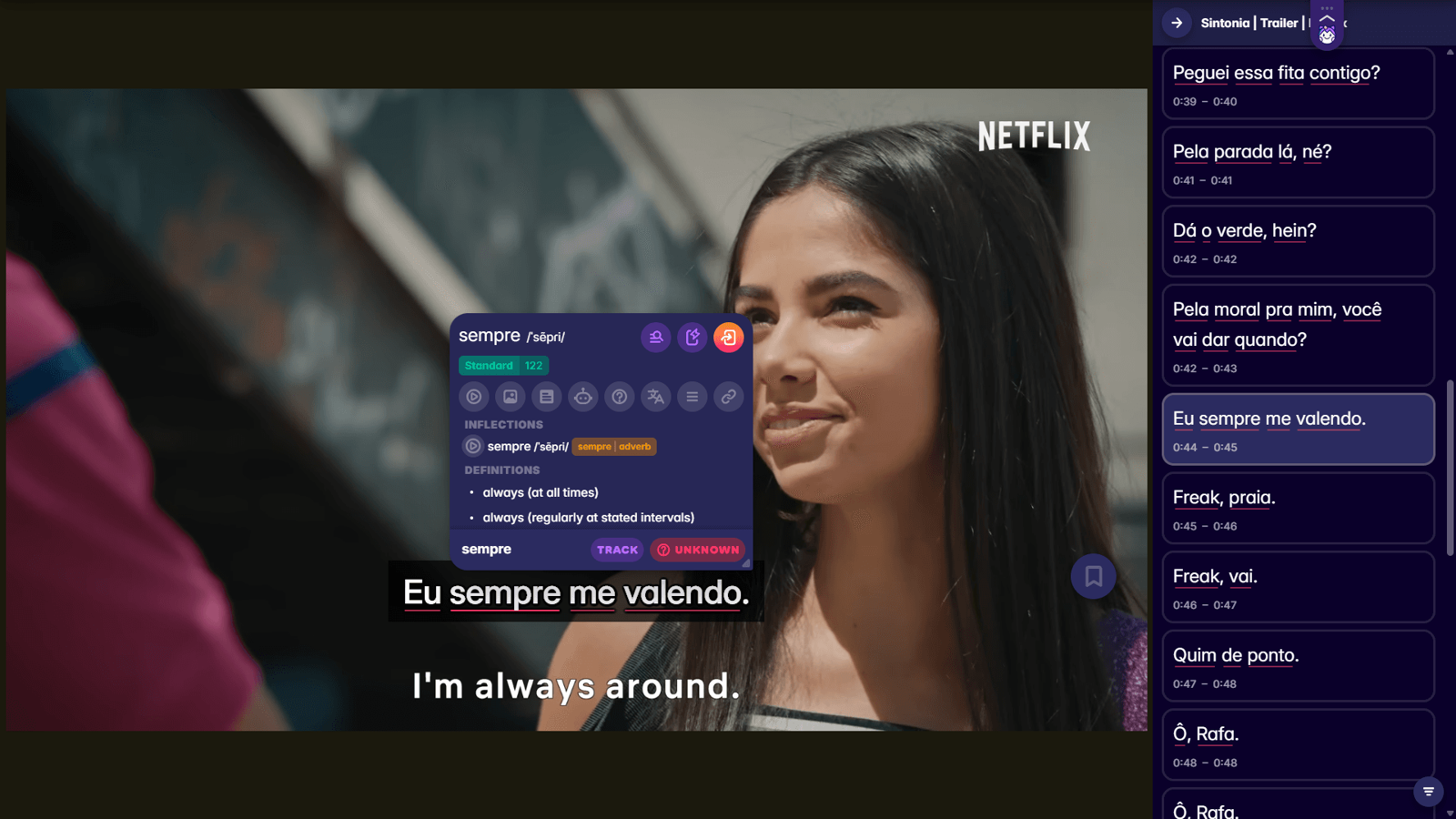
Learn Portuguese connectors to express yourself smoothly
They let you express complex thoughts, tell engaging stories, and connect ideas the way native speakers actually talk. Pay attention to how native speakers use these words in articles, dramas, social media, and other media content. Gradually add more sophisticated connectors as your grammar knowledge expands.
If you consume media in Portuguese, and you understand at least some of the messages and sentences within that media, you will make progress. Period.
Master the connectors, master the flow.💪