# Present Tense Verbs: Romance Language Conjugation Guide
> Learn how present tense verbs conjugate across Spanish, French, Italian, and Portuguese. Comparative charts, patterns, and examples for language learners.
**URL:** https://migaku.com/blog/language-fun/present-tense-verbs-romance-languages
**Last Updated:** 2026-04-29
**Tags:** fundamentals, grammar, verbs
---
The present tense seems simple enough in English, we just say "I speak" or "she speaks" and call it a day. But Romance languages? They take that basic concept and run wild with it. Here's the thing though. Once you understand how present tense verbs work across French, Spanish, Italian, and Portuguese, you start seeing patterns. These languages all came from Latin, so they share a ton of DNA. [Learning one actually makes the others easier to pick up.](https://migaku.com/) Let me walk you through how present tense conjugation works in Romance languages, what makes each one unique, and how you can use this knowledge to level up your [language learning](https://migaku.com/blog/language-fun/3-things-to-learn-a-language).
----
## What are present tense verbs
> 💡 Definition 💡
Present tense verbs describe an action that **happens right now, happens regularly, or represents a general truth.** When you say "I walk to work every day" or "Water boils at 100 degrees," you're using the present tense.
In English, we actually have a few different present tense forms.
1. **The simple present tense** is the basic form of the verb with minimal changes. "I eat breakfast" uses the simple present.
2. Then we have **the present continuous** for ongoing actions: "I am eating breakfast right now."
3. There's also **the present perfect** for actions that started in the past but connect to now: "I have eaten breakfast already."
Romance languages handle this differently. They pack more information into the verb itself through conjugation. Instead of using helping verbs like "am" or "have," they change the verb ending based on who's doing the action.
----
## The Latin origins of Romance verb conjugation
All Romance languages evolved from Vulgar Latin, the everyday spoken Latin that regular people used in the Roman Empire. Classical Latin had four main conjugation patterns based on the infinitive ending.
1. First conjugation verbs ended in -are (like amare, to love).
2. Second conjugation verbs ended in -ere (like habere, to have).
3. Third conjugation verbs ended in -ere with a different pattern (like legere, to read).
4. Fourth conjugation verbs ended in -ire (like audire, to hear).
As Latin spread across Europe and evolved into separate languages, these patterns stuck around but changed in interesting ways. Spanish, French, Italian, and Portuguese all kept distinct conjugation groups, though they simplified some of the complexity. The present indicative endings you see today are direct descendants of those Latin forms, just worn down by centuries of everyday use.
----
## [Spanish present tense](https://migaku.com/blog/spanish/spanish-present-tense) conjugation
Spanish keeps things relatively straightforward with **three main conjugation groups**. Verbs ending in **-ar** (like hablar, to speak), **-er** (like comer, to eat), and **-ir** (like vivir, to live) each follow predictable patterns in the present tense.
For hablar (to speak):
- yo hablo (I speak)
- tú hablas (you speak, informal singular)
- él/ella/usted habla (he/she speaks, you speak formal)
- nosotros hablamos (we speak)
- vosotros habláis (you all speak, informal plural in Spain)
- ellos/ellas/ustedes hablan (they speak, you all speak)
The subject pronouns (yo, tú, él) tell you who's performing the action. Each form of the verb has a distinct ending that matches the subject. The -ar verbs are the most common conjugation pattern in Spanish.
- Second conjugation verbs like comer (to eat) follow their own pattern: como, comes, come, comemos, coméis, comen.
- Third conjugation verbs like vivir (to live) go: vivo, vives, vive, vivimos, vivís, viven.
Spanish does have irregular verbs that break these rules.
- Ser (to be) goes soy, eres, es, somos, sois, son.
- Estar (another verb meaning to be) goes estoy, estás, está, estamos, estáis, están.
----
## French present tense conjugation
French makes things a bit trickier with more irregular verbs and some pronunciation challenges. **The three main groups** are **-er** verbs (like parler, to speak), **-ir** verbs (like finir, to finish), and **-re** verbs (like vendre, to sell).
For parler (to speak):
- je parle (I speak)
- tu parles (you speak, informal singular)
- il/elle/on parle (he/she/one speaks)
- nous parlons (we speak)
- vous parlez (you speak formal or plural)
- ils/elles parlent (they speak)
Here's something interesting about French. Many of these conjugated forms sound identical when spoken, even though they're spelled differently. Parle, parles, and parlent all sound the same. You rely on the subject pronoun to know who's doing the action.
French uses **infixes** in some verb conjugations, adding letters inside the verb stem. For finir (to finish), the plural forms add -iss- before the ending: nous finissons, vous finissez, ils finissent. This infix pattern shows up in many -ir verbs.
The irregular verbs in French are super common, which is kind of annoying when you're learning.
- Être (to be) goes: suis, es, est, sommes, êtes, sont.
- Avoir (to have) goes: ai, as, a, avons, avez, ont.
- Aller (to go) is weird: vais, vas, va, allons, allez, vont.
----
## Italian present tense conjugation
Italian feels a bit more musical with its verb endings, and it also has **three main conjugation groups**: **-are** verbs (like parlare, to speak), **-ere** verbs (like vedere, to see), and **-ire** verbs (like dormire, to sleep or finire, to finish).
For parlare (to speak):
- io parlo (I speak)
- tu parli (you speak, informal singular)
- lui/lei/Lei parla (he/she speaks, you speak formal)
- noi parliamo (we speak)
- voi parlate (you all speak)
- loro parlano (they speak)
The -ere verbs follow their pattern with vedere (to see): vedo, vedi, vede, vediamo, vedete, vedono.
Italian has two types of -ire verbs. Some just add regular endings like dormire: dormo, dormi, dorme, dormiamo, dormite, dormono. Others add an -isc- infix in certain forms like finire: finisco, finisci, finisce, finiamo, finite, finiscono.
That infix only appears in the singular forms and the third person plural, not in the first and second person plural. You just have to memorize which -ire verbs use the infix and which don't. There's no consistent rule, though verbs borrowed from Latin tend to use it.
Italian irregular verbs include:
- Essere (to be): sono, sei, è, siamo, siete, sono.
- Avere (to have) goes: ho, hai, ha, abbiamo, avete, hanno.
----
## Portuguese present tense conjugation
Portuguese shares a lot with Spanish since they both evolved from Latin on the Iberian Peninsula, but Portuguese pronunciation and some verb forms diverged over time. **The three conjugation groups** are **-ar** verbs (like falar, to speak), **-er** verbs (like comer, to eat), and **-ir** verbs (like partir, to leave).
For falar (to speak):
- eu falo (I speak)
- tu falas (you speak, informal singular, mainly in Portugal)
- ele/ela/você fala (he/she speaks, you speak)
- nós falamos (we speak)
- vós falais (you all speak, archaic)
- eles/elas/vocês falam (they speak, you all speak)
Brazilian Portuguese tends to use você instead of tu, and vocês instead of vós. European Portuguese still uses tu regularly. This affects which verb form you use most often.
- The -er verbs like comer go: como, comes, come, comemos, comeis, comem.
- The -ir verbs like partir follow: parto, partes, parte, partimos, partis, partem.
Notice how similar these patterns are to Spanish. If you know one, picking up the other gets easier.
Portuguese irregular verbs include:
- Ser (to be): sou, és, é, somos, sois, são.
- Ter (to have) goes: tenho, tens, tem, temos, tendes, têm.
- Ir (to go) is: vou, vais, vai, vamos, ides, vão.
----
## When to use the present tense
Romance languages use the simple present tense in several situations.
1. **You use it for actions happening right now**: "Hablo con mi amigo" (I speak with my friend).
2. **You use it for habitual actions that happen regularly**: "Comme du pain chaque matin" (I eat bread every morning). You use it for general truths and facts: "L'acqua bolle a 100 gradi" (Water boils at 100 degrees).
3. **Romance languages also use the simple present for the near future when context makes the timing clear.** In Spanish, you can say "Mañana viajo a Madrid" (Tomorrow I travel to Madrid) even though the event hasn't happened yet. English speakers often find this weird since we'd typically say "I'm traveling" or "I will travel" for future events.
4. **The present tense can describe scheduled events:** "El tren sale a las tres" (The train leaves at three).
5. **It works for historical narration to make past events feel more immediate:** "En 1492, Colón llega a América" (In 1492, Columbus arrives in America).
Unlike English, Romance languages don't always use the present continuous form for ongoing actions. Spanish has "estoy hablando" (I am speaking), but you can also just say "hablo" (I speak) even if you're speaking right now. The simple present covers more situations than it does in English.
----
## Common simple present tense verbs and examples
Let me give you some present tense verbs you'll use constantly in Romance languages.
**To be:** ser/être/essere/ser (permanent states) and estar/être/essere/estar (temporary states or locations in Spanish/Portuguese)
- Spanish: Soy estudiante (I am a student), Estoy cansado (I am tired)
- French: Je suis étudiant (I am a student)
- Italian: Sono studente (I am a student)
- Portuguese: Sou estudante (I am a student)
**To have:** tener (haber)/avoir/avere/ter
- Spanish: Tengo un libro (I have a book)
- French: J'ai un livre (I have a book)
- Italian: Ho un libro (I have a book)
- Portuguese: Tenho um livro (I have a book)
**To do/make:** hacer/faire/fare/fazer
- Spanish: Hago la tarea (I do the homework)
- French: Je fais les devoirs (I do the homework)
- Italian: Faccio i compiti (I do the homework)
- Portuguese: Faço o dever (I do the homework)
**To go:** ir/aller/andare/ir
- Spanish: Voy al mercado (I go to the market)
- French: Je vais au marché (I go to the market)
- Italian: Vado al mercato (I go to the market)
- Portuguese: Vou ao mercado (I go to the market)
**To want:** querer/vouloir/volere/querer
- Spanish: Quiero agua (I want water)
- French: Je veux de l'eau (I want water)
- Italian: Voglio acqua (I want water)
- Portuguese: Quero água (I want water)
**To eat:** comer/manger/mangiare/comer
- Spanish: Como pizza (I eat pizza)
- French: Je mange une pizza (I eat pizza)
- Italian: Mangio pizza (I eat pizza)
- Portuguese: Como pizza (I eat pizza)
**To speak:** hablar/parler/parlare/falar
- Spanish: Hablo español (I speak Spanish)
- French: Je parle français (I speak French)
- Italian: Parlo italiano (I speak Italian)
- Portuguese: Falo português (I speak Portuguese)
**To live:** vivir/vivre/vivere/viver
- Spanish: Vivo en México (I live in Mexico)
- French: Je vis en France (I live in France)
- Italian: Vivo in Italia (I live in Italy)
- Portuguese: Vivo no Brasil (I live in Brazil)
**To work:** trabajar/travailler/lavorare/trabalhar
- Spanish: Trabajo en casa (I work at home)
- French: Je travaille à la maison (I work at home)
- Italian: Lavoro a casa (I work at home)
- Portuguese: Trabalho em casa (I work at home)
**To know:** saber (conocer)/savoir (connaître)/sapere (conoscere)/saber (conhecer)
- Spanish: Sé la respuesta (I know the answer)
- French: Je sais la réponse (I know the answer)
- Italian: So la risposta (I know the answer)
- Portuguese: Sei a resposta (I know the answer)
These ten verbs show up in almost every conversation. Master their present tense forms and you'll be able to express a huge range of ideas.
----
## Moving beyond simple present: Present progressive tense & present perfect tense
The present tense is just the starting point. Romance languages have other present tense forms that add nuance to how you describe actions.
**The present continuous (or present progressive)** describes actions happening right now.
- Spanish uses estar + gerund: "Estoy comiendo" (I am eating).
- French uses être en train de + infinitive: "Je suis en train de manger" (I am in the process of eating).
- Italian uses stare + gerund: "Sto mangiando" (I am eating).
- Portuguese uses estar + gerund: "Estou comendo" (I am eating).
**The present perfect** connects past actions to the present moment. You form it with the helping verb (avoir/haber/avere/ter) plus the past participle.
- "He comido" (I have eaten) in Spanish.
- "J'ai mangé" (I have eaten) in French.
- "Ho mangiato" (I have eaten) in Italian.
- "Tenho comido" (I have eaten) in Portuguese.
----
## Learning strategies for present tense conjugation
1. **Start with the most common verbs.** The high-frequency verbs give you the biggest return on your time investment.
2. **Use the verbs in complete sentences, not just as isolated forms.** "Hablo" by itself is boring. "Hablo español con mi familia" (I speak Spanish with my family) gives you context and makes the form memorable. Create sentences about your own life using the present tense.
3. **Read and listen to native content where you'll see these verb forms used naturally.** When you encounter "mange" in a French article or "vive" in a Spanish podcast, you're seeing the form in a real sentence with actual meaning. This beats drilling conjugation tables any day.
4. **Focus on one conjugation group at a time.** Master the -ar verbs in Spanish before moving to -er and -ir verbs. Get comfortable with regular patterns before tackling irregular verbs. Building your knowledge gradually works better than trying to learn everything at once.
5. **Practice with [spaced repetition](https://migaku.com/blog/language-fun/spaced-repetition-in-2026-how-it-actually-works) to move verb forms into long-term memory.** See a conjugation, try to recall it a few minutes later, then an hour later, then a day later. This spacing effect helps cement the forms so you can access them quickly when speaking or writing.
6. **Pay attention to patterns across languages if you're learning multiple Romance languages.** Noticing that "I speak" is hablo, parle, parlo, and falo helps you remember all four. The similarities make each subsequent language easier to pick up.
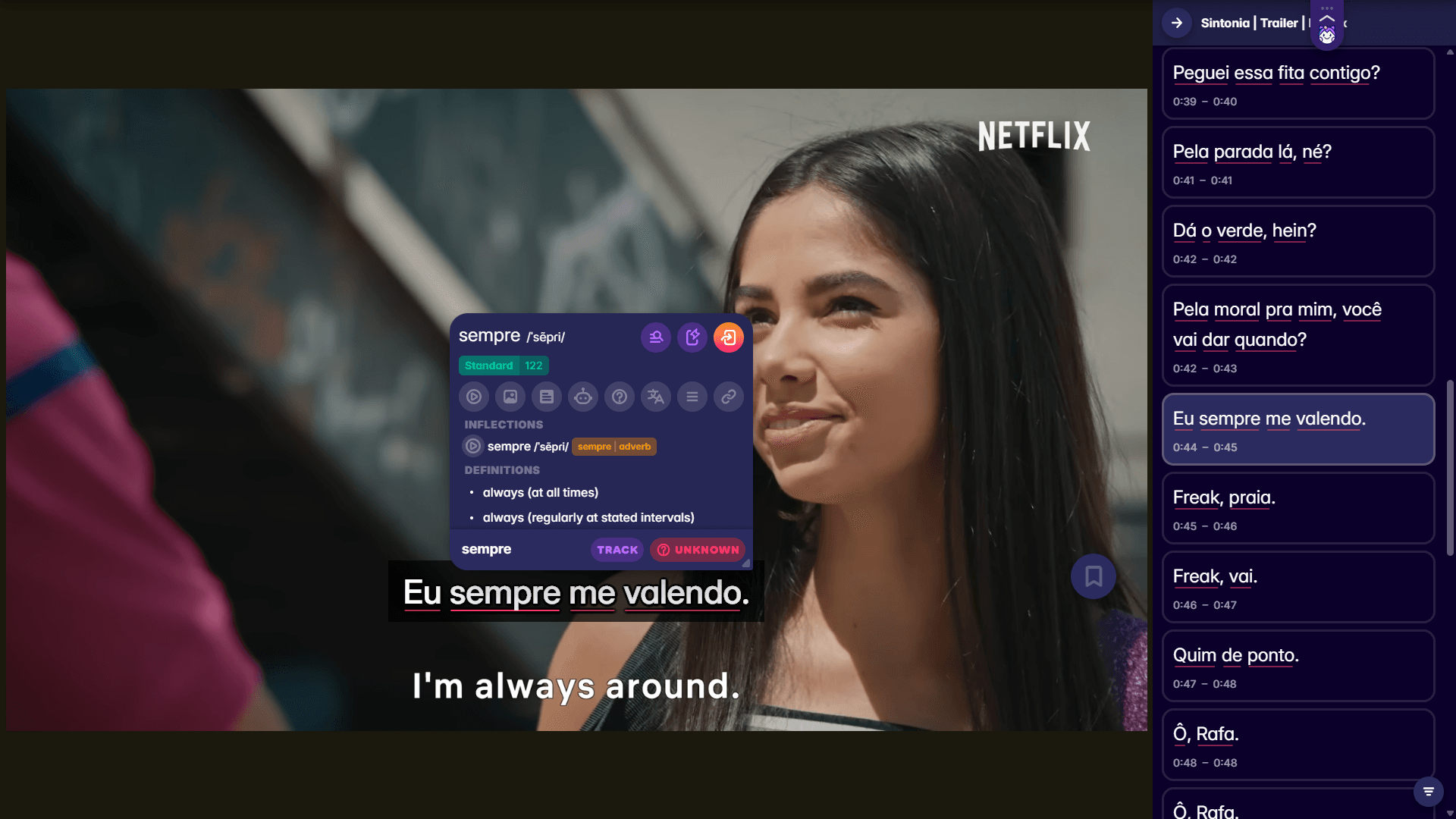
Anyway, if you're serious about learning Romance languages through real content, Migaku's browser extension and app let you look up conjugated verb forms instantly while watching shows or reading articles in Spanish, French, Italian, or Portuguese. You see the verbs in context and can check their meaning without breaking your flow. There's a 10-day free trial if you want to give it a shot.
 ----
## Understanding verbs in the simple present across Romance languages gives you a framework for learning
Instead of treating each language as completely separate, you see the shared patterns and can transfer knowledge between them. The present tense lets you express yourself and understand many expressions right away. You can talk about your daily routine, describe what you're doing, share facts and opinions, and have basic conversations. Similarly, you can also understand the grammar and meanings when you encounter this tense in media content.
> If you consume media in your target language, and you understand at least some of the messages and sentences within that media, you will make progress. _Period_.
Learn the pattern, and transfer your knowledge.
----
## Understanding verbs in the simple present across Romance languages gives you a framework for learning
Instead of treating each language as completely separate, you see the shared patterns and can transfer knowledge between them. The present tense lets you express yourself and understand many expressions right away. You can talk about your daily routine, describe what you're doing, share facts and opinions, and have basic conversations. Similarly, you can also understand the grammar and meanings when you encounter this tense in media content.
> If you consume media in your target language, and you understand at least some of the messages and sentences within that media, you will make progress. _Period_.
Learn the pattern, and transfer your knowledge.