# Chinese vs Japanese: Tell the Difference Between Chinese and Japanese, and Choose Wisely
> Comparing Chinese and Japanese for language learners. Breaking down tones, writing systems, grammar, and which language matches your goals better.
**URL:** https://migaku.com/blog/japanese/chinese-vs-japanese
**Last Updated:** 2026-02-15
**Tags:** fundamentals, discussion, comparison
---
So you're trying to decide between [learning Chinese](https://migaku.com/learn-chinese) or [Japanese](https://migaku.com/learn-japanese)? I get it. Both languages look intimidating with all those characters, both have massive cultural appeal, and honestly, both will impress people at parties. The thing is, they're actually pretty different once you dig into them. Let me break down what makes each language tick so you can figure out which one matches your brain better.
---
## Why Chinese and Japanese look so similar (but really aren't)
Here's the thing that confuses everyone at first: Japanese uses Chinese characters. Back in the 5th century, Japan didn't have a writing system, so they borrowed characters from China. These characters are called (Kanji) in Japanese, which literally means "Han characters."
But that's where the similarity mostly ends.
1. The spoken languages sound completely different, have different [grammar](https://migaku.com/blog/japanese/japanese-sentence-structure), and even the shared characters often mean different things or have different pronunciations. It's kind of like how English borrowed tons of Latin words, but nobody would say English and Latin are similar languages.
2. Japanese people can sometimes guess the meaning of written Chinese because of the shared characters, but they can't understand spoken Mandarin at all. The languages come from completely different language families and aren't actually related.
---
## The writing system breakdown of Chinese and Japanese languages
This is where things get interesting. The writing systems are probably the biggest factor in how hard each language feels to learn.
### Chinese characters: One system, thousands of characters
When you learn Chinese, you're dealing with one writing system called [Hanzi](https://migaku.com/blog/chinese/how-many-chinese-characters-to-learn). Mandarin Chinese uses simplified characters (around 3,500 for basic literacy), while Taiwan uses traditional characters that have more strokes. Each character represents a syllable and usually a meaning.
The good news? Once you learn a character, you know how to read it everywhere. The character 好 (hǎo, meaning "good") is always 好. There's consistency.
The bad news? You need to memorize a LOT of characters. Around 2,000-3,000 to read a newspaper comfortably. And Chinese characters don't really tell you how to pronounce them (though some have phonetic components that give hints).
### Japanese writing: Three systems working together
Japanese uses three different writing systems at the same time. Yeah, three.
1. First, there's kanji (Those borrowed Chinese characters). Japanese uses around 2,000 common kanji, but here's the twist: each kanji can have multiple pronunciations depending on context. The character 生 can be pronounced "sei," "shou," "nama," "i," "u," "o," "ha," and more. Pretty wild.
2. Then you've got (Hiragana), which is a phonetic alphabet with 46 basic characters. It's used for grammar particles, verb endings, and native Japanese words without kanji. You can learn hiragana in a few days.
3. Finally, there's (Katakana), another phonetic alphabet used mainly for foreign words, emphasis, and sound effects. Also 46 basic characters.
So Japanese writing feels easier at first because you can start reading simple stuff with just hiragana, but it gets complicated when you need to juggle all three systems.
### The character connection: Kanji versus hanzi
The Chinese characters used in Japanese (Kanji) and the characters in Chinese (Hanzi) share historical roots, but they've diverged over time.
Some kanji and hanzi are identical and mean the same thing. Some look the same but mean different things. Some look different because Japan simplified certain characters differently than China did.
For example, the character for "country" is 国 in Japanese and simplified Chinese, but 國 in traditional Chinese (used in Taiwan and Hong Kong). The meaning is the same, but the form varies.
Learning one doesn't automatically mean you can read the other, but there's definitely overlap. If you learn Chinese first, you'll recognize many kanji meanings. If you [learn Japanese](https://migaku.com/blog/japanese/how-to-learn-japanese-vocabulary) first, you'll have a head start on some Chinese characters.
---
## Pronunciation and tones: The real challenge for Chinese pronunciation
Let me be straight with you: Mandarin pronunciation is harder for most English speakers.
Mandarin is a **tonal** language with [four main tones plus a neutral tone](https://migaku.com/blog/chinese/chinese-tone-changes). The same syllable "ma" can mean mother (mā), hemp (má), horse (mǎ), or scold (mà) depending on your tone. Get the tone wrong and you're saying a completely different word. This trips people up constantly, especially in the beginning.
Chinese also has some sounds that don't exist in English, like the "x," "q," and "zh" sounds. But honestly, the individual sounds aren't that bad. The tone system is what makes pronunciation genuinely difficult.
Japanese pronunciation? Way easier. Japanese has five vowel sounds (a, i, u, e, o) that stay pretty consistent. There are no tones. The rhythm is different from English (It's mora-timed rather than stress-timed), but you can make yourself understood pretty easily even with an accent. Japanese people are generally forgiving of pronunciation mistakes.
The tricky part in Japanese is **pitch accent**, which is different from tones. Some words have high or low pitch patterns, and getting them wrong can sound weird, but usually people still understand you. It's more about sounding natural than being understood.
---
## Grammar structures of Japanese vs Chinese: Completely different approaches
### Chinese grammar
Chinese grammar is surprisingly straightforward. The basic sentence structure is **subject-verb-object**, just like English. "I eat rice" translates pretty directly to "我吃饭" (wǒ chī fàn). Verbs don't conjugate for tense, person, or number. You add time words or particles to show when something happened.
There are no articles (a, an, the), no plural forms, no gender. The grammar itself is probably easier than English grammar in many ways. The challenge is that Chinese relies heavily on context and word order to convey meaning.
### Japanese grammar
Japanese grammar is a whole different beast. The sentence structure is **subject-object-verb**, so "I eat rice" becomes "I rice eat" (はごをべます). Getting used to verbs at the end takes time.
Japanese verbs conjugate. A lot. Different forms for polite/casual speech, past/present tense, positive/negative, and various grammatical functions. You've got particles (は, が, を, に, で, etc.) that mark grammatical relationships, and they're crucial for meaning.
Japanese also has different levels of politeness built into the grammar. You speak differently to your boss versus your friend, and you need to learn these distinctions.
For English speakers, Chinese grammar feels more intuitive at first, but Japanese grammar becomes more logical once you understand the system.
---
## Key differences that affect learning difficulty of these two languages
> 📈The difficulty curve is different for each language.
> - Chinese is **front-loaded**: the tones and characters hit you hard from day one. But once you get past that initial wall, progress feels more linear. Learn more words, read more stuff, get better.
> - Japanese feels easier at the beginning. You can learn hiragana quickly, basic grammar makes sense, and pronunciation isn't scary. But the **difficulty ramps up as you go**. The multiple readings for kanji, the complex honorific system, the three writing systems, they all pile on as you advance.
Another practical difference: Chinese has more speakers (over a billion) and is more useful for business in many industries. Mandarin Chinese opens doors in mainland China, Taiwan, Singapore, and Chinese communities worldwide.
Japanese has fewer speakers (around 125 million, mostly in Japan), but Japanese culture has massive global influence through anime, manga, games, and technology. If you're into Japanese media, learning the language transforms your experience.
---
## Chinese or Japanese, which language should you learn
This depends entirely on your goals and interests.
Learn Chinese if you want a language that's more widely spoken, you're interested in business opportunities in China or Taiwan, or you like the idea of a more analytical grammar system. The tone challenge is real, but if you're willing to drill pronunciation early, the rest flows pretty naturally.
Learn Japanese if you're into Japanese culture, anime, manga, or games. If you want to visit or work in Japan specifically. If you prefer a language where pronunciation won't stress you out from day one. Just be ready for the long haul with grammar complexity and multiple writing systems.
Honestly? Both languages take serious time to learn well. We're talking years, not months. Pick the one that excites you more, because motivation matters way more than which one is "objectively easier."
I've seen people breeze through Chinese because they loved the culture and stayed motivated. I've seen others stick with Japanese through all its complexity because anime kept them engaged.
> 🚀Your interest will carry you further than any difficulty comparison.
---
## Resources and learning approaches for Japanese and Chinese languages
Both languages have tons of learning resources available in 2026. Apps, [textbooks](https://migaku.com/blog/japanese/best-japanese-textbooks), online courses, language exchange partners, you name it.
For Chinese, you'll want to focus hard on tones from the beginning. Get a good teacher or use audio resources that drill pronunciation. The writing system takes consistent daily practice.
For Japanese, master hiragana and katakana first (Seriously, do this in your first week). Then tackle basic grammar patterns before diving deep into kanji. The grammar needs more attention than Chinese grammar does.
Immersion helps massively for both. Watching shows, reading content, listening to podcasts. The more you expose yourself to real language use, the faster you'll improve.
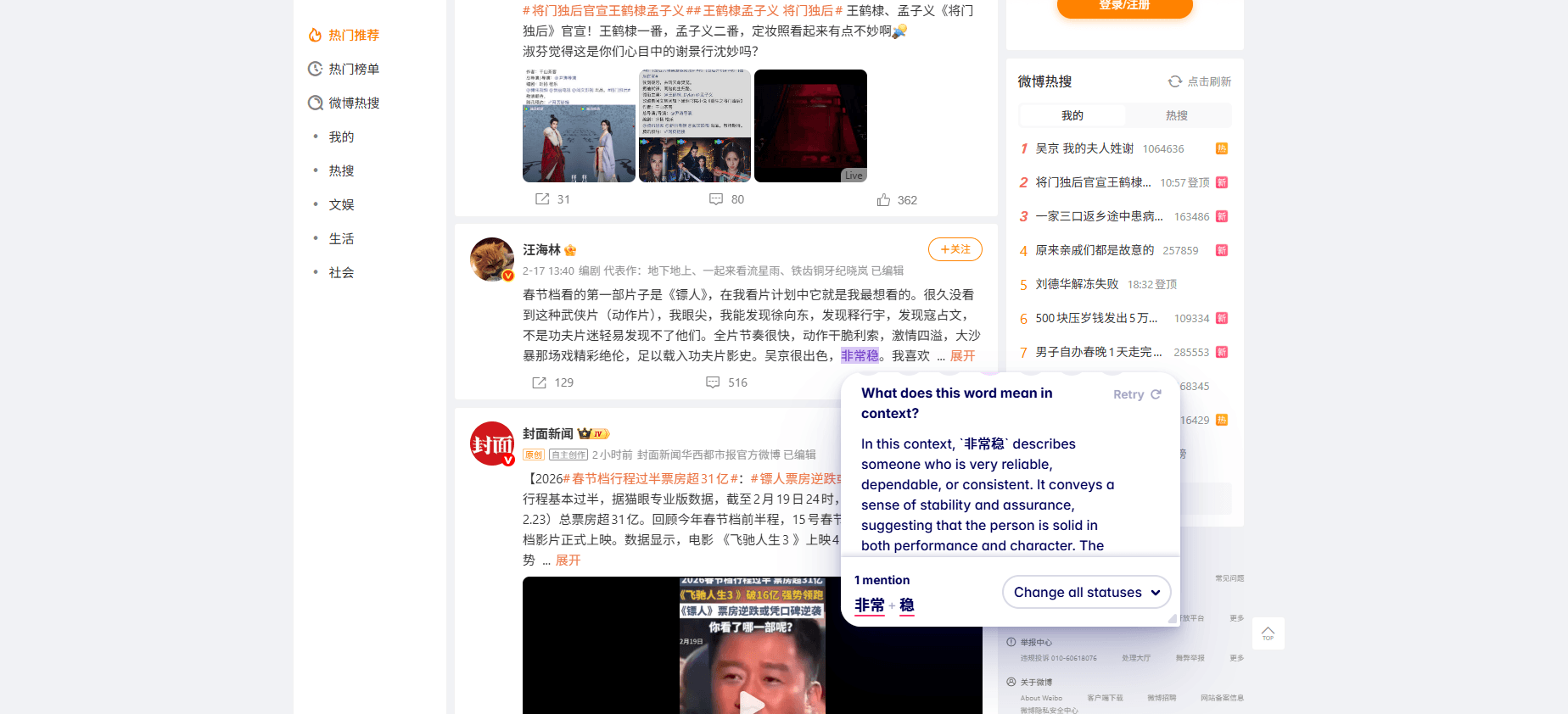
Anyway, if you want to actually immerse yourself in real content, Migaku's browser extension and app let you look up words instantly while watching shows or reading articles in either language. Makes the whole immersion process way more practical. There's a 10-day free trial if you want to check it out.
 ---
## FAQs
When you see text, here's how to identify which language it is: If you see curvy, simpler-looking characters mixed with the complex ones, it's Japanese. Those are hiragana. Japanese text has a mix of kanji and hiragana (and sometimes katakana, which looks more angular). If you see only complex characters with no phonetic alphabet mixed in, it's Chinese. Chinese text is all Hanzi, all the time. Also, Japanese often has small characters above or beside kanji showing pronunciation (called furigana). Chinese doesn't do this except in learning materials.
---
## No matter which one you choose, it will give learning the second one a head start
Can you imagine learning Japanese while you've already mastered Chinese and English? Phewww, connecting kanji to their meanings gets a lot easier. What's more? You can tell the meanings of katakana words with your English knowledge. And with your experience of learning the first foreign language, picking up the second one becomes all the more intuitive! If you enjoy the culture? All the easier for you to do immersion practice with dramas, shows, movies, and everything!😎
> If you consume media in the language you want to learn, and you understand at least some of the messages and sentences within that media, you will make progress. _Period_.
Progress builds confidence!
---
## FAQs
When you see text, here's how to identify which language it is: If you see curvy, simpler-looking characters mixed with the complex ones, it's Japanese. Those are hiragana. Japanese text has a mix of kanji and hiragana (and sometimes katakana, which looks more angular). If you see only complex characters with no phonetic alphabet mixed in, it's Chinese. Chinese text is all Hanzi, all the time. Also, Japanese often has small characters above or beside kanji showing pronunciation (called furigana). Chinese doesn't do this except in learning materials.
---
## No matter which one you choose, it will give learning the second one a head start
Can you imagine learning Japanese while you've already mastered Chinese and English? Phewww, connecting kanji to their meanings gets a lot easier. What's more? You can tell the meanings of katakana words with your English knowledge. And with your experience of learning the first foreign language, picking up the second one becomes all the more intuitive! If you enjoy the culture? All the easier for you to do immersion practice with dramas, shows, movies, and everything!😎
> If you consume media in the language you want to learn, and you understand at least some of the messages and sentences within that media, you will make progress. _Period_.
Progress builds confidence!