# Rosetta Stone Japanese Review: Is It the Best Way to Learn Japanese
> Honest Rosetta Stone Japanese review covering what works, what doesn't, pricing, and better alternatives. Real talk about whether it's worth your money in 2026.
**URL:** https://migaku.com/blog/japanese/rosetta-stone-japanese-review
**Last Updated:** 2026-01-15
**Tags:** fundamentals, vocabulary, phrases, grammar
---
What about using Rosetta Stone to [learn Japanese](https://migaku.com/learn-japanese)? Makes sense, right? Rosetta Stone has been around forever and basically invented the whole language learning software thing. But here's what you actually need to know before dropping cash on their Japanese program. I've spent a good chunk of time testing Rosetta Stone Japanese, and I'm going to break down exactly what works, what doesn't, and whether it's actually worth your money in 2026.
---
## How Rosetta Stone Japanese learning works
Rosetta Stone built their entire approach around what they call "[immersive learning](https://migaku.com/blog/japanese/japanese-immersion-learning)." The basic idea? You learn Japanese the same way you learned your first language as a kid. No translations, no English explanations, just pictures, audio from native speakers, and pattern recognition.
When you fire up a lesson, you'll see images paired with Japanese phrases. The program shows you a picture of someone eating, plays audio saying "tabemasu () - to eat," and you start connecting the dots. Pretty straightforward concept.
The software uses something called TruAccent, which is their speech recognition technology. You speak into your mic, and it tells you whether your pronunciation sounds close enough to a native speaker. Does it work perfectly? We'll get into that.
---
## The writing systems of Japanese with Rosetta Stone: Hiragana, katakana, and kanji
Here's where things get interesting. Japanese uses three [writing systems](https://migaku.com/blog/japanese/how-to-write-in-japanese), and Rosetta Stone has to teach you all of them.
1. They start you off with hiragana (ひらがな), which is the basic phonetic alphabet with 46 characters.
2. Then they introduce katakana (カタカナ), used mainly for foreign words.
3. Finally, they sprinkle in kanji (), those complex Chinese characters that make Japanese reading actually challenging.
The program teaches you to recognize these characters in context, but it doesn't break down stroke order or radicals (The building blocks of kanji). You just see them, hear the word, and hopefully remember. For some learners, that works fine. For others, it feels like trying to memorize random squiggles.
---
## How many levels does Rosetta Stone Japanese language have
Rosetta Stone Japanese comes with 3 levels, and each level has 4 units. Each unit breaks down into core lessons plus focused activities for reading, writing, speaking, and listening. All told, you're looking at roughly one year to complete everything.
1. Level 1 covers absolute basics: greetings, numbers, simple verbs, basic [sentence structure](https://migaku.com/blog/japanese/japanese-word-order). You'll learn phrases like "Konnichiwa (こんにちは) - hello" and "Watashi wa gakusei desu () - I am a student."
2. Level 2 moves into past tense, more complex sentence patterns, and everyday conversation topics like shopping, directions, and describing things.
3. Level 3 tackles more advanced grammar, longer conversations, and situations like making plans or discussing preferences.
Completing all three levels puts you somewhere around upper beginner to lower intermediate. You won't be watching anime without subtitles or reading novels, but you could handle basic conversations and navigate Japan as a tourist.
---
## What works well if learning Japanese with Rosetta Stone
Let me be straight with you: Rosetta Stone does some things really well for Japanese learners.
1. The immersive approach genuinely helps with intuitive understanding. Instead of memorizing grammar rules like "wa marks the topic, ga marks the subject," you just absorb how these [particles](https://migaku.com/blog/japanese/japanese-particles-guide) work through repetition. Your brain starts recognizing patterns without needing explicit explanations.
2. The audio quality is excellent. Every phrase comes from native speakers, so you're hearing authentic Japanese pronunciation from day one. This matters way more than people realize. Learning from native speaker audio builds better listening comprehension than textbook recordings.
3. TruAccent speech recognition actually works decently for Japanese. The technology has improved a ton since Rosetta Stone first launched. It catches major pronunciation errors and helps you refine your accent. Will it make you sound exactly like a native speaker? No. But it prevents you from developing terrible habits.
4. The program excels for visual learners. If you learn best by seeing and doing rather than reading explanations, Rosetta Stone's picture-based method clicks. You associate "inu () - dog" with an image of a dog, which creates stronger memory connections than just seeing the word written out.
For complete beginners who feel intimidated by Japanese, Rosetta Stone provides a comfortable entry point. The interface feels polished and professional. You won't get overwhelmed with grammar charts or complicated explanations. Just point, click, repeat.
---
## Where Rosetta Stone Japanese language learning falls short
Alright, real talk. Rosetta Stone has some serious limitations for learning Japanese specifically.
1. **Grammar explanations are basically nonexistent in the textbook.** You pick up patterns through context, which works for simple stuff. But Japanese grammar gets weird. Particles like "wa (は)," "ga (が)," "wo (を)," and "ni (に)" have subtle differences that you really need explained. Rosetta Stone just throws them at you and hopes you figure it out. Some learners do. Many don't.
2. **[Verb conjugation](https://migaku.com/blog/japanese/japanese-verb-conjugation) gets messy fast.** Japanese verbs change forms constantly: polite form, casual form, past tense, negative, passive, causative, and about a million combinations. Rosetta Stone shows you examples, but doesn't explain the conjugation system. You end up memorizing individual phrases without understanding the underlying structure.
3. **Cultural context is missing.** Japanese is deeply tied to social hierarchy and politeness levels. The difference between "taberu () - to eat (Casual)" and "tabemasu () - to eat (Polite)" matters hugely depending on who you're talking to. Rosetta Stone uses polite forms mostly, but doesn't teach you when to switch or why.
4. **Kanji coverage is weak.** I mentioned this earlier, but it's worth repeating. 300-400 kanji won't cut it for real Japanese literacy. You need dedicated kanji study alongside Rosetta Stone.
5. **No pitch accent training.** Japanese uses pitch accent to distinguish words. "Hashi ()" with a high-low pitch means chopsticks. "Hashi ()" with a low-high pitch means bridge. Rosetta Stone doesn't address this at all. You might develop a flat, monotone accent that sounds unnatural.
6. **Conversational skills plateau quickly.** The program teaches you set phrases and responses, but actual conversation requires flexibility. You need to understand how to build sentences from scratch, not just recall memorized chunks. After finishing all three levels, many learners struggle to create original sentences beyond the patterns they've practiced.
---
## Is Rosetta Stone any good for Japanese
Depends what you mean by "good."
For absolute beginners who want a gentle introduction to the Japanese language, Rosetta Stone works fine. You'll learn basic vocabulary, get comfortable with hiragana and katakana, and develop decent pronunciation. If your goal is tourist-level Japanese or just exploring whether you like the language, it does the job.
For learners aiming for conversational fluency or reading ability, Rosetta Stone alone won't get you there. You'd need to supplement heavily with grammar resources, kanji study tools, and actual conversation practice with real people.
The [immersion](https://migaku.com/blog/japanese/japanese-immersion-learning) method sounds great in theory, but Japanese is structurally different enough from English that some explicit instruction really helps. Kids learning their first language have years of constant exposure. You're doing 30-minute lessons a few times a week. The comparison doesn't quite hold up.
---
## Pricing and value in 2026
Here's where Rosetta Stone gets expensive. Their pricing structure offers a few options:
- A 3-month subscription runs about $36-48 depending on sales.
- A 12-month subscription costs around $120-180.
- They also offer a lifetime subscription for $200-300, which includes all languages available on Rosetta Stone (25+ languages total, including Spanish, French, Korean, Mandarin, and more).
The lifetime deal sounds tempting if you're interested in multiple languages. But for Japanese specifically, you're paying premium prices for a program that needs supplementing. Competitors like JapanesePod101 or Rocket Japanese offer more comprehensive Japanese-specific content for similar or lower prices.
Rosetta Stone does include access to live tutoring sessions for free with subscribers. These online group sessions let you practice with a tutor and other learners. They're helpful for getting actual speaking practice, but the sessions are short (25-30 minutes) and not always available at convenient times.
---
## Rosetta Stone vs. Alternatives for Japanese learners
Let me break down how Rosetta Stone stacks up against other popular options.
1. **JapanesePod101** costs less (Around $100-150 per year) and provides way more content specifically designed for Japanese. You get detailed grammar explanations, cultural notes, and lessons organized by skill level. The podcast format works great for learning on the go. If you want comprehensive Japanese instruction, JapanesePod101 gives you more bang for your buck.
2. **Rocket Japanese** runs about $259 for lifetime access and includes better grammar explanations, cultural lessons, and more thorough kanji instruction. The interface feels less polished than Rosetta Stone, but the content depth is superior for Japanese specifically.
3. **Pimsleur Japanese** focuses entirely on audio and speaking. It's more expensive than Rosetta Stone but develops conversational skills faster. You won't learn to read, though. Pimsleur is all about listening and speaking practice.
4. **Duolingo** is free and covers Japanese basics. The gamification keeps you engaged, and they've improved their Japanese course significantly. You won't reach high levels, but for casual learning or supplementing another resource, Duolingo works.
5. **[WaniKani](https://migaku.com/blog/japanese/anki-vs-wanikani)** specializes in kanji and vocabulary using spaced repetition. It costs about $9 per month and teaches you 2,000+ kanji systematically. If you're using Rosetta Stone, adding WaniKani fills the kanji gap perfectly.
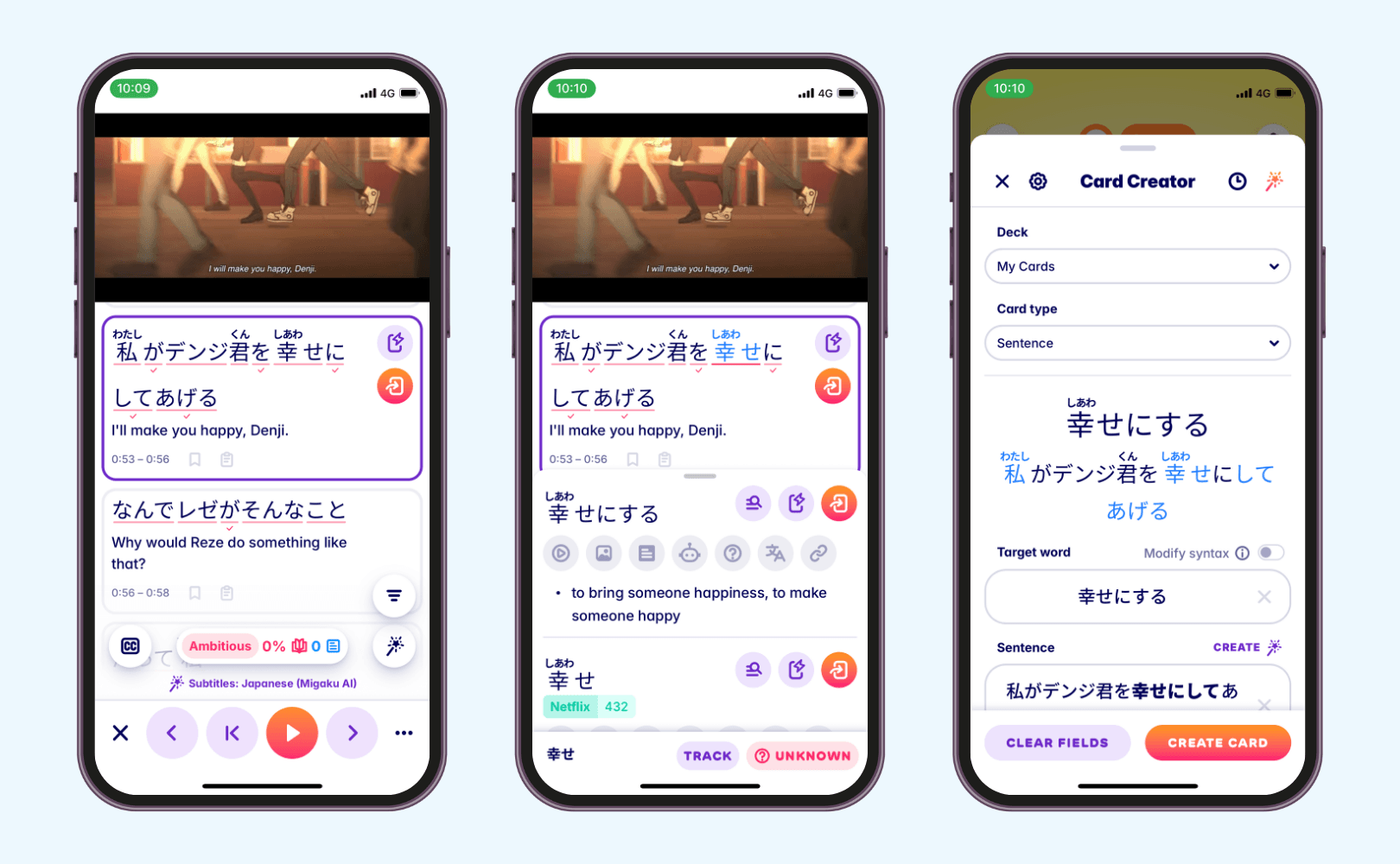
6. **[Migaku tools](https://migaku.com/learn-japanese)** If you want to actually immerse yourself in real Japanese content while learning, Migaku's browser extension and app let you look up words instantly while watching Japanese shows or reading articles. Makes learning from native content way more practical than isolated lessons. There's a 10-day free trial if you want to check it out.
 ---
## You don't have to stick to one source to learn Japanese
Does Rosetta Stone stand out as the best way to learn Japanese? Honestly, no. The immersive method works for building intuition, and the speech recognition helps with pronunciation. But the lack of grammar explanations, weak kanji coverage, and high price point make it hard to recommend as a standalone solution. If you expect to reach native-level Japanese, you need to explore other resources and media to make up for what you can't pick up from Rosetta Stone.
> If you consume media in Japanese, and you understand at least some of the messages and sentences within that media, you will make progress. _Period_.
Be a resourceful learner!
---
## You don't have to stick to one source to learn Japanese
Does Rosetta Stone stand out as the best way to learn Japanese? Honestly, no. The immersive method works for building intuition, and the speech recognition helps with pronunciation. But the lack of grammar explanations, weak kanji coverage, and high price point make it hard to recommend as a standalone solution. If you expect to reach native-level Japanese, you need to explore other resources and media to make up for what you can't pick up from Rosetta Stone.
> If you consume media in Japanese, and you understand at least some of the messages and sentences within that media, you will make progress. _Period_.
Be a resourceful learner!