# How to Watch Foreign Movies to Learn Languages in 2026
> Passive watching can't get you anywhere. Learn exactly how to watch movies for language learning with subtitle strategies and tools that actually work.
**URL:** https://migaku.com/blog/language-fun/how-to-watch-foreign-movies-for-language-learning
**Last Updated:** 2026-02-10
**Tags:** fundamentals, resources, discussion, deepdive
---
You've probably heard people say they [learned Spanish](https://migaku.com/learn-spanish) from watching telenovelas or [picked up Japanese](https://migaku.com/learn-japanese) from anime. Sounds too good to be true, right? Here's the thing: watching foreign movies and TV shows actually works for language learning, but only if you do it strategically. Just passively watching with English subtitles won't magically make you fluent. You need specific techniques to turn entertainment time into effective study sessions. This guide breaks down exactly how to watch foreign movies for language learning, from choosing the right subtitle setup to active techniques that actually stick.🎥
---
## Does watching foreign movies help with language learning
Short answer: yes, but with conditions.
Research shows that watching movies in your target language improves listening comprehension, expands [vocabulary](https://migaku.com/blog/japanese/how-to-learn-japanese-vocabulary), and teaches you how native speakers actually talk. You'll pick up natural speech patterns, slang, and cultural context that [textbooks](https://migaku.com/blog/japanese/best-japanese-textbooks) miss completely.
The problem is that passive watching doesn't cut it. If you're just sitting back with a bowl of popcorn and English subtitles, you're basically watching a dubbed film. Your brain takes the path of least resistance and reads the English instead of processing the foreign language audio.
Active watching makes the difference. This means:
1. Engaging with the content through techniques like pausing to look up words
2. Repeating dialogue out loud
3. Switching subtitle languages based on your level
When you actively process the language instead of zoning out, your brain actually builds new neural pathways for language comprehension.
The FBI's Foreign Service Institute has studied language acquisition for decades, and their methods [emphasize massive input through authentic materials](https://migaku.com/blog/language-fun/comprehensible-input-method-language-learning). They combine structured study with hours of listening to real content. Movies and TV shows count as that authentic input, especially once you're past the absolute beginner stage.
---
## Choosing the right movies for language learning levels that fit you
Not all foreign films work equally well for language learning. A beginner trying to watch a fast-paced crime thriller will just feel frustrated and lost.
1. **For beginners**, start with children's or animated films. The language is simpler, characters speak more clearly, and visual context helps you understand what's happening. Disney movies dubbed in your target language work surprisingly well because you probably already know the plot.
2. **Intermediate learners** should try teen movies, slice-of-life movies, or romantic comedies. These genres use everyday vocabulary and conversational language you'll actually need. The dialogue tends to be clearer than action films where characters mumble or use specialized jargon.
3. **Advanced learners** can handle anything: historical films, thrillers, documentaries, whatever interests you. At this point, pick content you'd genuinely enjoy watching even in your native language. Your motivation matters more than the difficulty level.
Genre also affects what you'll learn. Crime films teach you investigative vocabulary but maybe not useful daily conversation. Cooking films give you food-related terms. Office comedies teach workplace language. Pick based on your goals and interests.
---
## Recommended movies to learn a new language
| Language | Movie Title (Original) | English Translation | Year | Description |
| - | - | - | - | - |
| **Spanish** | *La Infiltrada* | *The Infiltrator* | 2024 | Spanish thriller based on a true story; features clear European Spanish with tension-driven, natural dialogue . |
| | *Padre No Hay Más Que Uno 5* | *Father There Is Only One 5* | 2025 | Popular family comedy from Spain; conversational, everyday Spanish with contemporary colloquialisms . |
| **French** | *Anatomie d'une chute* | *Anatomy of a Fall* | 2023 | Award-winning courtroom drama; deliberate, articulate Parisian French ideal for advanced listening . |
| | *Le Comte de Monte-Cristo* | *The Count of Monte-Cristo* | 2024 | Lavish period adaptation; formal, classic French with clear pronunciation and rich vocabulary . |
| **Japanese** | *The Boy and the Heron* (君たちはどう生きるか) | *The Boy and the Heron* | 2023 | Studio Ghibli's Oscar-winning film; thoughtful, well-paced Japanese suitable for intermediate learners . |
| | *Suzume* (すずめの戸締まり) | *Suzume* | 2022 | Makoto Shinkai's road-trip fantasy; contemporary Japanese with regional dialects and natural speech patterns . |
| **Korean** | *Exhuma* (파묘) | *Exhuma* | 2024 | Supernatural thriller; mixes formal ritual language with modern conversational Korean, massive box office hit . |
| | *12.12: The Day* (서울의 봄) | *12.12: The Day* | 2023 | Political drama; deliberate, authoritative speech and period-accurate dialogue, top-grossing recent release . |
| **German** | *Eine Million Minuten* | *A Million Minutes* | 2024 | Family drama; warm, conversational German with clear everyday dialogue . |
| | *Wunderschön* | *Beautiful* | 2022 | Ensemble comedy-drama; contemporary colloquial German, body-image themes, strong domestic popularity . |
| **Mandarin** | *YOLO* (热辣滚烫) | *YOLO* | 2024 | Inspirational dramedy; modern urban Mandarin, motivational dialogue, one of China's highest-grossing recent films . |
| | *Full River Red* (满江红) | *Full River Red* | 2023 | Zhang Yimou historical thriller; sharp, fast-paced dialogue in a suspenseful setting, massive commercial success . |
---
## Subtitle strategies when you watch foreign films
Subtitles are the most important tool for learning language by watching movies, but you need to use them strategically.
**The beginner approach**:
1. Start with subtitles in your native language while listening to the foreign audio. This helps you follow the plot while your ears get used to the sounds of the new language. You're building listening stamina without getting completely lost.
2. After a few episodes or movies, switch to dual subtitles if possible. Some apps show both the target language and your native language simultaneously. This lets you connect what you're hearing with the written form in the target language, while still having the English as a safety net.
**The intermediate sweet spot**:
1. Use subtitles in your target language only. This forces you to process the language both through listening and reading.
2. When you hear a word you don't know, you can see how it's spelled and look it up. You're connecting spoken and written forms, which strengthens memory.
**For advanced learners**:
1. Try watching without any subtitles first.
2. Then rewatch with target language subtitles to catch things you missed. This two-pass approach trains your ear while filling in comprehension gaps.
Here's a technique that works across all levels: **pause frequently**. When you hear an interesting phrase or don't understand something, stop the video. Look up the word, write it down, maybe even repeat it out loud. This active engagement beats watching three hours straight without pausing.
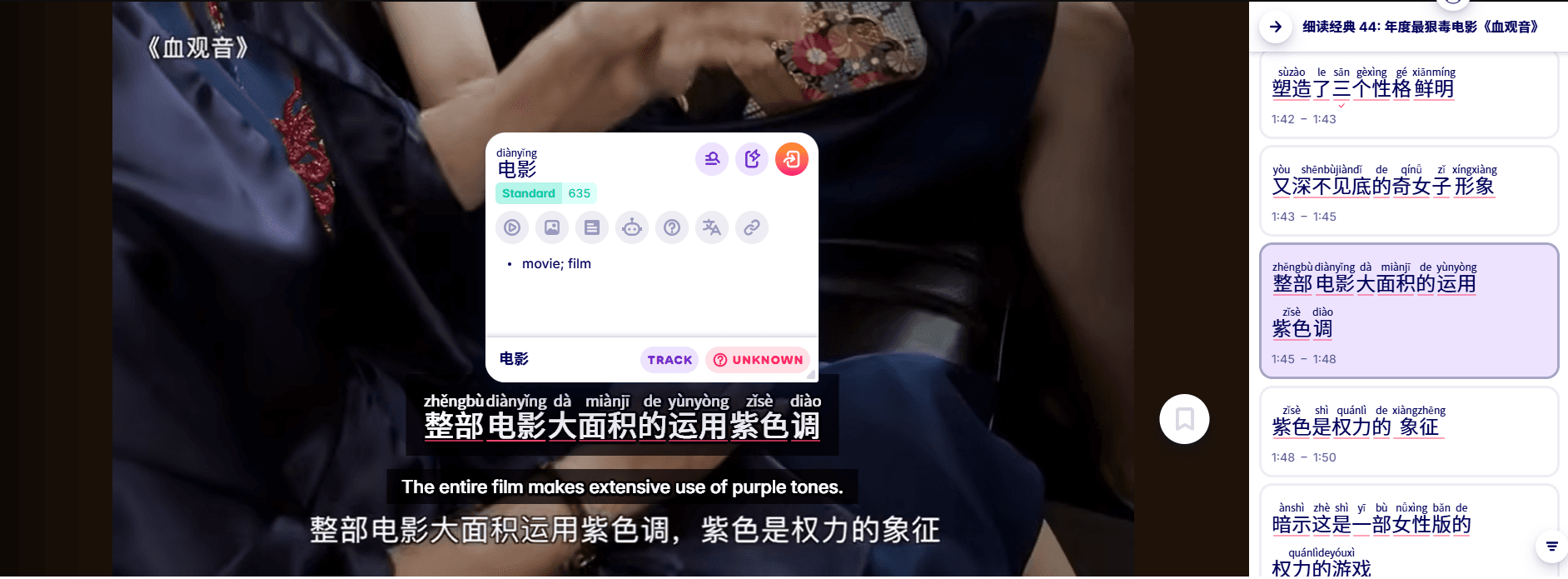
(Use tools like Migaku browser extension that allow you to customize subtitles.)
 ---
## Active learning techniques to improve your way to learn a language
Watching alone isn't enough. You need to interact with the content.
1. **Shadowing** means repeating dialogue immediately after you hear it, trying to match the pronunciation, rhythm, and intonation. Pick a scene, play a line, pause, and repeat it out loud. This technique improves your accent and helps phrases stick in your memory. Actors usually have clear pronunciation, making them good models to imitate.
2. **Note-taking** keeps you engaged. Keep a notebook or digital document open while watching. Write down new vocabulary, interesting expressions, or [grammar](https://migaku.com/blog/japanese/japanese-sentence-structure) patterns you notice. The act of writing reinforces memory better than just hearing something.
3. **Flashcard** creation from movie content works really well. When you encounter a useful phrase, make a flashcard with the sentence context. Apps like Anki let you add audio clips and screenshots, so you can review the exact moment from the show. Context makes vocabulary stick way better than isolated word lists.
4. **Dictation** exercises push your listening skills hard. Play a short dialogue segment, pause, and try to write down exactly what you heard. Then check against the subtitles. This reveals which sounds you're mishearing and forces careful listening.
5. **Rewatch** the same content multiple times. First viewing with target language subtitles to follow the plot. Second viewing without subtitles to test comprehension. Third viewing focusing on specific elements like [verb conjugation](https://migaku.com/blog/japanese/japanese-verb-conjugation)s or new vocabulary. Repetition with different focuses builds deep familiarity.
---
## Learning tools and apps for new language learning through movies: Lingopie and others
Several platforms specifically design features for language learners watching foreign content.
1. **Lingopie** built their entire service around learning languages through TV shows. You can click any word in the subtitles to see instant translations and save them to flashcards. They offer content in Spanish, French, German, Italian, Portuguese, Russian, Korean, and Japanese. You can customize your learning experience by adjusting playback speed, choosing subtitle display options, and tracking words you've learned. The platform also lets you practice reading through their interactive subtitle system. A single subscription gives you access to multiple languages, so you can explore different options.
2. **The Language Learning** with Netflix extension (now called **Language Reactor** and works with other platforms too) adds features to your regular Netflix account. It shows dual subtitles, lets you click words for definitions, and auto-pauses after each subtitle. Pretty cool for learners who already have Netflix.
3. **LingQ** works as a reading and listening platform where you can import content from various sources, including transcripts from shows. You click unknown words to save them, and the system tracks your vocabulary growth across all content you consume.
4. **YouTube with auto-generated subtitles** in various languages gives you free access to tons of content. The subtitle quality varies, but for common languages like Spanish, French, or German, they're usually accurate enough. You can slow down playback speed in YouTube settings, which helps when dialogue moves too fast.
5. **Regular streaming platforms** like Netflix, Amazon Prime, and Disney+ offer tons of foreign language content with multiple subtitle options. Check your account settings because you can often find language options that aren't immediately visible. Netflix especially has great international content from Korea, Spain, France, and other countries.
---
## Common mistakes to avoid
1. Don't rely only on English subtitles. You're training your reading skills, not your language skills. Your brain will ignore the foreign audio completely.
2. Don't watch content way above your level. You need to understand at least 70% of what's happening to learn effectively from context. Total confusion just leads to frustration and quitting.
3. Don't forget to review what you've learned. Writing down 50 new words feels productive, but if you never review them, they disappear from memory within days. Build a review system using flashcards or a vocabulary app.
4. Don't skip the speaking practice. Watching improves listening comprehension, but you need to actively speak to improve pronunciation and fluency. Use shadowing techniques or talk about the show's plot in your target language.
5. Don't watch dubbed versions in your target language. If you're learning Japanese, watching an American show dubbed in Japanese teaches you weird, unnatural phrasing. Stick to content originally produced in your target language for authentic speech patterns.
Anyway, if you want to level up your movie-watching study sessions, Migaku's browser extension and app let you instantly look up words while watching shows on Netflix, YouTube, or reading articles anywhere online. You can create flashcards directly from what you're watching, which makes immersion learning way more practical. There's a 10-day free trial if you want to check it out.
---
## Active learning techniques to improve your way to learn a language
Watching alone isn't enough. You need to interact with the content.
1. **Shadowing** means repeating dialogue immediately after you hear it, trying to match the pronunciation, rhythm, and intonation. Pick a scene, play a line, pause, and repeat it out loud. This technique improves your accent and helps phrases stick in your memory. Actors usually have clear pronunciation, making them good models to imitate.
2. **Note-taking** keeps you engaged. Keep a notebook or digital document open while watching. Write down new vocabulary, interesting expressions, or [grammar](https://migaku.com/blog/japanese/japanese-sentence-structure) patterns you notice. The act of writing reinforces memory better than just hearing something.
3. **Flashcard** creation from movie content works really well. When you encounter a useful phrase, make a flashcard with the sentence context. Apps like Anki let you add audio clips and screenshots, so you can review the exact moment from the show. Context makes vocabulary stick way better than isolated word lists.
4. **Dictation** exercises push your listening skills hard. Play a short dialogue segment, pause, and try to write down exactly what you heard. Then check against the subtitles. This reveals which sounds you're mishearing and forces careful listening.
5. **Rewatch** the same content multiple times. First viewing with target language subtitles to follow the plot. Second viewing without subtitles to test comprehension. Third viewing focusing on specific elements like [verb conjugation](https://migaku.com/blog/japanese/japanese-verb-conjugation)s or new vocabulary. Repetition with different focuses builds deep familiarity.
---
## Learning tools and apps for new language learning through movies: Lingopie and others
Several platforms specifically design features for language learners watching foreign content.
1. **Lingopie** built their entire service around learning languages through TV shows. You can click any word in the subtitles to see instant translations and save them to flashcards. They offer content in Spanish, French, German, Italian, Portuguese, Russian, Korean, and Japanese. You can customize your learning experience by adjusting playback speed, choosing subtitle display options, and tracking words you've learned. The platform also lets you practice reading through their interactive subtitle system. A single subscription gives you access to multiple languages, so you can explore different options.
2. **The Language Learning** with Netflix extension (now called **Language Reactor** and works with other platforms too) adds features to your regular Netflix account. It shows dual subtitles, lets you click words for definitions, and auto-pauses after each subtitle. Pretty cool for learners who already have Netflix.
3. **LingQ** works as a reading and listening platform where you can import content from various sources, including transcripts from shows. You click unknown words to save them, and the system tracks your vocabulary growth across all content you consume.
4. **YouTube with auto-generated subtitles** in various languages gives you free access to tons of content. The subtitle quality varies, but for common languages like Spanish, French, or German, they're usually accurate enough. You can slow down playback speed in YouTube settings, which helps when dialogue moves too fast.
5. **Regular streaming platforms** like Netflix, Amazon Prime, and Disney+ offer tons of foreign language content with multiple subtitle options. Check your account settings because you can often find language options that aren't immediately visible. Netflix especially has great international content from Korea, Spain, France, and other countries.
---
## Common mistakes to avoid
1. Don't rely only on English subtitles. You're training your reading skills, not your language skills. Your brain will ignore the foreign audio completely.
2. Don't watch content way above your level. You need to understand at least 70% of what's happening to learn effectively from context. Total confusion just leads to frustration and quitting.
3. Don't forget to review what you've learned. Writing down 50 new words feels productive, but if you never review them, they disappear from memory within days. Build a review system using flashcards or a vocabulary app.
4. Don't skip the speaking practice. Watching improves listening comprehension, but you need to actively speak to improve pronunciation and fluency. Use shadowing techniques or talk about the show's plot in your target language.
5. Don't watch dubbed versions in your target language. If you're learning Japanese, watching an American show dubbed in Japanese teaches you weird, unnatural phrasing. Stick to content originally produced in your target language for authentic speech patterns.
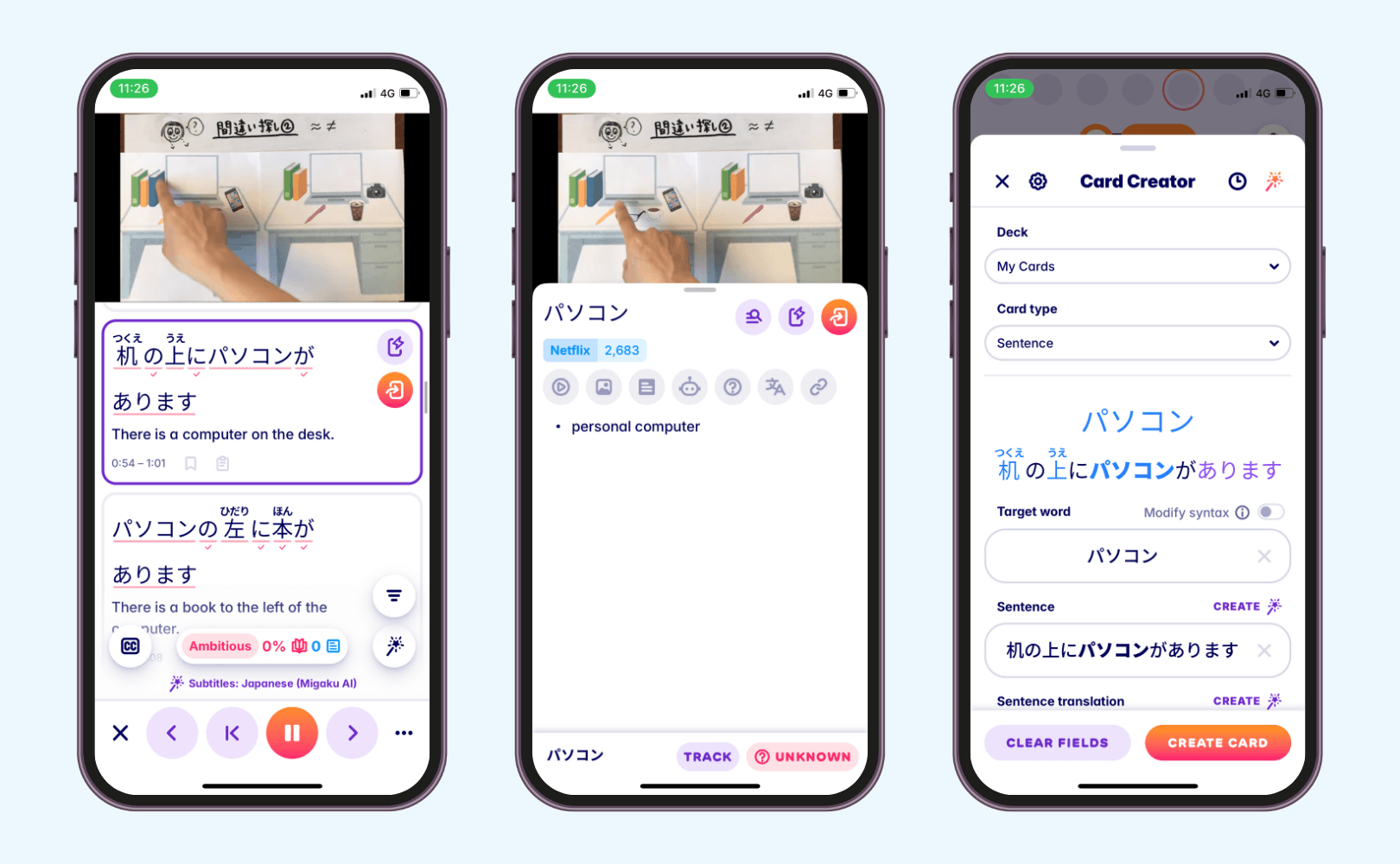
Anyway, if you want to level up your movie-watching study sessions, Migaku's browser extension and app let you instantly look up words while watching shows on Netflix, YouTube, or reading articles anywhere online. You can create flashcards directly from what you're watching, which makes immersion learning way more practical. There's a 10-day free trial if you want to check it out.
 ---
## Can watching movies really help you learn and become fluent
You can definitely improve your language skills significantly through TV shows, but they work best as part of a broader learning strategy. Movies excel at teaching listening comprehension, expanding vocabulary in context, and showing you how real people actually speak. You'll learn informal expressions, cultural references, and natural speech rhythm that formal courses often miss. The emotional connection to characters and plot also helps memory retention way better than memorizing word lists.
> If you consume media in the language you want to learn, and you understand at least some of the messages and sentences within that media, you will make progress. _Period_.
Enjoyable content keeps you motivated.
---
## Can watching movies really help you learn and become fluent
You can definitely improve your language skills significantly through TV shows, but they work best as part of a broader learning strategy. Movies excel at teaching listening comprehension, expanding vocabulary in context, and showing you how real people actually speak. You'll learn informal expressions, cultural references, and natural speech rhythm that formal courses often miss. The emotional connection to characters and plot also helps memory retention way better than memorizing word lists.
> If you consume media in the language you want to learn, and you understand at least some of the messages and sentences within that media, you will make progress. _Period_.
Enjoyable content keeps you motivated.