# Italian Travel Phrases: Essential Italian Words for Visiting Italy
> Greetings, directions, dining, emergencies... There are so many scenarios that learning common Italian phrases can make your trip to Italy smoother!
**URL:** https://migaku.com/blog/language-fun/italian-travel-phrases
**Last Updated:** 2026-02-13
**Tags:** vocabulary, phrases
---
You're planning a trip to Italy, and you're probably wondering if you can get by with just English. Sure, plenty of Italians in tourist areas speak English, but [knowing even a handful of Italian](https://migaku.com/learn-italian) travel phrases will completely change your experience. Here's everything you need to know about the essential Italian phrases that'll make your travels smoother and way more fun.✈️
---
## Why bother learning Italian phrases for travel
Here's the thing. Most travelers assume everyone in Italy speaks English, and while that's somewhat true in Rome, Florence, and Venice, step into smaller towns or family-run restaurants and you'll quickly realize English isn't as common as you'd think. I've watched countless tourists struggle to order food or ask for directions because they didn't bother learning even basic italian words.
[Learning Italian for your trip](https://migaku.com/blog/language-fun/comprehensible-input-method-language-learning) shows respect. Italians appreciate when visitors make an effort, even if your pronunciation isn't perfect. You'll notice the difference immediately. A shopkeeper who seemed indifferent suddenly becomes helpful and friendly when you greet them with a proper "buongiorno" instead of "hello."
Plus, knowing these phrases gives you independence. You won't need to rely on translation apps for every single interaction, which honestly gets exhausting after a day or two of traveling.
---
## Italian words for greetings and basic politeness
### Starting conversations the right way
The most important Italian phrase you'll use is probably **"ciao,"** but there's a catch. While ciao is super casual and perfect for friends or people your age, it's actually considered rude to use with strangers, older people, or in formal situations. Instead, you'll want to use **"buongiorno"** (Good morning/good day) or **"buonasera"** (Good evening, used after around 2-3 PM).
When you walk into a shop or restaurant, always greet people first. Italians find it strange when tourists just start asking questions without a proper greeting. A simple "buongiorno" goes a long way.
For saying goodbye formally, use **"arrivederci."** With friends or casual situations, ciao works perfectly fine for both hello and goodbye.
### The magic words: per favore, grazie, and prego
These three words will be your best friends during Italian travel.
- **"Per favore"** means please, and you should use it constantly. Italians value politeness, and adding per favore to any request makes you sound respectful rather than demanding.
- **"Grazie"** (Thank you) is straightforward, and you'll say it dozens of times daily. You can also say "grazie mille" (Thanks a million) for extra emphasis when someone really helps you out.
- **"Prego"** is the standard response to grazie, meaning "you're welcome." But prego has other uses too. You'll hear it when someone's offering you to go first through a door, or when a waiter presents your food.
### Getting someone's attention politely
When you need to get someone's attention or apologize, use **"scusi"** (Formal) or **"scusa"** (Informal). Scusi works in almost every situation where you need to interrupt someone, ask a question, or say excuse me. Trying to squeeze past someone on a crowded train? "Scusi." Need to ask a stranger for directions? Start with "scusi."
---
## Useful Italian questions for getting around
### Asking if someone speaks English in common Italian
One of the first things you'll want to know is **"Lei parla inglese?"** (Do you speak English?). This shows you're making an effort rather than just assuming everyone should accommodate you. The formal "Lei" is respectful, especially with older people or in professional settings.
If they respond with "sì" (Yes), great. If they say "no" or "un po'" (A little bit), you'll need to rely on your Italian phrases or some creative hand gestures, which Italians are pretty good at understanding.
### Speak Italian to find your way around
**"Dov'è...?"** (Where is...?) is incredibly useful. You can point at a map or say "Dov'è il bagno?" (Where is the bathroom?), "Dov'è la stazione?" (Where is the station?), or "Dov'è il centro?" (Where is the center/downtown?).
For directions, you'll hear **"a destra"** (To the right), **"a sinistra"** (To the left), and **"sempre dritto"** (Straight ahead). Learning these helps you actually understand when someone's trying to help you.
When asking for directions to a specific place, you can say **"Come si arriva a...?"** ([How do you get to](https://migaku.com/blog/language-fun/break-through-language-learning-plateau)...?). This works for landmarks, addresses, or neighborhoods.
### Italian travel phrases for transportation
If you're taking taxis or public transport, you'll need **"Quanto costa?"** ([How much does it cost](https://migaku.com/blog/language-fun/bilingual-brain-benefits)?). This is essential for avoiding tourist pricing or understanding ticket costs. The word "quanto" appears in lots of useful questions, like "Quanto tempo?" (How much time/How long?).
For trains and buses, **"A che ora parte?"** (What time does it leave?) and **"A che ora arriva?"** (What time does it arrive?) help you plan your schedule. You can also ask **"C'è un autobus per...?"** (Is there a bus to...?) or **"Quale binario?"** (Which platform?).
---
## Dining and food words to know
### At restaurants or cafés
Italian food is probably one of the main reasons you're visiting, so you'll want to navigate restaurants confidently. When you enter, wait to be seated or ask **"Un tavolo per due, per favore"** (A table for two, please).
To get the waiter's attention, a simple "scusi" works. When you're ready to order, say **"Vorrei..."** (I would like...) followed by whatever you want. "Vorrei una pizza margherita, per favore" is polite and clear.
For the check, ask **"Il conto, per favore"** (The bill, please). Don't expect the waiter to bring it without asking. In Italy, they consider it rude to rush diners, so you need to request it when you're ready.
### Basic Italian phrases for dietary needs and preferences
If you have allergies or dietary restrictions, **"Sono allergico a..."** (I'm allergic to...) could literally save your life. Follow it with the ingredient: "Sono allergico alle noci" (I'm allergic to nuts).
For vegetarians, **"Sono vegetariano/vegetariana"** helps, though Italian cuisine has plenty of vegetable-based dishes anyway. You can also ask "C'è carne?" (Is there meat?) or "Senza carne, per favore" (Without meat, please).
### Compliments and common restaurant phrases for your trip
After a great meal, **"Era buonissimo"** (It was delicious) or simply "Buono!" will make your server happy. Italians take pride in their food, and compliments are always appreciated.
You might hear the waiter ask **"Tutto bene?"** (Everything okay?) during your meal. A simple "Sì, grazie" or thumbs up works fine.
---
## Common Italian phrases for shopping and money
### Key phrases for in stores and markets
When browsing shops, you'll often hear **"Posso aiutarla?"** (Can I help you?). If you're just looking, respond with "No grazie, sto solo guardando" (No thanks, I'm just looking). If you need help, "Sì, grazie" opens the conversation.
**"Quanto costa?"** is your go-to for prices. You can point at items and ask this for anything you're interested in buying. At markets, you might be able to negotiate, but in regular shops, prices are fixed.
For sizes, **"Avete questo in..."** (Do you have this in...) followed by your size helps. Clothing sizes differ in Italy, so you might need to try things on. **"Posso provarlo?"** means "Can I try it on?"
### Payment phrases in Italian language
**"Posso pagare con carta?"** (Can I pay by card?) is useful since some smaller shops still prefer cash. If they say no, you'll need to find an ATM, which is "bancomat" in Italian.
When paying, you might hear **"Contanti o carta?"** (Cash or card?). Just respond with whichever you're using.
---
## Numbers in Italian for travelers
You'll need basic numbers constantly for prices, times, addresses, and quantities. Here are the essentials:
- **1-10**: uno, due, tre, quattro, cinque, sei, sette, otto, nove, dieci
- **11-20**: undici, dodici, tredici, quattordici, quindici, sedici, diciassette, diciotto, diciannove, venti
- Then it follows a pattern: venti (20), trenta (30), quaranta (40), cinquanta (50), sessanta (60), settanta (70), ottanta (80), novanta (90), cento (100).
- For combining numbers, you just add them: ventuno (21), trentadue (32), quarantacinque (45). Pretty straightforward once you get the basics down.
Knowing numbers helps you understand prices without constantly converting in your head or relying on written amounts.
---
## Asking for help in Italian
### When you need assistance
**"Aiuto!"** (Help!) is the emergency word you hopefully won't need, but should definitely know. For less urgent situations, **"Mi può aiutare?"** (Can you help me?) works perfectly.
If you're lost, **"Mi sono perso/persa"** (I'm lost, masculine/feminine) gets the point across quickly. Combine it with showing someone your destination on a map or phone.
**"Ho bisogno di un medico"** (I need a doctor) and **"Ho bisogno di una farmacia"** (I need a pharmacy) are crucial if you get sick or injured. Medical emergencies are serious, and knowing these phrases helps you get help faster.
### Reporting problems in common phrases
**"Ho perso..."** (I've lost...) followed by "il mio passaporto" (My passport), "il mio portafoglio" (My wallet), or "il mio telefono" (My phone) helps you report lost items.
For theft, **"Mi hanno rubato..."** (They stole from me...) is unfortunately useful in crowded tourist areas. Follow it with what was stolen.
The emergency number in Italy is **112**, same as most of Europe. They usually have English speakers available, but knowing some Italian phrases helps communicate the basics quickly.
---
## Useful phrases for specific situations
### At hotels when visiting Italy
**"Ho una prenotazione"** (I have a reservation) starts your check-in smoothly. Follow with your name: "a nome di..." (Under the name of...).
**"A che ora è la colazione?"** (What time is breakfast?) and **"Il WiFi funziona?"** (Does the WiFi work?) are practical questions you'll probably ask.
For problems, **"Non funziona..."** (It doesn't work...) followed by "l'aria condizionata" (The air conditioning), "la doccia" (The shower), or whatever's broken helps get maintenance.
### Phrases to help make friends and small talk
**"Di dove sei?"** (Where are you from?) is a natural conversation starter. You can respond with **"Sono di..."** (I'm from...) and your country or city.
"È la prima volta in Italia?" (Is it your first time in Italy?) is something locals might ask you. "Sì, prima volta" (Yes, first time) or "No, sono già stato/stata qui" (No, I've been here before) are simple responses.
Italians often ask "Ti piace l'Italia?" (Do you like Italy?). A enthusiastic "Sì, mi piace molto!" (Yes, I like it a lot!) or "È bellissima!" (It's beautiful!) makes them happy.
### Wishing someone well
When someone's traveling, Italians say **"Buon viaggio!"** ([Have a good trip](https://migaku.com/blog/language-fun/easiest-languages-to-learn-for-english-speakers)!). This literally translates to "good journey" and it's the standard way to wish travelers well.
For safe travels specifically, you might hear **"Viaggia sicuro!"** or "Buon viaggio e stai attento!" (Have a good trip and be careful!), though "Buon viaggio" covers most situations.
**"Buona giornata!"** (Have a good day!) and **"Buona serata!"** (Have a good evening!) are nice ways to end interactions with shopkeepers or restaurant staff.
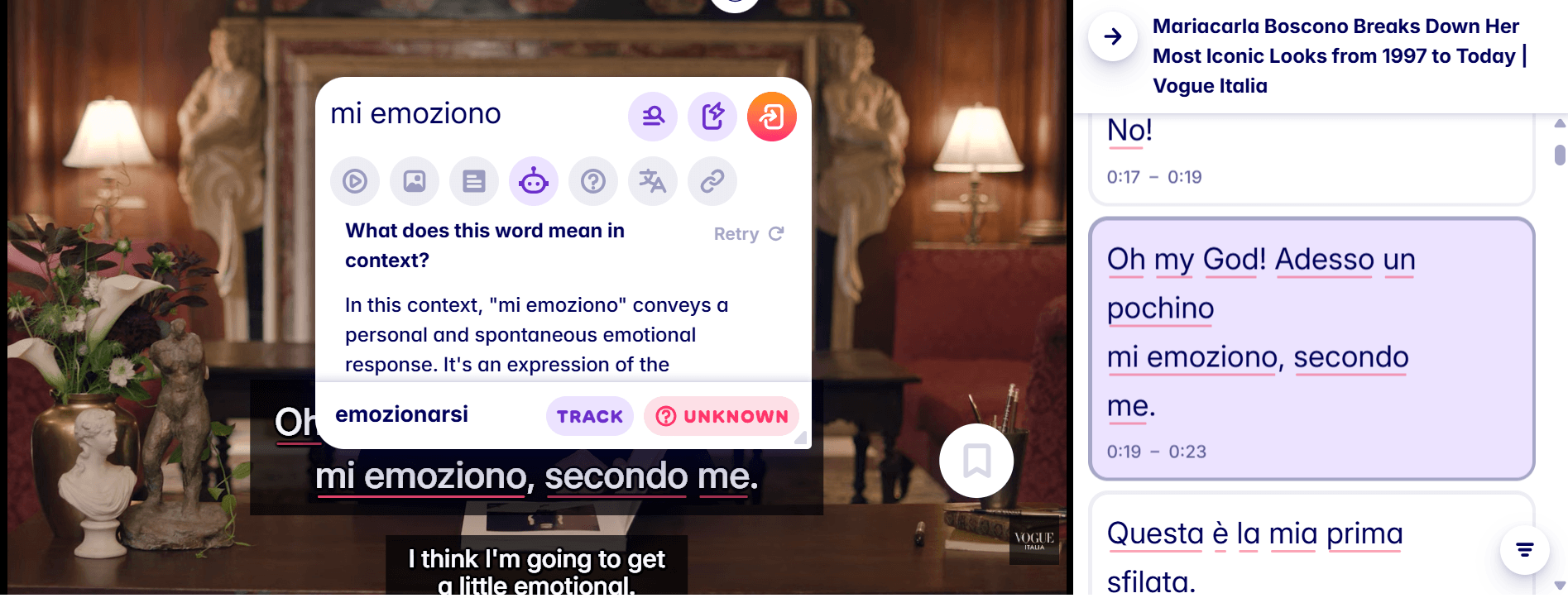
The best way to acquire the Italian phrases you need for travelling fast? Find a YouTube video on Italian travel phrases and use the Migaku extension or app to add all the essential words to flashcards. Review them for 3 to 4 days. You'll be pretty much ready for your travel! There's a 10-day free trial if you want to check it out before your trip.
 ---
## Learning the local language doesn't need to be overwhelming
It's totally understandable if you don't want to invest major time to study a new language before travelling. The simple solution? Start with the greeting words and phrases. Then add the basic questions like "Dov'è?" and "Quanto costa?" as you need them. You can use language apps, YouTube videos, or just repeat phrases to yourself while looking at a pronunciation guide.
> If you consume media in Italian, and you understand at least some of the messages and sentences within that media, you will make progress. _Period_.
The trip becomes so much richer when you can communicate, even basically.🏖️
---
## Learning the local language doesn't need to be overwhelming
It's totally understandable if you don't want to invest major time to study a new language before travelling. The simple solution? Start with the greeting words and phrases. Then add the basic questions like "Dov'è?" and "Quanto costa?" as you need them. You can use language apps, YouTube videos, or just repeat phrases to yourself while looking at a pronunciation guide.
> If you consume media in Italian, and you understand at least some of the messages and sentences within that media, you will make progress. _Period_.
The trip becomes so much richer when you can communicate, even basically.🏖️