# Language Learning With Subtitles: How to Learn a Language With Subtitles in 2026
> Learn how to use subtitles effectively for language learning. Proven techniques for beginners to advanced learners, plus the tools and platforms to use.
**URL:** https://migaku.com/blog/language-fun/language-learning-with-subtitles
**Last Updated:** 2026-03-07
**Tags:** resources, discussion
---
You've probably heard that watching TV shows and movies can help you [learn a new language](https://migaku.com/). And yeah, that's true, but there's a catch. If you just turn on a Spanish show and zone out, you won't magically become fluent. The secret sauce? **Using subtitles strategically**. I'm talking about actually thinking through which subtitles to use, when to use them, and how to actively engage with what you're watching. This guide will show you exactly how to turn your Netflix binge sessions into legitimate language practice.
---
## Can you learn a language by watching subtitles
Short answer: yes, but you need to be intentional about it.
Here's the thing. Subtitles have been used for [language learning](https://migaku.com/blog/language-fun/3-things-to-learn-a-language) since at least the 1980s, when researchers started studying how they affected comprehension. The method never went away because it works. In fact, language learning with subtitles has only gotten better over time. We've gone from clunky VHS tapes with burned-in subtitles to AI-generated captions that sync perfectly with streaming content.
The reason subtitles work comes down to something called **[comprehensible input](https://migaku.com/blog/language-fun/comprehensible-input-method-language-learning)**, a theory by linguist Stephen Krashen. Basically, you learn best when you're exposed to language that's just slightly above your current level. Subtitles bridge that gap. They give you visual reinforcement of what you're hearing, which helps your brain connect sounds to meanings.
A [2016 study](https://www.researchgate.net/publication/304611703_Watching_Subtitled_Films_Can_Help_Learning_Foreign_Languages) showed that learners who used subtitles improved their listening comprehension compared to those who didn't. Pretty cool! But the results vary wildly depending on how you use them.
---
## Understanding different types of subtitles
Not all subtitles have the same effects. The type you choose makes a huge difference in what you'll learn.
### Native language subtitles: A beginner's way to learn a language
These are subtitles in your own language while the audio plays in your target language. So if you're learning French, you'd watch a French show with English subtitles.
✅This approach works best for absolute beginners who need help following the plot with limited listening skills. You'll understand what's happening, which keeps you motivated to keep watching.
❌But there's a downside. Your brain tends to rely on reading your native language and basically ignores the foreign audio. You end up just reading a movie instead of training your ears to improve your listening skills.
I'd recommend using native language subtitles sparingly, maybe for the first episode of a series to get your bearings.
### Use target language subtitles to improve language skills
This means watching content with subtitles in the same language as the audio. French audio with French subtitles, for example.
✅This is where the magic happens for intermediate learners. You're training your listening and reading skills simultaneously. When you hear a word you don't know, you can see how it's spelled. This reinforces vocabulary and helps with pronunciation because you're connecting the written form to the spoken sound.
Research backs this up. [Learners using target language subtitles showed better vocabulary retention](https://pdfs.semanticscholar.org/dce1/a2433adc8433071028557a5ab69a581d0077.pdf#:~:text=Futhermore%2C%20Sadiku%20%282018%29%20revealed%20that%20interlingual%20subtitles%20facilitate,English%20subtitled%20movies%20could%20improve%20students%E2%80%99%20vocabulary%20achievement.) than those using their native language subtitles.
### Use dual subtitles to learn a new language
Some apps and browser extensions let you display two subtitle tracks at once. You'll see both your native language and the target language on screen simultaneously.
✅Dual subtitles can be useful when you're transitioning from beginner to intermediate. You get the safety net of your native language while still exposing yourself to the foreign language text.
❌But honestly, they can also be distracting. Your eyes don't know where to focus, and you might end up just reading the easier option.
---
## Using subtitles for language learning at different levels
Your approach should change as you progress. What works for a beginner will hold back an advanced learner.
### Beginner strategy
When you're just starting out, comprehension is king. You need to understand enough to stay engaged.
Start with content made for learners. YouTube channels that teach languages often have built-in subtitles and speak slowly. Apps like Yabla and FluentU are designed specifically for this, with interactive subtitles you can click for instant definitions.
Use this progression:
1. First watch with native language subtitles to understand the story.
2. Rewatch the same content with target language subtitles.
3. Focus on picking out individual words you recognize.
Don't worry about understanding everything. If you catch 30-40% of what's being said, you're doing great.
### Intermediate strategy
This is when you should switch primarily to target language subtitles. Your goal is to reduce reliance on your native language and to improve fluency.
1. **Pick content that's naturally interesting to you.** If you love cooking shows, watch those. If you're into true crime documentaries, go for it. The motivation from genuine interest will carry you through the harder parts.
2. Here's a technique that works really well: **the pause and predict method**. When a character is about to respond to a question, pause the video. Try to predict what they'll say. Then play it and see if you were close. This active engagement beats passive watching every single time.
3. **Also, start keeping a notebook.** When you see a subtitle with a useful phrase, write it down. Don't just write the foreign phrase, write the full sentence for context. Review these notes weekly. You can also use flashcard tools to help you with this step.
### Advanced strategy
At this level, you should be challenging yourself to go without subtitles entirely, at least some of the time.
Try this rotation:
1. Watch a scene without any subtitles.
2. Rewatch with target language subtitles to catch what you missed.
3. Look up any remaining unknown words or phrases.
You can also use subtitles for **shadowing** practice, which I'll cover in the next section. The goal is to use subtitles as a tool for refinement, not as a crutch for basic understanding.
---
## Specific techniques to maximize learning
Just having subtitles on isn't enough. You need active techniques that force your brain to process the language.
### Use subtitles for shadowing
Shadowing means repeating what you hear in real-time, like an echo. It's one of the best ways to improve your pronunciation.
Here's how to do it with subtitles:
1. Turn on target language subtitles
2. Play a scene and read along silently first
3. Replay it and speak along with the actors, matching their rhythm and intonation
4. Keep the subtitles on so you can see exactly what sounds correspond to which words
This technique forces you to pay attention to the musicality of the language, the stress patterns, the way native speakers link words together. It feels awkward at first, but stick with it.
### The pause and look up method
1. When you encounter a word you don't know in the subtitles, pause immediately. Don't let it slide by.
2. Look up the word in a dictionary. Better yet, use a pop-up dictionary browser extension that gives you instant definitions. Read example sentences. Try to understand how it's being used in context.
3. Then replay that scene. You'll hear the word again with fresh understanding, which helps cement it in your memory.
### Note-taking while watching
Keep a document or notebook open while you watch. Jot down interesting phrases, not just individual words.
- For example, if you're learning Spanish and you see the subtitle "me da igual" (I don't care), write down the full sentence it appeared in. Later, you can turn these notes into flashcards or just review them to reinforce what you learned.
I've found that the physical act of writing (or typing) helps with retention. You're adding another layer of engagement beyond just watching.
### Rewatch the same content
This might sound boring, but rewatching the same episode or movie multiple times is incredibly effective.
1. First watch: native language subtitles, just enjoy the story.
2. Second watch: target language subtitles, focus on comprehension.
3. Third watch: no subtitles, test yourself with the immersive practice.
Each time through, you'll notice things you missed before. Words that were gibberish on the first viewing suddenly make sense on the third.
---
## Best platforms and tools for subtitle-based learning
You don't need fancy paid apps to start, but some tools definitely make the process easier.
### Netflix with language learning extensions
Netflix has a huge library of foreign language content with quality subtitles. The subtitles are usually accurate and well-timed.
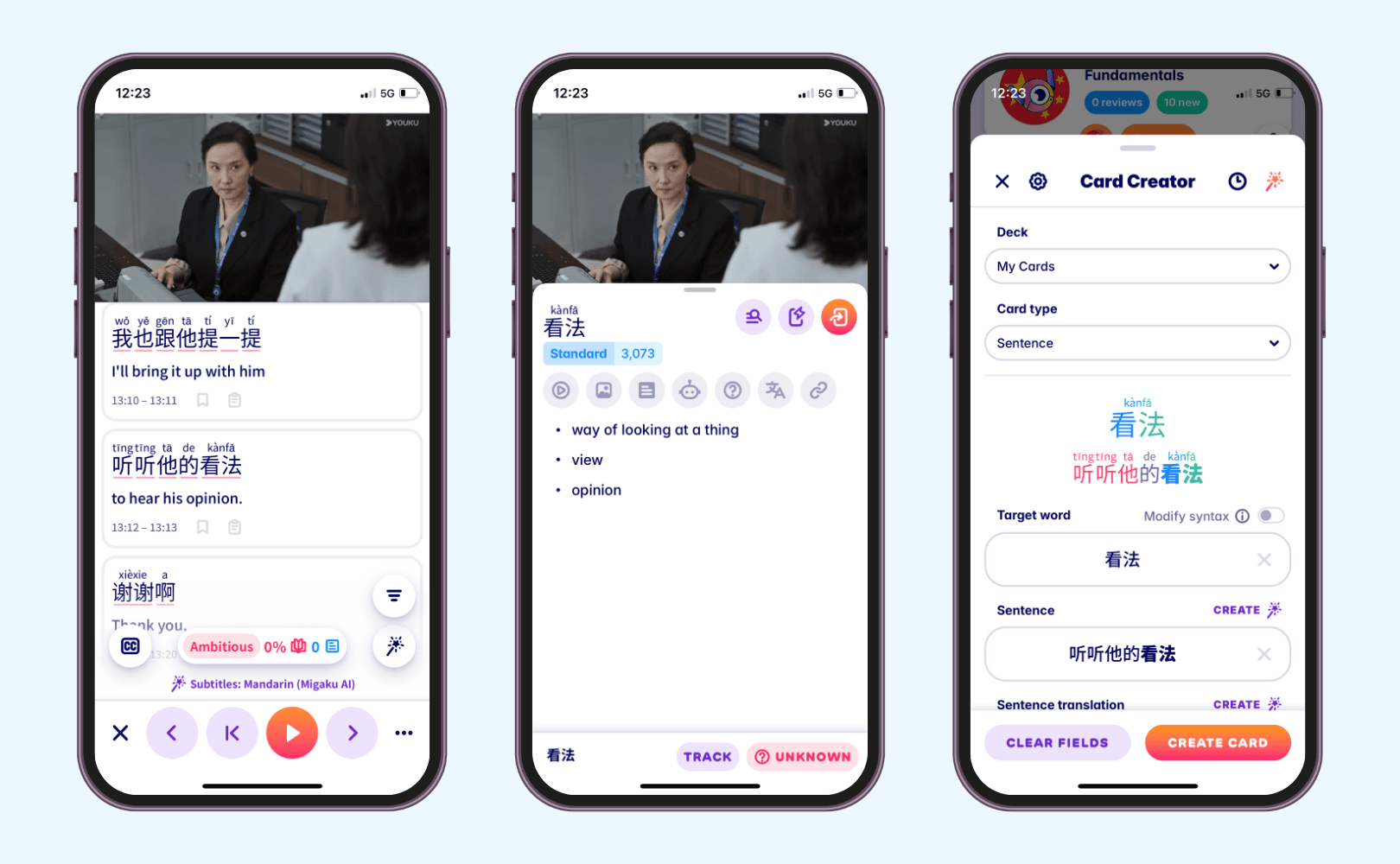
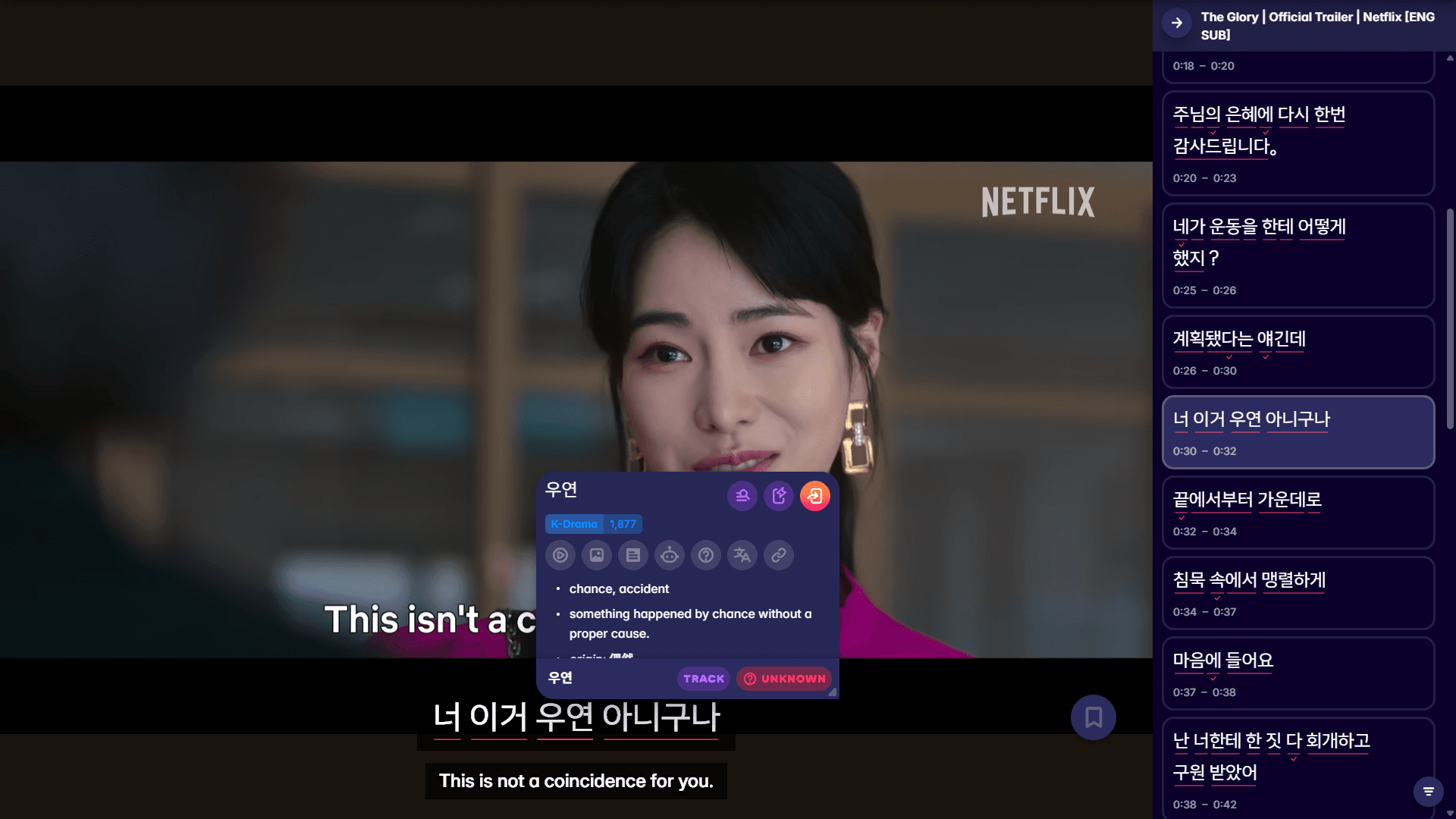
Browser extensions like Language Reactor (formerly called Language Learning with Netflix) and [Migaku](https://migaku.com/) add superpowers to Netflix. You get dual subtitles, click-to-translate functionality, and the ability to save words for later review. It's free and works surprisingly well.
### Dedicated language learning apps
Apps like FluentU and Yabla are built specifically for learning with subtitles. They use real-world videos (music videos, news clips, movie trailers) and add interactive subtitles.
Click any word in the subtitle and you get an instant definition, example sentences, and the option to save it for review. These apps usually cost money (FluentU is around $30/month, Yabla is about $13/month), but they remove a lot of friction from the learning process.
### Streaming services in your target language
If you're learning Spanish, try a subscription to a Spanish streaming service. If you're learning Korean, check out Viki, which specializes in Asian dramas and has great community-contributed subtitles.
The advantage here is that you're watching content made for native speakers, not watered-down learner content. The cultural context you pick up is just as valuable as the language itself.
### YouTube
YouTube is massively underrated for language learning. You can find content on literally any topic in any language, and the auto-generated subtitles have gotten pretty good thanks to AI improvements in 2026.
For popular languages like Spanish, French, or German, you'll find tons of channels with manual subtitles that are even better. Plus, YouTube lets you slow down playback speed, which is perfect for beginners. With browser extensions and apps, language learners can generate subtitles more easily in 2026 as well.
 ---
## Common challenges and how to overcome them
Subtitle-based learning isn't perfect. Here are the main problems you'll run into and how to deal with them.
### Subtitle dependency
The biggest trap is becoming so reliant on subtitles that you can't understand anything without them.
To avoid this, gradually reduce your subtitle use. If you always watch with target language subtitles, start doing every third episode without any subtitles. Make it a game to see how much you can understand on audio alone.
Another trick: cover the bottom of your screen with a piece of paper. Only uncover the subtitles when you're truly lost. This forces you to listen first and read second.
### Reading instead of listening
When subtitles are on, your brain wants to take the easy route and just read. You end up improving your reading skills but not your listening comprehension.
Combat this by occasionally turning off the video and just listening to the audio. Close your eyes or look away from the screen. Force yourself to rely on your ears.
You can also try watching with subtitles that are slightly delayed or out of sync. This sounds annoying, but it forces you to listen to the audio first before the subtitle confirms what was said.
### Choosing content that's too difficult
If you're a beginner watching a legal drama with complex courtroom vocabulary, you're going to have a bad time. Even with subtitles and translation, you'll spend more time in the dictionary than watching.
Pick content at the right level. Kids' shows aren't just for kids. They use simpler vocabulary and clearer pronunciation. Animated movies are great because the audio is usually very clear.
As you improve, you can move to sitcoms (lots of everyday conversation), then dramas, then news or documentaries.
Anyway, if you want to take this approach seriously, Migaku's browser extension and app make subtitle-based learning way more practical. You get instant word lookups, the ability to save sentences for review, and tools that integrate with spaced repetition. There's a 10-day free trial if you want to check it out.
---
## Common challenges and how to overcome them
Subtitle-based learning isn't perfect. Here are the main problems you'll run into and how to deal with them.
### Subtitle dependency
The biggest trap is becoming so reliant on subtitles that you can't understand anything without them.
To avoid this, gradually reduce your subtitle use. If you always watch with target language subtitles, start doing every third episode without any subtitles. Make it a game to see how much you can understand on audio alone.
Another trick: cover the bottom of your screen with a piece of paper. Only uncover the subtitles when you're truly lost. This forces you to listen first and read second.
### Reading instead of listening
When subtitles are on, your brain wants to take the easy route and just read. You end up improving your reading skills but not your listening comprehension.
Combat this by occasionally turning off the video and just listening to the audio. Close your eyes or look away from the screen. Force yourself to rely on your ears.
You can also try watching with subtitles that are slightly delayed or out of sync. This sounds annoying, but it forces you to listen to the audio first before the subtitle confirms what was said.
### Choosing content that's too difficult
If you're a beginner watching a legal drama with complex courtroom vocabulary, you're going to have a bad time. Even with subtitles and translation, you'll spend more time in the dictionary than watching.
Pick content at the right level. Kids' shows aren't just for kids. They use simpler vocabulary and clearer pronunciation. Animated movies are great because the audio is usually very clear.
As you improve, you can move to sitcoms (lots of everyday conversation), then dramas, then news or documentaries.
Anyway, if you want to take this approach seriously, Migaku's browser extension and app make subtitle-based learning way more practical. You get instant word lookups, the ability to save sentences for review, and tools that integrate with spaced repetition. There's a 10-day free trial if you want to check it out.
 ---
## And here's the most important part: Enjoy what you're watching!
If you're forcing yourself through boring content just because it's "good for learning," [you'll burn out](https://migaku.com/blog/language-fun/language-learning-burnout-recognize-recover). Find shows and movies you genuinely want to watch. The learning will happen naturally when you're engaged with the story.
> If you consume media in the language you want to learn, and you understand at least some of the messages and sentences within that media, you will make progress. _Period_.
Enjoy the process, grow faster!
---
## And here's the most important part: Enjoy what you're watching!
If you're forcing yourself through boring content just because it's "good for learning," [you'll burn out](https://migaku.com/blog/language-fun/language-learning-burnout-recognize-recover). Find shows and movies you genuinely want to watch. The learning will happen naturally when you're engaged with the story.
> If you consume media in the language you want to learn, and you understand at least some of the messages and sentences within that media, you will make progress. _Period_.
Enjoy the process, grow faster!