Portuguese Office Vocabulary: Portuguese Business Terms That Matter
Last updated: April 7, 2026

Learning Portuguese office vocabulary might seem like a niche goal, but if you're planning to work in Brazil, Portugal, or with Portuguese-speaking clients, you'll need more than just basic conversational phrases. Whether you're preparing for a job interview in São Paulo or getting ready for your first day at a Lisbon startup, knowing how to talk about your trabalho (work) professionally makes a huge difference. This guide covers everything from basic office equipment terms to business meeting phrases, so you can actually communicate in workplace situations without awkwardly pointing at things or relying on Google Translate mid-conversation.
- Essential office equipment and furniture terms
- Portuguese words for job titles and workplace roles
- Important job interview and employment vocabulary
- Communication tools and digital workplace vocabulary
- Industry-specific vocabulary for specialized fields
- Practical lessons and free resources to keep learning
Essential office equipment and furniture terms
Let's start with the physical stuff you'll interact with every day. The good news? Many Portuguese office terms are cognates or borrowed from English, especially in tech-heavy workplaces.
Portuguese | English |
|---|---|
escrivaninha / mesa | Desk (mesa literally means "table") |
cadeira | Chair |
cadeira ergonômica | Ergonomic chair |
computador | Computer |
teclado | Keyboard |
rato (Portugal) / mouse (Brazil) | Mouse |
monitor | Monitor |
impressora | Printer |
arquivos / armários de arquivo | Filing cabinets |
pastas | Folders |
grampeador | Stapler |
grampos | Staples |
furador | Hole punch |
tesouras | Scissors |
fita adesiva | Tape |
One thing that tripped me up when I first started learning Portuguese business vocabulary was that a "pasta" can mean both a physical folder AND a computer folder. Context usually makes it clear, but it's worth knowing.
Portuguese words for job titles and workplace roles
Understanding who's who in a Portuguese office matters for professional communication. The hierarchy terms are pretty similar across Brazilian and European Portuguese, which is helpful.
Portuguese | English |
|---|---|
chefe / gerente | Boss / Manager |
diretor executivo / CEO | CEO |
supervisor | Supervisor |
colegas | Colleagues |
colega de trabalho | Coworker |
funcionário / funcionária | Employee |
recepcionista | Receptionist |
secretário / secretária | Secretary |
recursos humanos / RH | Human resources |
estagiário / estagiária | Intern |
freelancer / trabalhador autônomo | Freelancer |
trainee / aprendiz | Trainee |
chefes de departamento | Department heads |
líderes de equipe | Team leaders |
contabilidade | Accounting department |
marketing | Marketing |
vendas | Sales |
Important job interview and employment vocabulary
Are you having a business meeting or any particular business situation in Portuguese soon? Job interviews require specific vocabulary that differs from everyday office talk.
A job interview is an "entrevista de emprego." Your resume or CV is a "currículo." A cover letter is a "carta de apresentação."
Some common employment words and phrases are:
Portuguese | English |
|---|---|
salário | Salary |
benefícios | Benefits |
férias | Vacation days |
vale-transporte | Transportation vouchers (common in Brazil) |
vale-refeição | Meal vouchers (common in Brazil) |
tempo integral | Full-time |
meio período | Part-time |
contrato temporário | Temporary contract |
contratar | To hire |
demitir | To fire |
Communication tools and digital workplace vocabulary
Modern offices run on digital communication, and Portuguese has adapted to include both local terms and English borrowings.
Portuguese | English |
|---|---|
e-mail / correio eletrônico | Email |
assunto | Subject line |
anexos | Attachments |
ligação / chamada telefônica | Phone call |
correio de voz / voicemail | Voicemail |
teleconferências / chamadas em conferência | Conference calls |
videochamadas | Video calls |
mensagem / mensagem instantânea | Chat message / Instant message |
reuniões online / reuniões virtuais | Online meetings / Virtual meetings |
a internet | The internet |
WiFi | WiFi |
senha | Password |
Industry-specific vocabulary for specialized fields
Different industries use specialized Portuguese vocabulary. Here are some examples from common professional sectors.
In finance, you'll encounter:
Portuguese | English |
|---|---|
investimento | Investment |
ações | Stocks |
títulos | Bonds |
mercado financeiro | Financial market |
conta bancária | Bank account |
transferência | Transfer |
empréstimo | Loan |
Technology vocabulary mixes Portuguese and English heavily:
Portuguese | English |
|---|---|
software | Software |
hardware | Hardware |
desenvolvedor | Developer |
programação | Programming |
codificação / programar | Coding / To program |
bug / erro | Bug |
sistema | System |
Marketing people use:
Portuguese | English |
|---|---|
campanha | Campaign |
público-alvo | Target audience |
marca | Brand |
estratégia de marketing | Marketing strategy |
redes sociais | Social media |
conteúdo | Content |
Legal professionals work with:
Portuguese | English |
|---|---|
contrato | Contract |
lei | Law |
regulamento | Regulation |
compliance | Compliance |
advogado / advogada | Lawyer |
Practical lessons and free resources to keep learning
Learning Portuguese office vocabulary works best when you combine vocabulary study with real-world practice and exposure to authentic business content.
- Reading Portuguese business news sites like Jornal de Negócios (Portugal) or Valor Econômico (Brazil) exposes you to professional language in context. You'll see how these terms actually get used in articles about economia (economy), empresas (companies), and mercado (market).
- LinkedIn is surprisingly useful for learning business Portuguese. Follow Portuguese-speaking professionals in your industry, and you'll see how they write about their work, describe their roles, and discuss professional topics. The language is authentic and current.
- If you want structured lessons, many language schools offer business Portuguese classes specifically designed for professionals. These typically cover vocabulary, common business situations, and cultural aspects of working with Portuguese-speaking people.
- Podcasts about business topics in Portuguese give you listening practice with professional vocabulary. Even if you don't understand everything at first, repeated exposure helps these terms stick.
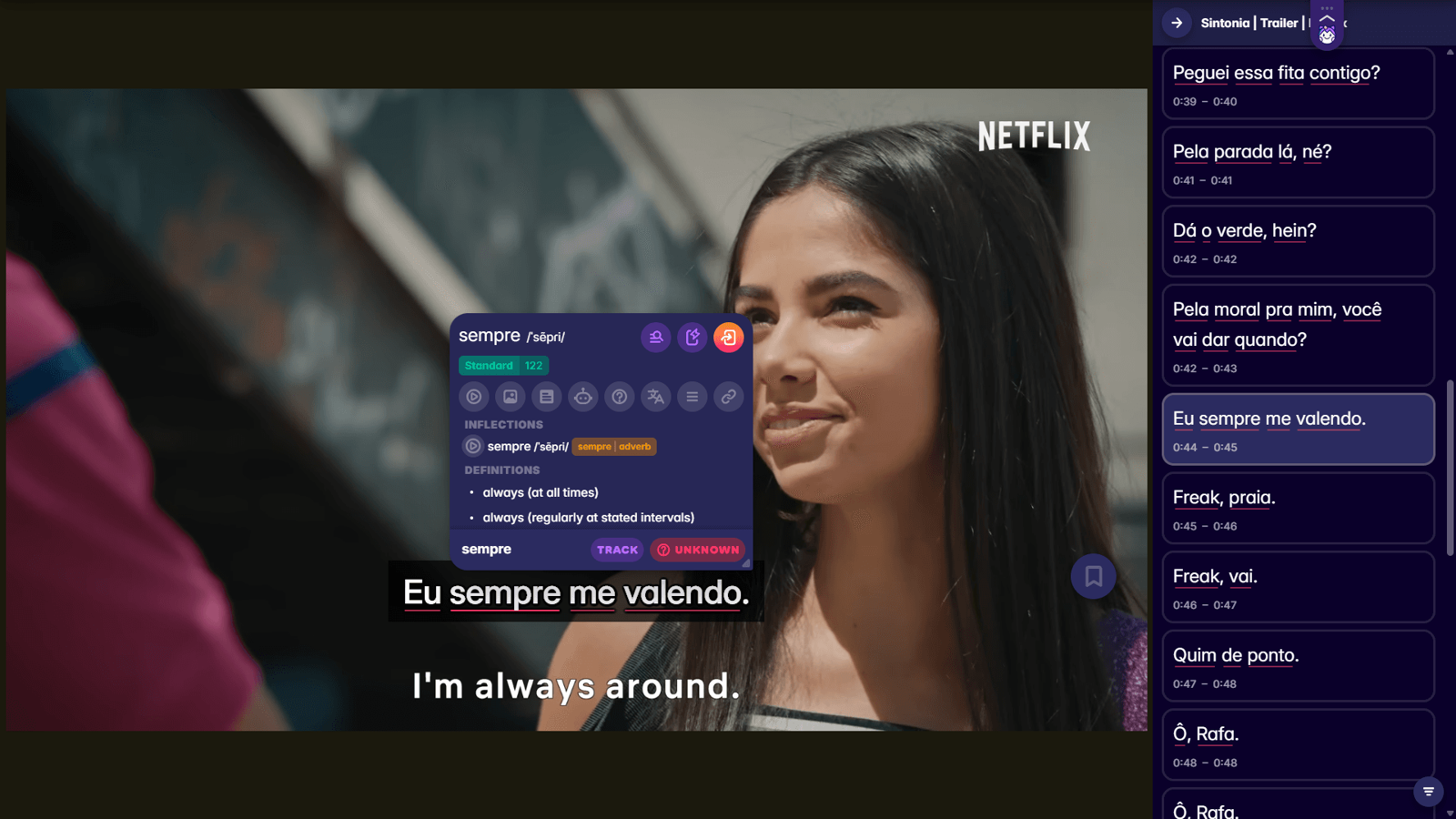
Speaking of learning from real content, Migaku's browser extension and app let you look up Portuguese words instantly while reading business articles or watching professional videos in Portuguese. You can save workplace vocabulary directly to your flashcards as you encounter it in context. There's a 10-day free trial if you want to see how it works with actual Portuguese business content.
To learn any Portuguese vocabulary...
You need to use it to remember it. Flashcards help, but nothing beats actually trying to describe your work situation in Portuguese or following along with a business meeting.
The most effective approach combines vocabulary learning with immersion in business contexts. Watch Portuguese business presentations, read company websites, and if possible, practice with native speakers who work in professional environments.
If you consume media in Portuguese, and you understand at least some of the messages and sentences within that media, you will make progress. Period.
Invest time in the things that can make your career more successful!