# Essential Guide of Portuguese Phrases Travelers Should Know
> Portuguese phrases for greetings, dining, and cultural expressions with pronunciation. If not this trip, maybe next time they will come in handy!
**URL:** https://migaku.com/blog/language-fun/portuguese-travel-phrases
**Last Updated:** 2026-02-06
**Tags:** vocabulary, phrases
---
Planning a trip to Portugal?✈️ You'll want to pick up some [basic Portuguese phrases](https://migaku.com/learn-portuguese) before you go. Sure, plenty of people in Lisbon and other tourist spots speak English, but knowing even a handful of phrases makes your experience way better. This guide covers the essential portuguese [travel phrases](https://migaku.com/blog/japanese/japanese-travel-phrases) you actually need, organized by situation so you can find what you're looking for fast.
---
## Essential Portuguese phrases for [greetings](https://migaku.com/blog/language-fun/portuguese-greetings) and politeness
Let's start with the basics. These greeting phrases will get you through most initial interactions in Portugal.
1. "**Olá**" (oh-LAH) is your standard hello. Simple and works everywhere. You'll hear this constantly in shops, restaurants, and on the street.
2. "**Bom dia**" (bom DEE-ah) means good morning, used until around noon. "Boa tarde" (boa TAR-deh) is good afternoon, and "boa noite" (boa NOY-teh) is good evening or goodnight. Portuguese people actually use these time-specific greetings more than just saying olá, especially in formal situations.
3. "**Por favor**" (por fah-VOR) means please. Stick this phrase at the end of requests and you'll sound polite. "Com licença" (kohm lee-SEN-sah) works for excuse me when you need to get past someone or get attention.
4. "**Desculpe**" (desh-KOOL-peh) is sorry or excuse me for apologies. You'll use this when you bump into someone or need to interrupt.
Here's something important: when you want to say thank you, it changes based on your gender.
- If you're male, say "obrigado" (oh-bree-GAH-doo).
- If you're female, say "obrigada" (oh-bree-GAH-dah).
This trips up a lot of travelers, but locals appreciate when you get it right.
Want to ask how someone is doing? "Tudo bem?" (TOO-doo baym?) literally means "everything good?" The response is usually the same phrase back: "Tudo bem" or "tudo bom" (TOO-doo bom). Pretty easy to remember.
---
## Portuguese travel phrases for introducing yourself and basic conversation
When you meet someone, "Meu nome é" (MEH-oo NO-meh eh) means "my name is." Follow it with your name. To ask someone's name, say "Qual é seu nome?" (kwahl eh SEH-oo NO-meh?).
"Prazer" (prah-ZEHR) means "pleasure" and works when meeting someone, similar to "nice to meet you."
Here are some super useful phrases for when your Portuguese runs out:
1. "**Fala inglês?**" (FAH-lah een-GLAYSH?) means "do you speak English?" Most people in tourist areas do, but asking in Portuguese first shows respect.
2. "**Não compreendo**" (now kohm-preh-EN-doo) is "I don't understand." You'll probably use this one a lot at first.
3. "**Pode falar mais devagar, por favor?**" (POH-deh fah-LAR mice deh-vah-GAR, por fah-VOR?) means "can you speak more slowly, please?" Super helpful when someone's rattling off directions.
4. "**Pode repetir, por favor?**" (POH-deh heh-peh-TEER, por fah-VOR?) is "can you repeat, please?" These two phrases together will save you constantly.
---
## Getting around and asking for directions with basic Portuguese phrases
Transportation and navigation phrases are crucial for actually getting where you need to go in Portugal.
1. "**Onde é**" (OHN-deh eh) means "where is." Follow it with whatever you're looking for. "Onde é a estação?" (Where is the station?) or "Onde é o banheiro?" (Where is the bathroom?).
2. "**Quanto custa?**" (KWAN-too KOOSH-tah?) means "how much does it cost?" Essential for taxis, tickets, and avoiding surprises.
3. "**Um bilhete para**" (oom bee-YEH-teh PAH-rah) means "a ticket to." Use this at train stations and bus stops. "Lisboa" (Lisbon), "Porto," "Sintra," wherever you're headed.
4. "**À esquerda**" (ah esh-KEHR-dah) is left, "**à direita**" (ah dee-RAY-tah) is right, and "**em frente**" (aym FREN-teh) is straight ahead. When someone gives you directions, listen for these words.
5. "**Longe**" (LON-zheh) means far, "**perto**" (PEHR-too) means near or close. "É longe?" (Is it far?) helps you figure out if you should walk or grab transportation.
Speaking of bathrooms, that's "banheiro" in Brazilian Portuguese, but in Portugal you'll more commonly hear "casa de banho" (KAH-zah deh BAN-yoo). This is one of those Portugal versus Brazilian differences worth knowing.
---
## Dining out in Portugal
Restaurant phrases make eating out way more enjoyable. [Portuguese food](https://migaku.com/blog/language-fun/portuguese-food-vocabulary) is amazing, and being able to order properly helps.
1. "**Uma mesa para**" (OO-mah MEH-zah PAH-rah) means "a table for." Follow with the number: "uma mesa para dois" (A table for two).
2. "**A conta, por favor**" (ah KON-tah, por fah-VOR) is "the bill, please." You'll need this at the end of every meal.
3. "**Água**" (AH-gwah) is water. Specify "água com gás" (With gas/sparkling) or "água sem gás" (Without gas/still). They'll usually ask which you want.
4. "**Vinho**" (VEE-nyoo) is wine. "Vinho tinto" is red wine, "vinho branco" is white wine. Portugal makes excellent wine, so you'll use these phrases often.
5. "**Que é isto?**" (keh eh EESH-too?) means "what is this?" Point at something on the menu you can't pronounce and ask. Most servers are happy to explain.
6. "**Tem**" (taym) means "do you have." "Tem vegetariano?" (Do you have vegetarian options?) or "Tem cerveja?" (Do you have beer?).
7. "**Recomenda?**" (heh-koh-MEN-dah?) is "do you recommend?" Ask your server "O que recomenda?" (What do you recommend?) and you'll often get pointed toward the best dishes.
---
## Shopping and transactions
These Portuguese phrases help when you're buying stuff, whether at markets, shops, or street vendors.
1. "**Quanto custa isto?**" (KWAN-too KOOSH-tah EESH-too?) is "how much does this cost?" Point at the item while asking.
2. "**Muito caro**" (MWEE-too KAH-roo) means "very expensive." You can say this at markets where bargaining is acceptable, though fixed-price shops won't negotiate.
3. "**Tem desconto?**" (taym desh-KON-too?) means "do you have a discount?" or "is there a discount?" Worth asking, especially if buying multiple items.
4. "**Posso ver?**" (POH-soo vehr?) is "can I see?" Use this when you want to look at something behind the counter or get a closer look.
5. "**Vou pensar**" (voh pen-SAR) means "I'll think about it." Polite way to decline without just walking away.
[Numbers](https://migaku.com/blog/language-fun/numbers-in-portuguese) are super important for shopping. Learn at least one through ten: um, dois, três, quatro, cinco, seis, sete, oito, nove, dez. Prices and quantities come up constantly.
---
## Portuguese phrases to know for emergencies with pronunciation
Hope you won't need these, but better to know them just in case.
1. "**Ajuda!**" (ah-ZHOO-dah!) means "help!" Shout this if you're in trouble.
2. "**Preciso de um médico**" (preh-SEE-zoo deh oom MEH-dee-koo) is "I need a doctor." "Médico" is doctor, and you can also say "hospital" (oh-spee-TAL), which is pretty similar to English.
3. "**Onde é a farmácia?**" (Where is the pharmacy?) helps you find medication. Pharmacies in Portugal are marked with green crosses.
4. "**Perdi-me**" (pehr-DEE-meh) means "I'm lost." Follow up with showing someone your hotel address or destination.
5. "**Polícia**" (poh-LEE-see-ah) is police. The pronunciation is close enough to English that you'll be understood.
6. "**Alguém fala inglês?**" (AL-gaym FAH-lah een-GLAYSH?) means "does anyone speak English?" In an emergency, finding someone who speaks English can speed things up significantly.
---
## Cultural phrases and useful words to know
These phrases aren't strictly necessary, but they make you sound more natural and help you connect with locals.
1. "**Com certeza**" (kohm sehr-TEH-zah) means "certainly" or "of course." Use it to agree enthusiastically.
2. "**Não faz mal**" (now fahz mahl) is "no problem" or "it doesn't matter." Say this when someone apologizes for something minor.
3. "**Está bom**" (esh-TAH bom) means "it's good" or "that's fine." Simple agreement phrase you'll use all the time.
4. "**Até logo**" (ah-TEH LOH-goo) is "see you later," a casual goodbye. "Adeus" (ah-DEH-oosh) is a more formal goodbye.
5. "**Saúde!**" (sah-OO-deh!) means "health!" and is what you say when toasting. You'll hear this constantly in bars and restaurants.
6. "**Fixe**" (FEESH) is a very Portuguese way to say "cool" or "nice." It's slang but widely used. When something's good, you can say "que fixe!" (How cool!).
---
## Learning Portuguese beyond travel phrases
### Practice Portuguese with context
Memorizing these basic Portuguese phrases gets you started, but here's the thing: you'll pick them up and speak Portuguese phrases way faster if you actually hear them in context.
Watching Portuguese shows or listening to Portuguese music helps the pronunciation stick in your brain much better than just reading phonetic guides.
Portugal has some great content for learners. Portuguese dramas and comedies on streaming platforms give you real conversational Portuguese, not the [textbook](https://migaku.com/blog/language-fun/best-portuguese-textbooks) stuff. You'll hear how people actually speak, with all the casual expressions and natural rhythm.
### Know the difference between Brazilian Portuguese and European Portuguese
The difference between European Portuguese (What they speak in Portugal) and Brazilian Portuguese matters more than most guides admit. The pronunciation is quite different.
Brazilian Portuguese tends to be clearer and more open, while European Portuguese has more closed vowel sounds and drops syllables. If you're traveling to Portugal specifically, focus on European Portuguese resources.
One challenge with Portuguese: people speak fast. Like, really fast. That's why those phrases asking people to slow down and repeat are so essential. Don't feel bad about using them constantly. Even intermediate learners need things repeated sometimes.
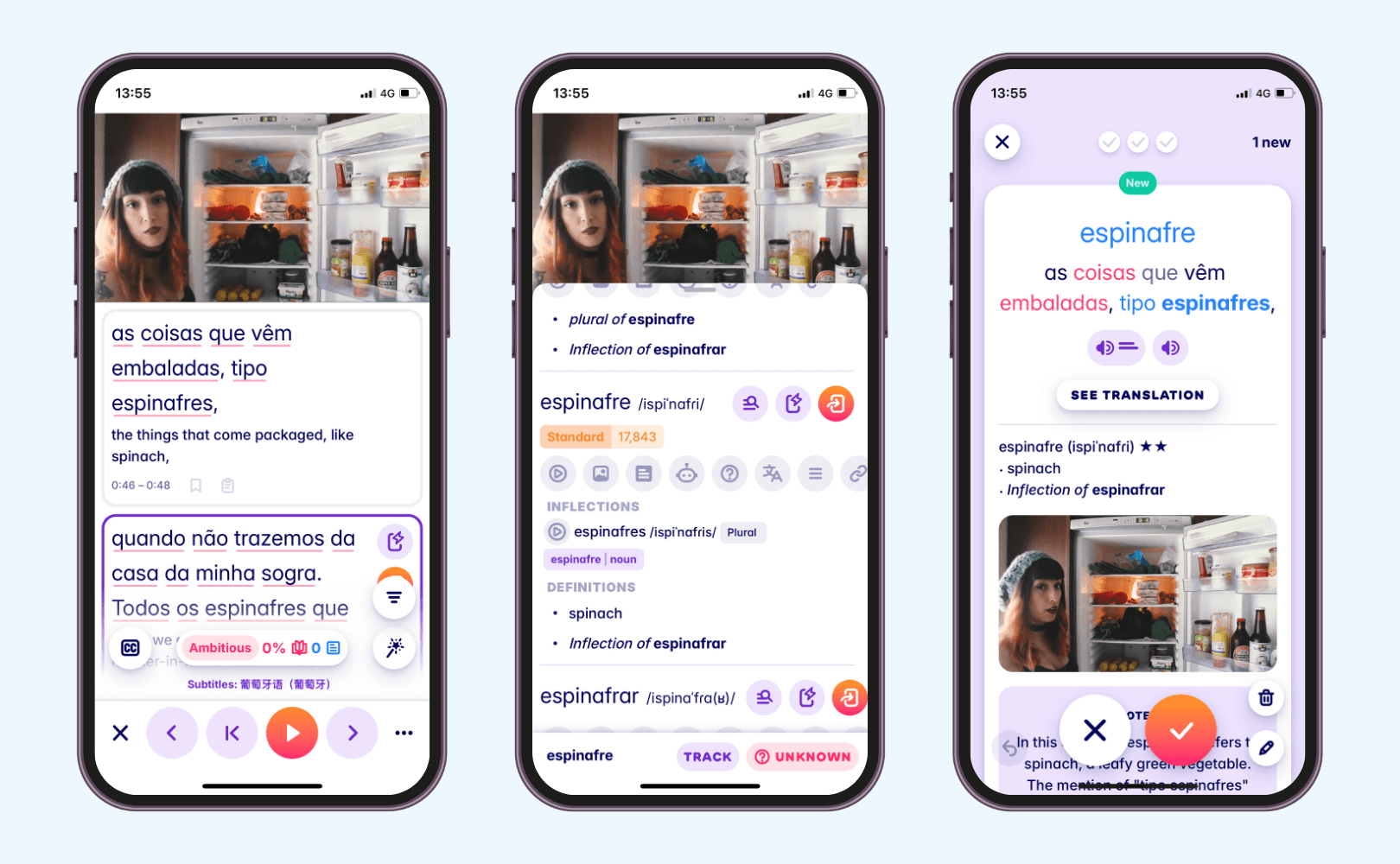
Anyway, if you want to actually learn Portuguese beyond just tourist phrases, Migaku's browser extension and app let you look up words instantly while watching Portuguese shows or reading Portuguese websites. Makes learning from real content way more practical instead of just drilling phrase lists. There's a 10-day free trial if you want to check it out.
 ---
## What if I still can't speak these Portuguese phrases and words fluently before the trip?
The good news? Portuguese people generally appreciate any effort to speak their language. Even if your pronunciation is rough, trying gets you way further than just defaulting to English immediately. The phrases above cover probably 80% of tourist situations you'll encounter. To internalize these phrases better, try watching some tourist vlogs about your destination countries.
> If you consume media in Portuguese, and you understand at least some of the messages and sentences within that media, you will make progress. _Period_.
There's always a next trip when these phrases will come into use!
---
## What if I still can't speak these Portuguese phrases and words fluently before the trip?
The good news? Portuguese people generally appreciate any effort to speak their language. Even if your pronunciation is rough, trying gets you way further than just defaulting to English immediately. The phrases above cover probably 80% of tourist situations you'll encounter. To internalize these phrases better, try watching some tourist vlogs about your destination countries.
> If you consume media in Portuguese, and you understand at least some of the messages and sentences within that media, you will make progress. _Period_.
There's always a next trip when these phrases will come into use!