How to Track Language Learning Progress: Methods That Help You Track Your Progress & Stay Consistent
Last updated: March 31, 2026

You know that feeling when you've been studying a language for months and someone asks "So, are you fluent yet?" and you just... freeze? You've put in the hours, done the flashcards, watched the shows, but you have no idea if you're actually making progress or just spinning your wheels. Here's the thing: most language learners never track their progress in any meaningful way, which makes it impossible to know if what you're doing is working. Let me show you how to measure your language learning progress so you can stop guessing and start knowing.
- Why language learning progress tracking matters
- What counts as progress in language learning
- Track your vocabulary growth
- Measure your listening comprehension
- Track reading speed and comprehension
- Monitor your speaking ability
- Use standardized tests strategically
- Set up a learning journal
- Language learning apps that help you track progress
- Track your progress with real content
Why language learning progress tracking matters
I've seen so many people give up on learning a new language because they felt like they weren't getting anywhere. The problem? They had no way to measure their progress. When you can't see improvement, motivation dies pretty fast.
Tracking your progress does three critical things.
- First, it shows you what's working and what's wasting your time. If you've been doing grammar drills for three months and your speaking hasn't improved, that's valuable data.
- Second, it gives you those small wins that keep you going when the journey feels long.
- And third, it helps you adjust your study plan based on real results instead of gut feelings.
The language learning apps and systems that work best all include some form of progress tracking. There's a reason for that. When learners can see their improvement, they stick with it. When they're flying blind, they quit.
What counts as progress in language learning
A lot of people think progress means "getting closer to fluency" or "understanding more grammar rules." That's way too vague to be useful.
Real progress in language learning shows up in specific, measurable ways.
- Can you understand more of what you hear?
- Can you read faster?
- Can you express more ideas without struggling?
These are concrete things you can track.
Progress looks different at different stages too.
- As a beginner, learning 100 new words is huge progress.
- As an intermediate learner, being able to follow a podcast episode without subtitles is a major win.
- For advanced learners, progress might mean understanding regional dialects or using subtle expressions correctly.
The key is defining what progress means for your current level and your specific goals. A language learner who wants to read manga in Japanese has different progress markers than someone who needs business Spanish for work.
Track your vocabulary growth
This is probably the easiest type of progress to measure and one of the most satisfying. Your vocabulary size directly impacts how much of the language you can understand.
Most language learning apps track this automatically.
- Anki shows you how many cards you've learned.
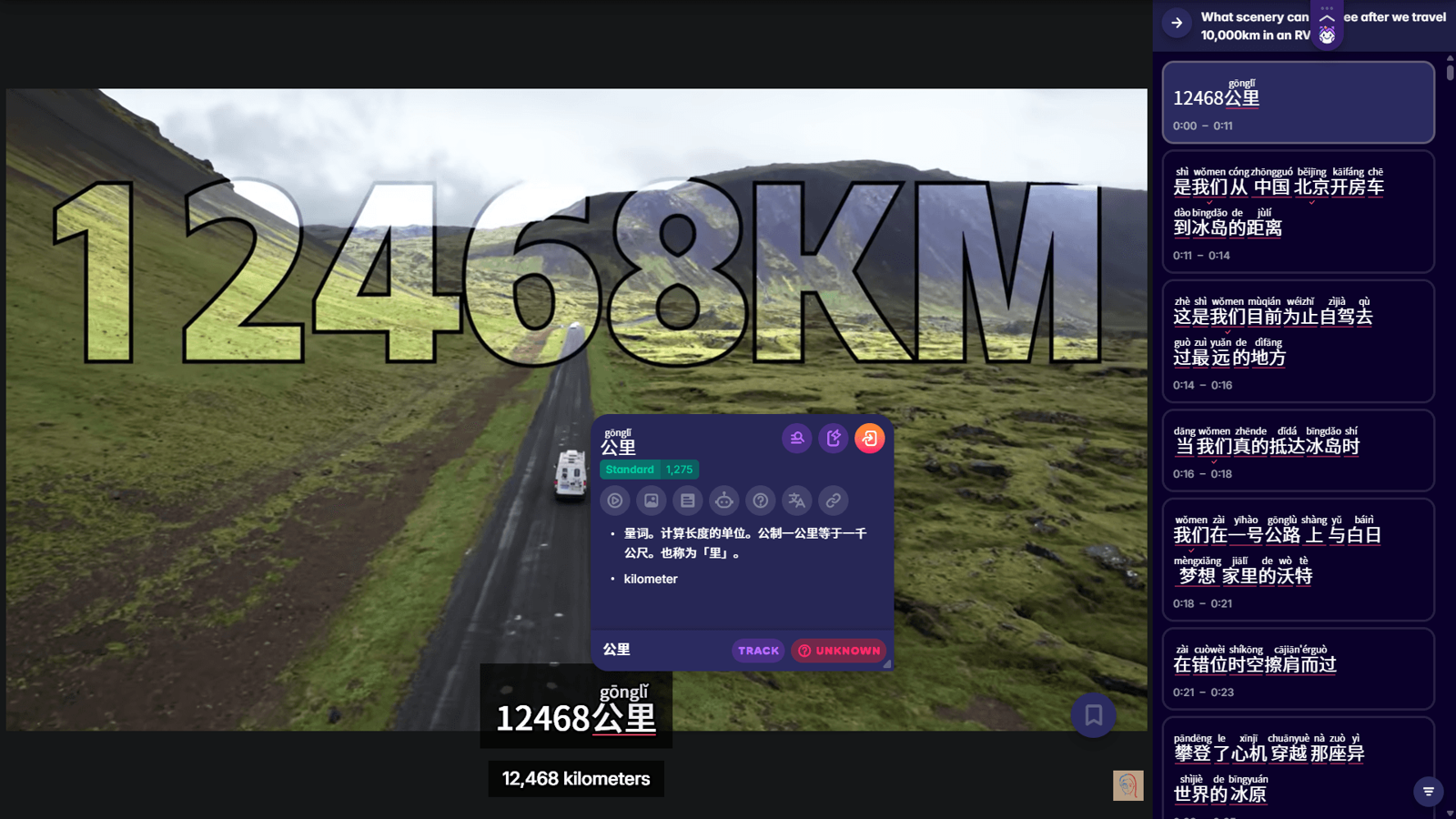
- Migaku's browser extension lets you save words and phrases as you encounter them, building your personal dictionary over time. You can literally watch the number grow.
I recommend tracking both passive vocabulary (words you recognize) and active vocabulary (words you can use). Test yourself monthly. Pick a random page from a book at your level and count how many words you know versus don't know. Do the same thing a month later with a similar text. The ratio should improve.
You can also track vocabulary by category. How many food words do you know? How many business terms? This helps you see gaps in your knowledge and focus your learning where it matters most for your goals.
Measure your listening comprehension
This one's trickier to quantify, but super important. Listening comprehension is often the skill that takes the longest to develop, so tracking it helps you stay patient with the process.
Here's a practical method:
- Pick a podcast episode or YouTube video in your target language. Watch or listen to a five-minute segment and write down what percentage you understood. Not word-for-word, just the general meaning. Be honest with yourself. 20%? 50%? 80%?
- Save that video or podcast episode. Come back to it in a month or two and test yourself again. Your comprehension should jump noticeably. This is one of the most encouraging ways to see progress because the difference is so clear.
You can also track how long you can listen before getting mentally exhausted. When I started learning Japanese, I could only handle about 10 minutes of native content before my brain hurt. Six months later, I could watch a full episode of a show. That's measurable progress.
For learners using content-based learning, track how often you need to pause and look things up. If you're constantly stopping every sentence, that's one level. If you can follow along and only check a few words per scene, that's a significant improvement.
Track reading speed and comprehension
Reading is easier to measure than listening because you control the pace. Time yourself reading a page of text at your level. How long did it take? How much did you understand?
Do this weekly or monthly with similar difficulty texts. Your reading speed should increase as you get more comfortable with the language. More importantly, your comprehension should improve even when reading at the same speed.
I like to use graded readers for this because they're designed for specific levels. Read a chapter, then answer comprehension questions or write a summary. Keep these summaries. Looking back at early attempts versus current ones shows you how much better you've gotten at extracting meaning from text.
Another metric: track how many times you need to look up words per page. As your vocabulary grows and you get better at inferring meaning from context, this number should drop steadily.
Monitor your speaking ability
Speaking progress is harder to track solo, but there are ways.
Record yourself speaking for two minutes about a random topic once a month. Listen back and evaluate yourself on fluency, vocabulary range, and accuracy.
You'll cringe at your early recordings. That's normal. But comparing month one to month six will blow your mind. You'll hear yourself speaking more smoothly, using more complex structures, and making fewer basic mistakes.
If you have a language exchange partner or tutor, ask them to rate specific aspects of your speaking on a simple scale. Can you maintain a conversation for 5 minutes? 15 minutes? 30 minutes? How often do you need to switch to your native language or ask for help?
Track the topics you can discuss comfortably. At first, maybe you can only talk about yourself and your hobbies. Later, you should be able to discuss news, abstract ideas, and complex topics. That expansion of conversational range is real progress.
Use standardized tests strategically
Language proficiency tests like CEFR levels, JLPT for Japanese, DELE for Spanish, or HSK for Chinese give you objective benchmarks. You don't need to take the official tests (They're expensive), but you can use practice tests to gauge your level.
Take a practice test when you start learning, then retake similar tests every few months. Your score should improve. These tests aren't perfect measures of real-world ability, but they do track your progress in reading, listening, and grammar.
The nice thing about standardized frameworks is that they give you clear goals. "I want to reach B2 level by the end of the year" is way more concrete than "I want to get better at French."
Set up a learning journal
This sounds old-school, but it works. Spend five minutes each week writing about what you learned, what you struggled with, and what you want to focus on next.
The act of reflecting helps you process your learning. Plus, when you look back at entries from three months ago, you'll see how far you've come. Problems that seemed impossible then are probably easy now.
In your journal, track specific wins. "Had a 10-minute conversation with a native speaker today." "Read an entire news article without using a dictionary." "Understood a joke in the language for the first time." These moments matter.
Also track your study time. How many hours per week are you actually putting in? If you're not seeing progress, sometimes the issue is simply not enough input. The data helps you be honest with yourself.
Language learning apps that help you track progress
Most modern language learning apps include built-in tracking features.
- Duolingo shows you streak counts and XP (though honestly, those metrics don't mean much for real progress). Better apps track more meaningful data.
- Anki tracks your retention rates, showing you what percentage of cards you're remembering. This helps you identify which types of content stick and which don't. If you're only retaining 60% of grammar cards but 90% of vocabulary from shows you watched, that tells you something about how you learn best.
- Apps focused on reading, like LingQ, track words you've learned and how many words of content you've consumed. Watching those numbers climb is genuinely motivating.
The key is using apps as tools for tracking, not as the entire learning method. The app shows you the data, but you need to interpret it and adjust your approach accordingly.
Track your progress with real content
This is where immersion-based learning really shines. Instead of artificial exercises, you're measuring progress against real content you actually want to consume.
Pick a TV show in your target language. Watch episode one and rate your comprehension. How much dialogue did you catch? How often did you need subtitles? Watch a few more episodes as you continue learning, then go back and rewatch episode one. You'll be shocked at how much more you understand.
Same thing with books, podcasts, or YouTube channels. The content you struggled with three months ago should feel noticeably easier now. That's your brain getting better at processing the language.
I love this method because it ties progress directly to your interests. You're not just hitting arbitrary numbers on an app. You're able to enjoy content you care about in your new language. That's the whole point, right?
Speaking of tracking progress with real content, Migaku's browser extension and app let you look up words instantly while watching shows or reading articles, and it automatically saves them to your personal deck. You can literally see your vocabulary grow as you consume content you actually enjoy. There's a 10-day free trial if you want to check it out.

Track your language learning journey with your unique "GPS"
You wouldn't take a road trip without knowing if you're heading in the right direction. Learning a language works the same way. Track your progress, measure what matters, and adjust based on real data instead of feelings. Be it rewatching a drama episode, reviewing your learned vocabulary, or understanding more content when listening to a new podcast, the beautiful thing about tracking is that it makes the invisible visible.
If you consume media in your target language, and you understand at least some of the messages and sentences within that media, you will make progress. Period.
You are making progress every time you study, even when it doesn't feel like it.
The data proves it.✅